
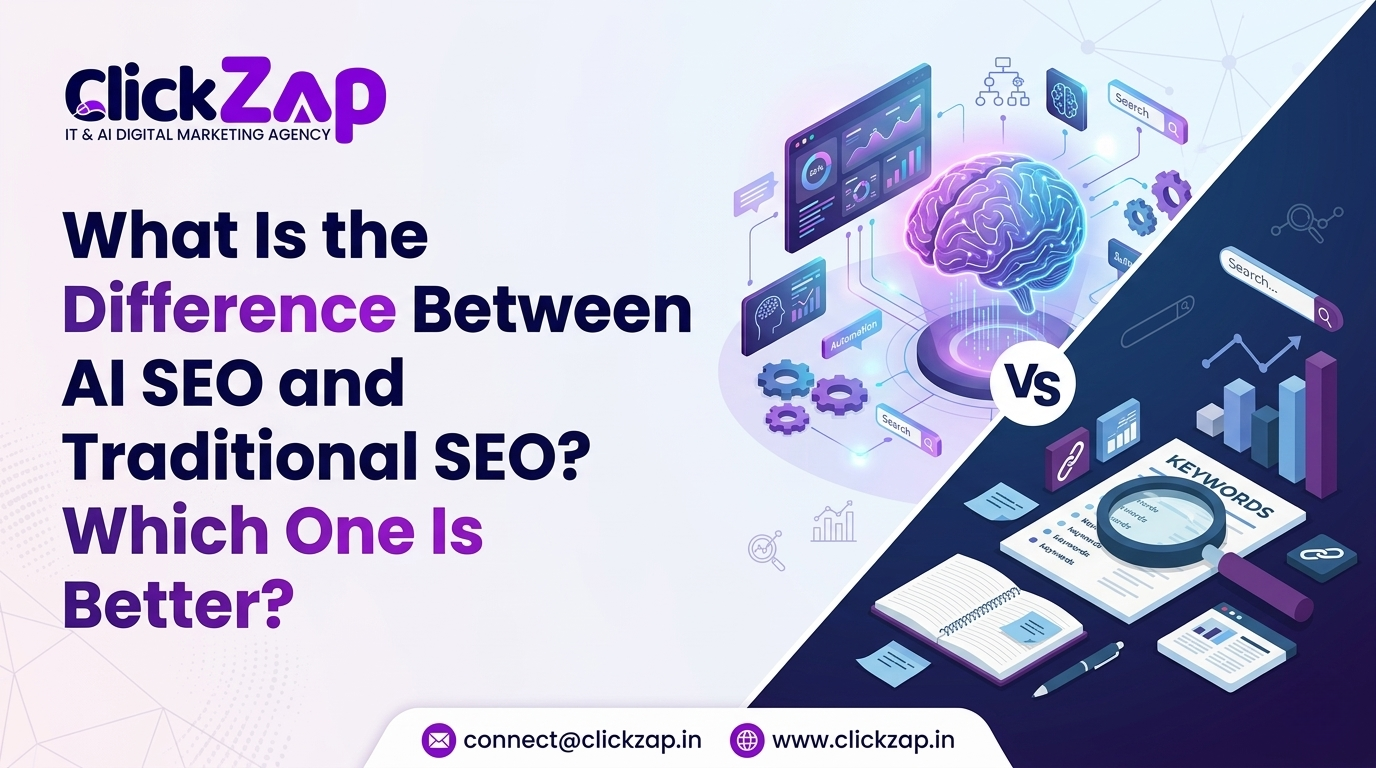
Difference between AI SEO and traditional SEO
In today’s hyper-competitive digital landscape, ranking on the first page of Google is no longer optional; it’s essential. Search Engine Optimization (SEO) has been the backbone of online visibility for decades. But in recent years, a seismic shift has occurred. Artificial intelligence has entered the arena, and marketers everywhere are asking the same question: what is the difference between AI SEO and traditional SEO, and which approach delivers better results?
Whether you’re a small business owner trying to attract local customers or a marketing professional managing large scale campaigns, understanding this distinction could be the key to unlocking your next level of digital growth. Both methodologies aim for the same goal: higher rankings, more organic traffic, and better conversions but they differ dramatically in how they get there.
In this comprehensive guide, ClickZap IT breaks down the AI SEO vs traditional SEO debate in plain language, so you can make a confident, informed decision for your brand.
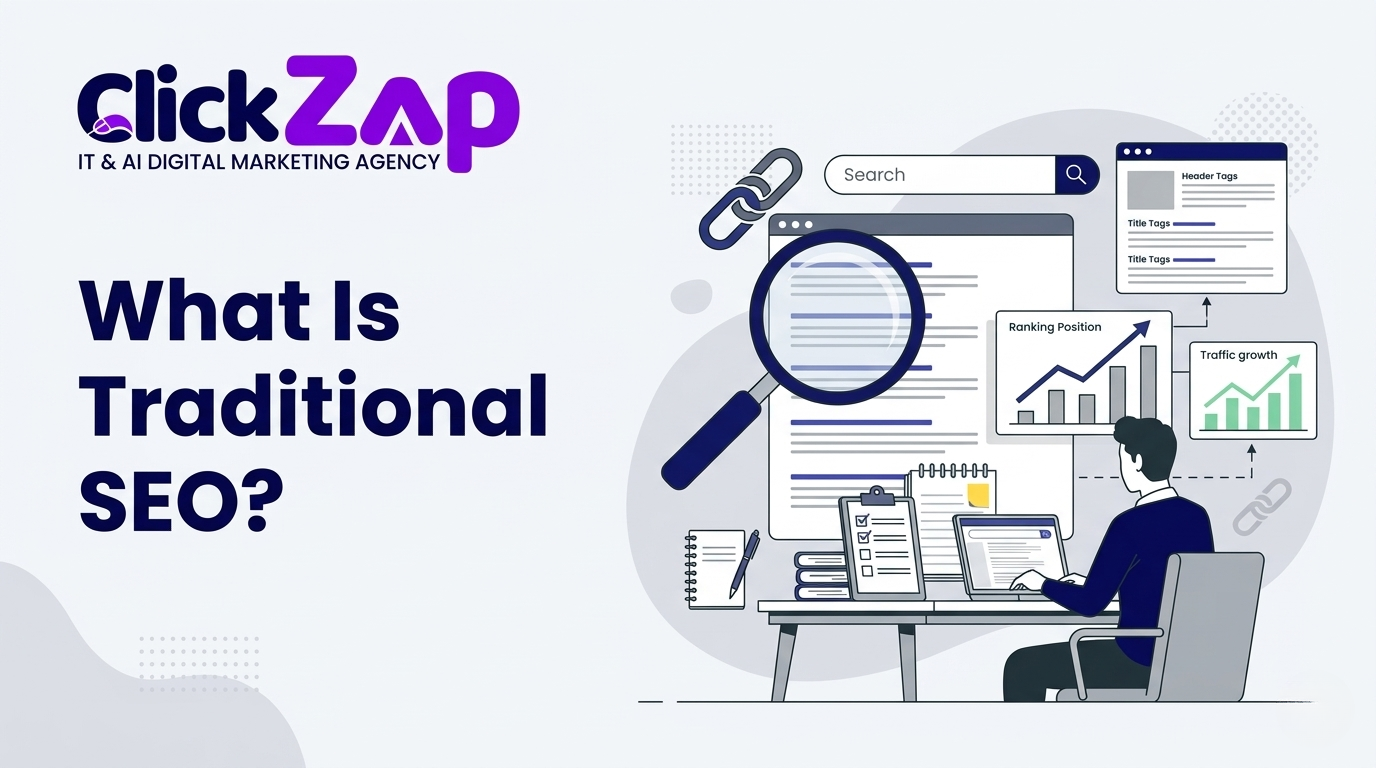
What Is Traditional SEO?
Traditional SEO refers to the time tested, manual process of optimizing a website to rank higher on search engine results pages (SERPs). It relies on human expertise, established best practices, and a set of techniques that have evolved since the early days of search engines.
Core Elements of Traditional SEO
- Keyword Research: Manually identifying search terms using tools like Google Keyword Planner or SEMrush, then strategically placing them within content.
- On-Page SEO Techniques: Optimizing title tags, meta descriptions, header tags (H1–H6), internal linking, and image alt text by hand.
- Off-Page SEO Strategies: Building backlinks through outreach, guest blogging, press releases, and directory submissions.
- Technical SEO: Manually auditing site speed, mobile friendliness, XML sitemaps, and crawlability to meet search engine requirements.
- Content Creation: Writing high quality, human crafted blog posts, landing pages, and web copy targeted at specific keywords.
Traditional SEO is methodical, thorough, and well understood. When executed correctly by skilled practitioners, it produces strong, sustainable results. However, it is time intensive and heavily reliant on the analyst’s skill level making it difficult to scale efficiently.
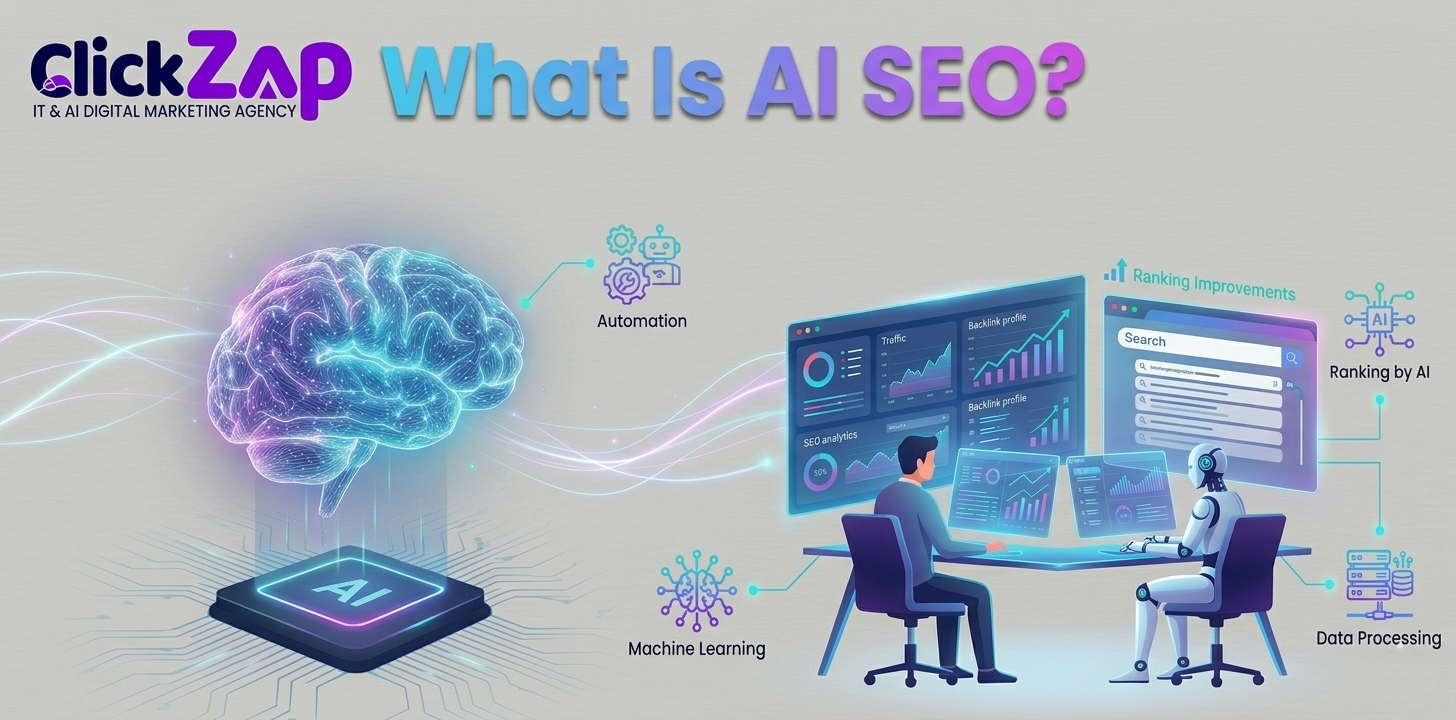
What Is AI SEO?
AI SEO, or AI-powered SEO, uses artificial intelligence, machine learning in SEO, and natural language processing (NLP) to automate, enhance, and accelerate optimization tasks. Instead of relying solely on human judgment, AI SEO tools analyze massive datasets in seconds, uncover hidden patterns, and generate actionable insights that would take human analysts days or weeks to produce.
Core Elements of AI SEO
- Keyword Research Automation: AI tools like Surfer SEO, Clearscope, and Ahrefs AI analyze search intent, SERP ranking factors, and competitor data to surface high-opportunity keywords instantly.
- Content Optimization Using AI: Tools powered by NLP evaluate semantic relevance, content depth, readability, and topical authority then recommend specific improvements.
- Predictive SEO: AI can forecast how algorithm changes might affect rankings, enabling proactive strategy adjustments before traffic drops occur.
- Technical SEO Automation: AI crawlers identify and prioritize technical issues automatically, dramatically reducing audit time.
- Voice Search Optimization: AI models interpret conversational queries and help marketers optimize for the growing voice search landscape.
- SEO Analytics Tools: AI-driven platforms like Google’s RankBrain and BERT understand user intent at a deeper level, rewarding content that truly satisfies searcher needs.
AI SEO doesn’t replace the need for strategic thinking, it amplifies it. By handling the heavy lifting of data analysis, AI frees SEO professionals to focus on creativity, strategy, and relationship-building.
Key Differences Between AI SEO and Traditional SEO
| Aspect | Traditional SEO | AI SEO |
| Keyword Research | Manual research; time consuming | Automated, intent driven discovery in seconds |
| Data Analysis | Human led; limited by analyst bandwidth | Processes millions of data points instantly |
| Content Optimization | Manual editing based on guidelines | NLP powered semantic analysis with precise recommendations |
| Speed & Scalability | Slow; difficult to scale | Fast and highly scalable across thousands of pages |
| Adaptability | Reactive; adjusts after algorithm changes | Predictive; anticipates trends before they emerge |
| Cost | Lower tool costs; higher labor costs | Higher tool investment; lower ongoing labor costs |
| Accuracy | Dependent on human expertise | Data-driven; reduces human error significantly |
| User Intent Optimization | Inferred manually from keyword data | Deep intent modeling using machine learning |
| Voice Search | Limited optimization capability | Built-in conversational query understanding |
| Technical Audits | Manual; time-intensive | Automated crawling and prioritized issue detection |
| Learning Curve | Moderate; relies on practitioner experience | Steep initially; powerful once mastered |
Benefits of AI SEO
Understanding the AI SEO benefits helps explain why forward thinking businesses are rapidly integrating AI-powered SEO strategies into their digital marketing plans.
Speed and Efficiency
AI SEO tools can complete in minutes what would take a human team days. From crawling thousands of URLs to generating content briefs, the speed advantage is undeniable. This means faster time to rank and quicker wins for your business.
Superior Data Interpretation
Search engine algorithms process billions of signals. AI tools trained on similar data at scale are uniquely equipped to interpret these signals, identify patterns, and translate them into clear optimization opportunities. This leads to smarter decisions rooted in real evidence, not guesswork.
Scalability Across Large Websites
For e-commerce brands, enterprise websites, or content heavy platforms with thousands of pages, traditional SEO falls short. AI SEO scales effortlessly, applying optimization logic consistently across entire site architectures.
Smarter User Intent Optimization
Modern SEO is less about stuffing keywords and more about satisfying user intent. AI excels here, modeling search behavior through natural language processing SEO techniques that decode what users actually want, not just what they type.
Predictive Capabilities
Predictive SEO is one of the most exciting frontiers of AI in SEO. Rather than reacting to algorithm updates, AI tools can model likely future trends and adjust content strategies proactively giving businesses a competitive head start.
Competitive Intelligence
AI-powered SEO analytics tools continuously monitor competitor activity, surfacing gaps, content opportunities, and SERP ranking factors that manual analysis would miss. This real-time competitive intelligence is a game changer for digital marketers.
Limitations of Traditional SEO
While traditional SEO has proven its value over the years, it carries several limitations in today’s fast-moving digital environment.
- Time-Intensive Processes: Manual keyword research, content audits, link building, and reporting consume enormous amounts of time often slowing down campaign velocity.
- Scalability Challenges: Traditional SEO struggles to keep pace with large or rapidly growing websites where hundreds of pages require simultaneous optimization.
- Reactive Rather Than Proactive: Without predictive analytics, traditional SEO practitioners typically react to algorithm changes after the fact resulting in ranking drops before recovery strategies kick in.
- Data Overload: The sheer volume of SEO analytics data is difficult for human analysts to process comprehensively and consistently.
- Inconsistency at Scale: Human analysts have varying skill levels, and manual tasks introduce inconsistency across large site sections.
- Slow Adaptation to Voice Search: Voice search optimization requires understanding of natural language patterns that traditional keyword models are not designed to handle effectively.
Use Cases: When to Use AI SEO vs Traditional SEO
When Traditional SEO Works Best
- Small businesses or startups with limited budgets that cannot yet invest in premium AI SEO tools.
- Niche markets with low competition where basic on page SEO techniques and quality content are sufficient to rank.
- Campaigns focused on relationship-based link building, where the human element is critical to outreach success.
- Local SEO strategies that require a personal, community-oriented approach to content and citation building.
When AI SEO Delivers Maximum Value
- Large enterprises managing extensive websites with thousands of indexed pages requiring consistent, scalable optimization.
- E-commerce platforms that need to optimize product pages and site architecture at speed.
- Content marketing-heavy strategies where AI content optimization ensures every piece is semantically rich and well-structured.
- Highly competitive industries where predictive SEO and deep SERP analysis provide the edge needed to outrank well resourced competitors.
- International or multilingual SEO campaigns where machine learning in SEO automates localization and keyword research across languages.
The Hybrid Approach: Best of Both Worlds
In practice, the most effective modern SEO strategies combine both approaches. AI handles data analysis, content recommendations, technical audits, and performance tracking while human strategists apply creativity, brand voice, and relationship building skills that AI cannot replicate. This hybrid model is exactly what ClickZap IT delivers for its clients.
Which One Is Better? AI SEO or Traditional SEO?
The honest answer: AI SEO is the future, but traditional SEO principles remain the foundation. Neither approach “wins” in isolation; they are complementary, not competing.
If you are a solo blogger or a very small business with a limited budget, mastering traditional SEO techniques will still produce meaningful results. The fundamentals of creating helpful content, earning quality backlinks, and maintaining a technically sound website are timeless.
However, if you’re serious about growing your digital presence, scaling your traffic, and staying ahead in competitive markets, embracing AI-powered SEO strategies is no longer optional; it is a strategic imperative. Businesses that adopt AI SEO tools today are building a significant, compounding advantage over those that don’t.
At ClickZap IT, we believe the difference between AI SEO and traditional SEO isn’t about choosing one over the other, it’s about knowing when and how to apply each intelligently to maximize your ROI.
The Future of SEO: AI Trends Shaping Search
The SEO landscape in 2025 and beyond will be defined by several powerful AI-driven trends. Forward-thinking marketers need to understand and prepare for these shifts now.
Predictive SEO
Predictive SEO uses machine learning to model algorithm updates, content trends, and user behavior shifts before they happen. This allows brands to optimize content proactively reducing volatility and maintaining consistent rankings through major Google updates.
Voice Search Optimization
With the rise of smart speakers and voice assistants, voice search optimization is a growing priority. AI models trained on conversational speech patterns help marketers structure content to match the natural language queries users make verbally, a capability far beyond traditional keyword matching.
Natural Language Processing (NLP) SEO
Google’s BERT and MUM algorithms represent a quantum leap in search engine understanding. Natural language processing SEO techniques, powered by AI, help content creators align their work with how these algorithms evaluate topical depth, semantic relationships, and contextual relevance.
AI-Generated Content Optimization
The most effective strategies use AI to optimize human written content ensuring it meets technical and semantic standards while retaining the authenticity and brand voice that resonates with real readers.
Multimodal Search
AI is enabling search engines to understand images, videos, and audio alongside text. Optimizing for multimodal search will become a critical SEO competency, requiring AI-powered tools that can analyze and tag non-text content for discoverability.
Hyper-Personalized SERP Experiences
Machine learning in SEO is enabling search engines to deliver increasingly personalized results based on user history, location, and behavior. AI-powered content strategies that anticipate audience segments will outperform generic approaches significantly.
Conclusion
The debate between modern SEO vs traditional SEO ultimately comes down to one thing: your ambition for growth. Traditional SEO remains a solid foundation; its core principles of quality content, technical excellence, and authority building are as relevant as ever. But AI-powered SEO is the accelerant that allows businesses to act faster, scale further, and compete smarter in an increasingly complex search landscape.
The difference between AI SEO and traditional SEO isn’t just about tools, it’s about a fundamentally different philosophy of how data, speed, and intelligence can be harnessed to drive organic growth. The winners in the next decade of digital marketing will be those who master both.
ClickZap IT is at the forefront of this evolution. As a leading AI-powered digital marketing agency, we combine the proven principles of traditional SEO with the transformative power of AI to deliver strategies that rank, convert, and grow.
Ready to Transform Your SEO Strategy?
Stop guessing. Start ranking.
Partner with ClickZap IT and let our AI-powered SEO experts craft a strategy that puts your business at the top of Google and keeps it there. From keyword research automation to content optimization using AI, we handle every dimension of your SEO so you can focus on what you do best: running your business.
Visit us at clickzap.in and get your FREE SEO audit today.
Also Read : Best Time to Post on Social Media to Get More Likes and Reach
Frequently Asked Questions (FAQs)
Q1: AI SEO vs. Traditional SEO?
Traditional SEO is manual and intuition-driven; AI SEO is automated, predictive, and scalable processing vast data instantly.
Q2: Are AI tools better?
AI tools win on speed and scale. Best results come from combining AI analysis with human strategy.
Q3: Can small businesses use AI SEO?
Yes. Affordable AI tools for keywords, content scoring, and audits give small businesses a compounding competitive edge.
Q4: Will AI replace SEO professionals?
No, it automates repetitive tasks, freeing professionals to focus on strategy, storytelling, and creative work.
Q5: AI SEO & voice search?
AI excels here using NLP to target conversational queries and align content with Google’s BERT/MUM algorithms for both voice and text search.

0 Comments