
AI Powered Marketing Attribution for Businesses
A customer rarely buys after seeing a single ad. More often, they find a business through a Google search, read a blog post a week later, see a retargeting ad on Instagram, open a follow-up email, and finally convert after a direct visit to the website weeks later. Each of these Google Search, Google Ads, Meta Ads, organic search, email, landing pages, retargeting, and CRM follow ups is a touchpoint. And every touchpoint competes for credit when it comes time to answer a simple but expensive question that AI powered marketing attribution for businesses is designed to solve: which marketing channel actually drove this sale?
Traditional attribution models were never built to answer that question well. Last click attribution gives all the credit to whichever channel closed the deal, ignoring the channels that built awareness and consideration along the way. First click attribution has the opposite problem. Marketers end up making six figure budget decisions based on incomplete, and often misleading, data.
This is where AI powered marketing attribution for businesses changes the equation. Instead of applying a fixed rule to every conversion, AI analyzes the entire pattern of touchpoints across thousands of customer journeys and calculates a statistically grounded estimate of how much each channel actually contributed. For B2B companies, local businesses, and growing brands that are spending across Google Ads, Meta Ads, SEO, and email simultaneously, this shift from guesswork to pattern based analysis is what makes accurate ROI measurement possible.
This guide walks through what AI powered marketing attribution actually is, how it works step by step, the different attribution models available, the tools businesses use to implement it, and the realistic challenges and limitations involved.
What Is AI Powered Marketing Attribution?

AI powered marketing attribution for businesses is the use of machine learning to analyze customer touchpoints across the entire buying journey and assign data driven credit for conversions, rather than relying on a fixed rule like “first click” or “last click.” It helps businesses understand which channels, campaigns, and content genuinely influence revenue.
Traditional attribution is rule based: a human decides in advance that the first touchpoint, or the last touchpoint, gets 100% of the credit. This is simple to set up but ignores everything else that happened in between.
AI powered attribution instead looks at:
- Customer touchpoints : every interaction a prospect has with the business, from an ad impression to a pricing page visit
- Conversion tracking : the events that indicate progress, such as form fills, demo requests, or purchases
- Lead attribution : which channels and campaigns generated qualified leads, not just clicks
- Revenue attribution : connecting specific marketing activities to actual closed revenue, often using CRM data
- Marketing channel performance : how each channel performs relative to the others across the full journey
The core difference is that AI models are trained on historical conversion data and can identify which combinations and sequences of touchpoints statistically correlate with a higher likelihood of conversion. A rule based model treats every customer journey the same way; an AI model can recognize that, for example, a webinar followed by a retargeting ad converts at a meaningfully higher rate than a retargeting ad alone and weight credit accordingly.
Best Digital Marketing Agency in Hyderabad
Why Marketing Attribution Matters for Businesses
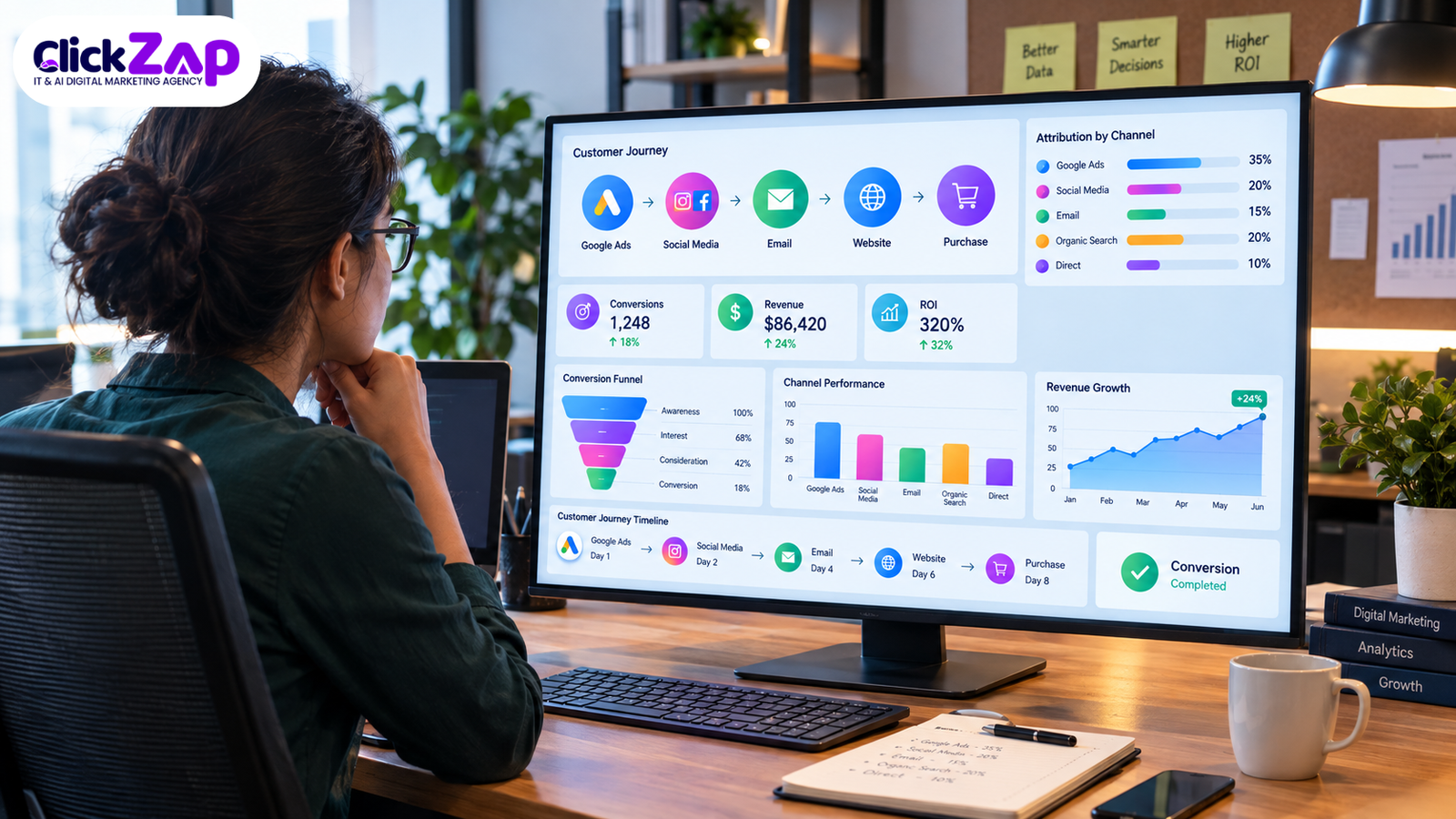
Attribution isn’t an academic exercise; it directly determines where marketing budgets go. Without a reasonably accurate view of what’s working, businesses tend to either overinvest in the channel that happens to close deals or underinvest in the channels that quietly build the pipe line. This is exactly the gap AI powered marketing attribution for businesses is built to close replacing assumption based budget decisions with evidence from the full customer journey
Good attribution helps businesses:
- Understand the real shape of the customer journey, not an assumed one
- Identify which channels are genuinely profitable versus merely present
- Allocate budget toward what’s driving pipeline, not what’s easiest to measure
- Reduce wasted ad spend on channels that only get credit because they happen to be the last click
- Improve campaign performance by reallocating based on evidence
- Increase overall marketing ROI without necessarily increasing total spend
- Improve lead quality by identifying which channel combinations produce leads that actually close
- Connect day to day marketing activity to revenue, which is the metric leadership actually cares about
Practical example: A B2B SaaS company running Google Ads and LinkedIn campaigns might see, under last click attribution, that Google Ads drives 80% of demo requests. But a multi touch view could reveal that most of those “last click” conversions were preceded by a LinkedIn ad and an organic blog visit weeks earlier. Cutting LinkedIn spend based on the last click number alone would quietly damage the top of the funnel that Google Ads was relying on to close deals.
How Does AI Powered Marketing Attribution Work?
AI powered attribution follows a fairly consistent process, regardless of which platform or model is used.
Step 1: Collect marketing data Data is pulled from every active channel: Google Ads, Meta Ads, organic search, PPC Ads, email platforms, and the website itself.
Step 2: Connect customer touchpoints Individual interactions are linked to a single identifiable user or account, so a search click, an ad view, and an email open can be recognized as steps in one journey rather than isolated events.
Step 3: Track conversions Defined conversion events from submissions, demo bookings, purchases, sign ups are recorded with a timestamp and the touchpoint that preceded them.
Step 4: Build customer journeys The system stitches together the full sequence of touchpoints for each converting user, creating a journey map rather than a single data point.
Step 5: Analyze attribution patterns Machine learning models compare converting journeys against non converting ones to detect which touchpoints, and which sequences of touchpoints, are statistically associated with conversion.
Step 6: Assign conversion or revenue contribution Based on that analysis, the model distributes credit across the touchpoints in each journey rather than assigning it all to one.
Step 7: Identify high performing channels Aggregated across many journeys, this reveals which channels, campaigns, and even individual ads or keywords are consistently contributing to conversions.
Step 8: Generate optimization insights The output is translated into recommendations where to shift budget, which campaigns to scale, and which touchpoints are underperforming relative to their cost.
The advantage of machine learning here is scale. A human analyst can reasonably study a few hundred customer journeys manually. AI models can process millions of touchpoint sequences and detect patterns like a specific ad to email combination that outperforms others that would be effectively invisible otherwise.
AI-Powered Attribution Models Explained
First Touch Attribution
Gives 100% of the conversion credit to the very first touchpoint in the customer journey, often the ad or search result that first brought the visitor to the website.
- Advantage: Simple to understand; useful for measuring which channels create initial awareness
- Limitation: Ignores every interaction after the first one
- Best used: When the goal is specifically measuring top of funnel discovery
Last-Touch Attribution
Assigns all credit to the final touchpoint before conversion.
- Advantage: Easy to implement, directly tied to the conversion event
- Limitation: Overvalues bottom of funnel channels like branded search or retargeting
- Best used: For short sales cycles with minimal multi channel involvement
Linear Multi Touch Attribution
Splits credit equally across every touchpoint in the journey.
- Advantage: Recognizes that multiple touchpoints contributed
- Limitation: Treats every touchpoint as equally important, which is rarely true in practice
Time Decay Attribution
Gives more credit to touchpoints that occurred closer to the conversion, and progressively less to earlier interactions.
- Advantage: Reflects the assumption that recent interactions carry more weight
- Limitation: Can still undervalue the awareness stage that started the journey
Position Based Attribution
Also called U shaped attribution gives the largest share of credit to the first and last touchpoints, with the rest split among the middle.
- Advantage: Balances discovery and conversion
- Limitation: The fixed percentages are still a rule, not a data driven calculation
Data-Driven Attribution
Uses machine learning to calculate custom credit weights for each touchpoint based on actual historical conversion data.
- Advantage: Adapts to the business’s actual customer behavior
- Limitation: Requires a meaningful volume of conversion data to be statistically reliable
|
Attribution Model |
How It Works |
Best For |
Main Limitation |
|
First Touch |
100% credit to first interaction |
Measuring awareness channels |
Ignores everything after first touch |
|
Last Touch |
100% credit to final interaction |
Short, simple sales cycles |
Overvalues closing channels |
|
Linear |
Equal credit across all touchpoints |
Simple multi channel overview |
Treats all touchpoints as equally important |
|
Time Decay |
More credit to recent touchpoints |
Longer consideration cycles |
Undervalues early awareness |
|
Position Based |
Heavy credit to first and last touch |
Balancing discovery and conversion |
Fixed percentages, not data driven |
|
Data Driven (AI) |
ML calculated credit from real data |
Businesses with sufficient conversion volume |
Needs enough data to be reliable |
AI powered attribution is often described as more dynamic than static models; it isn’t locked into a single fixed rule. It can recalculate credit as customer behavior shifts, campaigns change, and new channels are added.
AI vs Traditional Marketing Attribution
|
Factor |
Traditional Attribution |
AI Powered Attribution |
|
Data analysis |
Manual or rule based |
Pattern based, machine learning driven |
|
Customer journey analysis |
Often limited to one or two touchpoints |
Full multi touchpoint journey mapping |
|
Attribution modeling |
Fixed rules (first touch, last touch) |
Adaptive, data driven weighting |
|
Automation |
Largely manual reporting |
Automated data processing and updates |
|
Scalability |
Difficult beyond a few channels |
Handles large, multi channel datasets |
|
Predictive insights |
Minimal to none |
Can highlight likely to convert patterns |
|
ROI measurement |
Approximate, often channel siloed |
Cross channel, revenue connected |
|
Campaign optimization |
Reactive, based on lagging reports |
Faster, pattern informed recommendations |
In simple terms: traditional attribution answers “which channel closed the deal?” AI powered attribution tries to answer the harder and more useful question “which combination of channels made the deal possible?”
How AI Helps Businesses Measure Marketing ROI
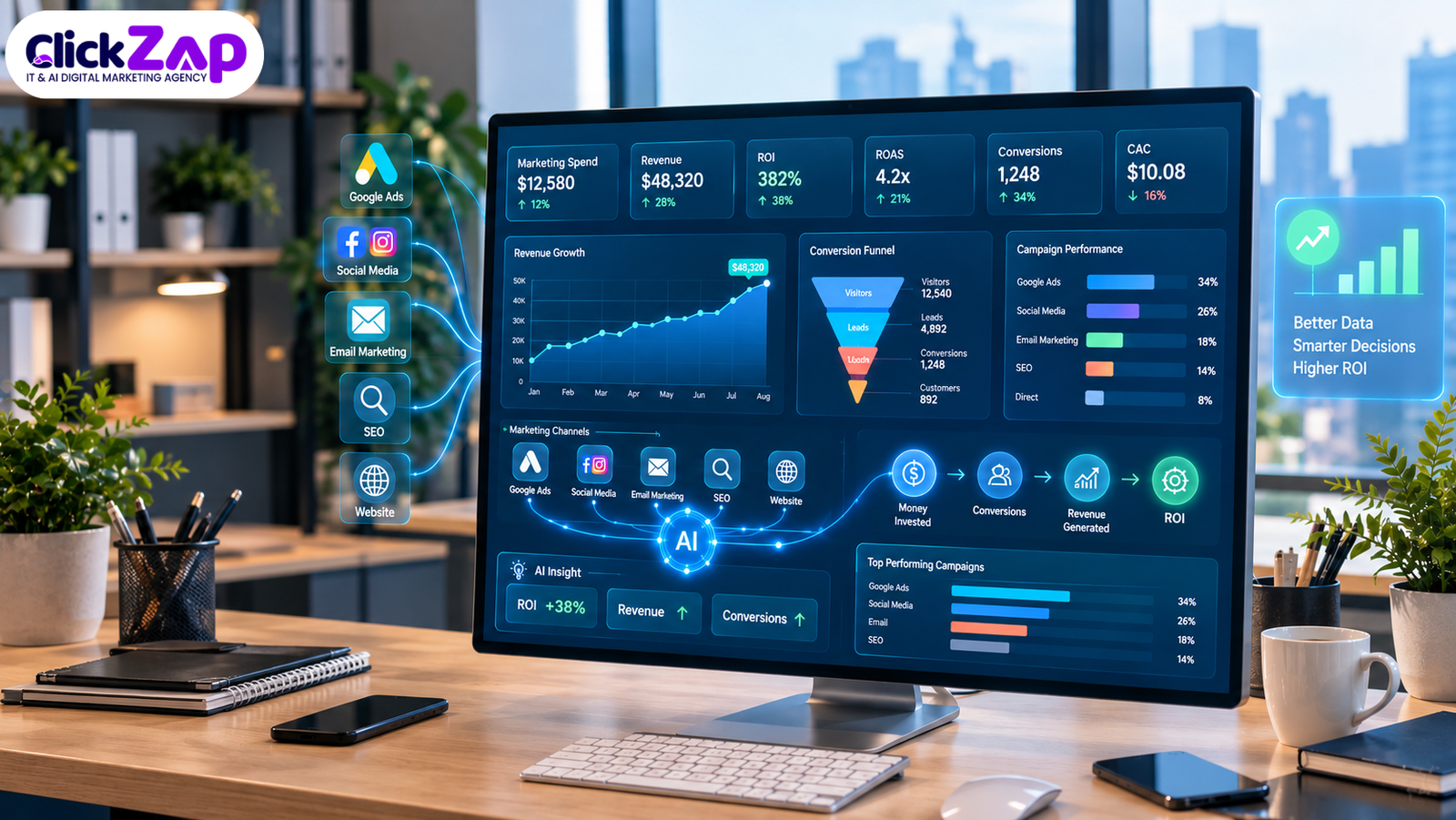
AI-based marketing ROI tracking works by connecting the full chain:
Marketing Spend → Customer Touchpoints → Leads → Conversions → Revenue → ROI.
Instead of looking at cost per click or cost per lead in isolation, AI models trace spend all the way through to closed revenue, factoring in:
- Customer acquisition cost (CAC) across the full journey, not just the last channel
- Return on ad spend (ROAS) adjusted for multi-touch contribution
- Conversion value, weighted by which touchpoints actually influenced the outcome
- Revenue attribution connected back to CRM data, tying marketing to actual closed-won deals, not just form fills
Illustrative example (hypothetical, for demonstration only):
|
Channel |
Last Touch Credit |
AI Multi Touch Credit |
Monthly Spend |
Last Touch ROAS |
AI Adjusted ROAS |
|
Google Ads |
60% |
35% |
₹1,00,000 |
4.2x |
2.8x |
|
Meta Ads |
15% |
25% |
₹60,000 |
1.8x |
3.1x |
|
SEO / Organic |
10% |
25% |
₹40,000 |
1.5x |
3.9x |
|
|
15% |
15% |
₹10,000 |
3.0x |
3.2x |
In this illustrative scenario, last touch attribution makes Google Ads look dominant, while AI multi touch attribution reveals that SEO and Meta Ads contribute far more to the journey than their last click numbers suggest. A business relying only on last touch data might keep increasing Google Ads spend while quietly starving the channels doing more of the actual work.
AI Customer Journey Attribution
AI customer journey attribution focuses on mapping the entire sequence of interactions a prospect has with a business, rather than isolating a single moment.
A realistic B2B journey might look like this:
Google Search → Organic Blog Post → Meta Ad (Retargeting) → Landing Page → Email Nurture → Demo Request → Sales Call → Purchase
Assigning full credit to only the first step or the last step would miss the fact that the blog post built trust, the retargeting ad kept the brand visible, and the email nurture sequence moved the lead toward a demo request. AI driven journey analysis considers:
- Customer journey tracking : the full sequence, not a snapshot
- Cross-channel journeys : how paid, organic, and CRM touchpoints interact
- Lead attribution : which combination of touchpoints produced a qualified lead
- Revenue attribution : which journeys eventually closed, and what they had in common
For B2B companies with longer sales cycles common across SaaS, IT services, manufacturing, and consulting this kind of journey level analysis is usually far more useful than any single touch model, because the buying decision genuinely involves multiple stakeholders and multiple touchpoints over weeks or months.
AI Marketing Attribution Tools for Businesses
No single platform performs AI attribution end to end. In practice, businesses combine measurement platforms, CRM data, and AI analysis tools.
Google Analytics 4 (GA4) : Uses an event based data model and includes data driven attribution as a built in reporting option, distributing conversion credit across touchpoints rather than defaulting to last click.
Google Ads : Provides campaign, ad group, and keyword level conversion data, and can apply data driven attribution when connected to GA4 or Google Ads conversion tracking.
Meta Ads : Tracks its own attribution window for social campaigns, though it typically needs to be combined with GA4 or a CRM to see how Meta touchpoints fit into the broader cross channel journey.
HubSpot : As a combined CRM and marketing platform, it can track touchpoints from first visit through to closed deals, connecting marketing activity directly to revenue.
Salesforce : Primarily a CRM, holding the sales side data that attribution models need to connect campaigns to actual closed won revenue rather than just leads.
Adobe Analytics : Used more by larger enterprises; offers advanced customer journey analysis and flexible attribution modeling across web, app, and offline data.
Google Big Query : A data warehouse that lets businesses centralize data from GA4, ad platforms, and CRMs in one place, often a prerequisite for running custom AI attribution models.
Looker Studio : Turns attribution data from GA4, Big Query, or a CRM into visual dashboards that marketing teams and leadership can read and act on.
OpenAI and ChatGPT : Generative AI tools don’t independently track or collect attribution data. Their role is in interpretation: summarizing attribution reports in plain language, helping analyze patterns across exported data, drafting insights, or supporting campaign analysis based on data pulled from the platforms above. ChatGPT interprets and communicates attribution data; it does not generate it
How to Automate Marketing Attribution Using AI
- Define business goals : Decide whether the priority is lead volume, lead quality, revenue, or a mix.
- Identify conversion events : Form fills, demo requests, purchases, or whatever represents real business value.
- Map customer touchpoints : List every channel and campaign type that could plausibly appear in a journey.
- Connect marketing platforms : Link Google Ads, Meta Ads, GA4, and email tools so data isn’t siloed.
- Centralize data : Bring it into one place, such as Big Query, so it can be analyzed together.
- Select an attribution model : Choose a starting model rather than defaulting to last click by omission.
- Apply AI analysis : Use the chosen platform’s machine learning attribution features, or a custom model.
- Build attribution dashboards : Turn output into a dashboard in Looker Studio or similar that non technical stakeholders can read.
- Monitor results : Attribution isn’t a one time setup; patterns shift as campaigns and behavior change.
- Optimize marketing budgets : Use the insights to actually reallocate spend, not just report on it.
How AI Can Improve Campaign Attribution
AI powered campaign attribution helps marketers move beyond channel level reporting into campaign and ad level decisions. It can:
- Compare campaigns against each other on a like for like, journey adjusted basis
- Identify which audiences are most valuable across the full funnel, not just at the point of conversion
- Detect underperforming channels before they consume a disproportionate share of budget
- Identify conversion patterns, such as specific creative and channel combinations that consistently perform
- Predict likely outcomes for similar future campaigns based on historical patterns
- Optimize budget allocation across active campaigns in near real time
- Improve overall campaign performance through faster feedback loops
Example: If Google Ads and Meta Ads are both active, AI attribution can reveal whether Meta Ads is driving genuinely new demand or largely reaching people who would have converted through Google Ads anyway. This kind of overlap analysis is difficult to do manually but is a natural output of pattern based attribution models.
Benefits of AI Driven Marketing Performance Measurement
- Better ROI visibility across channels, not just the last click winner
- More accurate customer journey analysis, reflecting how buyers actually behave
- Faster reporting, since data processing is automated
- Automated attribution, reducing analyst time spent reconciling platform level reports
- Better budget allocation, based on evidenced contribution rather than assumption
- Improved campaign optimization, with faster feedback on what’s working
- Stronger revenue attribution, when connected to CRM data
- Data driven decision making, replacing “the last channel gets the credit” with pattern based evidence
It’s worth being clear eyed: AI attribution meaningfully improves the accuracy and speed of these insights, but it does not make attribution perfect or eliminate the underlying data challenges below.
Challenges of AI Powered Marketing Attribution
AI improves analysis and it does not fix poor data quality. Common challenges include:
- Incomplete data, when not every channel or touchpoint is properly tracked
- Tracking restrictions, from browser privacy features and ad blockers
- Privacy regulations, which limit certain types of cross site tracking
- Cross device tracking limitations, when the same customer uses multiple devices without a consistent identifier
- Data quality issues, including duplicate records or inconsistent UTM tagging
- Offline conversions, such as phone calls or in person sales, often missed entirely
- CRM integration challenges, when marketing and sales data live in separate, poorly connected systems
- Attribution bias, where the chosen model still shapes which channels look successful
- Platform data discrepancies, since Google, Meta, and GA4 often report different numbers for the same campaign
- AI model limitations, since models are only as good as the data and volume they’re trained on
- Lack of sufficient historical data, particularly for newer businesses or lower traffic websites
Best Practices for AI Marketing Attribution
Getting the most out of AI powered marketing attribution for businesses comes down to a few fundamentals that most implementation failures trace back to:
- Start with clean, verified conversion tracking before layering on any AI model
- Establish consistent UTM naming conventions across every campaign and channel
- Connect CRM and marketing data so attribution can reach all the way to revenue
- Track both online and offline conversions wherever possible
- Define clear attribution goals before choosing a model
- Compare multiple attribution models rather than trusting one in isolation
- Validate AI generated insights against known business context before acting on them
- Monitor how attribution changes over time as campaigns and behavior shift
- Avoid relying on a single platform’s built in attribution as the full picture
- Focus on revenue and lead quality, not just click volume
- Maintain privacy and data governance standards throughout
AI Marketing Attribution Example for a Small Business
Consider a small business advertising across Google Ads, Meta Ads, SEO, and email.
|
Channel |
Last Touch Attribution |
AI Multi Touch Attribution |
|
Google Ads |
70% of conversions credited |
40% of conversions credited |
|
Meta Ads |
5% of conversions credited |
20% of conversions credited |
|
SEO |
10% of conversions credited |
25% of conversions credited |
|
|
15% of conversions credited |
15% of conversions credited |
Under last touch attribution, Google Ads looks like it’s carrying almost the entire conversion volume. Under an AI multi touch view, SEO and Meta Ads turn out to be involved in a much larger share of converting journeys; they just rarely happen to be the final click. A business making budget decisions from the last touch numbers alone would likely be underinvesting in the channels quietly building most of its pipeline.
How to Choose AI Marketing Attribution Software
- Integration capabilities : Does it connect cleanly with your ad platforms, CRM, and website analytics?
- Data sources : Can it pull in both online and offline conversion data?
- Attribution models : Does it offer data driven attribution, or only fixed rule based models?
- AI capabilities ; Is the “AI” genuinely pattern based analysis, or just a labeled dashboard?
- Real time reporting : How quickly does data update after a conversion occurs?
- CRM integration : Can it connect marketing touchpoints to actual closed revenue?
- Dashboard functionality : Can non technical stakeholders read the output without help?
- Scalability : Will it hold up as traffic, channels, and campaigns grow?
- Privacy controls : Does it comply with relevant data protection requirements?
- Ease of use : Can your team actually operate it without constant vendor support?
- Pricing considerations : Does cost scale reasonably with your traffic and conversion volume?
- Data export capabilities : Can you get your data out and into tools like BigQuery or Looker Studio?
What Is the Future of AI Powered Marketing Attribution?
These trends should be read as directional, not guaranteed outcomes:
- Predictive attribution, estimating which touchpoints are likely to drive future conversions, not just explaining past ones
- AI assisted budget allocation, with models suggesting spend shifts closer to real time
- Privacy first measurement, adapting to a world with fewer third party cookies and more consent restrictions
- Greater reliance on first party data, as businesses build direct data relationships with customers
- Customer journey intelligence, going beyond attribution into broader behavioral analysis
- Automated campaign optimization, where attribution insights feed directly into bidding and budget systems
- Cross channel analytics, unifying paid, organic, and offline data more completely
- AI generated marketing insights, with natural language summaries becoming a standard reporting layer
- A stronger shift toward revenue focused attribution, rather than lead or click focused metrics
- Generative AI reporting, where tools like ChatGPT are used to interpret and communicate findings to non technical stakeholders
FAQ
What is AI powered marketing attribution?
It’s the use of machine learning to analyze customer touchpoints and determine how much each one contributed to a conversion, rather than relying on a single fixed rule like first click or last click.
How accurate is AI marketing attribution?
AI attribution is generally more accurate than single touch models because it analyzes patterns across many customer journeys, but its accuracy still depends on data quality, tracking coverage, and how well marketing platforms are integrated.
What data is required for AI attribution?
It requires clean conversion tracking, consistent UTM tagging, website analytics events, and ideally CRM and offline conversion data, all connected so the AI can trace complete customer journeys.
Can AI attribution actually improve campaign performance?
By revealing which channels and combinations genuinely drive conversions, AI attribution helps businesses reallocate budget toward what’s working and reduce spend on channels that only appear successful under simplistic models.
What is the difference between first touch and last touch attribution?
First touch attribution credits the very first interaction in a customer journey, while last touch attribution credits only the final interaction before conversion both ignore everything that happens in between.
Key Takeaways
- AI powered marketing attribution for businesses replaces fixed rule credit assignment with pattern based analysis of full customer journeys.
- Traditional first touch and last touch models each ignore most of the customer journey, often misrepresenting which channels actually drive results.
- AI powered attribution models, particularly data driven attribution, adapt to a business’s real conversion data instead of applying a generic rule.
- Multi touch attribution distributes conversion credit across several touchpoints rather than assigning it all to one interaction.
- AI connects marketing spend to leads, conversions, and revenue, enabling more accurate ROI and ROAS measurement.
- Common tools include GA4, Google Ads, Meta Ads, HubSpot, Salesforce, Adobe Analytics, BigQuery, and Looker Studio, with generative AI tools like ChatGPT supporting interpretation rather than data collection.
- AI attribution requires clean, well integrated data. It improves analysis but does not fix poor tracking or data quality on its own.
- Businesses should compare multiple attribution models rather than depending on any single one.
- Implementation works best as a step by step process: define goals, connect data sources, select a model, apply AI analysis, and monitor results over time.
- The future of attribution is moving toward predictive, privacy first, and revenue focused measurement.
Conclusion
Marketing attribution has always been about answering one question honestly: what’s actually working? Rule based models were a reasonable starting point when customer journeys were simpler, but they were never built for the multi channel, multi device reality most businesses operate in today. AI powered marketing attribution for businesses gives marketers a far more accurate way to trace the real path from first impression to closed revenue and to make budget decisions based on evidence rather than whichever channel happened to get the last click.
Getting there does require the fundamentals: clean tracking, connected platforms, and a willingness to look past the easiest metric to the one that actually matters revenue.
If your business is spending across Google Ads, Meta Ads, SEO, and email but still isn’t sure which channels are actually driving growth, ClickZap IT’s AI powered digital marketing services can help you set up proper attribution tracking and turn that data into decisions that improve campaign performance and ROI.
Also Read: AI Powered Website Performance Optimization: Boost Speed, SEO & Conversions
0 Comments