
AI Marketing Funnel Optimization Services
Most businesses don’t have a traffic problem. They have a leaking bucket problem. Visitors land on the site, browse a page or two, maybe add something to cart, and then vanish never to fill out a form, book a call, or complete checkout. Marketing teams respond by spending more on ads, which only pours more water into a bucket that’s still leaking. This is exactly the gap AI marketing funnel optimization services are built to close.
The real issue usually isn’t visibility. It’s the funnel itself, the sequence of touchpoints between “stranger” and “customer” and how poorly most businesses understand what’s happening inside it. Traditional funnel audits rely on spreadsheets, gut instinct, and monthly reports that are already stale by the time anyone reads them. By the time a human analyst spots a drop-off point, hundreds of leads have already walked away.
This is where AI marketing funnel optimization services change the equation. Instead of waiting for a quarterly report, AI systems continuously analyze customer behavior, campaign performance, and conversion data flagging bottlenecks as they happen and suggesting fixes in near real time. In this article, we’ll break down what AI marketing funnel optimization actually involves, how it works at each stage of the funnel, ten concrete ways it can lift conversions, the tools commonly used to power it, and how to evaluate a service provider if you’re ready to bring in outside help.
What Are AI Marketing Funnel Optimization Services?
AI marketing funnel optimization services use machine learning and data analysis to identify where prospects drop out of a marketing funnel and to recommend or automate changes that improve conversion rates at each stage. Rather than reviewing performance after the fact, AI tools work continuously analyzing traffic sources, on site behavior, ad performance, and lead quality to surface patterns a human team would take weeks to find manually.
At its core, marketing funnel optimization is the practice of improving each stage of the buyer’s journey of awareness, interest, consideration, conversion, and retention so that a higher percentage of people who enter the funnel come out the other end as customers. AI adds three things traditional optimization struggles to deliver at scale: speed, pattern recognition across large datasets, and personalization applied to individual users rather than broad segments.
Practically, this means AI systems pull data from sources like Google Analytics, ad platforms, CRM tools, and on site behavior tracking, then apply models that predict which visitors are likely to convert, which are likely to churn, and which campaigns are underperforming relative to their spend. The output isn’t a black box, it’s a set of prioritized, explainable recommendations that a marketing team can act on immediately.
Why Marketing Funnels Need AI Optimization
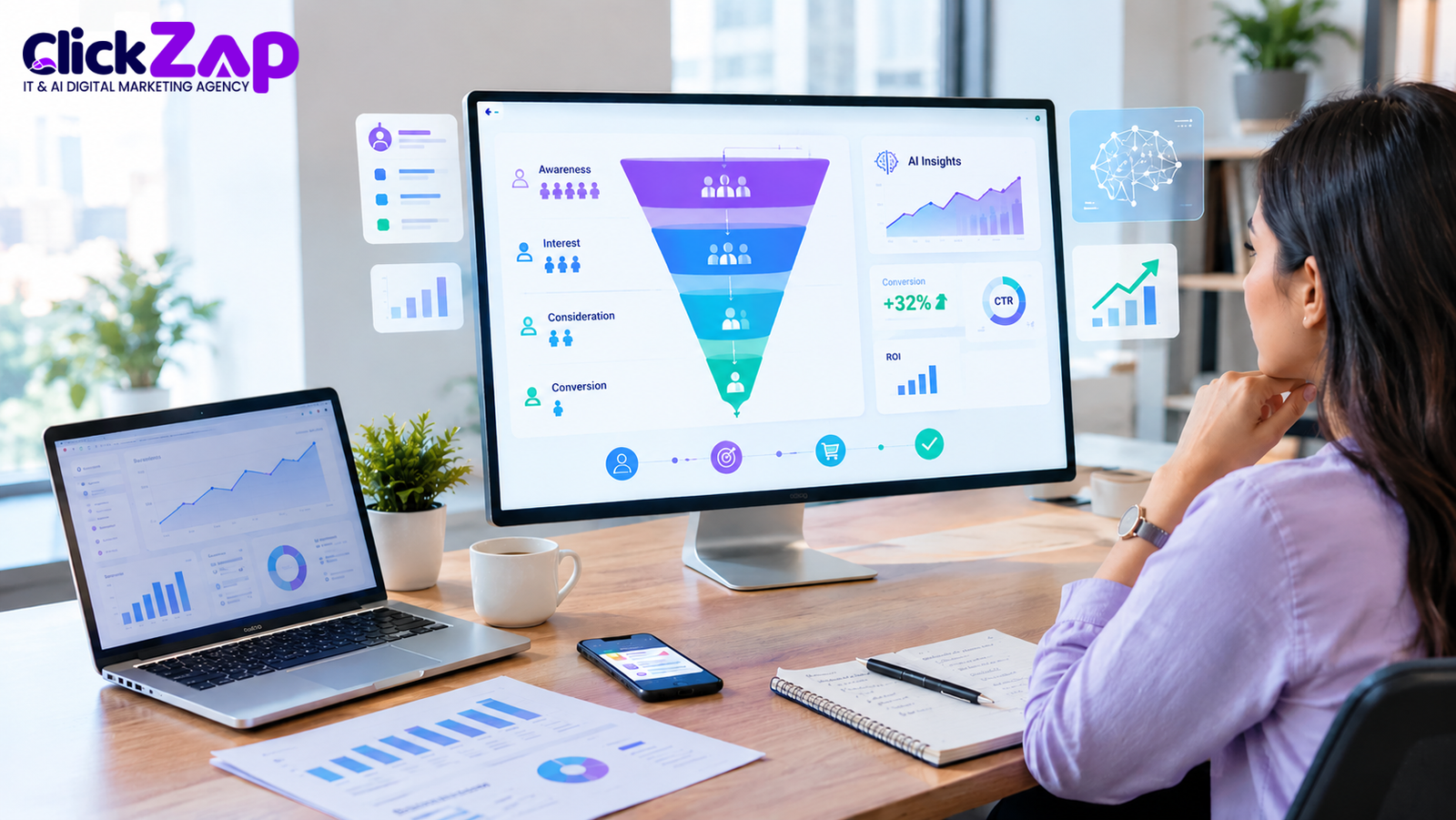
Traditional funnel optimization has real limitations, and most marketing teams run into the same ones:
- Limited customer insights : teams see aggregate numbers (visits, clicks, conversions) without understanding why individual users behave the way they do.
- Manual data analysis : someone has to pull reports, cross-reference spreadsheets, and manually spot trends, which takes days or weeks.
- Poor personalization : most funnels show the same message to every visitor regardless of where they came from or what they’ve already shown interest in.
- Lead leakage : prospects who show buying intent go cold because no one follows up at the right moment.
- Weak lead nurturing : generic email sequences don’t account for where a lead actually is in their decision process.
- Inefficient campaign targeting : ad spend gets distributed across audiences based on assumptions rather than behavioral evidence.
- Slow optimization cycles : by the time a team reviews last month’s numbers, the market and the campaign have already moved on.
- Difficulty identifying conversion bottlenecks : a funnel can be leaking at three different stages at once, and manual analysis often catches only the most obvious one.
AI addresses these gaps by processing far more data points than a human team can, updating its analysis continuously instead of on a reporting cycle, and surfacing the specific stage and often the specific reason where prospects are dropping off. That shift, from periodic review to continuous analysis, is the main reason businesses adopt AI marketing funnel optimization in the first place.
How AI Marketing Funnel Optimization Works
While every provider’s process looks slightly different, most AI marketing funnel optimization services follow a similar sequence:
- Collect customer and marketing data from analytics platforms, ad accounts, CRM systems, and on site tracking.
- Analyze customer behavior page paths, time on site, scroll depth, form abandonment, and engagement patterns.
- Identify funnel bottlenecks by comparing conversion rates between each stage of the customer journey.
- Segment audiences based on behavior, source, intent signals, and stage in the buying process rather than just demographics.
- Personalizing customer experiences different messaging, offers, or content depending on the segment and behavior.
- Optimize campaigns by reallocating budget toward the channels and audiences producing the best qualified leads.
- Automate lead nurturing with triggered emails, retargeting, or chat follow-ups based on specific actions a lead takes.
- Track conversions across the full journey, not just the last click before a sale.
- Continuously test and improve the funnel using A/B tests and ongoing behavioral feedback rather than a one time audit.
This isn’t a “set it and forget it” process. Marketing automation and funnel analytics tools generate the data and the recommendations; a strategist still needs to interpret results in the context of the business and decide which changes actually make sense to ship.
How AI Optimizes Each Stage of the Marketing Funnel
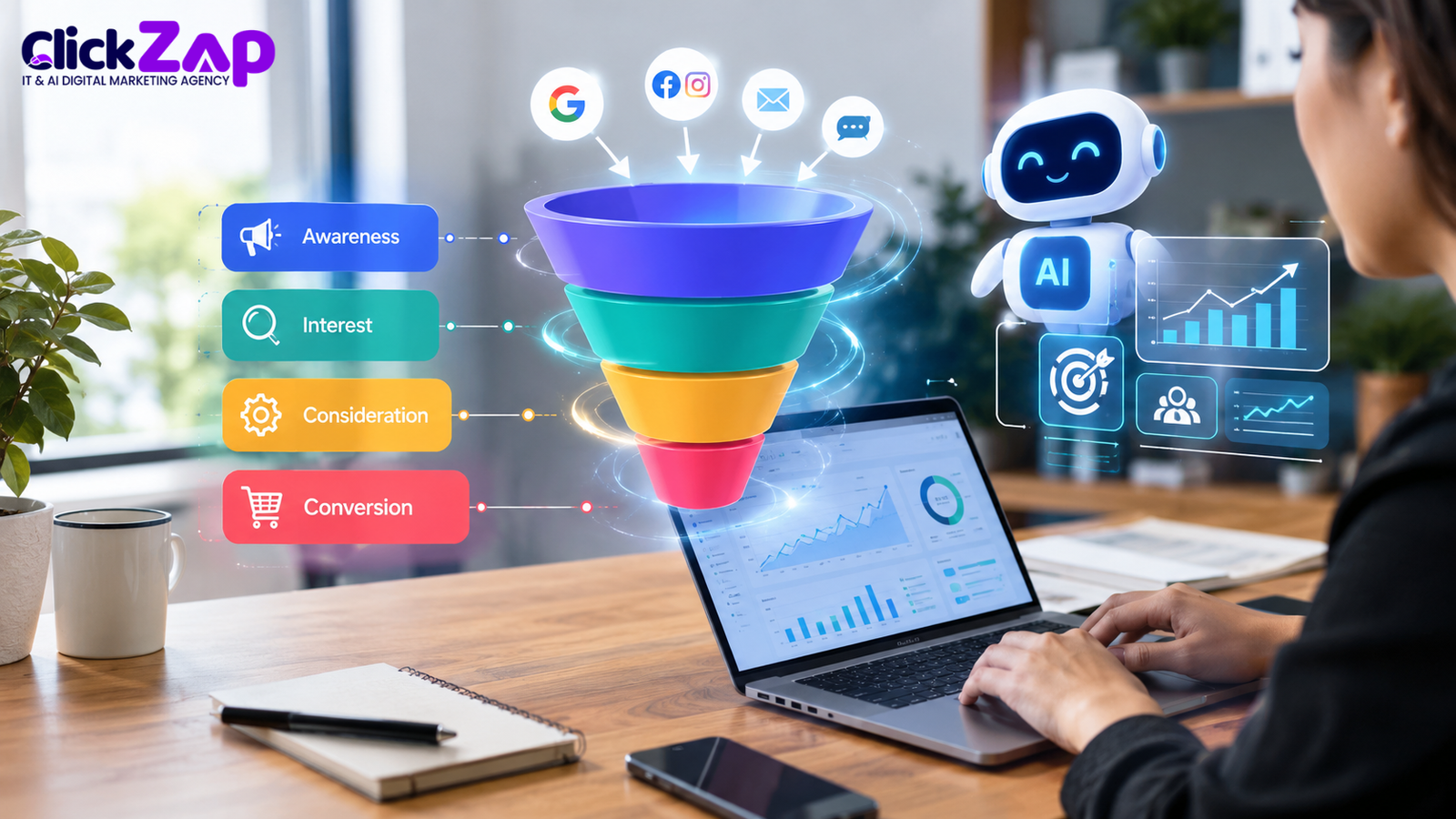
Awareness Stage
At the top of the funnel, AI helps with audience identification and customer segmentation, finding look-alike audiences that resemble your best existing customers rather than relying on broad demographic guesses. It supports content targeting by identifying which topics and formats resonate with specific segments, and it plays directly into Google Ads optimization and Meta advertising through automated bidding and audience expansion. Ongoing campaign analysis flags underperforming ad sets early, before significant budget is wasted.
Interest and Consideration Stage
Once a visitor shows interest, AI-driven personalized content adjusts what a returning visitor sees based on prior behavior. Customer behavior analysis identifies which pages and content pieces correlate with eventual conversion, informing what to promote more heavily. Retargeting becomes more precise, focused on users who’ve shown genuine intent rather than everyone who bounced. Lead scoring models rank prospects by likelihood to convert, while chatbots handle initial questions and qualify leads outside business hours. Engagement analysis ties all of this together by measuring which touchpoints actually move someone closer to a decision.
Conversion Stage
This is where AI marketing funnel optimization services typically deliver the most visible impact. Landing page optimization uses behavioral data to identify friction points, confusing copy, weak calls to action, slow load times. Conversion rate optimization efforts get sharper because they’re informed by actual user behavior rather than assumptions. Personalized offers can reflect what a specific visitor has already engaged with, and A/B testing runs continuously rather than as an occasional project. Purchase intent prediction flags high value prospects for priority follow up, and conversion tracking ties every step back to the campaigns and content that actually drove the result.
Retention Stage
Funnel optimization doesn’t end at the sale. AI supports customer retention through personalized communication based on purchase history and behavior, and customer lifecycle analysis identifies when a customer is at risk of churning or ready for another purchase. This data feeds cross selling and upselling recommendations that feel relevant rather than generic, and it powers repeat purchase campaigns timed around a customer’s actual buying cycle instead of an arbitrary email schedule.
10 Ways AI Marketing Funnel Optimization Services Can Increase Conversions
- Identifying high intent prospects. AI models score leads based on behavior pages visited, time spent, content downloaded so sales and marketing teams can prioritize the prospects most likely to convert instead of treating every lead equally. A B2B software company, for example, might see that leads who view pricing and a case study within the same session convert at a much higher rate, and route those leads for immediate follow-up.
- Improving customer segmentation. Instead of a handful of broad segments, AI can group audiences by actual behavior and intent signals, allowing far more relevant messaging for each group.
- Personalizing customer journeys. Content, offers, and follow-up sequences can adjust automatically based on what a visitor has already done, rather than showing everyone the same generic path.
- Automating lead nurturing. Triggered, behavior based email or WhatsApp sequences reach leads at the right moment instead of on a fixed weekly schedule, reducing the number of warm leads that go cold.
- Improving landing pages. Behavioral heatmap and session data reveal exactly where visitors hesitate or drop off, giving a clear, evidence based list of what to test first rather than guessing.
- Optimizing advertising campaigns. AI-assisted bidding and audience targeting in platforms like Google Ads and Meta Ads shift budget toward what’s actually converting, rather than leaving it spread evenly across underperforming ad sets.
- Predicting customer behavior. Models trained on historical data can flag which visitors are likely to convert or churn, letting teams intervene with an offer, a follow up call, or a retargeting ad before it’s too late.
- Improving conversion tracking. AI-powered attribution can connect conversions back to the full sequence of touchpoints that led to them, not just the last click, giving a more accurate picture of what’s actually working.
- Identifying funnel drop off points. Instead of a single overall conversion rate, AI breaks performance down stage by stage, showing precisely where the biggest leak is awareness, consideration, or checkout.
- Continuously optimizing campaigns. Because AI systems process data continuously rather than on a monthly cycle, underperforming campaigns can be adjusted within days instead of waiting for the next scheduled review.
AI Technologies and Tools Used for Funnel Optimization
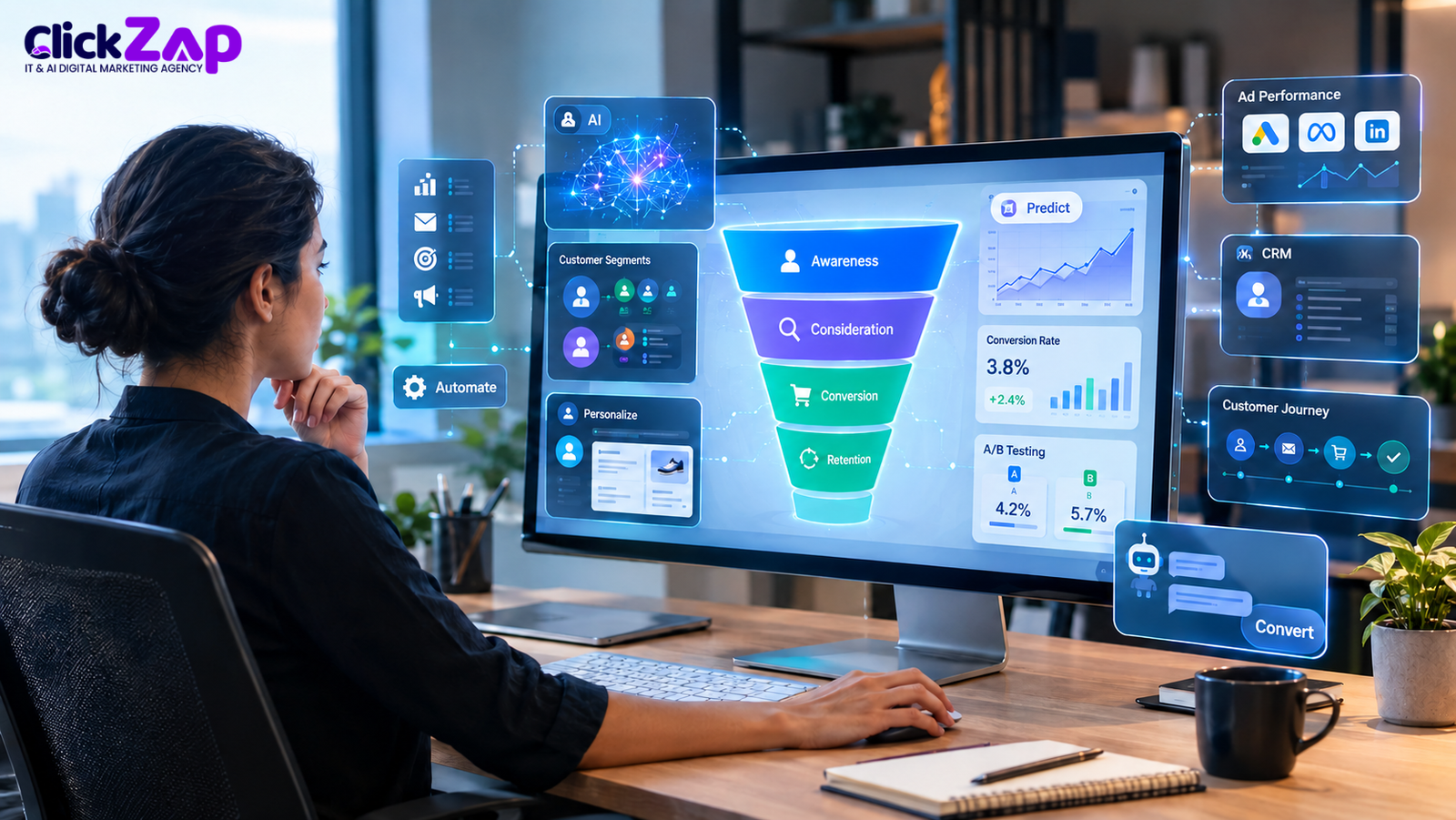
Most AI marketing funnel optimization work relies on a combination of established platforms rather than a single proprietary system:
- Google Analytics provides the behavioral data foundation traffic sources, on-site behavior, and conversion paths.
- Google Ads applies AI-assisted bidding and audience targeting to improve campaign efficiency.
- Google Tag Manager enables the granular event tracking that funnel analytics and conversion tracking depend on.
- HubSpot and Salesforce bring AI-supported lead scoring, marketing automation, and CRM data together so marketing and sales work from the same picture of a prospect.
- OpenAI’sChatGPT and similar large language models support content generation, chatbot interactions, and customer-facing conversational tools within the funnel.
- Microsoft tools, including Clarity and Advertising, add behavioral analytics and additional ad targeting capability.
- Meta advertising platforms use machine learning for audience expansion and ad delivery optimization across Facebook and Instagram.
No single platform does all of this. Effective AI marketing funnel optimization services typically integrate several of these tools so that data flows between analytics, advertising, and CRM systems instead of sitting in disconnected dashboards.
AI-Powered Marketing Funnel Optimization vs Traditional Funnel Optimization
|
Factor |
Traditional Optimization |
AI-Powered Optimization |
|
Data analysis |
Manual review of reports, often monthly |
Continuous, automated analysis of live data |
|
Customer segmentation |
Broad demographic groups |
Behavior and intent based micro segments |
|
Personalization |
Generic messaging for most visitors |
Dynamic content based on individual behavior |
|
Lead scoring |
Manual or rule based scoring |
Predictive scoring based on behavioral patterns |
|
Campaign optimization |
Periodic manual adjustments |
Ongoing, data driven reallocation of spend |
|
Funnel analysis |
Single overall conversion rate |
Stage by stage breakdown of drop off points |
|
Automation |
Limited, mostly scheduled emails |
Behavior triggered nurturing across channels |
|
Conversion prediction |
Based on past averages |
Model based prediction per user or segment |
|
Optimization speed |
Weeks to months |
Days, sometimes near real time |
|
Scalability |
Harder to scale without adding headcount |
Scales across large data volumes with less manual effort |
Benefits of AI Marketing Funnel Optimization Services for Businesses
Businesses that adopt AI-driven funnel optimization typically see improvements across several areas: higher conversion rates as bottlenecks get identified and addressed faster, better lead quality through more accurate scoring, and a smoother customer experience thanks to more relevant, timely messaging. Marketing spend tends to become more efficient because budget shifts toward what’s actually converting rather than staying static across campaigns.
Faster decision making is another consistent benefit teams aren’t waiting for a monthly report to know something isn’t working. Personalization improves because messaging can reflect actual behavior instead of broad assumptions, and campaign performance benefits from continuous testing rather than occasional reviews. Much of the manual reporting and data pulling work gets reduced, freeing the team to focus on strategy. ROI measurement becomes more accurate through better attribution, and the whole approach scales more easily as a business grows, since AI systems handle larger data volumes without a proportional increase in manual effort. None of this guarantees a specific percentage lift; results depend heavily on the starting point, industry, and execution but the direction of improvement is consistent across the businesses that implement it well.
How to Implement AI Marketing Funnel Optimization
- Defining business goals, more leads, higher average order value, lower cost per acquisition, or improved retention all require different priorities.
- Map the existing customer journey so you know what touchpoints actually exist before trying to optimize them.
- Audit the current funnel to establish a baseline conversion rate at each stage.
- Set up conversion tracking across all relevant channels and touchpoints, not just the final purchase step.
- Collecting reliable customer data inconsistent or incomplete data undermines everything downstream.
- Identify funnel bottlenecks using the baseline data from the audit.
- Select appropriate AI tools based on your existing tech stack and the specific bottlenecks identified.
- Automate repetitive processes like lead nurturing sequences and retargeting rules.
- Test personalization strategies on a smaller segment before rolling out broadly.
- Measure and continuously improve results, treating funnel optimization as an ongoing process rather than a one time project.
Metrics to Measure AI Marketing Funnel Performance
- Conversion rate : the percentage of visitors who complete a desired action at each funnel stage.
- Cost per lead : how much is spent, on average, to generate a single lead.
- Customer acquisition cost : total cost to acquire a paying customer, including marketing and sales spend.
- Click-through rate : how often people click on an ad or link relative to how many see it.
- Landing page conversion rate : the percentage of landing page visitors who take the target action.
- Lead to customer rate : what portion of leads eventually become paying customers.
- Customer lifetime value : the total revenue a business can expect from a customer over the relationship.
- Return on ad spend : revenue generated per unit of advertising spend.
- Funnel drop off rate : the percentage of prospects lost at each individual stage.
- Engagement rate : how actively users interact with content, ads, or on site elements.
- Retention rate : the percentage of customers who continue buying or engaging over time.
Tracking these consistently rather than checking them once a quarter is what makes AI-driven optimization possible in the first place; the models need ongoing data to keep improving their recommendations.
Common Mistakes to Avoid When Using AI for Marketing Funnel Optimization
- Relying entirely on AI without human oversight. AI surfaces patterns and recommendations; a strategist still needs to judge whether a suggested change fits the brand and business context.
- Using poor quality data. Inconsistent tracking or incomplete data leads to unreliable recommendations, no matter how sophisticated the model is.
- Ignoring customer privacy. Personalization has to stay within data protection regulations and platform policies cutting corners here creates real legal and trust risk.
- Automating everything without strategy. Automation should execute a clear plan, not replace the need for one.
- Focusing only on conversion rate. A high conversion rate on low quality leads doesn’t help the business; lead quality and downstream retention matter just as much.
- Not tracking the complete customer journey. Optimizing one stage in isolation can create bottlenecks elsewhere if the full journey isn’t visible.
- Using too many disconnected tools. Data spread across systems that don’t talk to each other undermines the whole point of continuous analysis.
- Failing to test AI recommendations. Not every suggestion will fit every business test before rolling out broadly.
- Ignoring customer experience. Aggressive personalization or over automation can feel intrusive; the goal is relevance, not surveillance.
How to Choose AI Marketing Funnel Optimization Services
Evaluating a provider for AI marketing funnel optimization services comes down to a few practical checks:
- Industry experience : has the provider worked with businesses in your sector or a comparable one?
- SEO and digital marketing expertise : funnel optimization doesn’t happen in isolation from search visibility and paid media.
- AI capabilities : ask specifically what tools and models they use, and how those integrate with your existing systems.
- Analytics and tracking expertise : can they set up and interpret conversion tracking correctly, not just generate reports?
- Conversion optimization experience : look for a track record of structured testing, not just design opinions.
- Marketing automation capabilities : do they build genuinely behavior triggered sequences, or just scheduled email blasts labeled as automation?
- Reporting and transparency : you should be able to see what’s changing and why, not just a summary dashboard.
- Custom strategies : be cautious of providers offering the same templated funnel to every client regardless of industry.
- Integration capabilities : can they connect your CRM, analytics, and ad platforms so data actually flows between them?
- Ongoing optimization : funnel optimization is a continuous process; a provider offering only a one time audit isn’t set up to deliver AI-driven results.
Why Choose ClickZap IT for AI Marketing Funnel Optimization?
ClickZap IT is a Hyderabad based digital marketing agency that combines AI-powered marketing with SEO, Google Ads and PPC management, Meta Ads, conversion optimization, marketing automation, analytics, lead generation, and customer journey optimization under one roof. Rather than treating funnel optimization as a standalone project, ClickZap IT integrates it with the broader marketing strategy search visibility, paid campaigns, content, and social so improvements at one stage of the funnel don’t create new problems at another.
The approach centers on connecting your analytics, ad accounts, and CRM data so recommendations are grounded in your actual customer behavior rather than generic best practices, and on building nurturing and retargeting sequences around what a specific segment of your audience actually does. If your current funnel is generating traffic but not converting it into leads or customers, that’s exactly the kind of problem AI-driven funnel optimization is built to diagnose.
If you’re ready to look closely at where your funnel is leaking and what AI-powered optimization could do about it, get in touch with ClickZap IT to talk through your goals.
Frequently Asked Questions
What are AI marketing funnel optimization services?
AI marketing funnel optimization services use machine learning and data analysis to identify weak points in a marketing funnel and improve conversion rates at each stage from awareness through retention using continuous, data driven recommendations instead of periodic manual reviews.
How does AI improve marketing funnel conversions?
AI improves conversions by analyzing customer behavior in real time, identifying exactly where prospects drop off, personalizing content and offers based on individual behavior, and continuously testing changes rather than relying on infrequent manual audits.
Can AI optimize a sales funnel?
Yes. AI can analyze lead behavior, score prospects by likelihood to convert, automate follow-up at the right moment, and flag where in the sales funnel prospects are stalling helping sales and marketing teams prioritize the right leads.
How does AI help with lead generation?
AI helps with lead generation by identifying high-intent audiences, improving ad targeting and bidding, scoring leads based on behavior, and automating nurturing sequences so warm leads are followed up with faster and more consistently.
How does AI personalize the customer journey?
AI personalizes the customer journey by adjusting content, offers, and messaging based on a visitor’s actual behavior pages viewed, content engaged with, and stage in the buying process rather than showing the same experience to every visitor.
Conclusion
A funnel that leaks leads at every stage isn’t a traffic problem, it’s an optimization problem, and it’s one that’s genuinely hard to solve manually at the pace modern marketing requires. AI marketing funnel optimization services give businesses a way to see exactly where prospects are dropping off, personalize the experience for the people most likely to convert, and adjust campaigns continuously instead of waiting for the next monthly report. None of this replaces good strategy AI surfaces the patterns and handles the repetitive work, but the decisions about what those patterns mean for your business still need a human behind them.
If your funnel is generating traffic but not enough conversions, it’s worth a closer look before spending more on ads. Contact ClickZap IT to talk through your current funnel and explore how AI-powered optimization could improve your lead generation, customer journey, and conversion process.
Also Read: AI Google Ads Optimization Services for Businesses: How AI Can Increase Your Advertising ROI
0 Comments