
You are getting traffic. Your analytics show visitors landing on your service pages, reading your blogs, and scrolling through your product listings. But the enquiry form stays empty, the “Buy Now” button gets ignored, and your sales team wonders where the leads went. This is usually a sign that your website needs CTA optimization using AI to turn that traffic into real enquiries.
This is one of the most common problems in digital marketing. Traffic is not the issue. The gap between interest and action is.
That gap is usually a call to action (CTA) problem. The CTA is the bridge between a visitor who is interested and a visitor who converts. A weak bridge loses people, however good your content is.
This is where CTA optimization using AI becomes practical. AI can help you write sharper CTA copy, show the right CTA to the right visitor, choose better placements, and test variations faster than manual methods allow.
This guide explains how it works, which tools to use, and how to avoid the mistakes that waste budget. It is written for business owners, marketers, and founders, and you don’t need prior AI experience.
What Is CTA Optimization Using AI?
CTA optimization using AI is the practice of using artificial intelligence to write, personalize, place, test, and analyze calls to action so more visitors click and convert.
Here is the breakdown.
A CTA (call to action) is the prompt that tells a visitor what to do next. It can be a button, a link, a banner, or a line of text. “Get Your Free Quote,” “Book a Demo,” and “Add to Cart” are all CTAs.
Call to action optimization means improving that prompt so more people take the action. You can improve the copy, colour, size, position, timing, and the offer behind it.
AI powered CTA optimization adds machine learning and language models to the process. Instead of guessing, you use AI to:
- Generate many CTA ideas quickly
- Analyze user behavior and search intent
- Show different CTAs to different audiences
- Run and read tests faster
- Spot patterns in CTA performance data
A simple example
Imagine a Hyderabad based interior design studio. Its service page has one button that says “Submit.”
With AI-powered CTA strategy, the team would:
- Ask an AI tool for 15 alternative CTAs based on the visitor’s goal
- Shortlist five and rewrite them in the studio’s tone
- Show “Get a Free Design Consultation” to first-time visitors and “See Our Recent Projects” to people still comparing
- Track clicks and enquiries in GA4
- Keep the winner and test again
The AI speeds up the thinking. The business still decides what fits its brand and offer.
Why CTA Optimization Matters for More Clicks and Leads
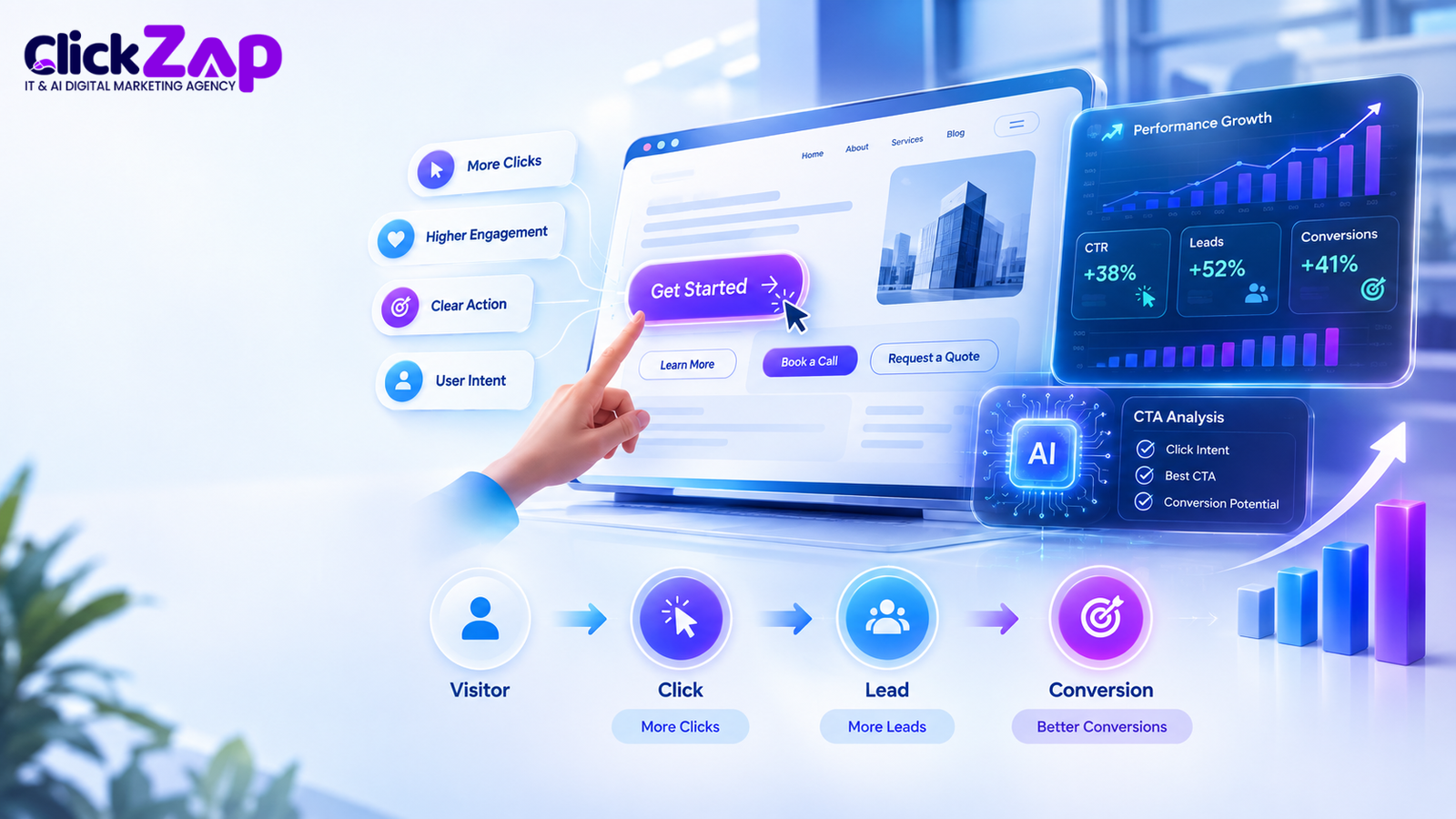
A CTA is the moment of decision. Visitors don’t convert because your page exists. They convert when the next step is clear, relevant, and worth taking.
Two numbers matter here:
- CTA click through rate (CTR): the percentage of visitors who see your CTA and click it.
- CTA conversion rate: the percentage of visitors who complete the final goal, such as a form submission, a call, or a purchase.
A CTA can get clicks and still fail to convert. If “Get Pricing” leads to a confusing form, people click and leave. Good website conversion optimization looks at the whole path, not just the button.
User intent decides everything
User intent and CTA must match. A visitor reading a beginner’s guide is not ready to “Buy Now.” A visitor on a pricing page is not looking for “Download Our Free Ebook.”
When the CTA matches the visitor’s stage, the action feels natural. When it doesn’t, it feels pushy or irrelevant.
Weak vs. strong CTAs
|
Situation |
Weak CTA |
Stronger CTA |
Why the stronger one is better |
|
Service page for GST filing |
Submit |
Get a Free GST Consultation |
States the action and the value |
|
SaaS pricing page |
Click Here |
Start Your 14 Day Free Trial |
Clear next step, low risk |
|
Real estate landing page |
Learn More |
Book a Site Visit |
Matches high intent behavior |
|
Blog on digital marketing |
Contact Us |
Get a Free Website Audit |
Fits the reader’s stage |
|
E-commerce product page |
Buy |
Add to Cart Free Delivery Across India |
Adds a reason to act |
Landing page CTA optimization
Landing pages have one job, so the CTA carries more weight there than anywhere else. A clear headline, a relevant offer, and one obvious action usually outperform a page with five competing buttons. We will cover this in detail later.
How AI Improves CTA Optimization
AI helps in four main areas: copy, personalization, placement, and testing. Each one solves a different problem.
AI Powered CTA Copy Optimization
An AI CTA generator can produce dozens of options in minutes. That is useful because most teams stop at their first idea.
Take the generic “Learn More.” It tells the visitor nothing. AI generated CTA copy can turn it into something specific:
|
Generic CTA |
Context aware alternatives |
|
Learn More |
See How Our SEO Process Works |
|
Get Quote |
Get Your Free Quote in 24 Hours |
|
Contact Us |
Book a Free Consultation |
|
Sign Up |
Start Your Free Trial |
|
Pricing |
Get Pricing for Your Team Size |
Context matters more than clever wording. “Book a Free Consultation” works well for a service business where trust must be built first. It fits poorly on an e-commerce product page, where “Add to Cart” is what the visitor expects.
Give the AI context: who the visitor is, what page they are on, what they want, and what worries them. Without that, you get generic output.
CTA copy optimization is also about specificity. “Get Your Free Quote” beats “Get Started” when the visitor knows exactly what a quote involves.
AI CTA Personalization
Not every visitor needs the same CTA. AI CTA personalization changes what a visitor sees based on signals like:
- User behavior: pages viewed, time spent, scroll depth
- Location: a Hyderabad visitor sees “Book a Free Visit in Hyderabad”
- Device: mobile users may see “Call Now” or “Chat on WhatsApp”
- Traffic source: a Google Ads visitor and an organic visitor have different intent
- Previous interactions: a returning visitor who viewed pricing twice is closer to buying
- Buyer stage: awareness, consideration, or decision
- User intent: informational, comparison, or purchase ready
Practical example: A Bengaluru B2B SaaS company sees three groups on its website:
- A first time visitor from a blog sees “Get the Free CRM Checklist.”
- A returning visitor who viewed the features page sees “Watch a 3 Minute Demo.”
- A visitor who visited pricing three times sees “Talk to Our Team.”
Same website, three CTAs, each matched to a different level of interest. That is what personalized CTAs do. Tools like HubSpot support this kind of smart content through its CRM data.
Start with two or three segments. Over segmenting creates a maintenance headache and gives you too little data per group.
AI CTA Placement Optimization
A good CTA in a bad spot still fails. CTA placement optimization uses behavior data to decide where the CTA belongs.
AI assisted analysis of heatmaps, scroll maps, and session recordings can show where visitors pause, where they drop off, and what they ignore. Consider these placements:
- Above the fold: best for high intent visitors who already know what they want
- Within content: works when the CTA follows a relevant point, such as a “Get a Free Audit” prompt after a section on SEO mistakes
- End of article: catches readers who finished the content and are ready for a next step
- Landing page sections: repeating the same CTA after the benefits, proof, and pricing sections gives visitors a chance to act at every stage
- Product pages: keep “Add to Cart” visible, especially on mobile where sticky buttons help
- Exit intent areas: a last chance offer, like a discount or a free checklist, can recover some leaving visitors
There is no universal best position. A long form service page and a short lead gen page behave differently. Let data from your own site guide you.
AI CTA Testing
Traditional CTA A/B testing is slow. You create two versions, wait for enough traffic, and repeat. AI CTA testing speeds this up in three ways:
- It generates many variations to test
- It helps predict which variations deserve testing first
- Some platforms shift traffic automatically toward better performers
You can test:
- CTA copy: “Get Free Quote” vs. “Get My Free Quote”
- Button placement: top vs. mid page vs. sticky
- Button size and color: visibility matters more than any “magic” color
- Design variations: filled vs. outline buttons
- Personalization: generic vs. segment specific CTAs
Judge results by conversion performance, not clicks alone. A CTA that gets more clicks but fewer qualified leads is not a win.
Small sites with low traffic should test one thing at a time. Testing too many variables with limited traffic gives you noise, not answers.
Best AI Digital Marketing Agency in Hyderabad
How to Use AI to Create High Converting CTAs
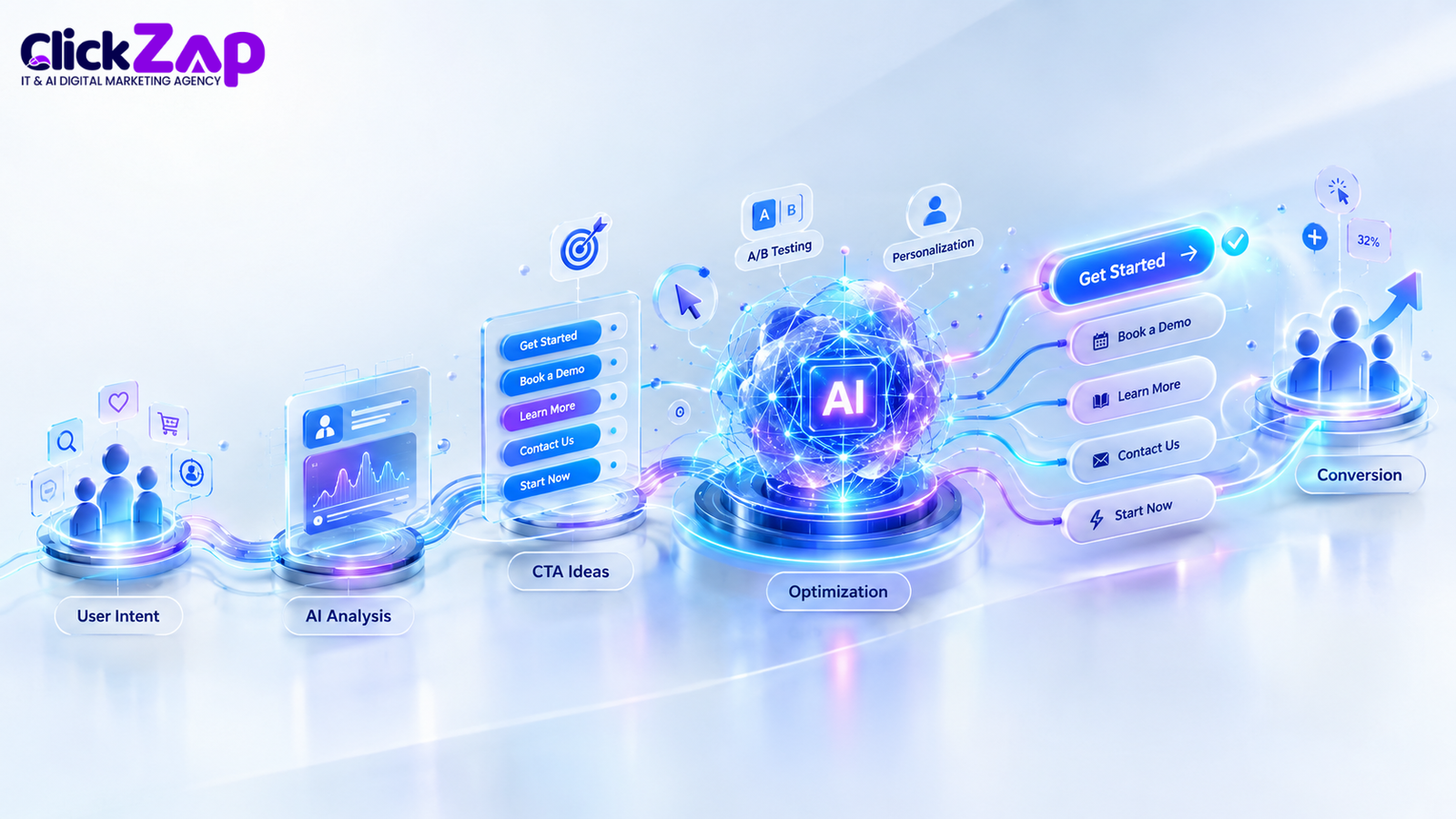
Here is a step by step process you can follow this week.
- Identify the conversion goal. Decide what one action you want: a form fill, a call, a purchase, or a trial signup. Without a clear goal, you can’t judge success.
- Understand the target audience. Who are they? A small business owner in Pune reads differently from a procurement head at a manufacturing firm. List their pain points, objections, and questions.
- Identify user intent. Check the search query, ad, or page that brought them. Are they learning, comparing, or ready to act?
- Choose the CTA type. Pick from a button, inline text link, banner, pop up, sticky bar, or form. Match it to the page and the intent.
- Generate CTA ideas using AI. Give your AI tool the audience, page, goal, and offer. Ask for 15 to 20 options.
- Improve the CTA copy. Cut vague words. Add the benefit. Keep it short, usually two to five words, though a supporting line can help.
- Create multiple variations. Build three to five versions that differ in one clear way, such as value, urgency, or specificity.
- Place CTAs strategically. Put the main CTA where attention is highest, and repeat it where visitors are likely to decide.
- Test the variations. Run a CTA A/B test with a clear hypothesis, for example: “Adding ‘Free’ will increase form starts.”
- Analyze performance. Look at CTR, conversions, and lead quality together.
- Improve continuously. Keep the winner, retire the loser, and test the next idea. CTA optimization is never finished.
Using ChatGPT for CTA Optimization
ChatGPT, built by OpenAI, is the easiest place to start. It handles the ideation and copywriting side well. It cannot see your analytics or your visitors, so you have to supply the context.
Here is what it can do for you:
- Generate CTA ideas from a short brief
- Rewrite weak CTA copy
- Create different CTA variations for testing
- Adapt CTAs for different audiences
- Write CTA copy for landing pages
- Write CTA copy for Google Ads landing pages
- Write CTA copy for Meta Ads landing pages
- Create CTAs for different funnel stages
Example prompts you can copy
Rewrite a weak CTA:
“Our CTA on the service page says ‘Submit.’ The page is for a Hyderabad based accounting firm offering GST filing for small businesses. Give me 10 better CTA options that are clear, specific, and low pressure.”
Different audiences:
“Write CTA variations for a project management SaaS. Audience 1: startup founders. Audience 2: IT team leads at mid size companies. Keep each under five words.”
Google Ads landing page:
“My Google Ads headline is ‘Best Dental Implants in Hyderabad Book Today.’ Write five landing page CTA options that match this message and keep the same intent.”
Meta Ads landing page:
“My Meta ad promotes a 20% discount on handloom sarees for first time buyers. Write six CTA options for the landing page that continue the offer.”
Funnel stages:
“Write one CTA each for awareness, consideration, and decision stages for a digital marketing agency’s SEO service page.”
What to keep in mind
- Feed it real details about your offer, audience, and tone.
- Ask for multiple options, then choose.
- Edit the output. AI generated CTA copy can sound generic or overpromise.
- Never treat the AI’s suggestion as proven. It becomes proven only after testing.
So, can ChatGPT create high converting CTAs? It can create strong candidates. Your data decides which ones convert.
AI CTA Examples for Different Marketing Goals
The table below shows how a basic CTA can be improved. These are examples, not guarantees. Performance depends on your audience, offer, page context, and testing.
|
Marketing Goal |
Basic CTA |
AI Optimized CTA |
Why It May Work |
|
Lead generation |
Submit |
Get My Free Growth Plan |
Names the value the visitor receives |
|
Free consultation |
Contact Us |
Book a Free 30 Minute Consultation |
Sets a clear, time bound expectation |
|
Product purchase |
Buy Now |
Order Now Delivery in 3–5 Days |
Removes doubt about delivery |
|
SaaS trial |
Sign Up |
Start Free Trial No Card Needed |
Lowers perceived risk |
|
Newsletter signup |
Subscribe |
Get Weekly Marketing Tips |
States what they will receive |
|
Contact form |
Send |
Talk to an Expert Today |
Feels human and direct |
|
E-commerce |
Add to Cart |
Add to Cart Easy 7 Day Returns |
Addresses purchase anxiety |
|
Service enquiry |
Enquire |
Get a Quote for Your Project |
Personal and specific |
The pattern is simple. Better CTAs state the action, hint at the value, and reduce friction. But a beautiful CTA on a weak offer will still underperform. Test before you scale.
AI Tools for CTA Optimization
You don’t need every tool. Pick based on your size, traffic, and budget. Here is what each does.
|
Tool |
Role in CTA optimization |
|
ChatGPT / OpenAI |
CTA ideation, rewriting, and copy generation |
|
Google Analytics 4 (GA4) |
Measures conversions, events, and user behavior |
|
Google Tag Manager |
Tracks CTA clicks and form submissions without editing code |
|
HubSpot |
Marketing automation, CRM data, and personalized content |
|
Unbounce |
Landing page building and conversion testing |
|
Optimizely |
Advanced experimentation and A/B testing |
|
VWO (Visual Website Optimizer) |
Conversion optimization, testing, and behavior insights |
|
Hotjar |
Heatmaps, scroll maps, and session recordings |
|
Microsoft Clarity |
Free session recordings and behavior insights |
|
Google Ads |
Paid search traffic and conversion campaigns |
|
Meta Ads |
Social advertising and conversion campaigns |
A note on Google Optimize
You may see older guides recommending Google Optimize. Google discontinued it in September 2023, so it is not an active option today. If you see it in an old tutorial, use a current testing platform such as Optimizely or VWO instead.
A budget friendly starting stack
For most small businesses in India, a practical starting setup is ChatGPT for copy, GA4 and Google Tag Manager for tracking, and Microsoft Clarity for free behavior insights. Add a paid testing tool later when traffic justifies it.
How to Measure CTA Performance
If you can’t measure it, you can’t improve it. CTA performance analysis starts with the right metrics.
|
Metric |
What it tells you |
|
CTA click through rate |
How many people click the CTA after seeing it |
|
Conversion rate |
How many complete the final goal |
|
Form submission rate |
How many who start a form finish it |
|
Lead generation rate |
Leads generated per visitor or per session |
|
Bounce rate |
How many leave without taking any action |
|
Engagement |
Time on page, scroll depth, and interactions |
|
Cost per lead |
How much you spend to get each lead |
|
Landing page conversion rate |
Share of landing page visitors who convert |
Tracking CTA clicks with GA4 and Google Tag Manager
Here is how the two work together:
- Google Tag Manager lets you set up a trigger for CTA button clicks or form submissions, with no developer needed for most setups.
- GA4 receives those events and lets you mark them as conversions.
- You then compare CTA performance by page, device, traffic source, and campaign.
A simple performance analysis example
Suppose your service page has two CTA versions over two weeks:
|
Version |
Visitors |
Clicks |
Leads |
|
A: “Contact Us” |
2,000 |
60 |
12 |
|
B: “Get a Free Website Audit” |
2,000 |
90 |
18 |
Version B has a higher CTR (4.5% vs. 3%) and more leads. That looks promising. But check lead quality too. If the extra leads never respond, the “win” is hollow. Also make sure you have enough data before declaring a winner.
AI CTA Optimization for Landing Pages

Landing pages are where CTA work pays off fastest, because they have one goal and one audience.
What to improve
- Headline to CTA relevance: if the headline promises a “free SEO audit,” the button should say something like “Get My Free SEO Audit,” not “Submit.”
- CTA copy: specific, benefit led, and consistent with the offer.
- Button placement: visible without hunting. Repeat it after key sections on long pages.
- User intent: a visitor from a “buy now” search needs a different page from a visitor from a “how to” search.
- Trust signals: testimonials, client logos, certifications, and clear privacy notes near the CTA reduce hesitation.
- Form length: every extra field costs conversions. Ask only for what you need to follow up.
- Personalization: adjust the CTA or supporting text by source, location, or returning status.
- Mobile CTA optimization: most Indian traffic is mobile. Use thumb friendly buttons, sticky CTAs, and click to call or WhatsApp options.
How tools support this
- Unbounce helps you build and test landing pages quickly.
- VWO and Optimizely let you run structured experiments on CTA copy, layout, and forms.
- Hotjar and Microsoft Clarity show where visitors hesitate, rage click, or abandon the form, which gives you test ideas grounded in real behavior.
This is where AI conversion optimization gets practical. AI drafts the options, behavior tools show the problems, and testing platforms confirm what works.
AI CTA Optimization for Google Ads and Meta Ads
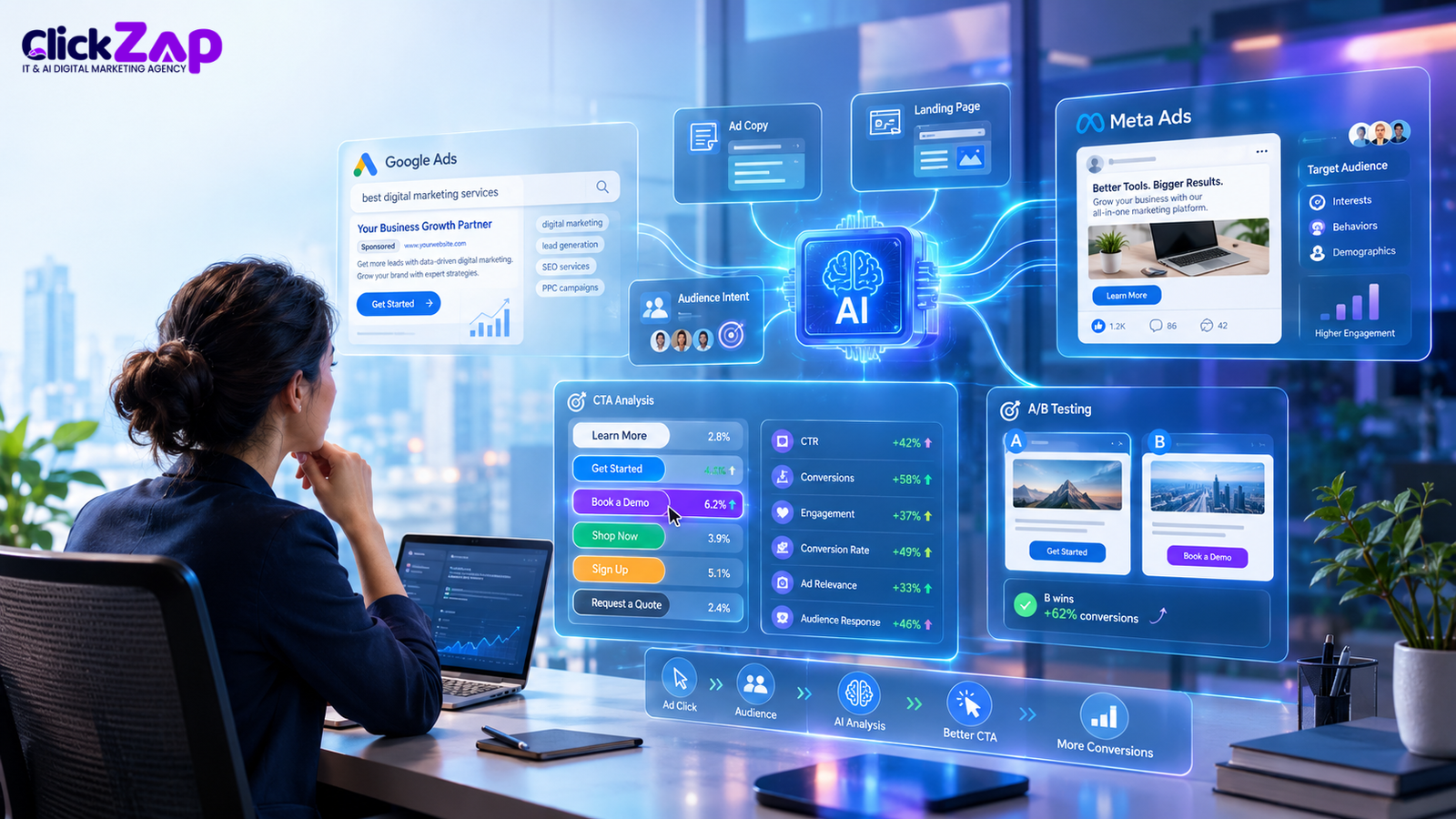
Paid traffic is expensive. If your ad promises one thing and the landing page CTA says another, you pay for clicks that never convert.
Message matching
Message matching means the landing page continues the conversation the ad started.
Google Ads example: A visitor searches “book CA for GST filing Hyderabad” and clicks your ad, “Book a GST Expert in Hyderabad.” The landing page CTA should say “Book a GST Expert,” not “Learn More About Us.”
Meta Ads example: A Jaipur jewellery brand runs a Meta ad offering “Free shipping on your first order.” The landing page CTA should carry that offer: “Shop Now Free Shipping on First Order.”
Ad intent vs. landing page intent
|
Ad source |
Typical intent |
Landing page CTA approach |
|
Google Ads (search) |
Active, problem aware |
Direct, action focused: “Get a Quote,” “Book Now” |
|
Meta Ads (social) |
Discovery, interest driven |
Softer, offer led: “Claim Your Offer,” “See the Collection” |
Search visitors are often looking for a solution now. Social visitors are usually browsing, so they may need a little more persuasion.
Where AI helps
AI can create multiple CTA variations for different campaigns, audiences, and ad groups. You can give the model each ad’s headline and ask for landing page CTAs that keep the same promise. Then test them through your landing page tool and track results in GA4.
The principle is simple: build conversion focused CTAs that continue the ad’s promise instead of restarting the conversation.
Common CTA Optimization Mistakes to Avoid
- Using vague CTA copy. “Click Here” and “Submit” give no reason to act. Say what happens next.
- Using too many CTAs. Five competing buttons create indecision. Keep one primary action per page or section.
- Ignoring user intent. A “Buy Now” button on an educational blog often hurts. Match the task to the stage.
- Hiding the CTA. If visitors have to search for it, many won’t. Make it visible and contrasting.
- Not optimizing for mobile. Small buttons, tiny text, and pop ups that cover the screen drive mobile users away.
- Using the same CTA for every audience. A first time visitor and a returning buyer are in different places.
- Not testing CTA variations. Opinions are not evidence. Test.
- Focusing only on clicks instead of conversions. A CTA can win clicks and lose leads. Track the full path.
- Not tracking CTA interactions. Without event tracking in GA4 and Google Tag Manager, you are optimizing blind.
- Using AI generated copy without human review. AI can be generic, off brand, or make claims you can’t back up. A human should read every line before it goes live.
Best Practices for CTA Optimization Using AI
- Focus on one primary action. One clear goal per page.
- Match CTA copy with user intent. Ask what the visitor wants right now.
- Highlight the value. “Get My Free Audit” beats “Submit.”
- Use action oriented language. Start with verbs like Get, Book, Start, Download, or See.
- Test different variations. Change one element at a time.
- Personalize where appropriate. Start with two or three segments.
- Track clicks and conversions. Set up GA4 events and Google Tag Manager triggers early.
- Review AI generated copy manually. Check tone, accuracy, and compliance.
- Optimize for mobile. Test on real phones, not just desktop previews.
- Keep improving based on real data. Last quarter’s winner may stop working.
CTA Optimization Using AI A Simple Workflow
Audience Research
↓
User Intent Analysis
↓
AI CTA Generation
↓
CTA Copy Optimization
↓
CTA Personalization
↓
CTA Placement
↓
A/B Testing
↓
Performance Analysis
↓
Continuous Optimization
Audience Research: Understand who visits, what they want, and what stops them. Use GA4, surveys, and sales team feedback.
User Intent Analysis: Group visitors by intent using search queries, ad sources, and page behavior.
AI CTA Generation: Use ChatGPT or another AI CTA generator to produce a wide set of options from your brief.
CTA Copy Optimization: Edit for clarity, specificity, and brand voice. Remove anything vague or exaggerated.
CTA Personalization: Adapt CTAs for key segments such as new vs. returning visitors or mobile vs. desktop.
CTA Placement: Use heatmaps and scroll data from Hotjar or Microsoft Clarity to position CTAs where attention is highest.
A/B Testing: Run controlled tests in Optimizely, VWO, or Unbounce, changing one variable at a time.
Performance Analysis: Review CTR, conversion rate, lead quality, and cost per lead together.
Continuous Optimization: Roll out winners, retire losers, and start the next test.
Frequently Asked Questions
What is CTA optimization using AI?
It is the use of AI to write, personalize, place, test, and analyze calls to action so that more website visitors click and convert. AI helps generate ideas, study behavior data, and speed up testing, while marketers make the final decisions.
How can AI improve CTA conversion rates?
AI can improve CTA conversion rates by generating clearer copy, matching CTAs to user intent, personalizing them for different audiences, and speeding up A/B testing. Results still depend on your offer, audience, and page context, so always validate with real data.
Can ChatGPT create high converting CTAs?
ChatGPT can create strong CTA options quickly, but it cannot guarantee conversions. Give it details about your audience, offer, and page, then test the variations. Real performance data shows which CTAs actually convert.
How does AI personalize CTAs?
AI personalizes CTAs by using signals such as user behavior, location, device, traffic source, previous visits, and buyer stage. It then shows the most relevant CTA to each visitor segment, such as “Book a Demo” for high intent users and “Get the Free Guide” for new visitors.
What is AI CTA testing?
AI CTA testing uses AI to create CTA variations and help analyze A/B test results. Some platforms also shift traffic to better performing versions automatically. It speeds up experimentation, but you still need enough traffic and clear goals to trust the results.
Conclusion
Traffic without action is wasted effort, and the CTA is often where that effort is lost. The best fix is a repeatable process, not one perfect button.
AI can help you generate stronger CTA copy, personalize CTAs by audience, choose better placements, run more tests, and analyze results faster. Tools like ChatGPT, GA4, Google Tag Manager, HubSpot, Unbounce, Optimizely, VWO, Hotjar, and Microsoft Clarity each play a role in that process.
But AI suggests and your data decides. Every idea should be tested with real users before you treat it as a winner. Start small: pick one page, one goal, and one test. Learn from it, then scale.
If you want a practical starting point, CTA optimization using AI is a good place to begin, especially on your highest traffic service or landing pages.
At ClickZap IT, a digital marketing agency in Hyderabad, we help businesses connect traffic, content, and conversion strategy. Want to improve your website conversions? Get in touch with our team to explore a data driven digital marketing and conversion optimization strategy.
Also Read: AI Heatmap Analysis: How to Improve Website User Experience and Conversions
0 Comments