
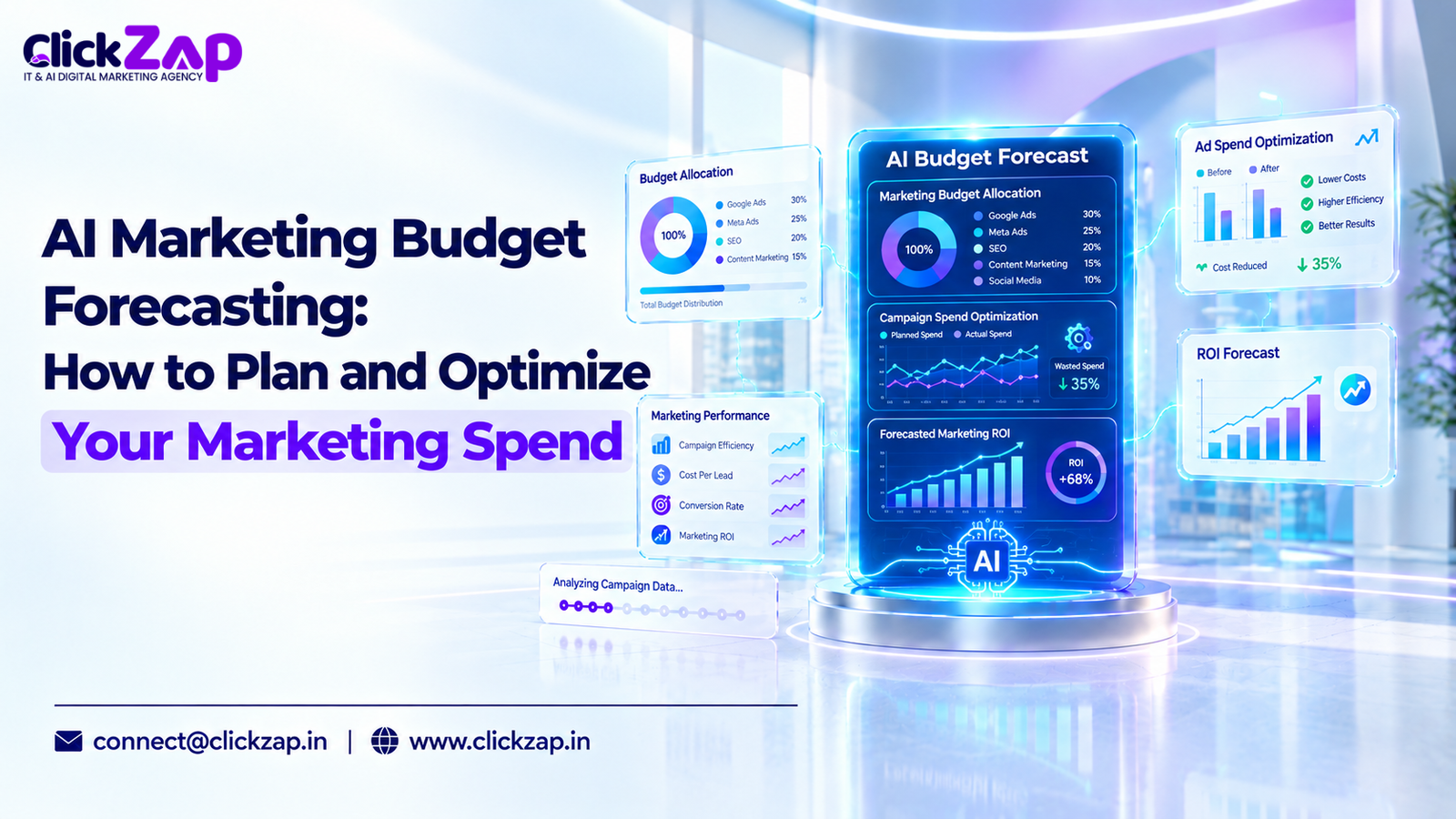
Most marketing budgets start as an educated guess. Last year’s number gets a 10% bump, someone argues for more Google Ads, and the spreadsheet stays untouched until the next review. AI marketing budget forecasting replaces part of that guesswork with models trained on your own campaign, website, and CRM data.
The goal is to estimate what a given spend is likely to produce in leads, customers, and revenue before you commit the money. That helps you compare channels, spot waste, and plan for seasonal swings. Forecasts support planning, but they do not guarantee exact results, so treat every number in this guide as an estimate to test against real performance.
Below you will find how forecasting works, which tools can help, a worked budget example with consistent figures, the metrics to track, and the mistakes that most often skew a forecast.
What Is AI Marketing Budget Forecasting?
AI marketing budget forecasting is the use of machine learning and predictive analytics to estimate future marketing costs and results from historical data. It projects spend, leads, conversions and revenue under different budget scenarios. Marketers then use those estimates to decide how much to spend and where.
The models look at patterns in your historical campaign data: how cost per click changed over time, which months convert better, and how leads from each channel turned into customers. They then apply those patterns to a planned budget and return a range of likely outcomes, not a single certain number.
Here is how the AI supported approach differs from the traditional one:
|
Factor |
Traditional budgeting |
AI supported forecasting |
|
Data used |
Last year’s totals and a few spreadsheet columns |
Campaign level, channel level and CRM data over time |
|
Seasonality |
Adjusted by hand, often by rule of thumb |
Detected from historical patterns |
|
Scenarios |
One or two |
Many, rerun quickly when inputs change |
|
Update frequency |
Quarterly or yearly |
Weekly or monthly |
|
Main risk |
Anchoring on old numbers |
Poor data quality or too much trust in the model |
Hypothetical example: A Hyderabad B2B software company spends ₹2,00,000 a month across Google Ads, Meta Ads and content. A forecasting model built on 12 months of data suggests that Google Ads cost per lead usually rises in the festive quarter and that content driven leads close at a higher rate. The team uses that estimate to reserve more budget for the festive months and to protect the content budget. This is an illustration, not a real client result.
Why Is AI Important for Marketing Budget Planning?

AI matters for budget planning because marketing costs, customer behavior and channel performance change faster than a yearly spreadsheet can track. It processes more data points than a person can review by hand and updates estimates when new data arrives. The decision still stays with the marketer.
Several problems make manual planning hard:
- Unpredictable ad costs. Auction based platforms such as Google Ads and Meta Ads can change cost per click or cost per thousand impressions as competition shifts.
- Shifting customer behavior. Buying cycles, device use and preferred channels change, so last year’s conversion rates may not hold.
- Fragmented data. Spend sits in ad platforms, traffic in Google Analytics 4, and revenue in a CRM. Nobody sees the whole picture without effort.
- Inefficient channel allocation. Budgets often follow habit or the loudest opinion rather than evidence.
When the data is connected, AI can help in these ways:
- Predict future expenditure from cost trends and seasonality.
- Flag campaigns that are drifting away from forecast.
- Estimate customer acquisition cost (CAC) by channel.
- Improve cross channel budget optimization by comparing marginal returns.
- Forecast leads and revenue under stated assumptions.
- Support data driven marketing decisions with ranges and scenarios.
Predictive analytics for marketing budgets works best as a second opinion. If the forecast and your market knowledge disagree, investigate before you move money.
Digital Marketing Services for Your’s Business
How Does AI Marketing Budget Forecasting Work?
AI marketing budget forecasting works in six stages: collect data, analyze performance, predict costs, forecast outcomes, allocate budget and monitor results. Each stage feeds the next, and the loop repeats every month or quarter.
Step 1: Collect Historical Marketing Data
Gather at least 6 to 12 months of data, more if your sales cycle is long. Useful fields include spend, impressions, clicks, leads, conversions and revenue. Typical sources are Google Analytics 4 (GA4), Google Ads, Meta Ads Manager and your CRM.
Check data quality before modeling. Consistent UTM parameters, working conversion tracking and matched lead to customer records matter more than model sophistication.
Step 2: Analyze Marketing Performance
Look for trends, seasonality, audience behavior and conversion rates by channel, campaign and device. For many Indian businesses, festive periods, financial year end and exam or admission seasons shift demand noticeably.
This step usually shows which channels bring volume and which bring customers. Those are often different channels.
Step 3: Predict Future Marketing Costs
Use the trends to estimate advertising cost prediction inputs: cost per click, cost per lead (CPL) and CAC. Then calculate the budget needed for a target:
Budget required = target leads × expected CPL
Add a conservative case in which costs rise, for example by 10%, so the plan does not break when auctions get expensive.
Step 4: Forecast Leads, Sales and Revenue
Apply conversion rates to the expected traffic or lead volume. A simple chain is:
Leads × lead to customer rate × average revenue per customer = forecast revenue
Write down every assumption next to the number. Forecasts without stated assumptions cannot be checked later.
Step 5: Allocate the Budget Across Channels
Divide the budget across Google Ads, Meta Ads, SEO, content marketing, email or WhatsApp and conversion improvements, based on forecast CPL, CAC and lead quality. Keep a small reserve for testing new campaigns.
Step 6: Monitor Results and Adjust Spending
Compare actual results with the forecast at least monthly. Where the gap is large, find out why before you adjust: tracking error, a seasonal effect, a creative problem or a real change in the market. Then update the assumptions and the next budget.
One Example Through the Whole Workflow
Hypothetical figures for illustration only. A Hyderabad IT services firm wants 18 new customers a month.
- Collect: it exports nine months of spend, leads and closed deals from Google Ads, Meta Ads Manager and its CRM.
- Analyze: it finds a Google Ads CPL of ₹1,500, a Meta CPL of ₹750 and a lead to customer rate of 8%.
- Predict costs: it uses ₹1,500 as the expected Google CPL and ₹1,650 (10% higher) as the conservative case.
- Forecast: 18 customers ÷ 0.08 = 225 leads needed. The plan below targets 230 leads, which gives 18.4 customers at 8%.
- Allocate: it splits a ₹3,00,000 monthly budget across channels (full table later in this guide).
- Monitor: at month end it compares actual leads and CPL by channel with the forecast and adjusts next month.
How to Use AI for Marketing Budget Optimization
AI marketing budget optimization means using performance data and predictive models to move spend toward channels and campaigns that deliver customers at an acceptable cost. It is an ongoing process of review and adjustment, not a one time setup. These marketing budget optimization strategies are a practical starting point:
- Find high CAC campaigns. Rank campaigns by cost per customer, not only by cost per lead. A cheap lead that you never buy is expensive.
- Identify stronger converting channels. Compare lead to customer rates across Google Ads, Meta Ads, organic search and referrals.
- Adjust spend to performance trends. If a campaign’s CPL has risen for four weeks, review it before the next budget cycle.
- Forecast seasonal demand. Use past years to plan higher spend before demand peaks, when auctions are often costlier.
- Detecting wasted ad spend. Look for search terms, placements or audiences that spend money without conversions.
- Balance paid and organic marketing. Paid channels give speed, while SEO and content build lower cost demand over time. Review both together.
- Use attribution modeling. Marketing attribution modeling assigns credit across touchpoints, which helps when one customer sees several channels.
- Monitor core metrics. Track ROAS, CAC, CPL, conversion rate and revenue on one dashboard.
AI-driven budget allocation has limits. Attribution models are simplified views of customer behavior, privacy rules reduce what can be tracked, and forecasts assume the future resembles the past. Always add business context such as margins, sales capacity and upcoming launches before acting on a model’s suggestion.
Best AI Marketing Budget Forecasting Tools
No single platform covers every part of forecasting, so most teams combine two or three tools. Marketing budget forecasting tools fall into four groups:
- Analytics platforms (GA4, Looker Studio) collect and show performance data.
- Advertising planning tools (Google Performance Planner, Meta Ads Manager, Microsoft Advertising) estimate results inside one ad platform.
- CRM and marketing automation systems (HubSpot Marketing Hub, Salesforce Marketing Cloud) connect marketing activity to leads and revenue.
- Custom or third party models add advanced predictive forecasting using machine learning, integrations or external software.
None of the platforms below should be assumed to offer fully automated AI budget forecasting across all channels. Features vary by account, region, subscription and data volume, so confirm each one in the official documentation before you build a plan around it.
Google Analytics 4
- Use case: Website and conversion tracking, audience analysis, and predictive metrics for eligible properties.
- Benefits: Shows how traffic sources contribute to conversions and supplies the data for CPL and conversion rate calculations.
- Limitations: Predictive metrics require sufficient data volume and suitable events, and GA4 does not hold your ad spend or CRM revenue unless you import them.
Google Ads and Google Performance Planner
- Use case: Planning spend for Google Ads campaigns and seeing how budget changes might affect conversions and cost.
- Benefits: According to Google’s help documentation, Performance Planner builds forecasts by simulating recent auctions and adjusting for seasonality, and you can set targets such as spend or cost per acquisition.
- Limitations: It forecasts only Google Ads campaigns, only eligible ones, and Google states that Display and Video campaigns and impression share based plans are no longer supported as of March 2026. It cannot compare Google Ads with SEO or Meta.
Meta Ads Manager
- Use case: Budget setup, estimated results, A/B testing and reporting for Facebook and Instagram campaigns.
- Benefits: Delivers campaign level performance data and platform estimates that help with day to day budget decisions.
- Limitations: Estimates are platform level and do not cover your other channels. Check Meta’s Business Help Center for what each estimate means.
Google Looker Studio
- Use case: Combining data from several sources into one reporting dashboard.
- Benefits: Connects GA4, Google Ads and spreadsheets so you can compare planned and actual spend in one place.
- Limitations: It is mainly a reporting tool. Any forecasting inside it is basic, so it will not replace a purpose built predictive model.
HubSpot Marketing Hub
- Use case: Campaign tracking, lead management and attribution reporting tied to CRM contacts.
- Benefits: Links marketing activity to leads and deals, which makes CAC and lead to customer rates easier to calculate.
- Limitations: Reporting and attribution features depend on the subscription tier, and HubSpot’s documentation should be checked for current capabilities.
Salesforce Marketing Cloud
- Use case: Large scale email, mobile and journey marketing with analytics.
- Benefits: Suits teams already running Salesforce for sales and service, since data can flow between systems.
- Limitations: Capabilities depend on the products, editions and integrations you license, and budget forecasting often needs additional analytics tools. Confirm with Salesforce documentation.
Microsoft Advertising
- Use case: Planning and managing search campaigns on the Bing network, including keyword research and performance estimates.
- Benefits: Useful where your audience skews toward desktop or enterprise users.
- Limitations: Estimates cover Microsoft Advertising only, and audience size is smaller than Google’s in many markets, so check Microsoft’s documentation for the planning tools available to your account.
Advanced predictive forecasting, such as a model that combines all channels, may require additional machine learning work, data integrations or third party software. Start with clean data and the tools you already have.
How to Forecast a Digital Marketing Budget Using AI

To forecast a digital marketing budget, work backward from a revenue goal to the leads, conversions and channel spend needed to reach it. AI then helps you test the assumptions and compare scenarios. This is a practical process for digital marketing budget planning:
- Define goals and revenue targets. Example: 18 new customers a month.
- Review historical performance. Pull 6 to 12 months of channel data.
- Calculate current CPL and CAC. Use real figures from your accounts and CRM.
- Estimate target leads, conversions and sales. Divide customers needed by the lead to customer rate.
- Forecast spend by channel. Multiply target leads per channel by that channel’s CPL.
- Build three scenarios. Create conservative, expected and optimistic versions.
- Allocate by priority. Fund proven channels first, then growth bets and testing.
- Monitor and update. Review monthly and rerun the forecast with actuals.
Sample inputs (illustrative figures for a hypothetical business):
|
Input |
Assumption |
|
Monthly marketing budget |
₹3,00,000 |
|
Goal |
About 18 new customers per month |
|
Lead to customer rate |
8% (same for all channels, a simplifying assumption) |
|
Average revenue per customer |
₹60,000 (first year revenue) |
|
Gross margin |
50% |
Scenario comparison for the same ₹3,00,000 budget:
|
Scenario |
Leads |
Lead to customer rate |
Customers |
Revenue |
CAC |
Marketing ROI |
|
Conservative |
190 |
7% |
13.3 |
₹7,98,000 |
₹22,556 |
33% |
|
Expected |
230 |
8% |
18.4 |
₹11,04,000 |
₹16,304 |
84% |
|
Optimistic |
270 |
9% |
24.3 |
₹14,58,000 |
₹12,346 |
143% |
Marketing ROI here is (gross profit − marketing spend) ÷ marketing spend. For the expected case: (₹5,52,000 − ₹3,00,000) ÷ ₹3,00,000 = 84%. These are example numbers, not benchmarks.
Real allocation depends on your business model, industry, competition, conversion rates, margins and growth goals. A business with long sales cycles may need more patience on SEO, while a local service business may lean on search ads.
Example of AI Powered Marketing Budget Planning
AI powered marketing budget planning turns forecast inputs into a channel by channel monthly plan. The table below shows a hypothetical plan for the business above. The figures are examples, not guaranteed results or verified benchmarks.
|
Marketing channel |
Planned monthly budget |
Forecast leads or outcomes |
Estimated cost per lead |
Expected business contribution |
|
Google Ads |
₹1,20,000 |
80 leads |
₹1,500 |
6.4 customers, ₹3,84,000 revenue |
|
Meta Ads |
₹60,000 |
80 leads |
₹750 |
6.4 customers, ₹3,84,000 revenue |
|
SEO and content |
₹50,000 |
50 leads |
₹1,000 |
4.0 customers, ₹2,40,000 revenue |
|
Email and WhatsApp nurturing |
₹20,000 |
20 leads |
₹1,000 |
1.6 customers, ₹96,000 revenue |
|
Landing page and tracking improvements |
₹30,000 |
Supports conversion rate |
Not applicable |
Improves all channels |
|
Testing reserve |
₹20,000 |
New campaign tests |
Not applicable |
Learning for next month |
|
Total |
₹3,00,000 |
230 leads |
₹1,304 fully loaded |
18.4 customers, ₹11,04,000 revenue |
Checking the math: 80 + 80 + 50 + 20 = 230 leads. At 8%, that is 18.4 customers. At ₹60,000 each, revenue is ₹11,04,000. Fully loaded cost per lead is ₹3,00,000 ÷ 230 = ₹1,304, and CAC is ₹3,00,000 ÷ 18.4 = ₹16,304. Marketing revenue per rupee spent is 11,04,000 ÷ 3,00,000 = 3.68.
Reviewing actuals and adjusting next month: Suppose Google Ads delivered 70 leads (₹1,714 CPL) and Meta delivered 95 leads (₹632 CPL). Before moving money, check lead quality. If Meta leads close at a similar rate, shift part of the Google budget, say ₹20,000, to Meta and rerun the forecast. If Meta leads close at a lower rate, the cheaper CPL may be misleading, and the shift would not be justified.
Key Metrics to Track
Track metrics that connect spend to customers and profit, not only traffic. These are the core measures and how to calculate them:
|
Metric |
Formula |
What it tells you |
|
ROAS (return on ad spend) |
Revenue from ads ÷ ad spend |
Revenue generated per rupee of ad spend |
|
CAC (customer acquisition cost) |
Total acquisition spend ÷ new customers |
Full cost of winning one customer |
|
CPL (cost per lead) |
Spend ÷ leads |
Cost of generating one lead |
|
Conversion rate |
Conversions ÷ visitors (or clicks) × 100 |
Share of visitors who take the target action |
|
CPA (cost per acquisition) |
Spend ÷ conversions |
Cost per defined conversion, such as a sale or sign up |
|
Marketing generated revenue |
Revenue attributed to marketing sourced leads |
Revenue linked to marketing effort |
|
Marketing ROI |
(Gross profit from marketing − marketing cost) ÷ marketing cost × 100 |
Profit return on marketing spend |
|
Budget utilization |
Actual spend ÷ planned budget × 100 |
How closely spending follows the plan |
|
Lead to customer rate |
Customers ÷ leads × 100 |
Lead quality and sales effectiveness |
ROAS and marketing ROI are different. ROAS is revenue based, so a campaign with a 4x ROAS can still lose money if margins are thin. Marketing ROI uses profit, which makes it the better measure for budget decisions.
Common AI Marketing Budget Forecasting Mistakes to Avoid
The most common mistakes come from poor inputs and too much trust in outputs. Each one below has a practical fix.
- Incomplete or inaccurate data. Missing conversions or duplicate leads distort every forecast. Fix: audit tracking and CRM matching before modeling.
- Relying entirely on AI predictions. A model cannot know about a planned price change or a new competitor. Fix: review forecasts with sales and finance.
- Ignoring seasonality and market changes. Fix: include prior year patterns and note known events.
- Allocating by clicks or impressions alone. Clicks do not pay invoices. Fix: allocate by cost per customer and margin.
- Overlooking conversion quality and customer lifetime value. Fix: track which channels produce customers who stay and repurchase.
- Ignoring attribution limits and overlapping channels. Several channels often influence one sale. Fix: compare attribution views and avoid cutting upper funnel channels on last click data alone.
- Failing to account for rising ad costs. Fix: build a conservative scenario with higher CPL.
- Not comparing forecasts with actuals. Fix: hold a monthly review and record forecast errors.
- Assuming past performance guarantees future results. Fix: treat forecasts as ranges and retest assumptions often.
Benefits and Limitations of AI Marketing Budget Forecasting
The main benefit is better informed planning, and the main limit is that a forecast is only as good as its data. AI supports human judgment and does not replace it.
Benefits:
- Better planning, with budgets tied to expected outcomes.
- Faster analysis of large, multi channel datasets.
- Easy scenario comparison before money is spent.
- More informed decisions, backed by stated assumptions.
Limitations:
- Insufficient data, especially for new businesses or new channels.
- Model bias when past data reflects past mistakes.
- Market shocks that no historical pattern predicts.
- Tracking gaps from consent rules, offline sales and cross device behavior.
- Forecast uncertainty that grows the further ahead you plan.
AI Marketing Budget Forecasting Best Practices
Good forecasting starts with clear objectives and reliable tracking, then adds scenario planning and human review. These practices apply across business sizes:
- Set clear objectives, such as customers or qualified leads, before choosing a budget.
- Set up accurate conversion tracking for forms, calls and WhatsApp enquiries.
- Connect ad, website and CRM data so spend can be matched to revenue.
- Review at consistent intervals, usually monthly.
- Test assumptions, such as conversion rate or CPL, rather than assuming they hold.
- Compare conservative, expected and optimistic scenarios.
- Require human oversight before major budget changes.
- Measure profitability and business outcomes, not only traffic.
By business stage:
- Small businesses: Start with a spreadsheet, GA4 and one or two channels. Accurate tracking matters more than complex models.
- Startups: Keep a larger testing reserve and shorter review cycles because history is limited.
- Growing companies: Connect the CRM, calculate CAC by channel and formalize monthly reviews.
- Established teams: Add custom models or third party tools, run attribution comparisons and forecast at campaign level.
How ClickZap IT Can Help Optimize Your Marketing Budget
ClickZap IT is an AI powered digital marketing agency in Hyderabad that helps businesses plan and manage marketing spend using their own performance data. We do not offer a proprietary forecasting platform, and we do not promise specific results. What we do is connect your data, test assumptions and help you make better informed budget decisions. Support areas include:
- SEO and organic growth.
- Google Ads and Meta Ads management.
- PPC performance analysis.
- Marketing analytics and conversion tracking setup.
- Data driven budget allocation across channels.
- Campaign optimization and lead generation.
- Website and landing page improvements.
- AI assisted reporting.
Want to make smarter marketing budget decisions? Get in touch with the ClickZap IT team to explore data driven digital marketing strategies for your business.
Frequently Asked Questions
How can AI help with marketing budget forecasting?
AI analyzes historical campaign, website and CRM data faster than manual spreadsheets and uses predictive models to estimate future spend, leads and revenue. It supports scenario planning by showing how different budget levels might perform, and it can flag campaigns drifting from forecast. The output is an estimate, not a promise. Marketers still need to review assumptions, check tracking quality and decide which recommendations fit their goals.
How do you forecast a digital marketing budget?
Start with a business goal, such as a revenue or customer target. Review historical data to find current CPL, CAC and conversion rates, then work backward to the leads needed and the budget required per channel. Build conservative, expected and optimistic scenarios, allocate funds by priority and review actual results monthly. Update assumptions as new data comes in, since rates and costs change over time.
What are the best AI tools for marketing budget planning?
There is no single best tool. Google Ads with Performance Planner suits Google campaign planning, GA4 supplies website and conversion data, Looker Studio brings sources into one dashboard, and HubSpot or Salesforce connect marketing to CRM data. Meta Ads Manager and Microsoft Advertising cover their own platforms. None offers fully automated cross channel forecasting, so advanced needs may require extra integrations or third-party models.
How can AI optimize advertising budget allocation?
AI compares campaign performance, estimates how each campaign might respond to more or less spend, and highlights where budget is likely to return more. It can suggest shifting spend toward channels with lower cost per customer and flag those with rising costs. Cross-channel planning depends on connected data. Treat suggestions as inputs, and test changes gradually rather than moving the whole budget at once.
How do you predict marketing ROI using AI?
Combine data on spend, conversions, revenue, attribution and profit margin. A model estimates future leads and conversions, which you convert into revenue and gross profit, then compare with spend to get expected ROI. Because attribution is imperfect and conditions change, present the result as a range, such as conservative and optimistic cases, and compare it with actual results each month.
Can AI help reduce digital marketing costs?
AI can help by identifying inefficient spend, such as keywords or audiences that cost money without converting, improving targeting and supporting bid and budget optimization. Savings are not guaranteed and depend on data quality, competition and how well the recommendations are applied. The most reliable gains usually come from fixing tracking and removing clear waste before testing more advanced methods.
Conclusion
AI marketing budget forecasting helps you plan spend, compare channels, estimate leads and revenue, and allocate resources with more evidence than a yearly guess. It works when the inputs are accurate, the assumptions are realistic and results are reviewed every month. It does not replace human judgment, because market changes, margins and business priorities still need a person to weigh them.
Start with clean tracking, build three scenarios, compare actuals with forecasts and adjust gradually. If you would like help setting this up, contact ClickZap IT to discuss a data driven budget plan for your business.
Also Read: AI Marketing Forecasting: How to Predict Leads, Sales and Revenue

0 Comments