
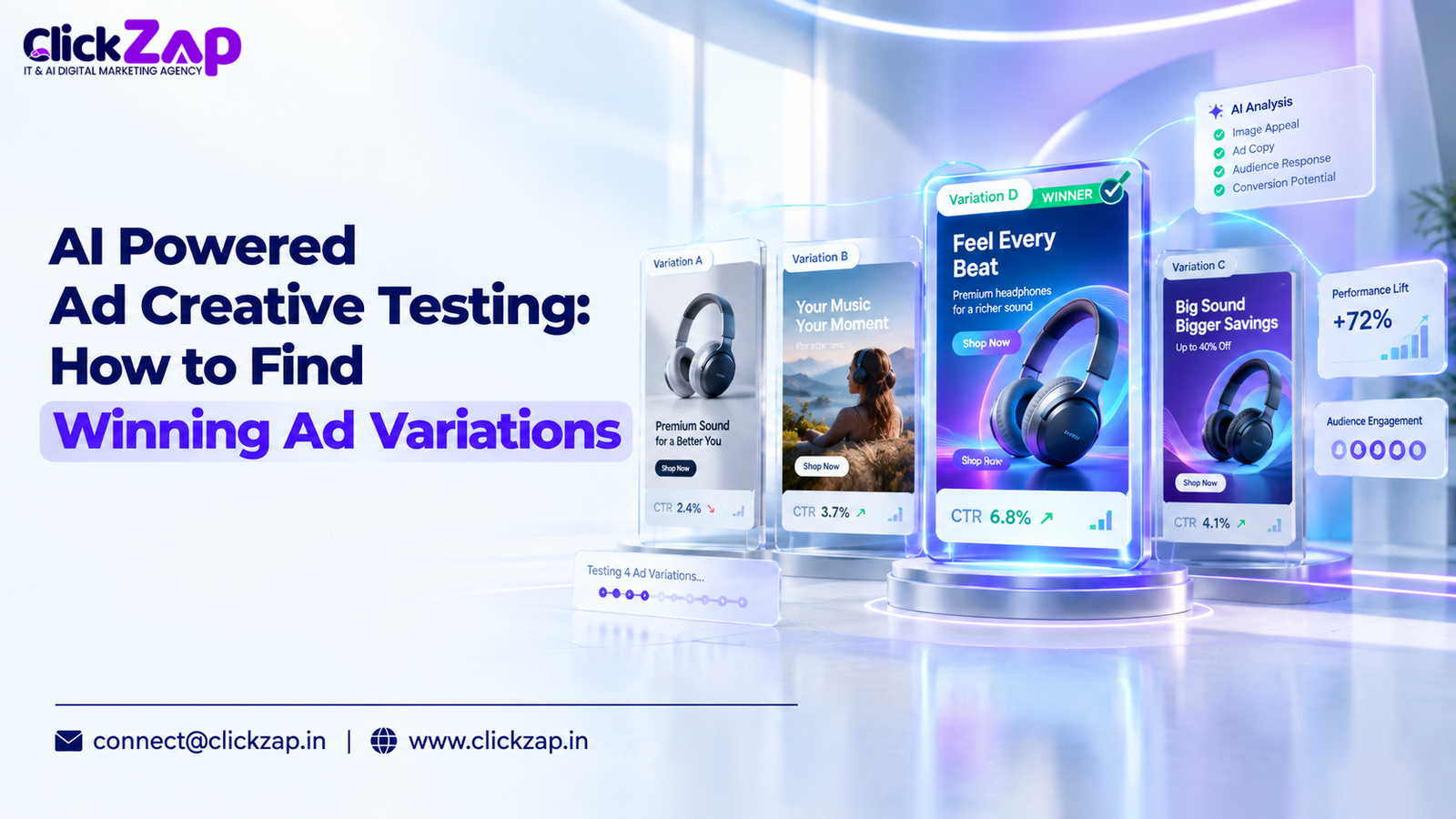
Many businesses run several versions of an ad, spend real money on each, and still cannot say which headline, image, or offer made the difference. The budget goes out, the numbers come in, and the next ad is chosen by instinct. That is the gap AI powered ad creative testing is meant to close.
AI powered ad creative testing is the use of AI tools to generate ad variations, organize controlled tests, and analyze which creative elements perform best against a campaign objective. It supports faster, more structured experimentation, but it does not replace sound test design or human judgment.
This guide covers how the process works, which elements to test, which tools play which role, how to read results, and which mistakes waste the budget.
What Is AI Powered Ad Creative Testing?
It is a testing approach where AI helps produce, compare, and learn from ad variations, while a proper test setup and your own judgment decide the winner.
AI contributes in four ways:
- Creative generation: drafting headlines, primary text, image concepts, or video hooks.
- Testing support: helping plan variations and organize them into a structured experiment.
- Pattern recognition: spotting which themes, formats, or phrasings tend to appear in better performing ads.
- Performance analysis: summarizing results across ads, audiences, and placements faster than a manual spreadsheet review.
These parts connect in a loop. Generation produces variations, testing produces data, analysis interprets the data, and the findings feed the next round of creativity.
Two terms are often confused. An AI generated creative is an asset an AI tool produces, such as a headline or an image. AI assisted creative testing means AI helps plan, monitor, or interpret an experiment. You can have one without the other. A human written ad can be analyzed with AI, and an AI written ad can be launched with no controls at all, which is not a test.
Two testing methods appear throughout this article. A/B testing compares two versions that differ in one element. Multivariate testing changes several elements at once and measures combinations, which needs far more traffic to give reliable answers.
Why Is Ad Creative Testing Important for Digital Advertising?

because audience reactions are hard to predict, ads wear out, and unmeasured creative choices waste budget.
- Audience preferences vary. The same offer can land differently depending on wording, imagery, and who sees it. Assumptions about what “should” work are often wrong.
- Creative fatigue is real. Creative fatigue means performance declines as the same audience sees the same ad repeatedly. Regular testing keeps fresh options ready.
- Wasted spend adds up. The budget behind a weak creative cannot be recovered. Our guide on using AI to detect wasted ad spend in PPC campaigns covers the wider picture.
- Conversion opportunities hide in details. A change in hook or offer can lift advertising conversion rate optimization without changing targeting or budget.
Assumptions alone are not enough because they cannot be checked. Testing turns an opinion into a measured comparison. Meta’s Business Help Center also notes that informal testing, such as running similar ads side by side, can cause overlapping audiences and unreliable results, which is why structured test tools exist.
Digital Marketing Services for Your’s Business
How Does AI Powered Ad Creative Testing Work?
you set an objective, build a baseline ad, create meaningful variations, run a controlled test, track the right metrics, and apply what you learn.
- Define the campaign objective. Choose one primary goal: awareness, traffic, leads, or sales. Everything else follows from it.
- Identify the target audience. Decide who the test is for. Mixing very different audiences in one test muddies the results.
- Create a baseline ad. This is your current best ad. It is the control that every variation is compared against.
- Generate meaningful variations. Use AI to draft options, but make them differ in a real way, such as a different hook or offer, not a swapped synonym.
- Set up a controlled test. Use the platform’s testing tool so audiences are split fairly and budgets are equal. Keep everything else the same.
- Track relevant metrics. Confirm conversion tracking works before launch. Record the primary metric and a few supporting ones.
- Analyze results. AI ad performance analysis can summarize patterns quickly. You still check whether the data is sufficient and the conditions were fair.
- Validate and apply findings. Retest promising variations, then roll winners into the wider campaign and plan the next experiment.
Which Ad Elements Should You Test Using AI?

test the elements that shape the first impression and the decision to act: headlines, visuals, video hooks, calls to action, offers, and landing page messaging.
Test one meaningful variable at a time. If you change the headline, image, and offer together and one version wins, you cannot say which change caused it. A single variable makes the result interpretable and gives you a lesson you can reuse.
Headlines and Primary Text
Headline testing is usually the fastest place to start. Test different angles: a problem statement, a benefit, a question, a specific detail. AI can draft many options quickly, and you pick a few that are genuinely different.
On Google Ads, responsive search ads combine your headlines and descriptions automatically. Google’s asset reporting shows how each asset performs, though Google notes that asset level metrics are attributed per instance and may not add up to ad-level totals, so it recommends evaluating at the asset group or campaign level where possible.
Images and Visual Designs
Test concepts, not small tweaks. A product on a plain background versus a person using the product is a real comparison. A slightly different shade of blue usually is not. Image and video ad testing works best when each version tests one clear visual idea.
Video Hooks and Opening Scenes
The first seconds of a video decide whether people keep watching. Test different openings: a question, a result shown first, a problem scene. Keep the rest of the video identical so the hook is the only variable.
Calls to Action
Test the action wording and its commitment level. “Get a free quote” and “Book a call” ask for different things and attract different leads. Compare lead quality as well as volume.
Offers and Value Propositions
An offer test compares what you are promising, such as free delivery versus a discount versus a bonus. Offers often move results more than design changes, but they also affect margins, so involve whoever owns pricing.
Landing Page Messaging and Creative Consistency
The landing page should keep the promise made in the ad. If the ad highlights fast delivery and the page buries it, people leave. Our post on AI landing page optimization for Google Ads goes deeper on this match.
Best AI Ad Creative Testing Tools
no single tool does everything. Some generate creativity, some automate delivery, some run controlled tests, and some measure outcomes.
AI powered ad creative testing usually combines tools from four groups: creative generation tools, campaign automation features, testing mechanisms, and analytics platforms. Mixing them up leads to wrong expectations, such as assuming a design tool will tell you which ad wins.
AdCreative.ai (generation plus predictive scoring). It generates ad creatives and copy. Its help documentation describes a Creative Scoring feature with a Performance Score that predicts click through rate. Benefit: quick variation and a rough pre-launch filter. Limitation: a prediction is not a result from your own audience, and CTR is not sales. Treat scores as a screening aid and still run a live test. See the AdCreative.ai help article on creative scoring.
Canva (design and production). A design platform, including AI assisted features whose availability can change by plan. Benefit: fast production, resizing, and brand consistency. Limitation: it does not run tests or analyze campaign results. Use it to build the variations you will test.
ChatGPT (text ideation). A general purpose assistant useful for drafting headlines, primary text, and hook ideas. Benefit: speed and range of angles. Limitation: it does not see your ad account unless you paste data in, and it can produce claims you cannot support. Review every line before use.
Google Ads automation and Experiments (automation plus controlled testing). Responsive search ads and Google Performance Max (PMax) are automation features that assemble your assets into combinations. They are not controlled by creative tests by themselves. Controlled comparison happens through Google Ads Experiments, which Google describes as a way to test changes with a base and trial campaign, including PMax experiments. See Google’s pages on Experiments and Performance Max asset reporting.
Meta Ads Manager and Advantage+ (testing mechanism plus automation). Meta’s A/B testing tool splits audiences so they are evenly split and statistically comparable, per Meta’s documentation. Advantage+ creative enhancements are a separate automation feature that can adjust images, text, and videos per viewer. These enhancements are not a controlled test, so check what is switched on before you compare ads. See Meta’s A/B testing overview and its developer documentation on Advantage+ creative standard enhancements.
Google Analytics 4 (analytics). GA4 measures what happens after the click. Google’s documentation explains that key events can be used to create Google Ads conversions, so both platforms can report the same actions. Limitation: it neither creates nor tests ads. See About key events.
|
Tool |
Main role |
Generates creativity? |
Runs controlled tests? |
Best use |
|
AdCreative.ai |
Generation and predictive scoring |
Yes |
No (scores are predictions) |
Producing and screening variations |
|
Canva |
Design and production |
Yes (visuals) |
No |
Building on brand ad assets |
|
ChatGPT |
Text ideation |
Text only |
No |
Headline and hook drafts |
|
Google Ads (RSAs, PMax, Experiments) |
Automation, reporting, experiments |
Combines your assets |
Yes, through Experiments only |
Search and PMax creative learning |
|
Meta Ads Manager (A/B tests, Advantage+) |
Testing and automation |
Enhancements, not a test |
Yes, through the A/B test tool |
Social creative comparison |
|
Google Analytics 4 |
Measurement |
No |
No |
Conversion tracking and analysis |
These AI and creative testing tools work best as a stack. Generate in one, test in another, and verify outcomes in a third.
AI Powered Ad Creative Testing Strategies That Work

change one major thing at a time, test distinct ideas, judge by conversions, and retest before scaling.
Reliable ad creative testing strategies share a few habits:
- Test one major variable at a time. It keeps results readable.
- Compare distinct creative concepts. Two ads built on different ideas teach you more than two near identical ones.
- Test hooks and headlines first. They are quick to produce and influence everything after the first glance.
- Compare static images with video. Format can change both cost and audience response.
- Segment results by audience or placement. A winner on one placement may lose on another. Segment after the test, but plan for the extra data needed.
- Use conversion data, not clicks alone. Clicks show interest. Conversions show action.
- Retest promising variations before scaling. A single result can be luck, so repeat it.
Automated ad creative testing can help by rotating variations and flagging early patterns. It does not remove the need for a hypothesis and a fair setup.
Best AI Digital Marketing Agency in Hyderabad
How to Measure Ad Creative Performance
pick the metrics that match your objective, and read them together rather than alone.
|
Metric |
What it measures |
Watch out for |
|
CTR (click through rate) |
Clicks divided by impressions |
High CTR can come from curiosity that never converts |
|
Conversion rate |
Share of clicks (or visitors) that complete the goal |
Needs reliable conversion tracking for ads |
|
CPC (cost per click) |
Spend divided by clicks |
A cheap click is not a good click |
|
CPA (cost per acquisition) |
Spend divided by conversions |
Define what counts as a conversion |
|
ROAS (return on ad spend) |
Conversion value divided by spend |
Needs accurate revenue data |
|
Engagement rate |
Reactions, comments, shares, or views relative to reach |
Engagement does not always lead to sales |
|
Qualified leads and lead quality |
Leads that meet your sales criteria |
Requires feedback from the sales team |
Which metrics matter most depends on the goal:
- Awareness: reach, impressions, video views, and engagement rate.
- Traffic: CTR, CPC, and quality of visits, such as time on page.
- Lead generation: conversion rate, cost per lead, qualified leads, and lead quality.
- Sales: CPA, ROAS, and conversion rate.
High CTR does not always mean more sales. An ad promising “free” or using a surprising image may attract many clicks from people who never buy. A lower CTR ad that speaks to a specific buyer can produce fewer clicks and more purchases. That is why the primary metric should come from the objective, not from whichever number looks best.
How to Identify Winning Ad Creative Variations
The winner is the variation that performs best on your campaign objective, under fair conditions, with enough data and consistent results.
Use this evaluation process:
- Restate the objective. Judge against the primary metric, such as cost per qualified lead or ROAS.
- Check test conditions. Were budgets, audiences, timing, and placements comparable? If not, the comparison is unreliable.
- Confirm sufficient data. No universal number applies. Needed volume depends on your baseline conversion rate and the size of the difference you hope to detect. Small differences need much more data.
- Account for statistical uncertainty. Statistical confidence describes how unlikely it is that a difference is just random variation. It is never certain. Treat narrow gaps as “possibly better,” not “proven.”
- Check conversion quality. Compare lead quality and order value, not only counts.
- Look for consistency over time. Run long enough to cover weekday and weekend behavior, and check that the lead holds across days.
- Retest before scaling. A repeat result is far more trustworthy than a single one.
Illustrative comparison (hypothetical numbers, not ClickZap IT campaign data). Assume three lead generation ads, each given ₹12,000.
|
Variation |
Clicks |
CTR |
Leads |
Cost per lead |
Qualified leads |
Cost per qualified lead |
|
A |
900 |
1.50% |
36 |
₹333 |
9 |
₹1,333 |
|
B |
640 |
1.10% |
38 |
₹316 |
19 |
₹632 |
|
C |
732 |
1.20% |
30 |
₹400 |
15 |
₹800 |
Variation A has the best CTR but the worst cost per qualified lead. Variation B has the lowest CTR and the best result on the metric that matters. With counts this small, B would still need a retest. These are examples only, not benchmarks.
Common Mistakes to Avoid in AI Ad Creative Testing
Most failed tests come from weak setup, not weak creativity.
- Testing too many variables at once. You cannot tell what caused the change.
- Ending tests early. Early leads often fade as more data arrives.
- Deciding on insufficient data. A handful of conversions is noise.
- Ignoring conversion tracking. Without it you are judging on clicks.
- Choosing ads on CTR alone. See the table above.
- Using low quality AI generated content. Generic, inaccurate, or off brand output hurts results. Human review of all AI generated advertising content is essential, including checks on claims and platform ad policies.
- Ignoring audience and placement differences. A pooled result can hide a loser in one segment.
- Scaling before validation. Raising a budget on an unconfirmed winner often exposes it as average.
Practical Example of an AI Ad Creative Testing Workflow
pick one objective, test three distinct hooks against each other, compare on the sales metric, and let the result shape the next experiment.
All details below are hypothetical. Imagine a small online home décor store in Hyderabad running Meta ads for purchases. Assume an average order value of ₹1,800 and ₹9,000 spent on each of three ads. The ads share the same image, audience, and landing page. Only the opening hook differs. AI helped draft hook options, and the team chose three distinct ones.
|
Step |
Action |
AI’s role |
Human check |
|
1 |
Set goal: purchases at a target ROAS |
None |
Owner confirms target |
|
2 |
Draft 10 hooks, shortlist 3 distinct angles |
Drafting |
Remove inaccurate claims |
|
3 |
Build three ads, equal budgets, same audience |
Optional asset variations |
Check tracking and tool settings |
|
4 |
Run the test across full weeks |
None |
Do not edit mid test |
|
5 |
Compare results |
Summarize the data |
Verify numbers in the platform and GA4 |
|
6 |
Choose the next experiment |
Suggest ideas |
Decide using the objective |
Hypothetical results:
|
Hook |
CTR |
Purchases |
Revenue |
ROAS |
|
1: Small space problem (“Lamps that fit tight corners”) |
2.1% |
11 |
₹19,800 |
2.2 |
|
2: Offer (“Free delivery across Hyderabad”) |
1.4% |
14 |
₹25,200 |
2.8 |
|
3: Story (“Made by local artisans”) |
1.6% |
9 |
₹16,200 |
1.8 |
Hook 1 wins on CTR, but Hook 2 leads on ROAS. The gap between 14 and 11 purchases is small, so the honest reading is “Hook 2 is promising,” not “Hook 2 won.” The next experiment keeps the free delivery offer fixed and tests two visual formats, a static image against a short video. If Hook 2 holds up on the retest, it becomes the baseline for scaling.
How AI Ad Creative Testing Improves Conversion Rate Optimization
it shows which messages persuade people, and those lessons can improve ads, landing pages, and the match between them.
Conversion Rate Optimization (CRO) is the practice of increasing the share of visitors who complete a desired action. Creative tests feed CRO in three ways:
- Campaign optimization: winning hooks and offers guide budget decisions and the next round of creative.
- Landing page messaging: if an ad angle wins, reflect that phrasing and promise on the landing page.
- Ad to page alignment: a mismatch between the ad promise and the page is a common reason clicks fail to convert.
This is why creative testing and landing page work belong in the same plan. If you want support coordinating both, our PPC advertising services cover campaign setup, testing, and optimization.
The Future of AI Powered Ad Creative Testing
expect more automation in generating and analyzing variations, with people still setting strategy and approving output.
Platforms continue to add creative automation, predictive analysis, and personalization features. These can reduce manual work, but they also make it harder to know what changed in an ad. Human oversight stays important for brand safety, accuracy, ad policy compliance, and judgment about what a result means. Feature availability changes often, so check current platform documentation before building a process around any one capability.
Key Takeaways
- AI helps generate, organize, and analyze tests. It does not guarantee better results.
- Test one meaningful variable at a time against a clear baseline.
- Use platform testing tools so audiences are split fairly.
- Judge winners on the campaign objective, not on CTR alone.
- Check sample size, test duration, conversion quality, and consistency before declaring a winner.
- Retest promising variations before scaling budget.
- Review all AI generated ad content for accuracy, brand fit, and policy compliance.
Frequently Asked Questions
What is AI powered ad creative testing?
It is the use of AI to generate, organize, and analyze ad variations so you can find which creative elements perform best for a specific objective. AI supports the work, but a controlled test setup and human review still decide the outcome.
How does AI help test different ad creatives?
AI speeds up the drafting of variations and the summarizing of results. It can spot patterns across headlines, images, and formats faster than manual review. It cannot make a poorly designed test reliable, so fair splits and proper tracking remain your job.
What are the best AI tools for ad creative testing?
The best choice depends on the role. AdCreative.ai and Canva help create assets, ChatGPT helps draft text, Google Ads Experiments and Meta’s A/B test tool run controlled comparisons, and GA4 measures outcomes. Most teams combine several.
How do you identify winning and creative variations?
Compare variations on your primary objective metric under equal conditions. Confirm there is enough data, check conversion quality, and see whether the lead holds over time. Retest before scaling.
How can AI improve ad click through rates and conversions?
AI can suggest more angles to test and highlight which themes resonate. It does not guarantee gains. Improvements come from testing ideas, keeping what works, and aligning the ad with the landing page.
How often should you test new ad creatives?
Test continuously, but one experiment at a time. The right rhythm depends on budget and traffic: higher spend accounts can cycle faster, while smaller budgets need longer tests. Refresh creative when performance drops or fatigue appears.
Conclusion
Good creative testing is mostly discipline: a clear objective, a fair setup, accurate tracking, and patience. AI speeds up idea generation and analysis, but it assists testing and does not replace strategic judgment. Results still depend on your audience, offer, creative quality, budget, tracking setup, and campaign conditions.
AI powered ad creative testing works best as a repeatable habit, not a one off experiment. If you would like to talk through your advertising goals, you can get in touch with our team. It is also worth reviewing your current testing approach, and considering professional PPC support if your campaigns need a more structured process.
Also Read: How to Use AI to Detect Wasted Ad Spend in PPC Campaigns
0 Comments