
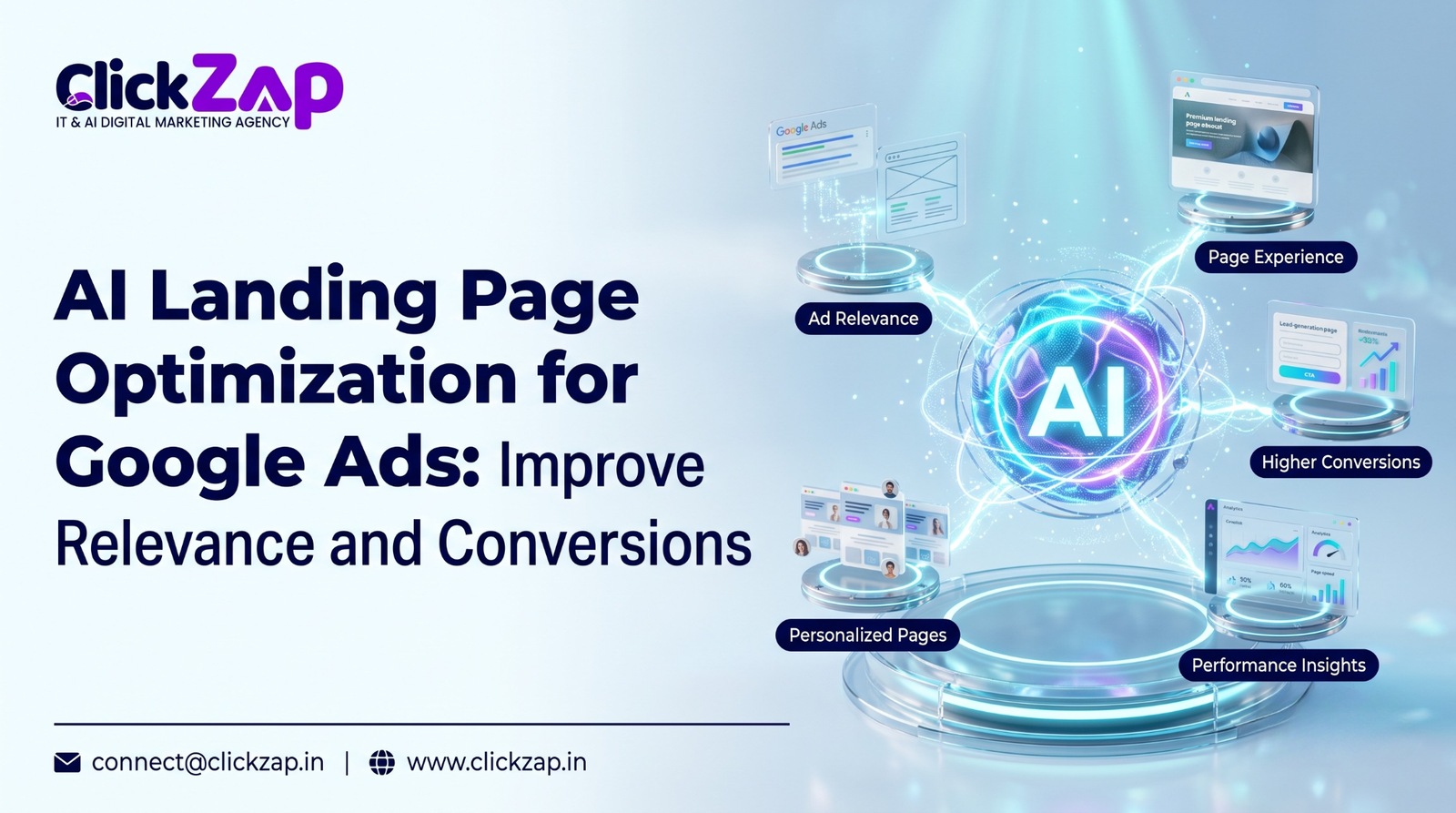
Your Google Ads are getting clicks, but the enquiries are not following. It is one of the most common and most expensive problems in paid search, and AI landing page optimization for Google Ads starts from a simple idea: the cause is often the page the click lands on, not the ad itself.
AI landing page optimization for Google Ads is the practice of using AI tools to find where that page loses visitors, then testing fixes that bring it closer to what the searcher actually wanted. Used well, it speeds up analysis, drafting and testing. Used badly, it produces generic copy and false confidence.
Here is the short answer to the central question. AI helps you spot gaps between what your ad promises and what your page delivers, surfaces behavior patterns you would miss by hand, and generates variations worth testing. It does not replace human judgment, and nobody can guarantee a better Quality Score or higher conversions.
This guide explains how landing page relevance and landing page user experience (UX) shape results, how to use AI step by step, which tools are worth knowing, and which mistakes to avoid. Where a claim depends on Google’s rules, we link to Google’s own documentation.
What Is AI Landing Page Optimization for Google Ads?
AI landing page optimization means using machine learning and generative AI to analyze a landing page, its visitors and its conversion data, then suggest or test improvements. The aim is simple: make the page a better answer to the search that triggered your ad.
AI landing page optimization for Google Ads uses AI tools to compare your ads with your landing page, analyze visitor behavior, and suggest improvements to headlines, copy, forms, and page experience. A person reviews every suggestion, then tests changes to confirm they improve qualified conversions, not just clicks.
AI looks at three kinds of input. Content: does the headline reflect the search query, and does the page explain the offer clearly? Behavior: where do visitors click, scroll, hesitate or leave? Conversion data: which traffic sources, devices and audiences turn into leads, and which do not?
Traditional optimization relies on a marketer reading reports, forming a hunch, rewriting the page and testing one idea at a time. AI assisted optimization compresses the slow parts. It can summarize hundreds of sessions, compare ad text with page text at scale, draft many variations and, in some tools, shift traffic toward the version that performs better. The decisions still belong to you.
Why Landing Page Optimization Matters for Google Ads
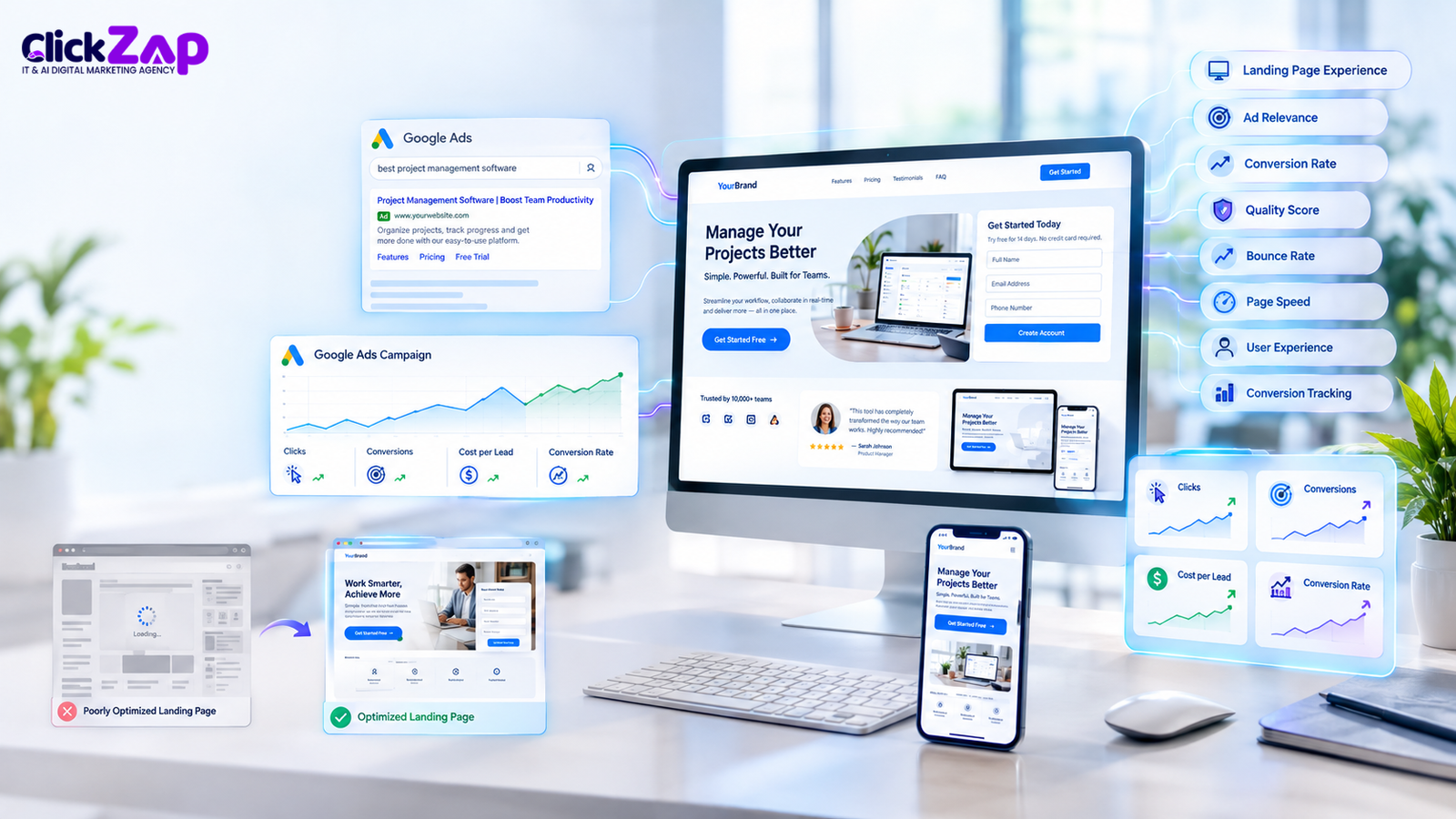
A click costs money whether or not the visitor stays. If the page does not match the reason for the click, you pay for traffic that was never going to convert.
Two ideas explain most of the problem. Search intent matching means your page serves what the person was actually trying to do, whether that was compare, learn or buy. Ad to page message match means the headline, offer and call to action on the page continue the promise made in the ad.
Imagine someone searches for “PPC agency for B2B companies in Hyderabad” and clicks an ad that says exactly that. If the page opens with “Digital Marketing Solutions for Everyone”, the visitor has to work out whether they are in the right place. Many will simply leave. Our Pay Per Click services page is built on the principle that each ad group deserves a page that answers its specific query.
Google also scores this. Landing page experience is one of the three Quality Score components, and Google describes it as how relevant and useful your landing page is to people who click your ad. You can read the definitions in Google’s Quality Score documentation.
One clarification matters here. Google states that Quality Score is a diagnostic tool, not an input in the ad auction. It is a useful signal for spotting weak ads or pages, but it is not a measure of business success. A page can have an excellent landing page experience rating and still attract the wrong leads.
How AI Improves Google Ads Landing Page Performance
AI can help at eight points in the landing page workflow. Each has real benefits and real limits, so treat these as options to test, not switches to flip.
AI Powered Landing Page Personalization
AI powered landing page personalization adjusts parts of a page, such as the headline, proof points or offer, based on the keyword, location, device or audience. The benefit is a closer match between the query and the page without building dozens of separate pages.
The limits are practical. Every variant needs maintenance, small segments produce thin data, and personalization that feels intrusive can erode trust. Start with two or three high value ad groups and change only the headline and supporting line. Use only data you are entitled to use.
AI Generated Landing Page Copy and Headline Optimization
AI-generated landing page copy is useful for volume. A tool such as ChatGPT can draft ten headline angles in a minute, which gives you more to test than a blank page would.
The risk is sameness. Unreviewed AI copy tends toward vague claims that every competitor also makes. Give the tool your real offer, audience and constraints, then edit hard. Remove anything you cannot prove, and never let AI invent statistics, testimonials or guarantees.
Smart CTA Optimization
Smart CTA optimization means testing the wording, placement and framing of your call to action. “Get a free PPC audit” and “Talk to a PPC specialist” attract different levels of commitment, and the right one depends on your sales process.
AI can suggest alternatives and flag buttons that sit below the fold on mobile. It cannot rescue a weak offer. If the button is clear but the proposition is vague, fix the proposition first.
AI-Driven Landing Page A/B Testing
AI-powered A/B testing can speed up setup by suggesting hypotheses and, in some platforms, routing visitors to the variant most likely to suit them. Unbounce’s Smart Traffic, for example, learns from visitor attributes such as browser, region and device to choose a variant, as described in Unbounce’s documentation.
The limits are statistical. Tests need enough traffic, early “winners” are often noisy, and automatic routing makes it harder to learn why something worked. If your campaign is small, run fewer, bolder tests and let each one finish.
Landing Page Heatmaps and Visitor Behavior Analysis
Heatmaps show where visitors click and how far they scroll. Session recordings show individual journeys, including rage clicks and dead ends. Tools such as Microsoft Clarity, Hotjar and VWO offer these views, and some add AI generated summaries.
Summaries save time but can miss context, and a few odd sessions can mislead you. Before changing a page, watch a batch of mobile recordings from paid traffic yourself and look for repeated patterns, not one off oddities.
Form Conversion Optimization
Form conversion optimization looks at which fields people skip, where they abandon and which errors frustrate them. Analytics and form tools can show drop off field by field, and AI can help you rewrite labels, error messages and microcopy.
Be honest about the trade off. Fewer fields usually mean more submissions, but not always better leads. Ask only what your team needs for a first conversation. Our guide on AI website form optimization goes deeper.
Landing Page Load Speed and Mobile UX Analysis
Landing page load speed optimization starts with measurement. Google PageSpeed Insights reports how a page performs on mobile and desktop and lists specific fixes, as explained in its official documentation. It is a diagnostic tool, not an AI tool.
AI can help explain the findings in plain language and prioritize them, but a developer still has to compress images, trim scripts and fix layout shifts. In India, where many visitors reach landing pages on phones and variable networks, check your own device split in GA4 before deciding how much mobile work to do. Pages built through web design with mobile in mind avoid many of these problems from the start.
AI Assisted Conversion Tracking and Performance Analysis
Google Analytics 4 (GA4) records events and lets you mark important ones, such as form submissions, as key events. When linked correctly with Google Ads, this shows which campaigns and keywords produce results. AI features can summarize trends and flag unusual changes.
The warning is simple: AI analysis is only as good as the tracking underneath it. If duplicate form fires or spam submissions are counted as conversions, every recommendation built on that data will be wrong. Test your tracking end to end before trusting any dashboard.
How to Use AI to Optimize a Google Ads Landing Page Step by Step
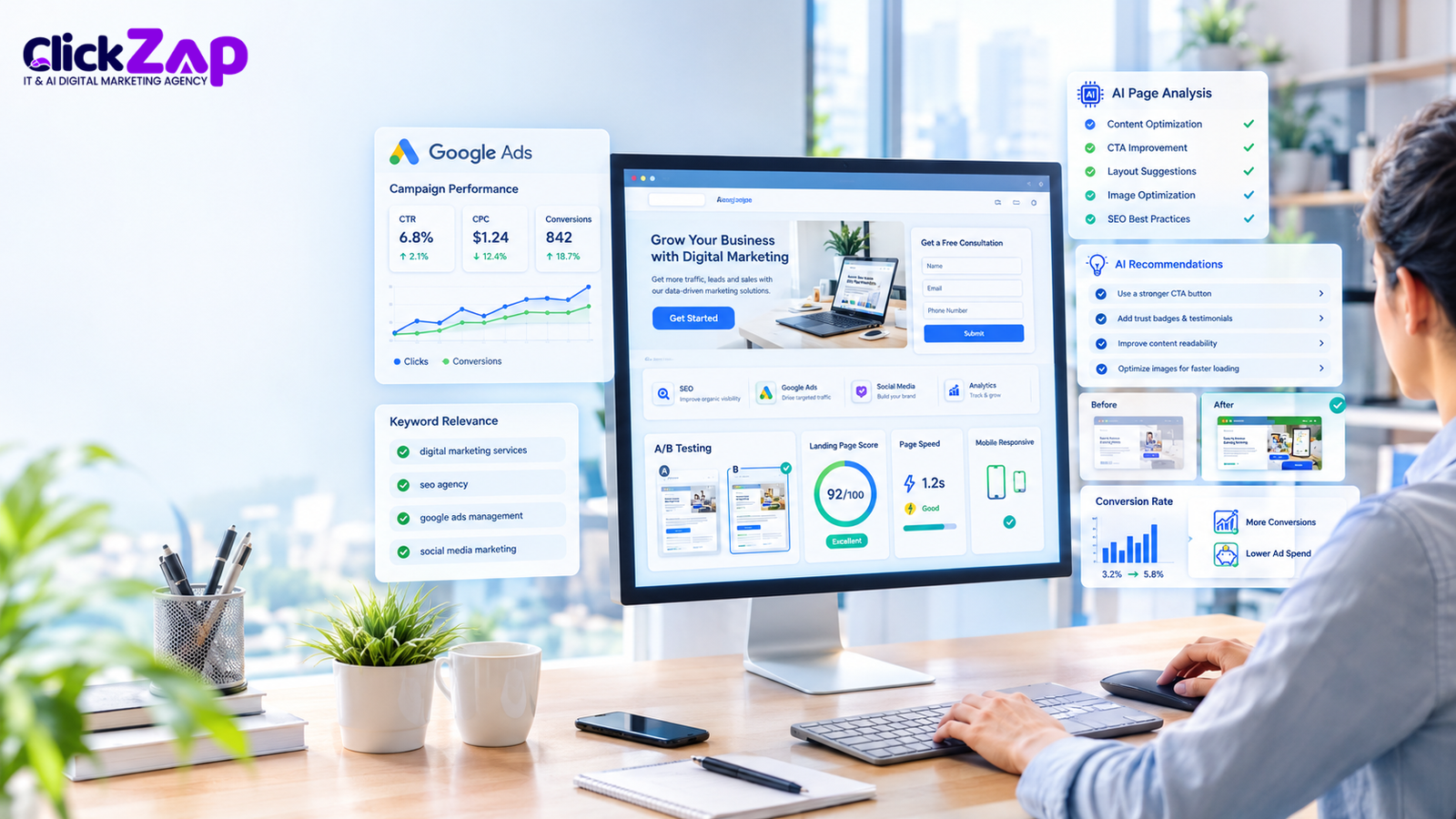
This workflow works for a single campaign or an entire account. Do the steps in order, because each one feeds the next.
- Identify the search intent for each ad group. List the main queries and decide whether each searcher wants information, comparison or a quote. Your SEO services research on query intent often helps here too.
- Compare ad headlines and descriptions with the landing page. Paste both into an AI assistant and ask where the promise, offer and wording differ. Treat the answer as a lead to verify, not a verdict.
- Audit content, design, mobile usability and page speed. Check the page on a real phone, run PageSpeed Insights, and read the page as a stranger would.
- Analyze visitor behavior and conversion tracking data. Review GA4, heatmaps and recordings. Confirm that conversions are being tracked correctly before drawing conclusions.
- Use AI to generate headline, content and CTA ideas. Ask for several options based on your real offer and the intent you identified in step 1.
- Prioritize by impact and effort. Score each idea on likely effect and ease of implementation. Start with changes that are high impact and quick to build.
- Run controlled A/B tests. Change one meaningful element at a time, split traffic fairly and decide your success metric before you launch.
- Measure and keep improving. Compare results against your baseline, document what you learned and feed it into the next round.
A short illustrative example. Suppose an ad group targets the query “Google Ads management for small business”. Step 1 shows that searchers want to understand what is included and roughly how it works. In step 2 you notice the ad promises “PPC management” but the page headline says “Digital Marketing Solutions”. After step 4 shows that mobile visitors rarely reach the form, you ask AI for five headline options and two shorter form layouts in step 5. You choose by impact and effort in step 6, then test the headline first in step 7. This is a thought exercise, not a result.
Best AI Tools for Landing Page Optimization
The tools below serve different jobs, and they are not all AI tools in the same sense. Some build pages, some test them, some record behavior and some simply measure. Choosing the right mix matters more for AI landing page optimization for Google Ads than chasing the most heavily advertised feature.
|
Tool |
Main job |
AI involvement |
|
ChatGPT |
Drafting headline, CTA and copy ideas; summarizing pasted feedback |
General purpose AI assistant; has no live view of your page unless you provide content |
|
Unbounce |
Landing page builder, A/B testing |
Smart Traffic routes visitors to a variant, per its documentation |
|
Instapage |
Landing page builder with ad to page mapping, experiments and personalization |
Vendor offers AI assisted features; confirm what your plan includes |
|
VWO |
Experimentation platform with testing, heatmaps and recordings |
Includes an AI assistant (Copilot) for ideas and variations; confirm current availability |
|
Hotjar |
Heatmaps, session recordings and feedback tools |
Behavior analysis; check its site for current AI features |
|
Microsoft Clarity |
Free heatmaps and session recordings |
Offers AI summaries of sessions and heatmaps; see its documentation |
|
Google Analytics 4 (GA4) |
Traffic, engagement and conversion measurement |
Measurement foundation with some automated insights |
|
Google PageSpeed Insights |
Speed and mobile performance diagnostics |
Not an AI tool; a diagnostic report |
Features, plans and pricing change often, so check each vendor’s official site before you buy. This article deliberately avoids quoting prices or plan details that may be out of date.
One more note: Google Optimize, Google’s former free testing tool, has been discontinued. Do not plan around it. Evaluate current alternatives such as the platforms above, and pair whichever you choose with GA4 so your results stay measurable.
Google Ads Quality Score Optimization Tips Using AI
Quality Score is built from three components, each rated as below average, average or above average: expected click through rate, ad relevance and landing page experience. Google explains them in its Quality Score guidance.
AI is most useful on the third component. Ask it to compare the keywords in an ad group with the page’s headline, subheadings and body copy, and list gaps. Then check the suggestions against the real search terms report before changing anything.
Practical landing page experience improvements are rarely exotic:
- Keep the page’s message consistent with the ad, including the offer and call to action.
- Make the page useful on its own, with clear explanations, not just a form.
- Check mobile usability and loading speed.
- Make navigation and next steps obvious.
Do not confuse Quality Score with conversion rate or profit. A high score tells you your ads and page look relevant compared with others. It does not tell you whether the leads were qualified, and no one can promise that a change will raise it.
How AI Helps Reduce Google Ads Bounce Rates
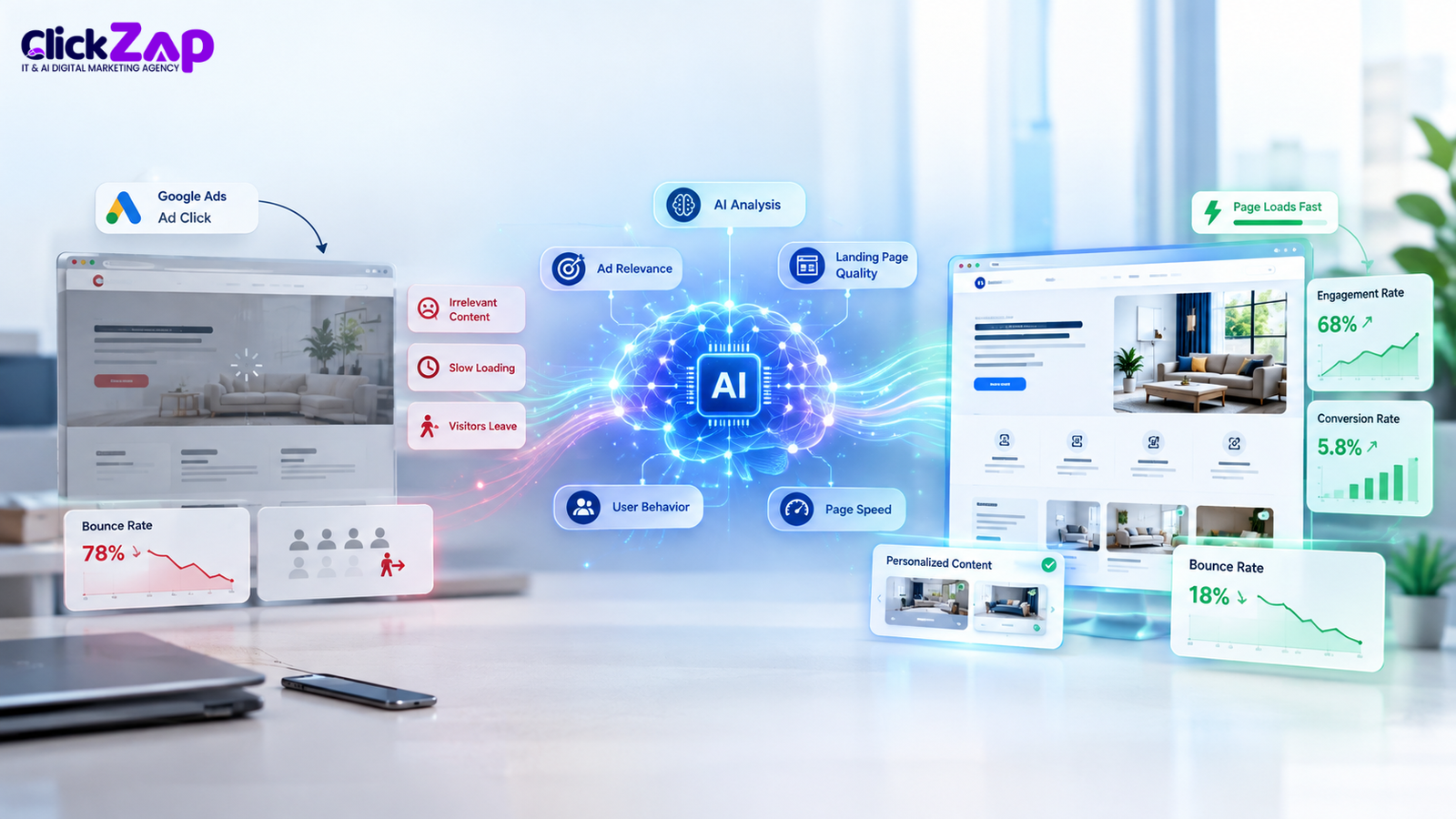
Visitors leave without interacting for predictable reasons: the page does not match the ad, it loads slowly, navigation is confusing, the call to action is weak, or the mobile experience is poor.
Analytics and behavior tools help you find which one applies. GA4 gives you engagement data by campaign and page. Heatmaps and recordings then show what visitors did, and AI summaries can group common friction points so you can review them faster.
Bounce rate also needs careful reading. In GA4, bounce rate is the percentage of sessions that were not engaged, and an engaged session meets criteria such as lasting longer than ten seconds or recording a key event, as described in Google’s Analytics help. A visitor who finds your phone number and calls you may still count as a bounce. A high bounce rate does not always mean failure. It depends on the page’s purpose, so read it alongside engagement and conversion metrics.
Practical Example of AI Landing Page Optimization
Hypothetical scenario, not a client case study: a Hyderabad based digital marketing agency runs Google Ads for its PPC services. The ads get clicks, but the landing page produces fewer enquiries than expected. No results are claimed here; this shows how the work would be approached.
In practice, AI landing page optimization for Google Ads on a page like this would proceed in six moves:
- Match the headline to the query and ad promise. If the ad says “Google Ads management for B2B companies”, the headline should say so, not “Grow Your Business Online”.
- Improve the service explanation. Add what is included, who it suits, how reporting works and what happens after enquiry. AI can draft a first version, which a specialist then corrects.
- Test CTAs. Compare a lower commitment option such as “Get a free account review” with a direct “Request a call”.
- Simplify the lead form. Keep the fields the sales team truly needs. Consider whether a WhatsApp option suits the audience, since many Indian buyers prefer it.
- Analyze mobile usability and page speed. Use PageSpeed Insights and recordings to find slow elements and awkward layouts.
- Measure qualified leads. Count enquiries the sales team judges genuine, not just form submissions.
At each stage, a human checks the AI’s output, and every change is tested against a baseline before it becomes permanent.
Common AI Landing Page Optimization Mistakes to Avoid
- Publishing unreviewed AI copy. Edit for accuracy, tone and claims you can support.
- Personalizing without privacy safeguards. Use data only with proper consent and notice. Review India’s Digital Personal Data Protection Act, 2023 and any other rules that apply to you, and take legal advice where needed.
- Testing without enough data. Small samples produce false winners.
- Changing many elements at once. You will not know what worked.
- Optimizing for clicks instead of qualified conversions. Cheap clicks and junk leads are not progress.
- Ignoring mobile users. Test on real phones and slower connections.
- Trusting AI recommendations without validation. Treat them as hypotheses.
- Overlooking tracking and attribution problems. Broken tags corrupt every decision.
How to Measure Landing Page Optimization Success
Judge AI landing page optimization for Google Ads against a baseline you record before making changes, and against your actual business goal. A lift in one metric means little if lead quality falls.
|
Metric |
What it tells you |
Watch out for |
|
Conversion rate |
Share of visitors who complete your goal |
Can rise while lead quality drops |
|
Cost per conversion or lead |
What each result costs |
Compare lead quality, not just cost |
|
Qualified lead rate |
Share of leads your team accepts |
Needs agreement on what “qualified” means |
|
Form completion rate |
How many people who start the form finish it |
Look for field level drop off |
|
Engagement and bounce rate |
Whether visitors interact |
Meaning depends on page purpose |
|
Loading performance |
Speed and stability |
Lab and real user data can differ |
|
Quality Score components |
Diagnostic signals on ads and page |
Not a measure of profit |
|
Revenue or return on ad spend |
Business impact |
Use only when revenue data is reliable |
Set the baseline, define success before testing, and give each test enough time and traffic to be meaningful. Results from one campaign will not necessarily repeat in another.
Frequently Asked Questions
What is AI landing page optimization for Google Ads?
It means using AI tools to analyze your ads, landing page, visitor behavior and conversion data, then suggest or test improvements. The goal is a page that matches what searchers wanted when they clicked. A person should review every recommendation before it goes live.
How can AI improve Google Ads conversion rates?
AI can help by spotting mismatches between ads and pages, drafting headline, copy and CTA options, summarizing behavior data and speeding up testing. It cannot guarantee higher conversion rates. Improvements come from validated changes, tested properly and measured against a clear baseline.
Does landing page experience affect Google Ads Quality Score?
Yes. Landing page experience is one of three Quality Score components, alongside expected click through rate and ad relevance. Google describes it as how relevant and useful your page is to people who click your ad. Quality Score itself is a diagnostic, not a measure of profit.
What are the best AI tools for landing page optimization?
There is no single best tool. ChatGPT helps draft ideas, Unbounce, Instapage and VWO support building or testing, Hotjar and Microsoft Clarity show behavior, GA4 measures results and PageSpeed Insights checks speed. Choose based on your traffic, budget and team, and verify current features.
How can AI help reduce Google Ads bounce rates?
AI can help find why visitors leave, such as message mismatch, slow loading or a weak CTA, by summarizing behavior data and comparing ad and page wording. You still need to fix the cause. Remember that a high bounce rate does not always signal a problem.
Do I still need to review AI generated landing page recommendations?
Yes, always. AI can be wrong, generic or unaware of your legal, brand and business constraints. Treat its output as ideas to check against real data, test carefully and approve before publishing.
Conclusion
AI landing page optimization for Google Ads works best as a support system for good marketing judgment. It helps you match pages to search intent, understand visitor behavior, draft better variations and test them faster. It does not remove the need for sound tracking, patient testing and human review.
If your ads are earning clicks but not enough qualified enquiries, start by comparing one ad group with its page and measuring a clean baseline. That small step often reveals more than any tool.
ClickZap IT is a Hyderabad digital marketing agency, and we are happy to help businesses evaluate their Google Ads and landing page performance. You can explore our Pay Per Click services or start from the ClickZap IT homepage if you would like a second opinion. Talk to ClickZap IT Team.
Also Read: AI WhatsApp Campaign Personalization: A Step by Step Guide for Marketers
0 Comments