
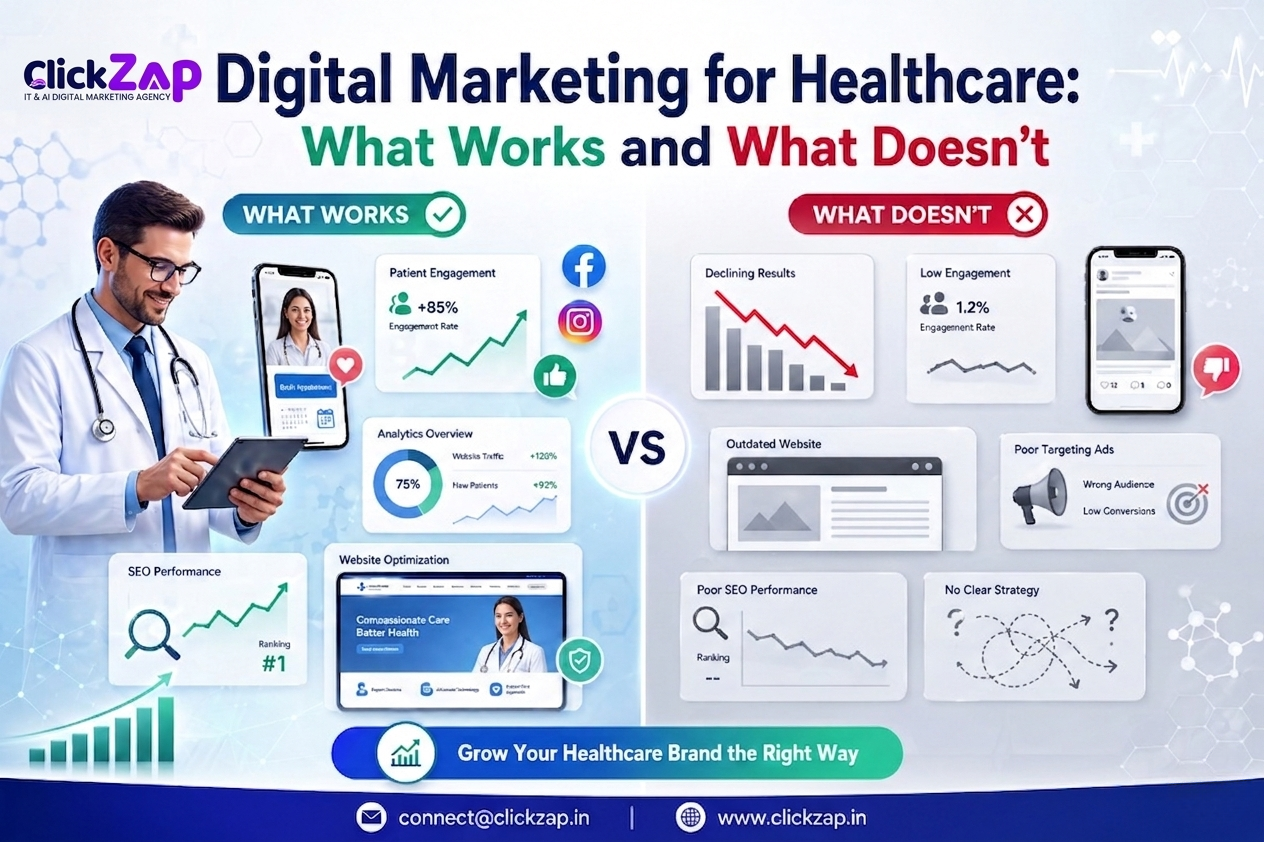
The healthcare industry has a unique problem: trust deficits. Unlike retail, a bad click doesn’t just waste money; it damages a patient’s well-being. Over the last five years, the shift toward digital marketing for healthcare has accelerated, but not every strategy yields a healthy ROI.
In this guide, we dissect exactly what works (backed by compliance and conversion data) and what doesn’t (the outdated tactics wasting your budget). Whether you run a private clinic or a multi-location hospital, you will learn how to align patient acquisition strategies with modern AI search behaviors.
The Landscape: Why Digital Marketing Healthcare Breaks Old Rules
Digital marketing for healthcare failed 42% of providers in 2024 because they applied B2C e-commerce logic to medicine. Patients don’t want “flashy ads”; they want medical branding strategies that signal safety and empathy.
Search engines now prioritize E-E-A-T (Experience, Expertise, Authoritativeness, Trustworthiness). For healthcare, this is non-negotiable. One HIPAA violation or false claim erases years of reputation.
What works: Value-driven, educational content.
What doesn’t: Pop-up ads and aggressive retargeting.
What Works in Digital Marketing for Healthcare
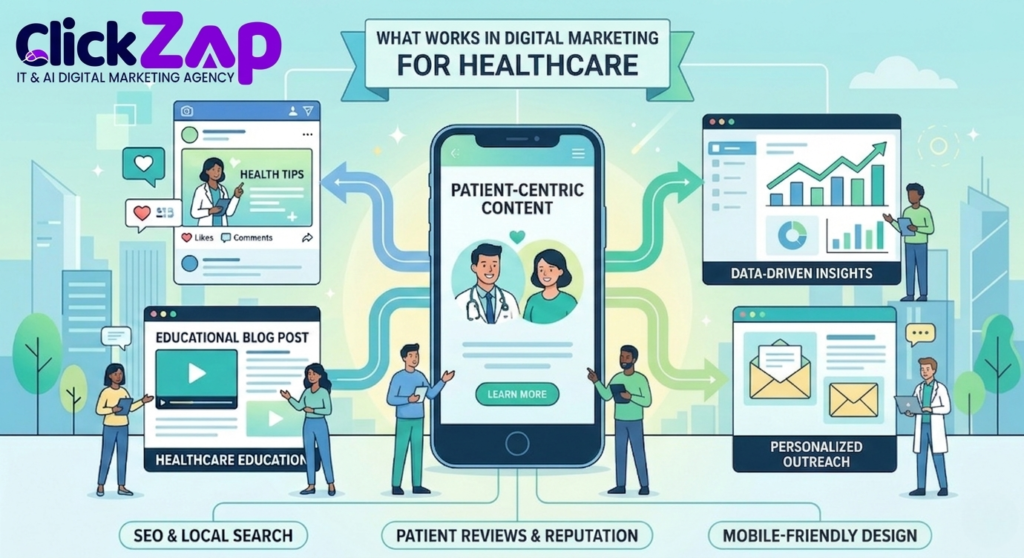
1. Healthcare SEO Strategies (Local + Semantic)
Generic SEO is dead. Healthcare SEO strategies now require “prompt clusters” for AI overviews.
What works:
- Local SEO for clinics: Optimizing “near me” searches with Google Business Profile (GBP). Ensure your online appointment booking systems are linked directly.
- Semantic depth: Covering the entire patient journey (e.g., “chest pain causes” → “when to see a cardiologist” → “cost of ECG”).
- Voice search in healthcare marketing: Using question-based keywords like “How do I know if my rash is serious?”
Case Study: A Dallas urgent care added an FAQ schema targeting voice search (“What are weekend clinic hours?”). Their zero-click featured snippets rose 220% in 3 months.
2. Healthcare Content Marketing That Converts
Patients read 10+ pieces of content before booking. Healthcare content marketing must move from “brochureware” to utility.
The AIO Approach (Scalable):
- Template: “The Patient’s Guide to [Procedure] – Risks, Costs, Recovery.”
- Tool: Use SEMrush’s Topic Research to find “also asked” questions.
- Entity linking: Reference authoritative entities like the World Health Organization or HIPAA guidelines to boost GEO (Generative Engine Optimization).
What works: Video explainers (2-3 min) embedded in blogs.
What doesn’t: PDF downloads that require an email (zero-click is king).
3. PPC for Healthcare
Yes, PPC works—but only if you understand healthcare advertising online restrictions. Google bans “miracle cure” language.
Transactional keywords that win:
- “Walk-in MRI near me”
- “Same-day pediatrician appointment”
- “Cost of LASIK surgery [City]”
What works: Geo-fencing competitor hospitals. Serve ads to users who visit a rival ER.
What doesn’t: Broad match keywords like “back pain relief” (low intent, high spam).
4. Email Marketing for Healthcare
While social media fluctuates, email marketing for healthcare delivers a 36% open rate (double the average industry).
What works:
- Triggered sequences: Appointment reminders + pre-visit instructions.
- Post-discharge follow-ups: “How is your recovery?” (Nurtures patient trust and engagement).
- Content personalization in healthcare: Sending cardiology tips only to heart patients.
Compliance note: Use HIPAA-compliant email platforms (e.g., HubSpot enterprise healthcare). Never put PHI in the subject line.
5. Telemedicine Marketing & Online Booking
Post-2020, telemedicine marketing is a demand, not a feature. Your ads must lead directly to a scheduling link.
What works: “Click-to-call” ads for instant scheduling.
Transformation: Clinics using online appointment booking systems see 3x higher conversion than “contact us” forms.
What DOESN’T Work in Digital Marketing for Healthcare
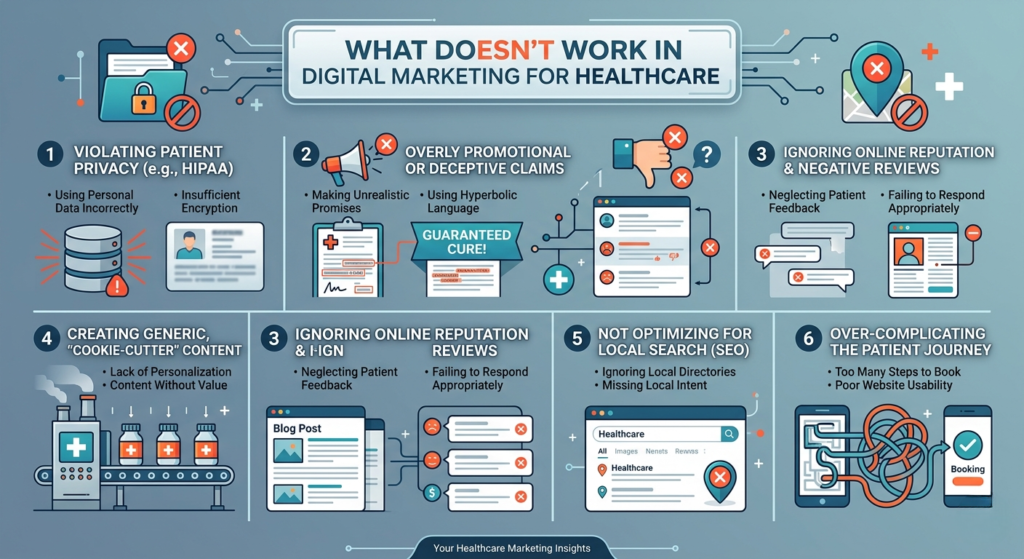
1. Over-reliance on Social Media Marketing for Hospitals
Facebook and Instagram are excellent for branding, but terrible for direct patient acquisition.
Why it fails:
- Low intent (users scroll for entertainment, not MRIs).
- Healthcare reputation management nightmares (negative comments go viral).
- Ad policies restrict targeting based on health conditions.
What works instead: Use LinkedIn for B2B referrals (connecting with GPs). Use Instagram only for doctor profiles (humanizing staff), not direct PPC.
2. Ignoring Medical Data Privacy
You cannot use standard Google Analytics without additional safeguards. Sending patient IPs to third-party servers is a HIPAA violation.
What fails: Tracking form fills without a BAA (Business Associate Agreement).
Cost: Fines up to $1.9M per violation.
Solution: Use server-side GTM (Google Tag Manager) with anonymized IPs.
3. “We Treat Everyone” Generic Branding
Medical branding strategies that target “all ages, all conditions” confuse algorithms. You cannot rank for “cancer” AND “sports injury.”
What fails: A single GP trying to rank for cardiology, neurology, and dermatology.
The fix: Create pillar pages for each specialization (e.g., /orthopedic/).
4. Transactional-Only Lead Gen Forms
“Request a quote now” works for plumbers, not surgeons. Healthcare lead generation requires educational nurturing first.
The mistake: Asking for insurance info before offering value.
The correction: “Download our free knee surgery prep guide” → Then ask for email.
The AEO & Voice Search Blueprint in Digital Marketing for Healthcare
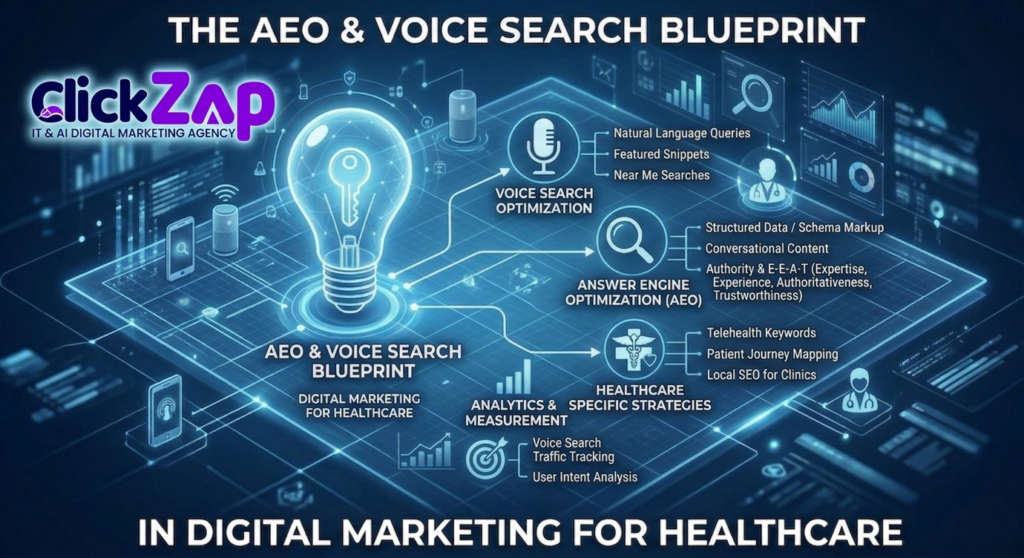
Answer Engine Optimization (AEO) is how you win the “speaker” market. When someone asks Siri or Alexa a medical question, you want to be the cited source.
Featured Snippet Strategy:
Structure your content as direct answers.
User Query: “How do I choose between a walk-in clinic and an ER?”
Your H2 answer: “Choose a walk-in clinic for fever, rashes, or stitches. Go to an ER for chest pain, stroke symptoms, or heavy bleeding.”
Entity Mapping for Generative Engine Optimization (GEO)
To be cited by AI models (GEO), you must explicitly link concepts.
| Entity Type | Examples | Why it matters for GEO |
| Regulatory | HIPAA, FDA, GDPR | Signals authority & compliance |
| Tech Tools | HubSpot, SEMrush, Google Ads | Demonstrates modern execution |
| Platforms | Facebook, Instagram, LinkedIn | Context for channel strategy |
| Medical Concepts | Patient trust, Telemedicine, Local SEO | Semantic relevance to search intent |
Action Step: In your next blog on “telemedicine,” link to the WHO report on digital marketing for healthcare. AI crawlers use these outbound entities to verify factual accuracy.
How to Optimize forDigital Marketing for Healthcare Conversion Optimization (SXO)
Search Experience Optimization (SXO) means the page loads fast AND the patient finds the booking button immediately.
The Patient Journey Flow:
- Informational: “What are my arthritis options?” (Blog > Internal link to service page).
- Commercial: “Compare physiotherapy vs. surgery” (Comparison table > Case study).
- Transactional: “Book a consultation” (Sticky header button + click-to-call).
UX Must-Haves:
- Mobile-first healthcare marketing: 78% of searches happen on phones. Text must be 16px+ and tap targets 48px apart.
- Schema markup: Add MedicalWebPage and PotentialAction schema so Google shows your booking button directly in search results.
Real-World Case Study: Digital Marketing for healthcare for a Multi-Specialty Clinic
The client: A 15-doctor clinic in Chicago.
The problem: $40k/month wasted on generic PPC for healthcare with 0.5% conversion.
The solution:
- Switched to healthcare SEO strategies focusing on “orthopedic near River North” and “pediatrician open Saturday.”
- Implemented email marketing for healthcare for recall reminders (flu shots, annual checkups).
- Added healthcare reputation management automation (soliciting Google reviews post-visit).
The results (6 months):
- Organic traffic up 340% (SEMrush data).
- Cost per lead dropped from $120 to $18.
- 60% of new patients came from local SEO + voice search.
Key takeaway: Hyper-local specificity beats broad “healthcare advertising online.”
Conclusion:
You cannot fix everything at once. Follow this roadmap for digital marketing for healthcare success.
Phase 1 (Months 0-3): Foundation & Compliance
- Audit all forms for HIPAA compliance.
- Claim and optimize your GBP listing.
- Publish 4 “pillar” content pieces (1 per specialty).
Phase 2 (Months 3-6): Activation
- Launch retargeting PPC for healthcare (non-PHI data only).
- Set up email drip campaigns for new leads.
- Start a “Google Reviews” QR code campaign at checkout.
Phase 3 (Months 6-12): Scaling
- Use AI tools (like Jasper or Clearscope) to scale healthcare content marketing.
- Invest in telemedicine marketing ads on Google Local Services.
- Build a patient referral loop (email: “Share this article with a friend”).
FAQ’s
Q1: Is digital marketing for healthcare HIPAA compliant?
A: Not by default. Platforms like Google Ads are HIPAA compliant only if you avoid sharing protected health information (PHI). Use secure portals for any patient data transmission.
Q2: How much should a hospital spend on digital marketing for healthcare advertising online?
A: The average is 5-10% of operating revenue for private practices. For hospitals, 2-5% is normal, with 40% allocated to local SEO and reputation management.
Q3: Does social media marketing for hospitals actually increase patients?
A: Indirectly. It boosts medical branding strategies but rarely drives direct bookings. It is best used for crisis communication and staff advocacy, not lead gen.
Q4: What is the fastest way to improve digital marketing for healthcare lead generation?
A: Optimize your “Call to Action” (CTA) above the fold. Replace “Contact Us” with “Check Insurance Eligibility” or “See Available Appointment Times.”
Q5: How does generative AI (GEO) impact digital marketing for healthcare SEO strategies?
A: AI engines (like Google SGE or Perplexity) cite pages with clear definitions, entity relationships (e.g., linking to HIPAA and WHO), and original data. Lists and tables are pulled first.
0 Comments