
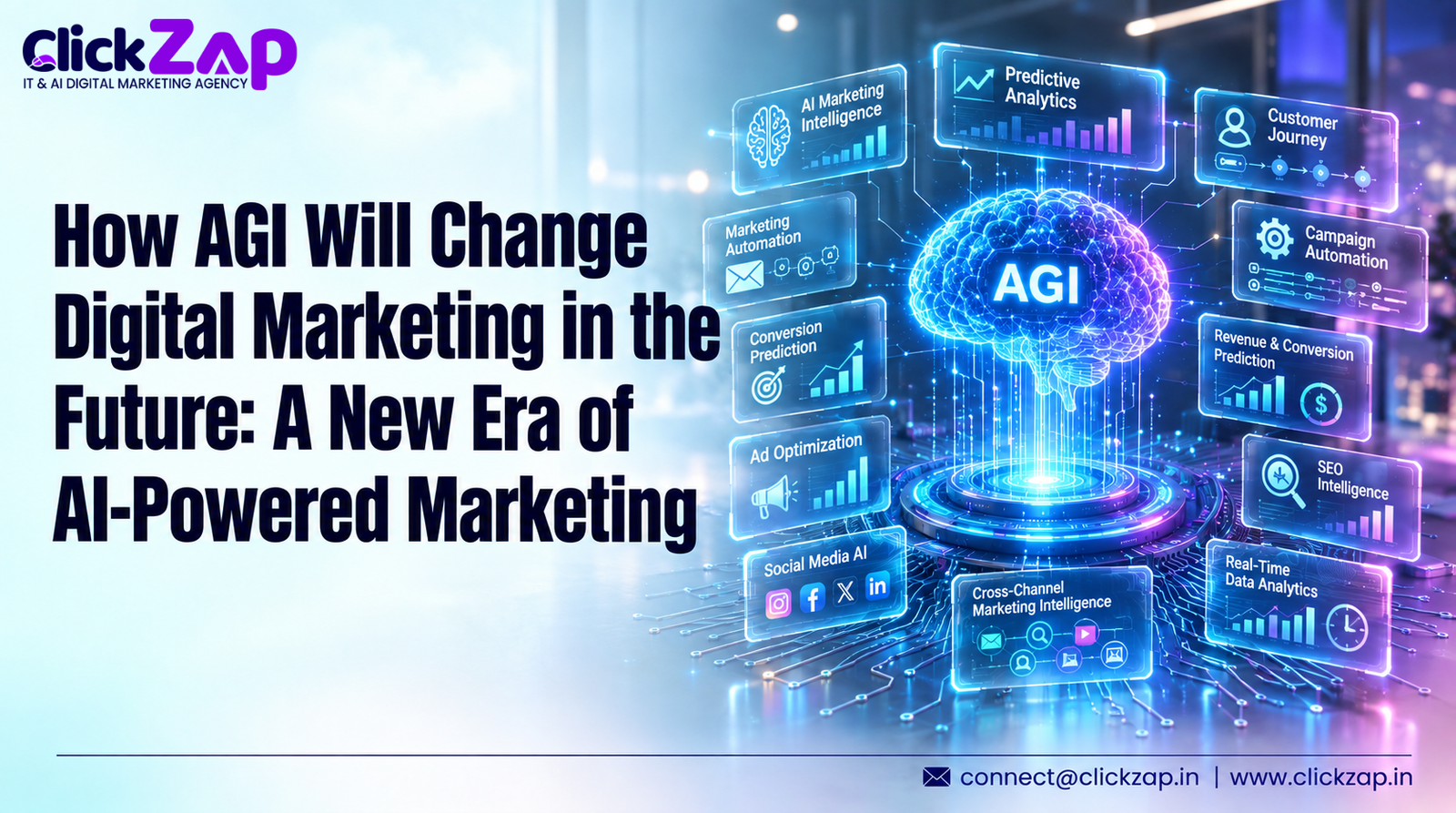
Every few months, a new AI model launches, and marketers scramble to figure out what it means for their campaigns. But underneath the noise of new tools and updates, a bigger question is starting to circulate in boardrooms and marketing teams: what happens when AI stops being a tool you use and starts being a system that can think, plan, and act almost like a person? That’s the idea behind Artificial General Intelligence, or AGI. Understanding how AGI will change digital marketing in the future matters now, even though AGI doesn’t exist yet in a confirmed, working form. The businesses that start preparing today by strengthening their data, content, and marketing systems will be the ones best positioned if and when AGI arrives.
This article breaks down what AGI actually means, how it differs from the AI tools marketers already use, and what its potential impact could look like across SEO, advertising, content, automation, and agency work. Wherever we discuss future capabilities, we’ll be clear that we’re talking about possibilities, not guarantees.
What Is Artificial General Intelligence (AGI)?
Artificial General Intelligence (AGI) refers to a hypothetical type of AI that could understand, learn, and apply knowledge across many different tasks at a level comparable to or beyond human intelligence. Importantly, AGI does not currently exist, and there is no single, universally accepted definition of what it would look like once it does.
Today’s AI tools, including the ones marketers already use, are examples of “narrow AI.” Narrow AI is trained to do specific tasks well writing captions, generating images, analyzing ad performance, or answering customer questions. It doesn’t truly “understand” the world the way a person does; it recognizes patterns from data and produces outputs based on those patterns.
AGI, by contrast, is envisioned as a system that could:
- Transfer knowledge from one domain to a completely different one, the way a human strategist might apply lessons from retail to a SaaS business
- Reason through new, unfamiliar problems without being specifically trained on them
- Set goals, plan multiple steps ahead, and adjust its own approach based on results
Because AGI is still a research goal rather than a deployed product, it should currently be discussed as a future possibility for marketing not as an established technology businesses can adopt today. Researchers, including teams at OpenAI and Google DeepMind, are actively working toward more general and capable AI systems, but timelines for AGI remain uncertain and widely debated.
AGI vs Generative AI: What’s the Difference?
Generative AI creates content based on patterns learned from data, while Artificial General Intelligence or AGI would potentially reason, plan, and act independently across many types of tasks. That’s the core difference marketers need to understand.
Generative AI tools like ChatGPT, Google Gemini, and Microsoft Copilot are extremely useful for drafting content, summarizing data, or answering questions. But they work within defined limits, they respond to prompts, and they don’t independently set business goals or manage ongoing campaigns without human direction.
Here’s a simple comparison:
|
Aspect |
Generative AI (Today) |
AGI (Potential Future) |
|
Scope of tasks |
Narrow trained for specific outputs |
General could apply reasoning across domains |
|
Autonomy |
Needs prompts and human direction |
Could potentially set goals and act independently |
|
Learning |
Learns patterns from training data |
Could potentially learn and adapt in real time |
|
Marketing role today |
Assists with drafting, ideas, analysis |
Not currently available for marketing use |
|
Oversight needed |
Moderate to high |
Likely to remain high, even if AGI develops |
It’s worth repeating: ChatGPT, Gemini, and Copilot are not AGI. They are advanced generative AI tools with real, current value for marketers but they don’t reason generally across unrelated problems the way AGI is envisioned to. Understanding this distinction matters because it prevents businesses from either over trusting today’s tools or dismissing AGI as pure science fiction. It’s the first step in understanding how AGI will change digital marketing in the future.
How AGI Will Change Digital Marketing in the Future

If AGI reaches the capabilities researchers envision, it could reshape nearly every function inside a marketing team. This section walks through the areas most likely to be affected, and how they might evolve beyond what’s possible with current AI marketing tools.
1. AI Powered Marketing Strategy
Strategy has always depended on a marketer’s ability to connect dots, business goals, customer data, competitor moves, and market shifts into a coherent plan. AGI could potentially process all of these inputs simultaneously and continuously, rather than through periodic reviews and reports.
A future AGI powered marketing strategy might, for example, monitor a competitor’s pricing changes, cross reference them with shifting customer sentiment, and suggest a repositioning strategy within hours instead of weeks. This is not something available today, but it illustrates the kind of shift AGI for digital marketing strategies could bring.
2. Autonomous Marketing
“Autonomous marketing” describes a future state where AI systems could potentially identify opportunities, build campaign strategies, launch them, monitor results, and adjust course largely without step by step human instruction.
This is fundamentally different from today’s marketing automation, which follows pre-set rules. Autonomous marketing, if AGI capabilities develop as researchers envision, would involve the system making judgment calls: deciding what to test, why, and when to pivot much like a human marketer would, but at much greater speed and scale. Human goals, brand guidelines, and approval checkpoints would likely remain essential even in this scenario.
3. SEO and AI Powered SEO
AI powered SEO already helps marketers with keyword clustering and content briefs. AGI could potentially take this further by connecting keyword research, search intent analysis, content planning, technical SEO audits, and competitor analysis into one continuously updating system.
Instead of running separate tools for rankings, backlinks, and content gaps, a business might one day work with a system that understands the full picture why a page underperforms, what searchers actually want, and how to fix both content and technical issues together. Even so, human oversight will likely remain necessary to protect brand voice, accuracy, and compliance with search engine guidelines.
4. Content Marketing and AI Content Generation
AI content generation already assists with drafting blog posts, product descriptions, and social captions. A more capable AI system could potentially extend this into deeper research, content strategy planning, personalized content variations, and smarter distribution across channels.
That said, human expertise isn’t going away. Originality, brand voice, fact checking, and editorial judgment are things businesses will still need people for especially since AI generated content can contain errors or lack the nuance a real customer relationship requires.
5. Personalized Marketing
AGI could potentially push AI powered customer personalization far beyond today’s “customers who bought this also bought that” recommendations. By combining AI customer behavior analysis with broader context timing, intent, past interactions, even mood signals from conversation future systems might tailor entire customer journeys in real time.
For example, a returning website visitor browsing pricing pages late at night might, in a future scenario, receive a different message than a first-time visitor exploring a product page during business hours generated dynamically rather than pre-scripted. This kind of predictive marketing is an extension of trends already visible in today’s recommendation engines, just significantly more advanced.
6. Google Ads and Meta Ads Optimization
Google Ads and Meta Ads already use machine learning for automated bidding and audience targeting. If AGI level reasoning becomes available, ad optimization could potentially extend to smarter creative testing, more accurate conversion prediction, and budget allocation that adapts to real world events not just historical data.
To be clear, AGI does not currently control these advertising platforms. Today’s improvements come from narrow AI and machine learning models built for specific optimization tasks, not general reasoning systems.
7. Marketing Automation
Marketing automation has followed a clear path: rule based automation evolved into AI powered automation. The next potential stage, AGI marketing automation, would involve systems that don’t just follow patterns but reason about why a strategy is or isn’t working.
This is the difference between AGI marketing automation and AGI and marketing automation working together as separate concepts: one describes automation infused with general reasoning, the other describes AGI systems that manage automation as one tool among many. Both point toward digital marketing automation becoming more adaptive and less dependent on manual rule building.
8. Lead Generation and Conversion
AI powered lead generation already helps score leads based on behavior. A more advanced system could potentially identify high intent prospects earlier, personalize outreach messaging automatically, and adjust the conversion journey for each individual rather than applying the same funnel to everyone.
9. Marketing Analytics and Attribution
Marketing analytics with AI could become significantly more sophisticated under AGI, potentially connecting fragmented data across customer journeys, campaigns, and channels to produce clearer attribution models. Instead of marketers manually piecing together spreadsheets to estimate ROI or customer lifetime value, a future system might surface these insights continuously and explain why certain patterns occurred, not just report the numbers.
10. Social Media Marketing
Social platforms move fast, and AGI could potentially help marketers keep pace by handling content planning, audience analysis, trend spotting, and community engagement more holistically. Meta AI already offers tools for ad creative and audience insights within Meta’s platforms; a more general AI system could potentially extend this kind of capability across content strategy and real time trend response, rather than isolated features.
AI Digital Marketing Services for Business
How AGI Could Transform the Role of Digital Marketing Agencies
It’s natural for agency owners and marketers to wonder whether AGI threatens their jobs. A more realistic way to think about it: AGI is more likely to change what agencies do than to make them unnecessary.
The likely shift looks something like this:
Executing marketing tasks → Managing intelligent marketing systems → Providing strategic human expertise
As AI systems take on more execution level work reporting, testing, routine optimization agencies could increasingly focus on:
- Strategy and business positioning
- Brand identity and creative direction
- Deep customer insight and market understanding
- Implementing and governing AI systems responsibly
- Interpreting data in the context of real business goals
- Running structured experiments and campaign governance
- Driving overall business growth, not just campaign metrics
Agencies that adapt early by understanding both marketing fundamentals and how to work alongside advancing AI systems are likely to remain valuable, not obsolete.
Best AI Digital Marketing Agency
Will AGI Replace Digital Marketers?
No single, confirmed answer exists yet, because AGI hasn’t arrived but the more useful framing is human AI collaboration, not human versus AI replacement.
Tasks AGI could potentially automate over time include:
- Repetitive reporting and dashboard building
- Large scale data analysis
- Ongoing campaign monitoring
- Basic bid and budget optimization
- Background research
- Generating content variations for testing
- Routine customer segmentation
Skills that are likely to remain distinctly human include:
- Creativity and original thinking
- Strategic decision making tied to business context
- Emotional intelligence and empathy
- Deep brand understanding
- Storytelling that resonates culturally and emotionally
- Ethical judgment
- Leadership and team direction
- Relationship building with clients and customers
The future of digital marketing with AGI is more plausibly one where marketers spend less time on repetitive execution and more time on judgment calls that require human context, not one where marketers disappear entirely.
Benefits of AGI for Businesses
If AGI develops as researchers hope, businesses could see meaningful benefits, including:
- Faster decision making, since data analysis that takes days today might take minutes
- Improved personalization across larger customer bases without proportional increases in manual work
- Better marketing efficiency, as systems could potentially manage more moving parts simultaneously
- Reduced repetitive work for marketing teams, freeing time for strategic tasks
- Improved campaign optimization through continuous, real time adjustments
- Faster experimentation, testing more ideas in less time
- Better customer insights from AI customer behavior analysis at scale
- Potentially lower operational costs for certain routine marketing functions
- More scalable marketing for growing businesses with limited team size
These are potential benefits tied to a technology that doesn’t yet exist in confirmed form, not guarantees.
Challenges and Risks of AGI in Digital Marketing
A balanced view of AGI has to include the risks, not just the upside. Businesses considering the impact of AGI on digital marketing should be aware of:
- Data privacy concerns, as more capable AI systems would likely require access to larger amounts of customer data
- Security risks, since more autonomous systems could create new vulnerabilities if not properly governed
- Misinformation, if AI generated content isn’t fact checked before publishing
- Inaccurate AI generated content, a known issue with today’s generative AI that could persist without safeguards
- Algorithmic bias, where AI systems reflect biases present in their training data
- Over automation, where businesses lose the human touch customers value
- Loss of human creativity, if teams over rely on AI generated ideas
- Brand safety issues, if autonomous systems make decisions that don’t align with brand values
- Ethical marketing concerns, particularly around persuasion techniques and transparency
- Dependence on AI systems, which could create risk if systems fail or change
- Regulatory uncertainty, as governments are still developing rules around advanced AI
Strong human oversight and clear governance policies will remain essential, regardless of how capable AI systems become.
How Businesses Can Prepare for the AGI Era
Businesses don’t need to wait for AGI to start improving their marketing foundation. Practical steps include:
- Build a strong digital foundation a fast, well structured website and clear tracking setup
- Organize and improve first party data, since better data means better AI outcomes, present and future
- Invest in quality content that reflects real expertise, not generic filler
- Strengthen SEO fundamentals, including technical health, site structure, and search intent alignment
- Learn how current AI marketing tools work, so your team isn’t starting from zero later
- Train marketing teams in AI literacy, covering both capabilities and limitations
- Develop responsible AI policies for content review, data use, and disclosure
- Experiment with AI automation in low risk areas first, like reporting or A/B testing
- Track marketing performance consistently, so you have a reliable baseline to measure future improvements against
- Focus on customer experience and brand differentiation, which will matter regardless of how advanced AI becomes
The Future of AI Powered Marketing
it’s really at the heart of how AGI will change digital marketing in the future. Digital marketing has been evolving in stages, and that evolution is likely to continue:
Traditional Digital Marketing → AI Assisted Marketing → AI Powered Marketing → Highly Automated Marketing → Potentially Autonomous Marketing
This is a plausible path, not a guaranteed timeline. Many businesses today are still moving from “AI assisted” to “AI powered” marketing using AI tools to support decisions rather than make them. The future of AI powered marketing likely involves marketers increasingly working with intelligent systems as collaborators, rather than simply operating individual AI tools one at a time.
What This Means for Digital Marketing in the Next Few Years
Here’s the realistic takeaway: businesses do not need to wait for AGI to start preparing for how AGI will change digital marketing in the future. The groundwork data, content, SEO, and team readiness is useful regardless of when or whether AGI arrives in its fullest envisioned form.
In the next few years, the practical opportunity lies in responsibly adopting what already works:
- AI powered marketing tools for content and analysis
- Marketing automation for repetitive workflows
- AI driven marketing strategies grounded in real data
- Predictive marketing to anticipate customer needs
- AI powered SEO to strengthen search visibility
- AI advertising optimization within platforms like Google Ads and Meta Ads
Businesses that build these habits now will be far better positioned to adopt more advanced systems later, whatever form they take.
Frequently Asked Questions
What is AGI in digital marketing?
AGI in digital marketing refers to the potential future use of Artificial General Intelligence, a hypothetical AI capable of human level reasoning across tasks to plan, execute, and optimize marketing activities. It does not currently exist as a working marketing technology.
How will AGI change digital marketing in the future?
If it develops as researchers envision, AGI could potentially unify strategy, SEO, content, advertising, and analytics into more autonomous, adaptive systems though this remains a future possibility rather than a current capability.
Will AGI replace digital marketers?
It’s unlikely to replace marketers entirely. AGI could automate repetitive tasks like reporting and basic optimization, while skills like creativity, strategy, and relationship building are expected to remain human-led.
What is the difference between AGI and generative AI?
Generative AI creates content based on learned patterns and requires human prompts, while AGI would potentially reason and act independently across many different types of tasks and domains.
How could AGI change SEO?
AGI could potentially connect keyword research, content planning, technical audits, and competitor analysis into one continuously updating system though human oversight would likely remain necessary for accuracy and search guideline compliance.
Conclusion
Understanding how AGI will change digital marketing in the future starts with separating hype from reality. AGI is a developing research concept, not a confirmed technology today’s ChatGPT, Gemini, and Copilot are powerful generative AI tools, not AGI. If AGI does reach the capabilities researchers envision, it could reshape strategy, SEO, content, advertising, automation, and analytics in significant ways. But the exact capabilities and timeline remain genuinely uncertain.
What businesses can control today is their foundation: clean data, strong content, solid SEO, and teams that understand how to use AI responsibly. That groundwork pays off regardless of how AGI unfolds.
At ClickZap IT, we help businesses build that foundation combining SEO, paid advertising, content, and AI powered marketing tools to prepare for what’s next, without overpromising on technology that hasn’t arrived yet. If you’d like help strengthening your marketing strategy for an increasingly AI driven future, our team is here to talk it through.
Also Read: AI Powered Marketing Attribution for Businesses: A Complete Guide to Measuring ROI
0 Comments