
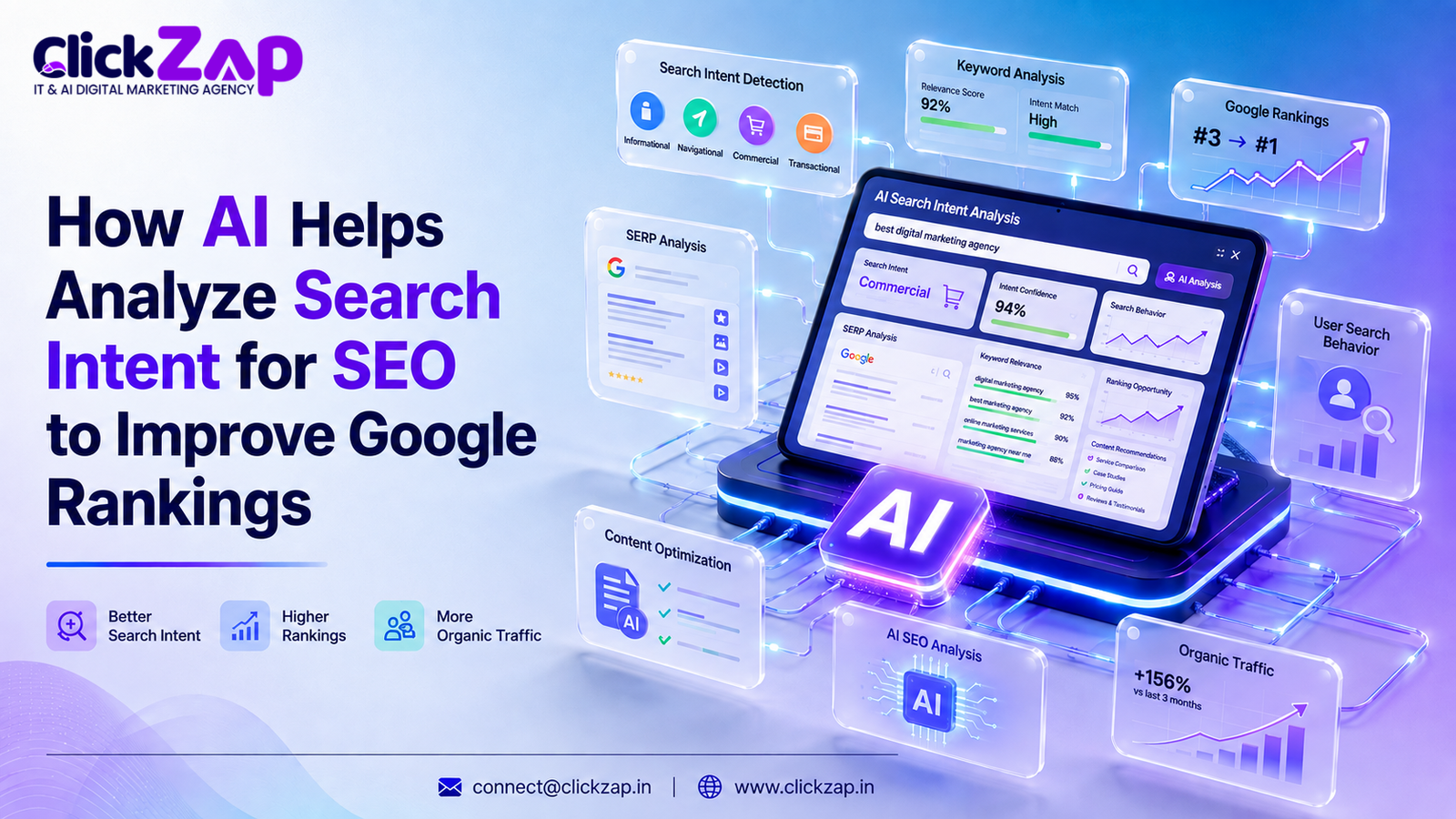
How AI Helps Analyze Search Intent for SEO
Ranking for the right keyword used to be enough. Not anymore. Google has spent years getting better at judging whether a page actually satisfies what a searcher wanted in the first place and if it doesn’t, no amount of keyword optimization saves it. This is where how AI helps analyze search intent for SEO becomes a genuinely useful question for anyone building content in 2026, not a buzzword to sprinkle into a pitch deck.
AI doesn’t replace SEO judgment. What it does is process far more keyword, SERP, content, and behavioral data than a human can manually review, and it does it fast enough to actually change how content gets planned. In this article, you’ll learn what search intent means, why it matters for rankings, the four core intent types, and a practical, step by step way to use AI for search intent analysis from raw keyword to a content brief you can actually publish.
What Is Search Intent in SEO?

Search intent is the underlying reason behind a search query that the user actually wants to find, learn, do, or buy. Two keywords can look similar on the surface and still represent completely different needs.
The relationship works like this:
Keyword → Search intent → User expectation → Content type → SEO performance
Here’s a simple example. Someone searching “best digital marketing agency” is comparing options they want: a list, reviews, or a comparison page. Someone searching “what is digital marketing” is starting from zero; they want a clear, educational explanation, not a sales pitch.
If you publish a service page for the second query or a beginner’s guide for the first, you’re technically “targeting the keyword” while completely missing what the searcher needed. Google notices this mismatch through engagement signals, and so does the searcher, who bounces straight back to the results page.
Why Search Intent Matters for Google Rankings

Matching search intent doesn’t guarantee a top ranking no single factor does. But it’s one of the clearest ways to make content more relevant, useful, and competitive in a crowded SERP. intent alignment doesn’t rank content by itself, but content that ignores intent rarely ranks well no matter how strong the rest of the SEO work is. This is exactly why how AI helps analyze search intent for SEO has become a core part of modern content planning rather than an afterthought.
Getting intent right affects:
- Relevance: content that answers the actual question is easier for Google to match to the query
- User satisfaction: visitors find what they came for instead of leaving immediately
- Engagement: time on page, scroll depth, and return visits tend to improve
- Conversion potential:transactional pages convert better when they’re shown to transactional searchers, not information seekers
- SERP competitiveness: you’re now competing against pages that already match intent, so a mismatched page starts at a disadvantage
- Topical relevance: intent aligned content fits more naturally into a broader content cluster
In short: intent alignment doesn’t rank content by itself, but content that ignores intent rarely ranks well no matter how strong the rest of the SEO work is.
What Are the Four Main Types of Search Intent?
There are four widely recognized categories of search intent in SEO. Understanding which bucket a keyword falls into shapes almost every content decision that follows.
|
Search Intent |
What the User Wants |
Example Keyword |
Suitable Content |
|
Informational |
Learn something |
what is SEO |
Guide/blog post |
|
Navigational |
Find a specific website or page |
Google Search Console |
Website/landing page |
|
Commercial |
Compare or evaluate options |
best SEO tools |
Comparison/listicle |
|
Transactional |
Take an action or purchase |
buy SEO software |
Product/service page |
Informational intent covers questions, definitions, and explanations the searcher wants to understand something, not buy it yet.
Navigational intent means the user already knows where they want to go; they’re using the search bar as a shortcut, not exploring options.
Commercial intent sits in the research phase the searcher is comparing tools, agencies, or approaches before deciding, which is exactly why “best,” “top,” and “vs” keywords tend to attract comparison style content.
Transactional intent is the closest to a purchase or action “buy,” “hire,” “sign up,” “pricing” and content here should remove friction, not educate from scratch.
Most keyword lists contain a mix of all four, which is exactly why intent classification has to happen before content gets written, not after.
How AI Helps Analyze Search Intent for SEO
This is the core of AI-powered search intent analysis: using AI to spot patterns across keywords, SERPs, content formats, related questions, and competitor pages faster and more consistently than manual review allows.
At scale, AI can help marketers:
- Classify large keyword lists by intent type in minutes instead of hours
- Spot shifts in intent when a keyword’s SERP changes over time
- Group semantically related keywords into topic clusters
- Identify patterns across top ranking pages
- Flag mismatches between existing content and the intent Google is currently rewarding
The value isn’t that AI “knows” intent better than an experienced strategist. It’s that AI search intent analysis can process hundreds of keywords and SERPs at once, surfacing patterns a person would need days to compile manually patterns that still need human judgment to interpret correctly.
How AI Analyzes Search Intent Step by Step
Here’s a practical, repeatable process for search intent analysis using AI.
Step 1: Collect keyword data
Pull keyword lists from tools like Semrush, Ahrefs, or Google Search Console. Search Console data is particularly useful because it reflects real queries already driving impressions to your site.
Step 2: Analyze the search query
AI can interpret wording, modifiers, and contextual relationships between keywords to infer what the searcher is really asking.
Step 3: Classify search intent
Based on query structure and context, AI sorts keywords into informational, navigational, commercial, or transactional buckets, the foundation for everything that follows.
Step 4: Analyze the SERP
AI-assisted SERP analysis looks at what’s actually ranking: content formats, featured snippets, People Also Ask boxes, video results, product listings, local packs, and other SERP features. The current SERP is the clearest signal of what Google believes satisfies that query right now.
Step 5: Identify content patterns
What do the top ranking pages have in common word count, structure, use of tables, FAQ sections, media? AI can summarize these patterns across dozens of results quickly.
Step 6: Map keywords to content
Based on intent, AI can recommend whether a keyword belongs on a blog post, landing page, service page, product page, comparison page, guide, or FAQ, a core part of keyword to content mapping.
Step 7: Identify content gaps
Compare existing content against competitor pages and SERP patterns to spot missing subtopics, unanswered questions, or thin sections.
Step 8: Optimize content for intent
Adjust headings, format, depth, examples, CTAs, FAQs, and internal links so the page matches what the SERP and the searcher expect.
How to Analyze Search Intent With AI: Practical Example

Take the keyword “digital marketing agency for small businesses.”
- Possible intent: Mixed commercial/transactional the searcher is likely evaluating agencies and close to reaching out
- What the user expects: Clear service offerings, pricing signals, credibility markers, and an easy next step
- SERP characteristics: Agency homepages, service pages, and a handful of “best agencies” listicles
- Recommended content format: A dedicated service page rather than a generic blog post
- Supporting keywords: affordable digital marketing for small business, Digital marketing services for small business, small business marketing agency
- CTA: A direct, low friction action “Get a free digital marketing audit” or “Talk to our team”
- Conversion opportunity: High this searcher is closer to a decision than someone searching “what is digital marketing”
AI can help pull this analysis together quickly by processing the keyword, the live SERP, and competitor pages in one pass but a strategist still needs to decide what the page actually says and how it’s positioned.
Best AI Tools for Search Intent Analysis
No single tool “does” search intent analysis end to end. In practice, most SEO teams combine a few of these:
Semrush : Strong for keyword research, intent labeling on keyword reports, SERP analysis, and competitor keyword gaps.
Ahrefs : Useful for keyword research, SERP position tracking, content research, and identifying what competitors rank for.
ChatGPT / OpenAI : Helpful for classifying keyword lists by intent, analyzing SERP data you feed it, spotting content patterns, generating content briefs, and mapping keywords to content types. It works best when you supply real data rather than asking it to guess in a vacuum.
Google Gemini : Can assist with organizing intent patterns across large keyword sets and generating content angle ideas, particularly when connected to other Google data sources.
Perplexity : Useful for quick research and cross referencing information patterns across sources when scoping a topic.
Google Search Console : Shows the actual queries already bringing traffic to your site, which is often the most reliable intent signal you have, since it’s real user behavior rather than a modeled estimate.
Screaming Frog : Crawl data combined with AI analysis can reveal technical and content patterns, thin pages, duplicate intent targeting, missing internal links that affect intent alignment site wide.
Surfer : Offers SERP based content recommendations that support building pages structured around what’s already ranking for a given intent.
None of these tools automatically “know” intent with certainty they surface data and patterns. Interpreting that data correctly is still the strategist’s job.
How AI Improves Keyword Intent Analysis
Traditional keyword research leans heavily on search volume and keyword difficulty. Those numbers matter, but they say nothing about whether the keyword fits your business or what the searcher actually wants.
AI-powered keyword intent analysis pushes further by weighing:
- Context and phrasing of the query
- Related topics and question clusters
- SERP patterns and content formats already ranking
- User expectations at that stage of the funnel
- Where the keyword sits in the buyer journey (informational vs. transactional)
A high volume keyword with the wrong intent for your business is often a worse target than a lower-volume keyword that matches exactly what you offer and who you serve.
AI-Powered Search Intent Analysis for Content Strategy
Once keywords are classified by intent, AI can help structure a broader content strategy:
- Keyword clustering : grouping related keywords under shared topics
- Search intent classification : labeling each cluster by primary intent
- Content mapping : deciding which page type serves each cluster
- Funnel mapping : aligning clusters to stages of the buyer journey
- Content gap analysis : finding topics competitors cover that you don’t
- Content refresh opportunities : flagging older pages whose intent match has drifted
- Internal linking opportunities : connecting informational content to commercial and transactional pages
A simple funnel example: a reader starts on an informational post like “what is SEO,” moves to a commercial comparison like “best SEO services in Hyderabad,” and finally lands on a transactional service page ready to enquire. Structuring content around this path rather than isolated keywords is where AI search intent analysis for SEO earns its keep.
How AI Helps With SERP Analysis
AI-assisted SERP analysis lets marketers review Google’s results at scale rather than manually checking one query at a time. It can help identify:
- Recurring content formats across top results
- Common subtopics and structure among ranking pages
- Frequently asked questions surfaced in People Also Ask
- Typical content depth and word count
- Which search features appear
- Where competitors are positioned and what they’re missing
AI should support this analysis, not replace it. A pattern spotted across ten SERPs still needs a human to decide whether it’s worth following or whether there’s an opportunity to do something genuinely different.
How to Align Content With Search Intent Using AI
Every piece of content should be able to answer five questions before it gets written:
What to write + Who it is for + Why they are searching + What format they expect + What action they may take next
A quick working checklist:
- Classify the keyword’s primary intent
- Check the live SERP for the dominant content format
- Identify the questions searchers are actually asking (People Also Ask, forums, Search Console queries)
- Match your content format to what’s already working, unless there’s a clear gap to exploit
- Write the answer to the core question early, then expand
- Add supporting subtopics based on competitor and gap analysis
- Match the CTA to the intent stage don’t push a sale on an informational page
Common Mistakes When Using AI for Search Intent Analysis
- Relying entirely on AI-generated assumptions without checking the live SERP
- Targeting keywords based on search volume alone, ignoring intent mismatch
- Creating content without understanding who the actual audience is
- Keyword stuffing instead of natural topical coverage
- Publishing generic, AI-sounding content with no original insight
- Ignoring the fact that search intent for a keyword can shift over time
- Never validating AI’s classification against real search results
- Failing to add first hand expertise or practical experience
- Optimizing purely for search engines instead of the person reading the page
AI Search Intent Analysis vs Traditional Search Intent Analysis
|
Factor |
Traditional Approach |
AI-Assisted Approach |
|
Data processing |
Manual, keyword by keyword |
Processes large keyword sets at once |
|
Speed |
Slow, time intensive |
Significantly faster |
|
Keyword classification |
Based on strategist judgment alone |
Pattern based, applied consistently at scale |
|
SERP analysis |
Manual review of each result page |
Can summarize patterns across many SERPs |
|
Content mapping |
Case by case decisions |
Faster recommendations based on patterns |
|
Scalability |
Limited by available hours |
Scales across hundreds of keywords |
|
Human involvement |
High throughout |
Still required for validation and strategy |
|
Accuracy |
Depends on individual expertise |
Depends on data quality and human review |
|
Personalization |
Deep, business specific |
Needs human input to stay business specific |
|
Content recommendations |
Slower, more deliberate |
Faster first drafts, needs refinement |
The strongest approach isn’t AI instead of human expertise, it’s AI handling the data volume while a strategist validates, refines, and adds the judgment AI can’t replicate.
How to Use AI for Search Intent Optimization: A Simple Workflow
Keyword Research → AI Intent Classification → SERP Analysis → Competitor Analysis → Content Mapping → Content Creation → Optimization → Publishing → Performance Monitoring → Content Refresh
Each stage feeds the next: keyword research surfaces the raw list, AI classification sorts it by intent, SERP and competitor analysis show what’s currently working, content mapping decides the right page type, and the cycle closes with performance monitoring that flags when a page needs refreshing because intent has shifted.
Can AI Help Improve Google Rankings?
AI doesn’t guarantee higher Google rankings, but it can meaningfully support the work that leads to them. No tool, AI or otherwise, controls rankings directly.
What AI-powered search intent analysis actually contributes:
- A clearer understanding of what searchers want for a given query
- Faster, more consistent content briefs
- Identification of content gaps competitors haven’t filled
- Improved topical and format relevance
- Faster competitor analysis at scale
- Discovery of related topics and supporting subtopics
- Better alignment between content and intent
Rankings still depend on relevance, content quality, authority, technical SEO, competition, backlinks, and overall search experience. AI supports several of these levers; it doesn’t replace all of them.
Best Practices for AI Search Intent Analysis
Getting consistent results from how AI helps analyze search intent for SEO comes down to a handful of habits, not a one time setup. Here’s what separates teams that get real value from AI from those chasing shortcuts:
- Start with the user’s problem, not the keyword
- Always check the live SERP before finalizing intent
- Classify intent carefully don’t assume from the keyword alone
- Validate AI-generated conclusions against real search results
- Study the pages currently ranking, not just the keyword list
- Map each keyword to the correct content format
- Build content around topics and clusters, not isolated keywords
- Add original expertise and first hand examples
- Monitor performance after publishing
- Refresh content when search intent for a keyword changes
Future of AI-Powered Search Intent Analysis
Search behavior is shifting toward longer, more conversational queries as generative search experiences become more common. This trend is pushing SEO toward:
- Conversational and natural language queries rather than short keyword fragments
- Greater weight on long tail searches and specific questions
- Stronger emphasis on context and entity relationships, not just keyword matches
- Topical authority built across clusters instead of single pages
- Content written in clear, natural language that answer engines can extract and summarize
- Thinking in terms of full search journeys rather than isolated keywords
These are reasonable directions based on how search behavior is already evolving, not guaranteed outcomes, but patterns worth planning for.
Frequently Asked Questions
What is search intent?
Search intent is the underlying reason behind a search query that a user actually wants to find, learn, do, or buy. It’s typically grouped into four types: informational, navigational, commercial, and transactional. Understanding intent helps determine what kind of content will actually satisfy a given search.
Why is search intent important for SEO?
Search intent matters because Google evaluates whether content genuinely satisfies what a searcher wanted, not just whether it contains the right keyword. Content that matches intent tends to see better engagement, lower bounce rates, and stronger relevance signals, all of which support long term SEO performance.
How does AI analyze search intent?
AI analyzes search intent by processing keyword wording, modifiers, SERP data, and content patterns across ranking pages. It classifies keywords into intent categories and identifies common characteristics among top performing content, helping marketers move faster than manual, page by page review would allow.
Can AI identify keyword intent?
Yes. AI tools can classify keywords into informational, navigational, commercial, or transactional intent based on query structure, context, and SERP behavior. This classification isn’t perfect and should be validated against the live search results, but it significantly speeds up the initial sorting process for large keyword lists.
What are the four types of search intent?
The four main types are informational (learning something), navigational (finding a specific site), commercial (comparing options), and transactional (taking an action or purchasing). Each type expects a different content format, from educational guides to comparison pages to product or service pages.
Can AI help improve Google rankings?
AI doesn’t directly control rankings, but it supports the work that influences them better content briefs, faster gap analysis, and improved relevance to search intent. Rankings still depend on many factors including content quality, authority, technical SEO, and backlinks, so AI should be treated as a support tool, not a shortcut.
Conclusion
Search intent analysis isn’t a side step in SEO it’s the filter that decides whether keyword research turns into content that actually performs. Understanding how AI helps analyze search intent for SEO means recognizing what it’s good at: processing large volumes of keyword and SERP data, spotting patterns across ranking pages, and speeding up classification and content mapping. What it doesn’t replace is judgment, knowing your audience, validating AI’s conclusions against the real SERP, and writing content with genuine expertise behind it.
The businesses that get the most out of AI-powered search intent analysis are the ones using it to work faster, not to skip the thinking altogether. If you’re ready to build a content and SEO strategy that’s actually grounded in what your audience is searching for, not just keyword volume ClickZap IT can help you develop a data driven digital marketing strategy built around real search intent, not guesswork.
Read More: AI Landing Page Optimization for Lead Generation: Tools, Strategies & Best Practices


0 Comments