
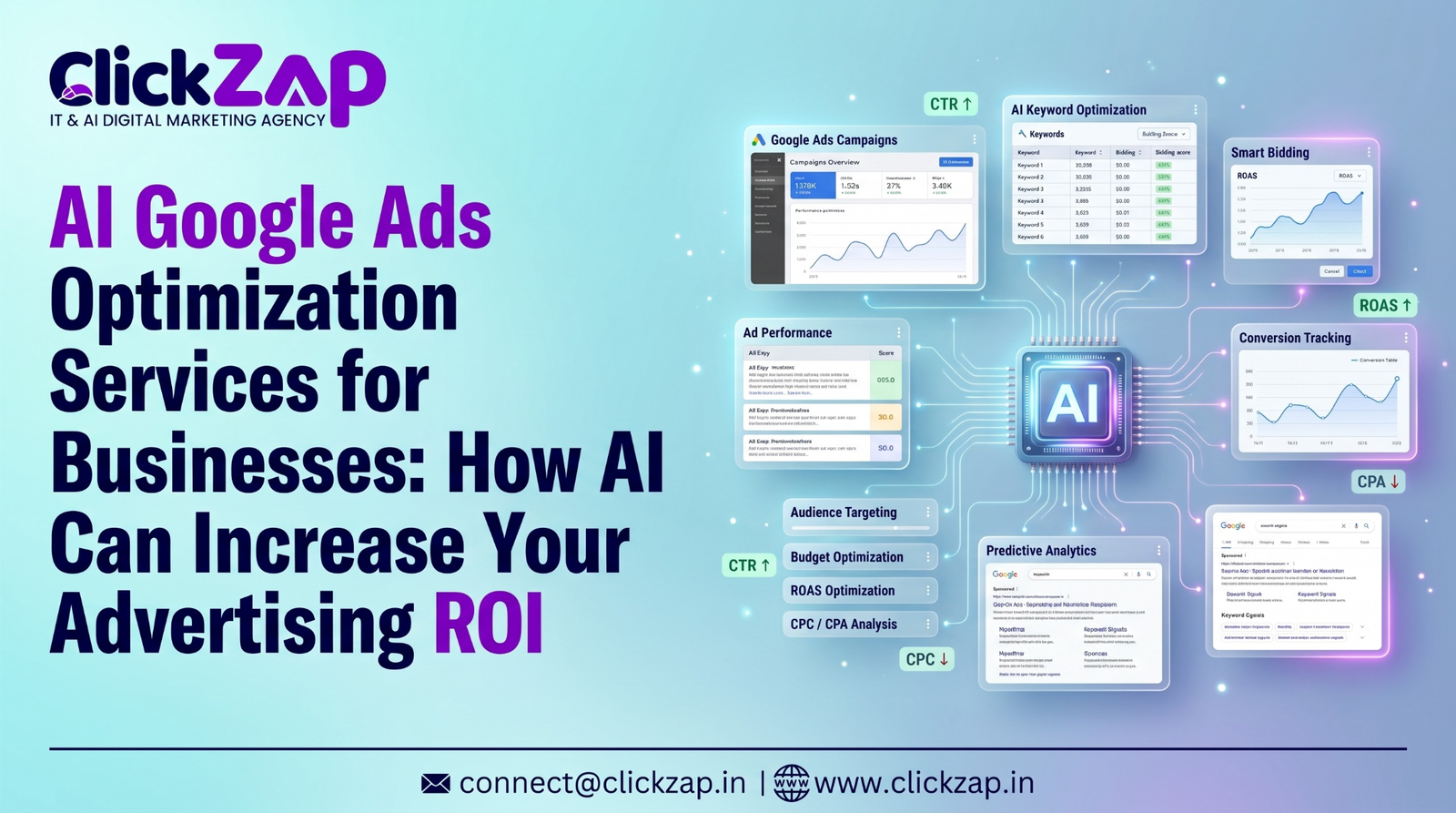
AI Google Ads Optimization Services for Businesses
Most businesses don’t lose money on Google Ads because their product is wrong. They lose it because nobody has time to check search term reports every day, adjust bids across a dozen ad groups, or rewrite ad copy fast enough to keep pace with shifting demand. A single marketing manager running five campaigns simply cannot review thousands of data points daily and still do the rest of their job, which is exactly the gap AI Google Ads optimization services for businesses are built to close.
This is where campaigns start leaking budgets. Cost per click creeps up, conversion rates stall, and nobody notices until the monthly report shows a disappointing return on ad spend. Traditional Google Ads management relies on a person checking dashboards on a schedule weekly, sometimes monthly while the auction itself changes by the hour.
AI Google Ads optimization services for businesses exist to close that gap. Instead of relying only on periodic manual reviews, AI systems continuously analyze bidding signals, search terms, audience behavior, and conversion data, then surface or apply optimizations in near real time.
This article explains what AI powered Google Ads optimization actually is, where it helps most, where human judgment still matters, and how a business should evaluate a provider before hiring one.
What Are AI Google Ads Optimization Services for Businesses?
AI Google Ads optimization services for businesses use machine learning and automation to analyze campaign data and improve performance including bids, keywords, ad copy, audiences, and budgets faster and at a larger scale than manual management alone.
Traditional Google Ads management depends on a person logging into Google Ads Manager, pulling reports, and manually deciding what to change. That works reasonably well for a small account with limited spend. It becomes harder to sustain once a business runs multiple campaigns, sells many products, or operates across several locations.
AI changes the process in three ways:
- It processes more data than a person can review manually. Impressions, clicks, conversions, device data, time of day patterns, and audience signals are analyzed continuously rather than in a weekly check in.
- It detects patterns humans tend to miss. A search term that converts well only on mobile between 6–9 PM is easy for software to spot and hard for a person to catch by scanning spreadsheets.
- It can act faster. Automated bidding systems can adjust bids at the individual auction level, something no human manager can realistically do by hand.
A simple comparison: A manual manager might review search terms once a week and add five negative keywords. An AI assisted system can flag irrelevant search terms daily and route budget away from them before they consume significant spend while a human still reviews and approves the strategy.
This is why more businesses are shifting toward AI powered PPC management: it doesn’t replace strategy, but it removes the lag between “the data changed” and “the campaign responded.”
Best AI Digital Marketing Agency in Hyderabad
How AI Is Changing Google Ads Campaign Optimization
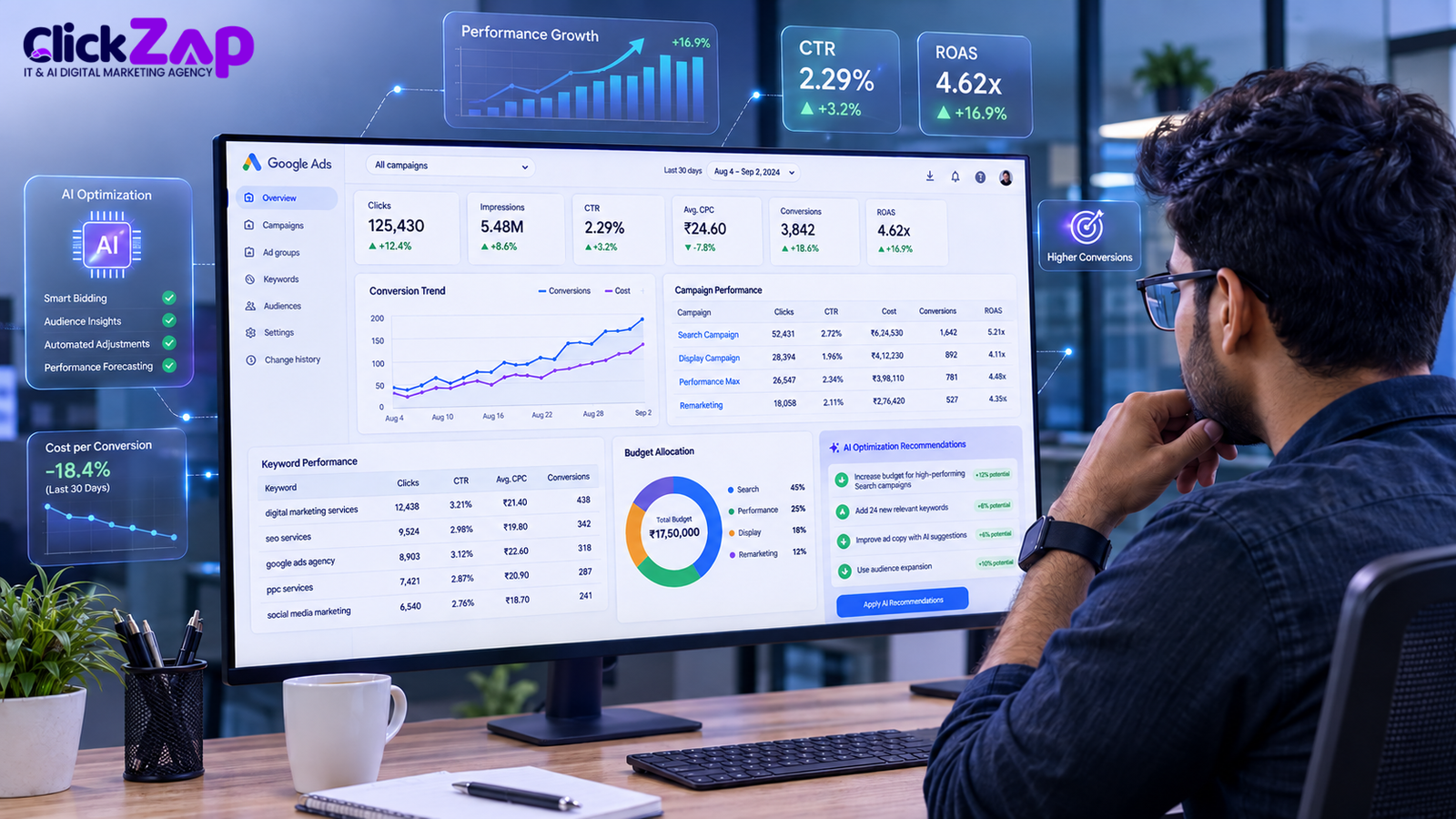
AI Google Ads optimization touches nearly every part of campaign management. Below are the areas where it has the most practical impact.
AI Powered Keyword Targeting
AI tools analyze search term reports to identify which queries are driving conversions and which are wasting spend. This supports:
- Search term analysis : grouping real user queries by intent and performance
- Keyword opportunity discovery : surfacing relevant terms a business hasn’t targeted yet
- Keyword relevance scoring : flagging terms that no longer match ad groups
- Negative keyword optimization : identifying irrelevant or low intent terms to exclude
- Search intent signals : distinguishing informational searches from purchase ready ones
AI Ad Copy Optimization
AI can generate and test multiple ad variations far faster than manual A/B testing allows. This includes:
- Creating several headline and description combinations aligned with different search intents
- Testing messaging variations against real performance data
- Matching ad copy to what the searcher is actually looking for
- Improving relevance, which typically supports a better click through rate (CTR)
- Requiring human review to keep tone, claims, and brand voice consistent AI generated copy still needs a person to approve it before it goes live
AI-Powered Bidding and Budget Optimization
This is where AI has the most mature track record inside Google Ads itself. Google’s Smart Bidding uses machine learning to set bids based on conversion signals, device, location, time of day, and audience data. Automated bid management can:
- Adjust bids per auction based on the likelihood of a conversion
- Reallocate budget toward higher performing campaigns or ad groups
- Help manage cost per click (CPC) against a target
- Support ROAS goals by prioritizing spend where conversion value is highest
AI Audience Targeting
AI evaluates audience signals browsing behavior, past interactions, purchase patterns to identify which segments are most likely to convert. This supports:
- More precise remarketing to users who already showed interest
- Identifying high value customer segments worth prioritizing
- Estimating conversion likelihood before spend is committed
- Reducing spend on audiences that rarely convert
AI Powered Conversion and Performance Analysis
None of the above works without accurate measurement. AI-powered performance analysis depends on clean conversion tracking through tools like Google Analytics 4 and Google Tag Manager, which feed conversion data back into Google Ads. This allows optimization systems to:
- Identify underperforming campaigns before they drain budget
- Highlight high performing campaigns worth scaling
- Connect ad spend to actual business outcomes, not just clicks
10 Ways AI Can Increase Google Ads Advertising ROI
AI does not guarantee a specific ROI increase results depend on the account, industry, and data quality. But there are consistent mechanisms through which AI powered Google Ads optimization tends to improve advertising ROI.
- Better keyword targeting. AI identifies converting search terms faster, so budget shifts toward proven queries instead of waiting for a monthly review. Example: an e-commerce account discovers a high converting long tail term within days instead of a full billing cycle.
- Smarter bidding. Smart Bidding strategies use conversion signals to adjust bids per auction, which can improve efficiency compared to fixed manual bids, especially in accounts with steady conversion data.
- Reduced wasted ad spend. Continuous search term monitoring catches irrelevant clicks earlier, before they accumulate into a meaningful chunk of the budget.
- Improved negative keyword management. AI flags low intent or unrelated search terms for exclusion on an ongoing basis rather than only during scheduled audits.
- Better ad copy testing. Running multiple ad variations simultaneously and comparing performance data helps identify what resonates faster than sequential manual testing.
- More accurate audience targeting. AI segments audiences by conversion likelihood, which helps direct remarketing budget toward users closer to a purchase decision.
- Faster campaign optimization. Automated systems respond to performance shifts in near real time instead of waiting for the next manual check in.
- Better budget allocation. AI can redistribute spend across campaigns based on which ones are converting, reducing the risk of underfunding a strong performer.
- Improved conversion rates. Combining better targeting, more relevant ad copy, and accurate bidding tends to improve the percentage of clicks that convert, though this depends heavily on landing page quality too.
- Better ROAS and advertising ROI. When the mechanisms above work together tighter targeting, efficient bidding, less waste the combined effect is typically a stronger return on ad spend over time, not an overnight jump.
AI Google Ads Optimization vs Traditional Google Ads Management
|
Factor |
Traditional Management |
AI Assisted Management |
|
Data analysis |
Manual review on a schedule |
Continuous, automated analysis |
|
Bid management |
Manual bid adjustments |
Automated Google Ads optimization via Smart Bidding |
|
Keyword analysis |
Periodic search term reviews |
Ongoing keyword and negative keyword detection |
|
Ad testing |
Sequential A/B tests |
Multiple variations tested simultaneously |
|
Audience targeting |
Broad, manually defined segments |
Signal based, dynamically refined segments |
|
Budget optimization |
Reallocated during reviews |
Adjusted based on real time performance |
|
Speed |
Limited by human bandwidth |
Near real time response to data |
|
Scalability |
Harder across many campaigns |
Scales more easily across accounts |
|
Reporting |
Manually compiled |
Often automated, still needs human interpretation |
|
Human involvement |
High, hands on |
Strategic oversight, less manual execution |
|
Decision making |
Fully human led |
AI assisted, human approved |
The takeaway: AI should support strategic human decision making, not replace it. A marketer still needs to set goals, interpret results in business context, and catch mistakes automation can’t recognize on its own.
AI Tools and Technologies Used for Google Ads Optimization
Several platforms and tools play a role in AI powered PPC management, though not all of them do the same job.
- Google Ads — the platform where campaigns run and where most native AI features (Smart Bidding, Performance Max, automated recommendations) are built in.
- Google Smart Bidding — Google’s machine learning based bidding system that sets bids using real-time conversion signals.
- Google Performance Max — a campaign type that uses Google’s AI to serve ads across Search, Display, YouTube, Gmail, and Maps from a single campaign, guided by the goals and assets a business provides.
- Google Ads Editor — a desktop tool for making and reviewing bulk changes offline; not an AI tool itself, but useful for implementing AI informed changes at scale.
- Google Analytics 4 — provides behavioral and conversion data that feeds back into optimization decisions.
- Google Tag Manager — manages the tracking tags that make accurate conversion data possible in the first place.
- Google Gemini — Google’s generative AI model, which is increasingly integrated into Google’s ad tools for tasks like asset generation and campaign assistance.
- ChatGPT (OpenAI) — useful for brainstorming ad copy variations, analyzing exported performance data, or drafting audience research; it is not directly connected to a live Google Ads account and does not optimize bids on its own.
It’s worth being clear here: not every tool on this list performs every kind of optimization. Google’s native systems (Smart Bidding, Performance Max) handle real time, in platform automation. Generative AI tools like ChatGPT support the human strategy and content side of the process. Human led strategy still decides what goals, budgets, and guardrails the AI operates within.
How AI Google Ads Optimization Works: Step by Step
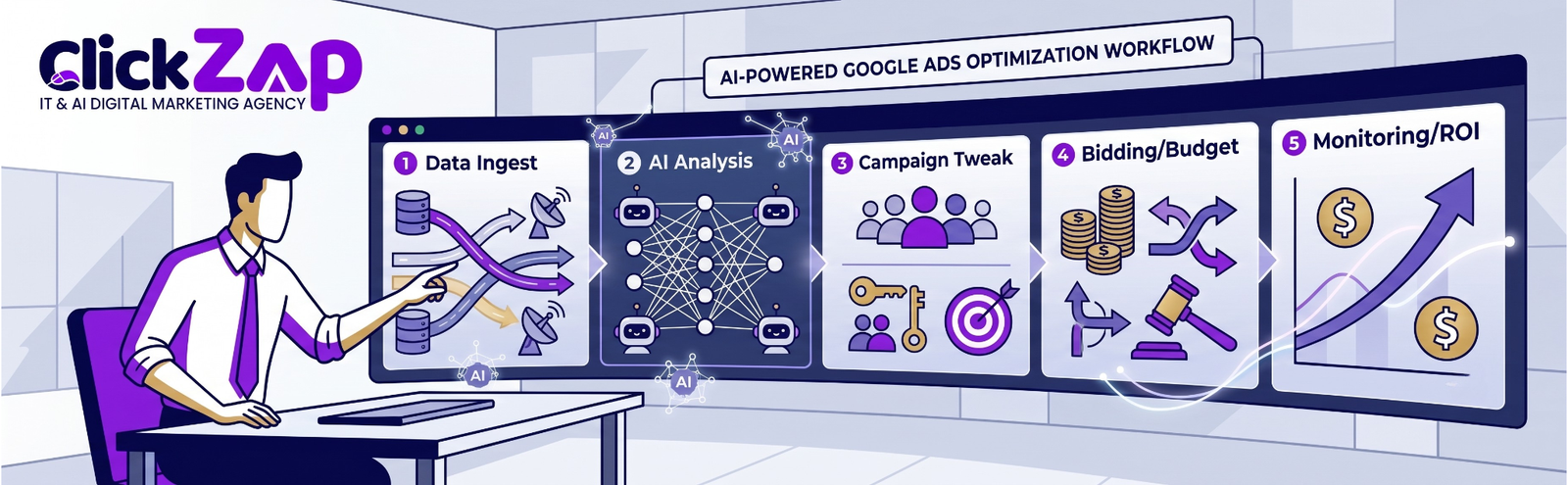
- Data Collection. Conversion tracking, audience signals, and historical performance data are gathered from Google Ads, Google Analytics 4, and Google Tag Manager.
- Campaign Analysis. AI reviews this data to understand current performance across keywords, ad groups, audiences, and devices.
- Opportunity Detection. The system flags underperforming search terms, bid inefficiencies, or audience segments worth expanding.
- Optimization. Adjustments are made automatically through Smart Bidding, or recommended for human approval, depending on the account setup.
- Testing. New ad copy, audiences, or bidding strategies are tested against existing performance benchmarks.
- Performance Monitoring. Results are tracked continuously rather than reviewed only at reporting intervals.
- Continuous Improvement. Insights from each cycle feed back into the next round of optimization, refining targeting and bidding over time.
This cycle repeats constantly rather than following a fixed monthly schedule, which is the core difference from traditional management.
How AI Can Optimize Different Google Ads Campaign Types
- Search Campaigns — AI assists with keyword targeting, search term analysis, negative keyword management, and Smart Bidding based on conversion signals.
- Performance Max Campaigns — relies heavily on Google’s AI to allocate budget and creative assets across channels automatically, based on the goals and inputs a business provides.
- Display Campaigns — AI helps with audience targeting and creative optimization across the Google Display Network, adjusting placements based on engagement data.
- Shopping Campaigns — AI evaluates product feed performance, adjusts bids per product, and identifies which SKUs deserve more budget.
- Remarketing Campaigns — AI segments users by behavior and conversion likelihood, helping prioritize spend on audiences closer to converting.
Key Google Ads Metrics AI Can Help Optimize
- Impressions — how often ads are shown; useful for understanding reach and auction competitiveness.
- Click-through rate (CTR) — the percentage of impressions that result in a click; reflects ad relevance.
- Cost per click (CPC) — what a business pays per click; a key lever in budget efficiency.
- Conversion rate — the percentage of clicks that become conversions; ties ad performance to actual results.
- Cost per conversion — how much each conversion costs, critical for judging efficiency.
- Conversion value — the monetary value assigned to conversions, used in value based bidding.
- ROAS — return on ad spend, a core profitability metric for e-commerce and lead gen accounts alike.
- Advertising ROI — the broader return once all costs are considered, not just ad spend.
- Quality Score — Google’s rating of keyword relevance, ad quality, and landing page experience, which affects CPC and ad rank.
- Search impression share — the percentage of eligible impressions a campaign actually receives, showing missed opportunity.
Each metric matters because it points to a different part of the funnel visibility, relevance, cost efficiency, or actual business return and AI driven optimization works best when all of them are tracked together, not in isolation.
Common Challenges of Using AI for Google Ads Optimization
AI powered optimization is genuinely useful, but it isn’t automatic and it isn’t foolproof.
- Poor quality conversion data. If tracking is broken or incomplete, AI systems optimize toward the wrong signals.
- Incorrect tracking setup. Misconfigured Google Tag Manager or Google Analytics 4 implementations can quietly distort performance data for months.
- Over reliance on automation. Letting AI run unsupervised can drift a campaign away from business goals if nobody checks in.
- Limited strategic context. AI doesn’t know a business is launching a new product line next month or pausing inventory humans still need to communicate that context.
- Brand messaging risks. AI generated ad copy can miss tone, compliance requirements, or brand voice without human review.
- Budget constraints. Smart Bidding and automated systems generally need enough conversion volume to learn effectively; very low budget accounts may see limited benefit.
- AI generated recommendations requiring human review. Not every suggestion Google Ads surfaces is appropriate for every account.
- Data quality issues. Seasonal shifts, promotions, or one off events can confuse automated systems if not flagged.
- Changing customer behavior. Consumer intent shifts, and AI systems need time to adapt to new patterns.
This is why human expertise remains essential. Someone still has to define goals, verify tracking, and interpret whether an AI recommendation actually fits the business.
Best Practices for Google Ads Optimization With AI
- Set up accurate conversion tracking before relying on any automated system
- Define clear, specific campaign goals (leads, sales, ROAS targets)
- Use reliable first party data wherever possible
- Review search term reports regularly, even with AI monitoring in place
- Maintain and update negative keyword lists
- Test ad messaging continuously rather than “set and forget”
- Monitor CPC and conversion rates weekly, not just monthly
- Evaluate ROAS by campaign and audience segment, not just account-wide
- Choose Smart Bidding strategies that match actual campaign goals
- Combine AI automation with human oversight at every stage
- Continuously analyze performance instead of waiting for scheduled reports
When Should a Business Use AI Google Ads Optimization Services?
AI Google Ads optimization services for businesses are worth considering when:
- Campaigns are spending more than expected without proportional results
- CPC is steadily increasing
- Conversion rates are low or declining
- Campaigns generate enough data volume for AI systems to learn from
- Manual optimization is taking up too much internal time
- Multiple campaigns or accounts need coordinated management
- The business wants to scale PPC spend without scaling in house headcount
- Internal teams don’t have deep Google Ads expertise
- The company’s main goal is a better, measurable advertising ROI
If an account is brand new with very little spend or conversion history, AI powered bidding may need more time to gather signals before it performs at its best. This is a reasonable trade off to plan for, not a reason to avoid it.
How to Choose the Right AI Google Ads Optimization Services for Your Business
Not every provider that claims “AI powered” management delivers the same value. Evaluate based on:
- Google Ads expertise — do they understand campaign structure, not just automation tools?
- AI and automation capabilities — do they use Smart Bidding, Performance Max, and data driven testing appropriately, rather than just claiming “AI” as a buzzword?
- Conversion tracking knowledge — can they audit and fix Google Analytics 4 and Google Tag Manager setups?
- Reporting transparency — do they show clear, honest performance data, not just vanity metrics?
- Industry experience — have they worked with businesses similar in size or vertical?
- Testing methodology — do they run structured ad copy and audience tests, or rely on guesswork?
- Human oversight — is there a real person reviewing AI recommendations before they go live?
- Communication — will they explain decisions in plain language, not just jargon?
- Performance measurement — do they tie results back to ROAS and advertising ROI, not just clicks?
- Strategic alignment — can they connect PPC performance to broader marketing goals like SEO and content?
Frequently Asked Questions
What is AI Google Ads optimization?
AI Google Ads optimization is the use of machine learning and automation to analyze campaign data bids, keywords, audiences, and ad copy and improve performance faster than manual management alone. It works alongside human strategy rather than replacing it, using continuous data analysis to catch inefficiencies earlier.
Can AI optimize Google Ads campaigns?
Yes. AI can adjust bids through Smart Bidding, identify converting and non-converting search terms, test multiple ad variations, and refine audience targeting based on conversion signals. It works best when conversion tracking is accurate and a human still reviews strategic decisions and results.
How does AI improve Google Ads ROI?
AI improves advertising ROI by reducing wasted spend on irrelevant clicks, refining bids based on real conversion signals, and directing budget toward higher-performing keywords and audiences. The effect builds over time as the system gathers more performance data, rather than producing an instant jump in ROI.
Can AI reduce Google Ads costs?
AI can reduce wasted spend by catching irrelevant search terms and inefficient bids faster than manual reviews. It doesn’t guarantee lower overall costs, since a business may choose to reinvest savings into scaling successful campaigns instead. The main benefit is more efficient spend, not necessarily a smaller budget.
What is AI-powered Google Ads management?
AI-powered Google Ads management combines automated tools like Smart Bidding and Performance Max with human oversight to run and optimize campaigns. AI handles data heavy tasks like bid adjustments and pattern detection, while a marketer sets goals, reviews recommendations, and maintains brand and strategic control.
Why Choose ClickZap IT for AI Powered Google Ads Optimization?
ClickZap IT is a Hyderabad based digital marketing agency that combines Google Ads expertise with AI assisted optimization across bidding, targeting, ad copy, and performance measurement. Rather than treating AI as a replacement for strategy, ClickZap IT uses it to support faster, more informed decisions while a human team still owns the goals, the testing plan, and the final call on what goes live.
For businesses looking at AI Google Ads optimization services, ClickZap IT’s approach connects PPC performance with the rest of a business’s digital marketing SEO, content, and conversion tracking so ad spend isn’t optimized in isolation from the rest of the growth strategy.
If your Google Ads campaigns are spending more than they should, converting less than they could, or simply taking too much internal time to manage, it’s worth a conversation. Contact ClickZap IT to discuss your Google Ads goals and see where AI assisted optimization could help.
Also Read : How AI Helps Analyze Search Intent for SEO to Improve Google Rankings
0 Comments