
Most businesses today are sitting on more customer data than they know what to do with. Website visits, ad clicks, email opens, purchase history it all piles up in different tools, and most of it never gets used to actually improve a campaign. Without AI powered customer segmentation for marketing, the result is generic messaging sent to everyone, wasted ad spend, and campaigns that convert far fewer people than they should.
This is exactly the problem that AI powered customer segmentation for marketing is built to solve. Instead of guessing who your best customers are, AI analyzes real behavior and data to group audiences based on what they actually do, want, and respond to. In this guide, you’ll learn what AI customer segmentation is, how it works, which tools support it, and how to build a practical segmentation strategy even if you’re running a small business with limited resources.
What Is AI Powered Customer Segmentation for Marketing?
AI powered customer segmentation for marketing uses artificial intelligence to analyze customer data, identify behavioral patterns, and divide audiences into meaningful groups so businesses can deliver more relevant marketing messages.
In simpler terms, AI customer segmentation looks at how people actually behave when they browse, buy, click, and ignore and organize them into groups based on shared patterns. This is different from manually sorting customers by a single trait like age or location. AI driven customer segmentation can combine dozens of signals at once, something that would take a marketing team weeks to do by hand.
For example, an online clothing store might use AI powered audience segmentation to notice that a group of customers regularly browses premium items, watches product videos, and returns to the site multiple times before buying only during sale periods. That’s a specific, actionable segment not just “women aged 25–40.”
Best AI Digital Marketing Agency in Hyderabad
How Does AI Customer Segmentation Work?
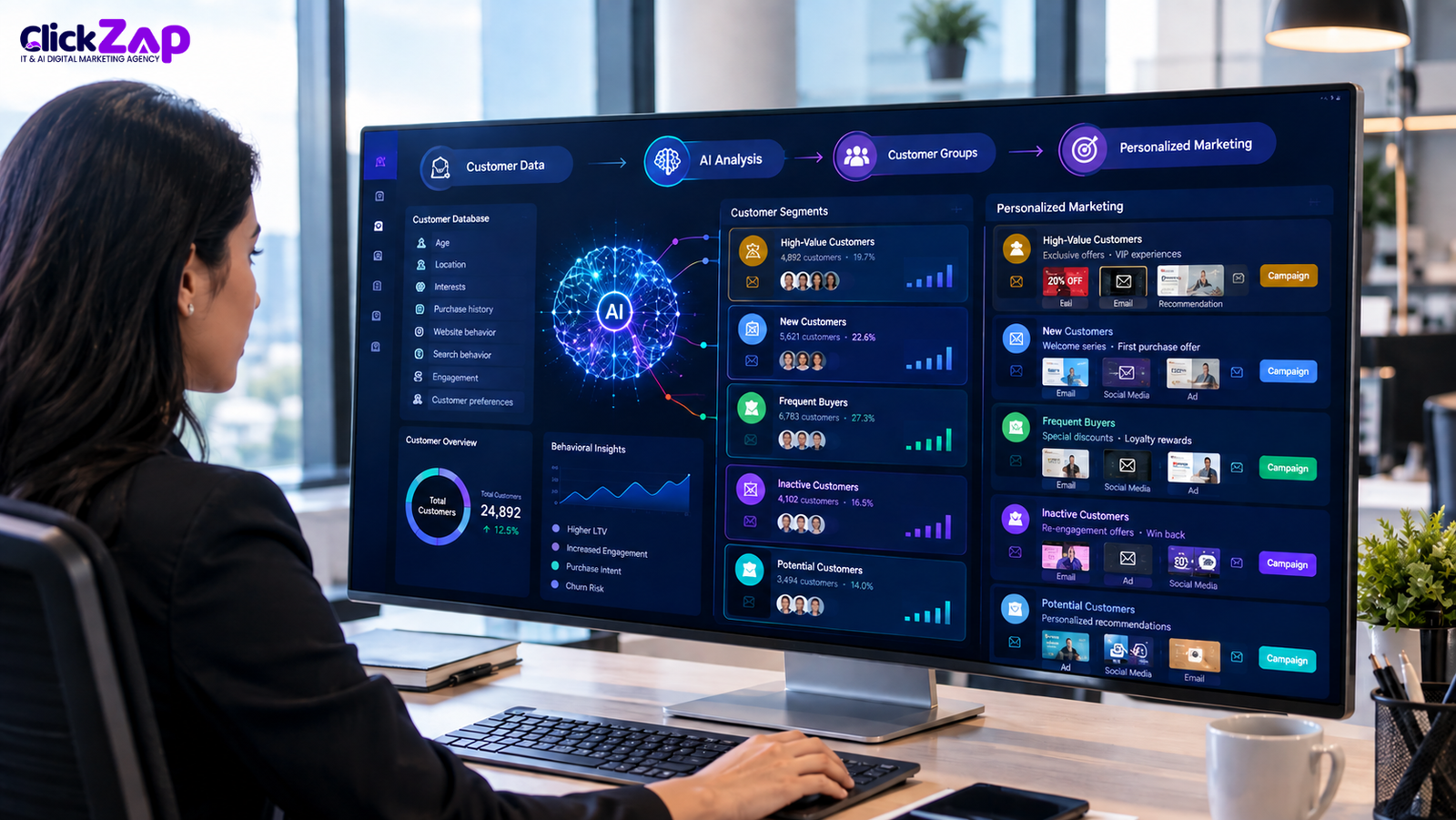
AI customer segmentation follows a fairly consistent process, even though the underlying tools vary by business.
- Collect customer data : from your website, CRM, ad platforms, and email tool.
- Clean and organize the data : removing duplicates, fixing formatting issues, and standardizing fields.
- Analyze customer behavior : reviewing browsing patterns, purchase history, and engagement.
- Identify patterns : AI models detect similarities across thousands of data points that a human would miss.
- Create customer segments : grouping people who share behaviors, needs, or intent.
- Predict customer intent : estimating who is likely to buy, churn, or re-engage.
- Build personalized audiences : turning segments into targetable lists for campaigns.
- Launch targeted campaigns : sending the right message to the right segment.
- Measure performance : tracking how each segment responds.
- Continuously improve segments : refining groups as new data comes in.
For example, a SaaS company might notice through this process that trial users who log in three or more times in the first week convert at a much higher rate. That single insight can reshape an entire onboarding email sequence.
Why Is Customer Segmentation Important for Targeted Marketing?
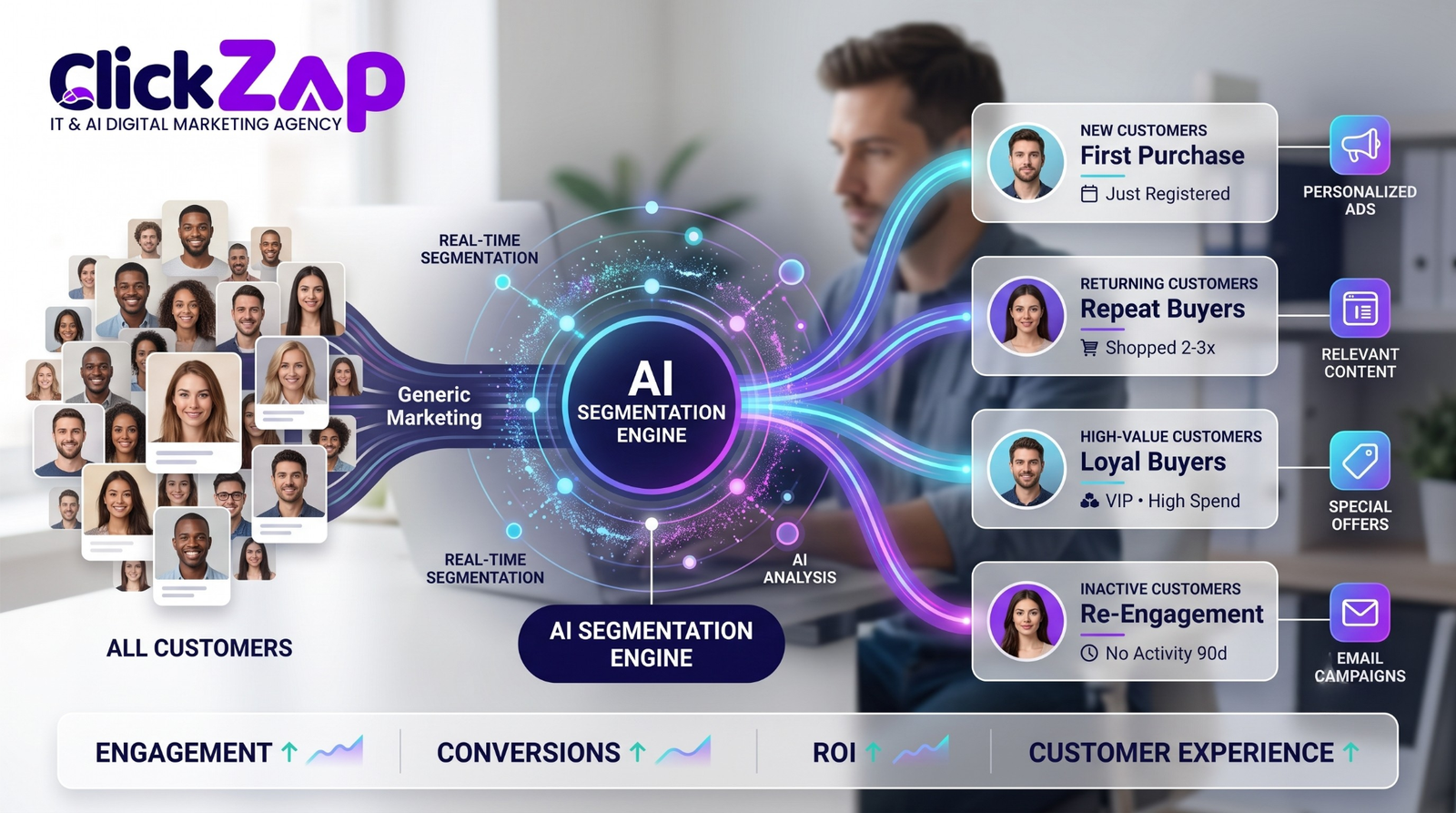
Customer segmentation for targeted marketing matters because it directly affects how relevant and effective your campaigns are.
- Better target audience identification: You know exactly who you’re speaking to.
- More relevant messaging: Each group gets content that actually applies to them.
- Higher engagement: Relevant messages get more clicks, replies, and views.
- Improved conversion rates: Personalized offers tend to convert better than generic ones.
- Better customer experience: People feel understood rather than spammed.
- Reduced advertising waste: Budget goes toward audiences likely to respond.
- Improved ROI: Every rupee spent works harder when targeting is precise.
- Better customer retention: Segmented follow up keeps existing customers engaged.
Without segmentation, marketing becomes a numbers game sent to everyone and hopes enough people respond. With it, marketing becomes a matching exercise: right message, right person, right time.
Traditional Customer Segmentation vs AI Customer Segmentation
Traditional segmentation still has value, especially for basic planning. But AI based customer segmentation adds depth, speed, and precision that manual methods can’t match at scale.
|
Factor |
Traditional Segmentation |
AI Customer Segmentation |
|
Data processing |
Manual, limited to a few variables |
Processes large, multi source datasets |
|
Speed |
Slow, often takes days or weeks |
Near real time |
|
Accuracy |
Based on assumptions and averages |
Based on actual behavior patterns |
|
Scalability |
Difficult beyond a few thousand records |
Scales across large customer bases |
|
Behavioral insights |
Limited |
Deep and continuously updated |
|
Predictive capabilities |
Minimal |
Can estimate intent, churn, and value |
|
Personalization |
Broad, generic groups |
Highly specific micro-segments |
|
Automation |
Mostly manual |
Can update segments automatically |
|
Real time optimization |
Not possible |
Segments adjust as behavior changes |
AI based customer segmentation doesn’t need to completely replace traditional methods. Many businesses still use basic demographic groupings as a starting point, then layer AI driven behavioral insights on top for sharper targeting.
Types of Customer Segmentation AI Can Improve
Demographic Segmentation
This groups customers by age, gender, income, occupation, and education. AI can combine these traits with behavior to avoid relying on demographics alone.
Geographic Segmentation
This covers the country, state, city, region, and local area. AI can identify which locations respond best to specific offers or messaging styles.
Behavioral Segmentation
This includes website visits, product views, purchases, email interactions, ad clicks, and browsing behavior. This is where AI tends to add the most value, since it can track patterns across many touchpoints at once.
Psychographic Segmentation
This covers interests, values, lifestyle, preferences, and motivations. AI can infer some psychographic signals from content engagement and browsing patterns, though this data is generally less precise than direct behavioral data.
Purchase Behavior Segmentation
This includes first time buyers, repeat customers, high value customers, discount driven customers, inactive customers, and abandoned cart users.
AI’s real advantage is combining multiple segmentation types at once. Instead of choosing between demographic or behavioral segmentation, AI can build a single segment like “repeat buyers aged 25–35 in Tier 1 cities who respond well to limited time offers.”
How AI Analyzes Customer Data
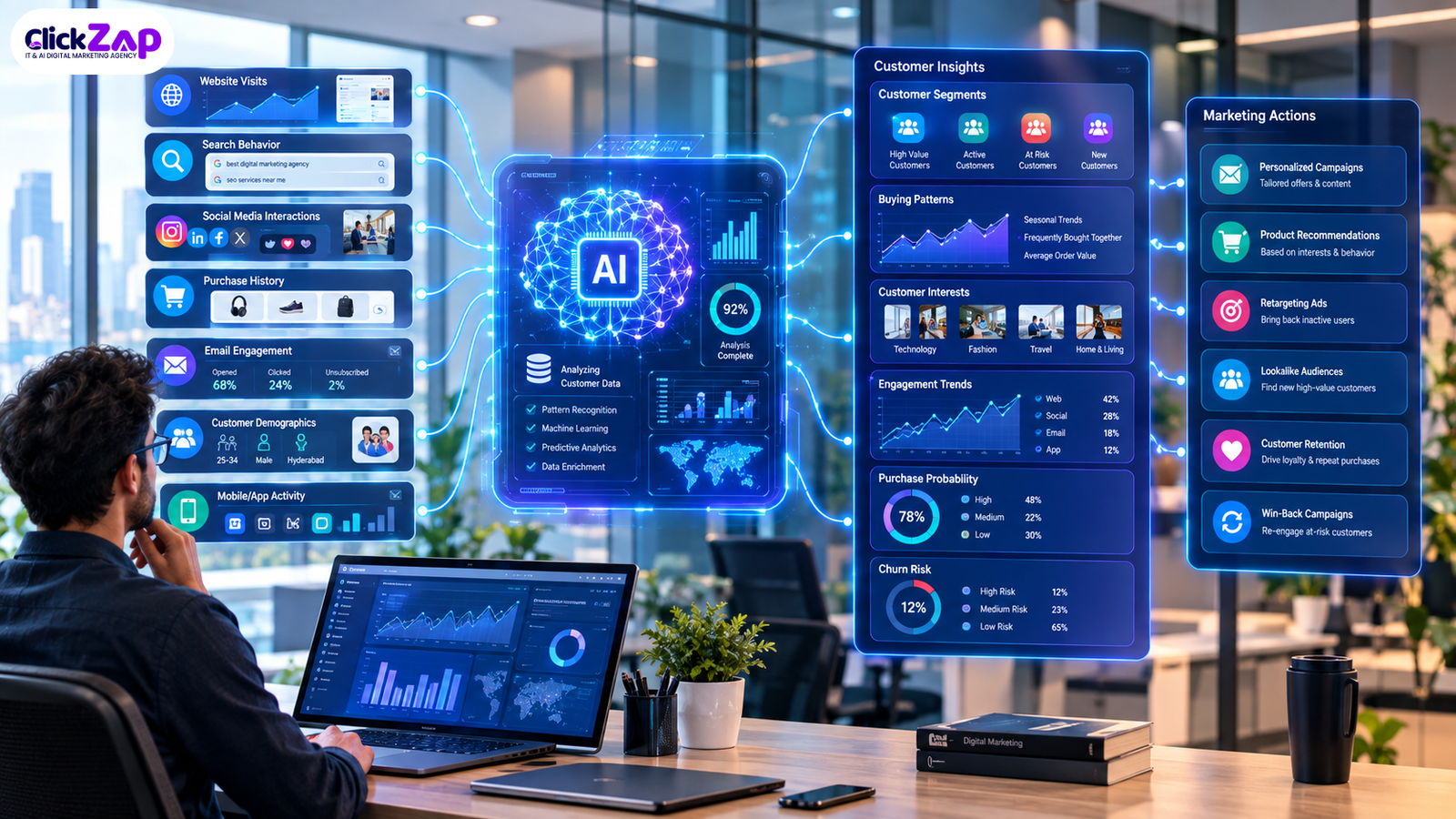
AI systems can process many types of customer information together, including:
- Website activity
- Purchase history
- Search behavior
- Advertising interactions
- Social media engagement
- Customer preferences
- CRM data
- Email interactions
This combined view is what makes customer data analysis and customer behavior analysis so much more useful with AI. Instead of looking at one data source in isolation, AI connects the dots across a customer’s full journey.
Predictive analytics is a core part of this process. In simple terms, predictive analytics uses past behavior patterns to estimate what a customer is likely to do next such as whether they’re likely to make a purchase, churn, or respond to a specific type of offer. It doesn’t guarantee outcomes, but it gives marketers a data backed starting point instead of a guess.
AI Customer Targeting: How AI Finds the Right Audience
AI customer targeting focuses on identifying which customers matter most for a specific goal. This typically includes:
- High intent customers: People showing strong signals of wanting to buy soon.
- High value customers: Customers who spend more or buy more frequently.
- Customers likely to convert: Based on behavior similar to past converters.
- Customers likely to churn: Showing reduced engagement or activity.
- Repeat purchase opportunities: Customers due for a reorder or renewal.
- Cross selling opportunities: Customers who may benefit from related products.
- Upselling opportunities: Customers who may be ready for a premium tier.
These AI audience targeting strategies help marketers stop treating every customer the same way. A first time visitor and a loyal repeat buyer have very different needs, and AI helps surface that difference clearly.
How AI Powered Audience Segmentation Improves Personalization
Once segments are defined, marketing personalization becomes far more practical. Different groups can receive different ads, offers, content, emails, landing pages, product recommendations, and calls to action.
Here’s a simple example of how this plays out:
Segment A: New website visitors
Message: Educational content that explains the product or service.
Segment B: Product viewers
Message: Product benefits paired with social proof, like reviews or case studies.
Segment C: Existing customers
Message: Upsell or cross sell offers based on past purchases.
Segment D: Inactive customers
Message: A re-engagement campaign, often with an incentive to return.
This is the practical core of AI powered customer segmentation for marketing matching the right message to the right stage of the customer journey, instead of sending the same email to everyone on the list.
How AI Segmentation Can Improve Google Ads Campaigns
Google Ads is one of the most common platforms where customer segmentation shows up directly in performance. AI-informed segmentation can help marketers identify high intent audiences, returning visitors, similar customer groups, high value customers, and conversion focused audiences.
Segmentation insights can influence several parts of a Google Ads campaign:
- Audience targeting: Choosing who sees which ad group
- Ad messaging: Tailoring copy to match what a segment cares about
- Landing page personalization: Sending different segments to pages built for their intent
- Budget allocation: Directing more spend toward segments with stronger conversion signals
- Campaign optimization: Adjusting bids and creative based on segment performance
It’s worth being clear here: segmentation improves the inputs marketers work with, but actual campaign results still depend on account structure, creative quality, and ongoing optimization.
How AI Segmentation Can Improve Meta Ads Targeting
On Meta Ads, customer insights gathered through Meta Business Suite can help marketers build more relevant audience strategies. This includes grouping people by engagement level, distinguishing website visitors from existing customers, building retargeting audiences, and using lookalike style audience strategies where the platform supports them.
For example, a business might create one Meta Ads audience for people who engaged with recent posts, a separate retargeting audience for website visitors who didn’t convert, and a third audience for existing customers eligible for a loyalty offer. AI informed segmentation doesn’t automatically guarantee better results; it simply gives marketers a clearer, more accurate starting point for building these audiences.
AI Marketing Segmentation Tools Businesses Can Use
Different tools play different roles in an AI segmentation workflow. Here’s a practical breakdown:
Google Analytics : Tracks website behavior like page visits, traffic sources, and on-site actions. Useful for understanding how different visitor segments interact with your website before you build targeting strategies around them.
Google Ads : An advertising platform where segmentation insights inform audience targeting, ad messaging, and budget decisions.
Meta Ads : Facebook and Instagram’s advertising platform, useful for reaching segments based on engagement, retargeting, and interest signals.
Meta Business Suite : A management hub for Meta’s ad and page tools, useful for reviewing audience engagement data across Facebook and Instagram.
HubSpot : A CRM and marketing automation platform. It can store customer data and support segmented email or workflow automation based on customer activity.
Salesforce : A CRM widely used for managing customer relationships, sales pipelines, and customer data that can inform segmentation strategies, particularly for B2B businesses.
OpenAI : The company behind AI models like GPT, which can support tasks like analyzing customer feedback or drafting segment specific messaging.
ChatGPT : A generative AI assistant that can help marketers summarize research, draft persona profiles, and generate campaign ideas for different segments.
Google Gemini : Google’s generative AI assistant, which can support similar tasks like content drafting and research summarization.
Amazon Personalize : A machine learning service that businesses can use to build personalized recommendations based on customer behavior data.
Not every tool here performs AI segmentation the same way. Analytics platforms track behavior, CRMs store and organize customer data, advertising platforms activate audiences, and generative AI tools support research and content creation. Understanding this distinction helps businesses use each tool for what it’s actually built for.
How ChatGPT, OpenAI, and Google Gemini Can Support Customer Segmentation
Generative AI tools like ChatGPT and Google Gemini aren’t segmentation engines on their own, but they can support the process in practical ways:
- Analyzing customer research and survey responses
- Creating draft customer persona descriptions
- Summarizing qualitative feedback from reviews or support tickets
- Developing segment specific messaging ideas
- Generating campaign concepts for different audience groups
- Creating personalized content variations for testing
It’s important to validate any AI generated insight against real customer and business data before acting on it. Generative AI can speed up research and drafting, but it doesn’t replace actual behavioral data from your analytics, CRM, or ad platforms.
How to Build an AI Customer Segmentation Strategy
Step 1: Define the marketing objective. Are you trying to increase conversions, retain customers, or launch a new product?
Step 2: Identify available customer data. List what you already collect: website analytics, CRM records, purchase history, email engagement.
Step 3: Select useful segmentation variables. Choose the traits and behaviors most relevant to your objective.
Step 4: Analyze customer behavior. Look for patterns in how different groups interact with your business.
Step 5: Create meaningful customer segments. Group customers based on shared, actionable characteristics.
Step 6: Develop customer personas. Turn each segment into a clear profile your team can reference.
Step 7: Match each segment with the right marketing message. Align content and offer what each group actually needs.
Step 8: Activate segments across relevant channels. Use email, ads, and website personalization to reach each group.
Step 9: Track campaign performance. Monitor how each segment responds compared to others.
Step 10: Continuously refine segments. Update groupings as new data comes in and behavior shifts.
For example, a B2B consulting firm might define its objective as generating more qualified leads, then use LinkedIn engagement data and website behavior to separate cold prospects from warm, sales ready leads, adjusting messaging for each group accordingly.
Example of AI Powered Customer Segmentation for an E-commerce Business
|
Segment |
Customer Behavior |
Marketing Strategy |
Example Message |
Goal |
|
New visitors |
Browsing without purchase history |
Educational content |
“Here’s how our product works” |
Build awareness |
|
First time buyers |
Made one purchase |
Welcome and onboarding |
“Thanks for your order here’s what’s next” |
Build loyalty |
|
Repeat buyers |
Multiple purchases over time |
Loyalty and rewards |
“You’ve earned a reward on your next order” |
Increase retention |
|
High value customers |
High average order value |
VIP or early access offers |
“Get early access to our new collection” |
Maximize lifetime value |
|
Discount focused customers |
Buys mainly during sales |
Sale and promo alerts |
“Sale starts tomorrow get ready” |
Drive conversions |
|
Abandoned cart users |
Added items but didn’t check out |
Cart recovery email |
“You left something in your cart” |
Recover lost sales |
|
Inactive customers |
No activity in recent months |
Re engagement campaign |
“We miss you here’s something special” |
Win back customers |
AI Segmentation Strategies for Marketers
- Segment by purchase intent useful for identifying who’s close to buying.
- Segment by customer lifetime value useful for prioritizing retention efforts.
- Segment by engagement level useful for deciding email or ad frequency.
- Segment by purchase frequency useful for identifying loyal versus occasional buyers.
- Segment by product interest useful for cross selling relevant items.
- Segment by website behavior useful for retargeting and content personalization.
- Segment by customer lifecycle stage useful for matching messaging to where someone is in the journey.
- Segment by predicted churn risk useful for timely retention campaigns.
- Segment by content engagement useful for nurturing leads with relevant content.
- Combine multiple data signals useful for building precise, high performing micro segments.
Each strategy fits a different goal, so most businesses end up using several of them together rather than relying on just one.
Digital Marketing Services for Business
Customer Personas and AI Powered Audience Segmentation
AI can help marketers move beyond generic personas toward more data informed profiles.
A generic persona might look like this: “Women aged 25-40 interested in fashion.”
A more useful, AI informed behavioral profile might look like this instead: “Customers who regularly browse premium products, engage with product videos, return to the website multiple times, and purchase during seasonal campaigns.”
The second version tells you what to say and when to say it. Behavioral signals add depth that demographic data alone can’t provide, which is why combining both tends to produce stronger personas than either one on its own.
Common Mistakes in AI Customer Segmentation
- Using poor quality data inaccurate or outdated data leads to inaccurate segments.
- Creating too many overly granular segments becomes hard to manage or act on.
- Ignoring privacy, collecting or using data without proper consent creates risk.
- Making assumptions from limited data small sample sizes can produce misleading patterns.
- Over relying on AI predictions AI output should guide decisions, not replace judgment.
- Not testing segments assuming a segment works without validating it through campaigns.
- Ignoring customer lifecycle stages, treating new and long term customers the same way.
- Creating segments without a marketing purpose segmentation for its own sake adds little value.
- Failing to update segments customer behavior changes, and segments should too.
- Treating AI output as automatically accurate AI models can misread patterns, especially with incomplete data.
Privacy and Ethical Considerations in AI Customer Segmentation
Responsible segmentation starts with responsible data collection. Businesses should only collect data with proper consent, store it securely, and be transparent with customers about how their information is used.
A few practical principles to keep in mind:
- Collect only the data you actually need for segmentation and marketing.
- Be clear with customers about what data is collected and why.
- Secure customer data against unauthorized access.
- Avoid using sensitive attributes in ways that could lead to discriminatory targeting.
- Stay compliant with applicable privacy regulations relevant to your market.
Ethical, transparent data practices aren’t just a compliance requirement; they also build the kind of customer trust that makes long term marketing relationships work.
Benefits of AI Powered Customer Segmentation for Businesses
- Better audience profiling a clearer picture of who your customers actually are.
- More accurate targeting messages reach people likely to respond.
- Personalized marketing content that feels relevant instead of generic.
- Improved customer experience customers get offers that match their needs.
- Better campaign efficiency, less budget wasted on the wrong audiences.
- Higher engagement relevant content earns more attention.
- Better conversion opportunities matched messaging tends to perform better.
- Improved retention segmented follow up keeps customers engaged longer.
- More informed decision making data backed segments reduce guesswork.
- Scalable marketing segmentation processes that work at any customer volume.
What Is the Future of AI Customer Segmentation?
AI customer segmentation is likely to keep moving toward more real time, connected systems. A few realistic directions worth watching:
- Real time audience analysis : segments that update as customer behavior changes, rather than static lists refreshed periodically.
- Predictive customer behavior : more refined predictions of intent, churn, and lifetime value.
- Hyper personalization : messaging tailored to smaller, more specific micro segments.
- AI powered marketing automation : segmentation feeding directly into automated campaign triggers.
- Cross channel audience intelligence : a more unified view of customer behavior across web, social, and email.
- Predictive customer lifetime value : better estimates of long term customer worth, not just immediate conversion likelihood.
- AI driven customer journeys : journeys that adapt based on real time segment behavior.
- More advanced personalization : deeper content and offer customization as data quality improves.
These trends point toward more connected, responsive marketing systems but they still depend on businesses maintaining clean data, clear objectives, and thoughtful execution.
How ClickZap IT Can Help With AI Powered Customer Segmentation
Building an effective AI segmentation strategy takes more than just picking a tool; it requires the right combination of audience research, customer data analysis, and consistent campaign execution.
ClickZap IT works with businesses to bring these pieces together. That includes analyzing customer data to identify meaningful segments, building AI driven marketing strategies around those segments, and supporting execution across SEO, Google Ads, Meta Ads, and social media marketing. From there, ClickZap IT helps refine messaging for marketing personalization, improve conversion optimization across landing pages, and track performance so segments keep improving over time.
If your business has customer data but isn’t sure how to turn it into sharper targeting, ClickZap IT can help you build a segmentation strategy that fits your specific goals and budget. Reach out and start the conversation.
FAQs About AI Powered Customer Segmentation for Marketing
What is AI powered customer segmentation for marketing?
AI powered customer segmentation for marketing uses artificial intelligence to analyze customer data and group audiences based on shared behaviors, preferences, and characteristics, so businesses can send more relevant marketing messages.
How does AI customer segmentation work?
AI collects and analyzes customer data from sources like websites, CRMs, and ad platforms, identifies behavioral patterns, and groups customers into segments that can be targeted with tailored campaigns.
What is the difference between traditional and AI customer segmentation?
Traditional segmentation relies on manual analysis of basic traits like age or location. AI customer segmentation processes larger, more complex datasets in real time and can identify deeper behavioral and predictive patterns.
How does AI help with audience targeting?
AI helps identify high intent, high value, and at risk customers by analyzing behavior patterns, making it easier to target the right people with the right message at the right time.
What data is needed for AI customer segmentation?
Common data sources include website analytics, purchase history, email engagement, CRM records, and advertising interactions.
Conclusion
AI powered customer segmentation for marketing gives businesses a practical way to move from generic messaging to targeted, relevant campaigns. By analyzing real customer behavior instead of relying on assumptions, businesses can identify the right audiences, personalize marketing at scale, and reduce wasted ad spend across platforms like Google Ads and Meta Ads.
AI can help improve targeting and may increase conversion efficiency when supported by accurate data, testing, and effective campaign execution. The businesses that benefit most are the ones that treat segmentation as an ongoing process not a on time setup and pair it with clean data and clear marketing objectives.
Also Read: Will AGI Replace Digital Marketers? The Future of Human and AI Collaboration

0 Comments