
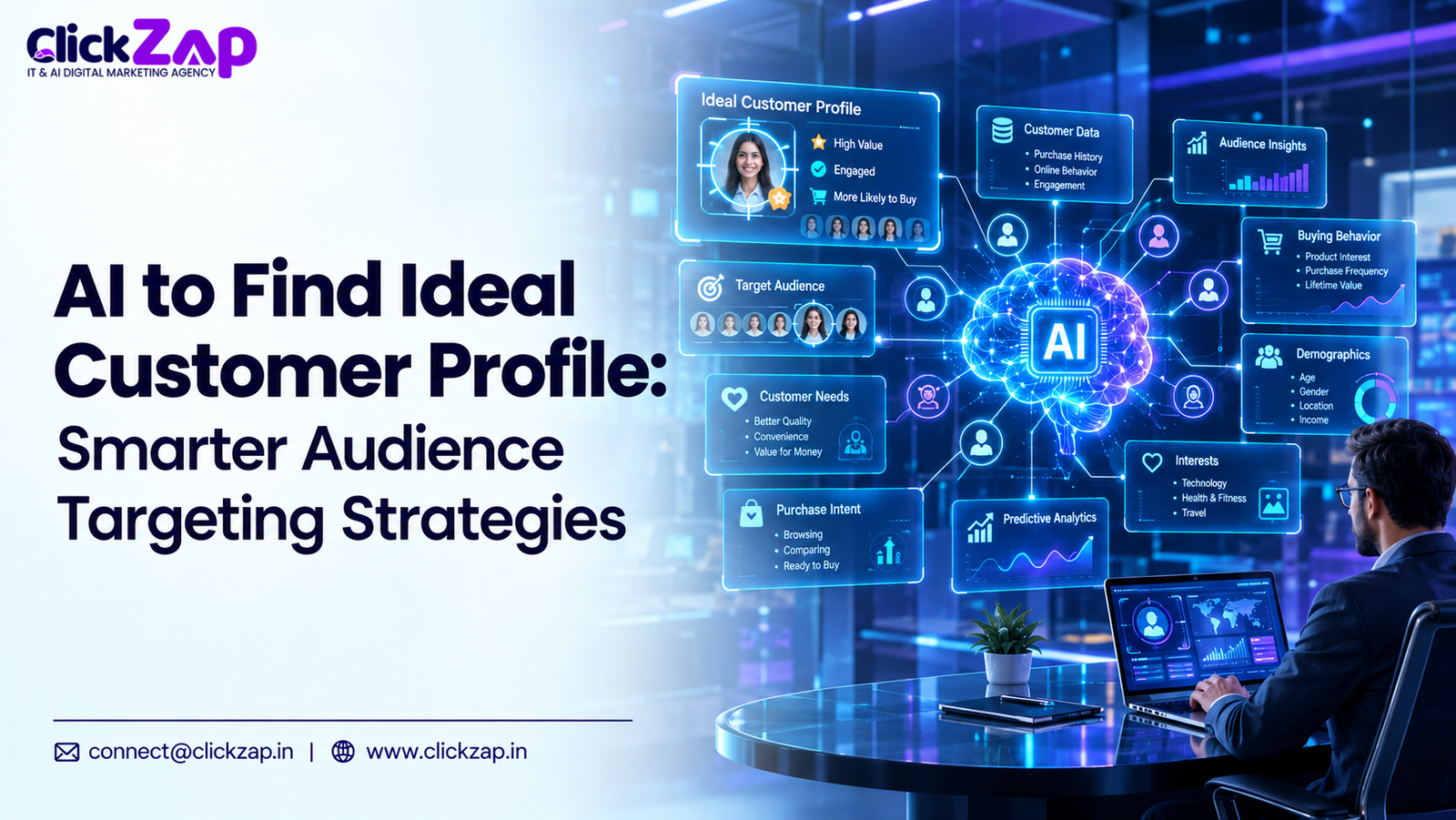
AI to Find Ideal Customer Profile
Most businesses don’t lose money because they aren’t marketing enough. They lose money because they’re marketing to the wrong people. A local ad budget gets spread across a broad, undefined audience, a social campaign pulls in clicks that never convert, and a sales team ends up chasing leads that were never a good fit in the first place. This is exactly the kind of problem that using AI to find ideal customer profile insights is designed to solve.
The problem usually isn’t effort. It’s clear. Businesses often don’t have a precise picture of who their best customers actually are, what they care about, how they behave, and what makes them buy.
This is where AI changes the equation. Using AI to find ideal customer profile insights allows businesses to analyze real customer data behavior, preferences, demographics, and purchasing patterns instead of relying on guesswork. Rather than assuming who the “right” customer might be, AI looks at what your actual data says and surfaces patterns a human might take weeks to notice manually.
This article breaks down what an ideal customer profile is, why so many businesses struggle to define one, and exactly how using AI to find ideal customer profile insights can help identify, build, and continuously refine it.
What Is an Ideal Customer Profile?
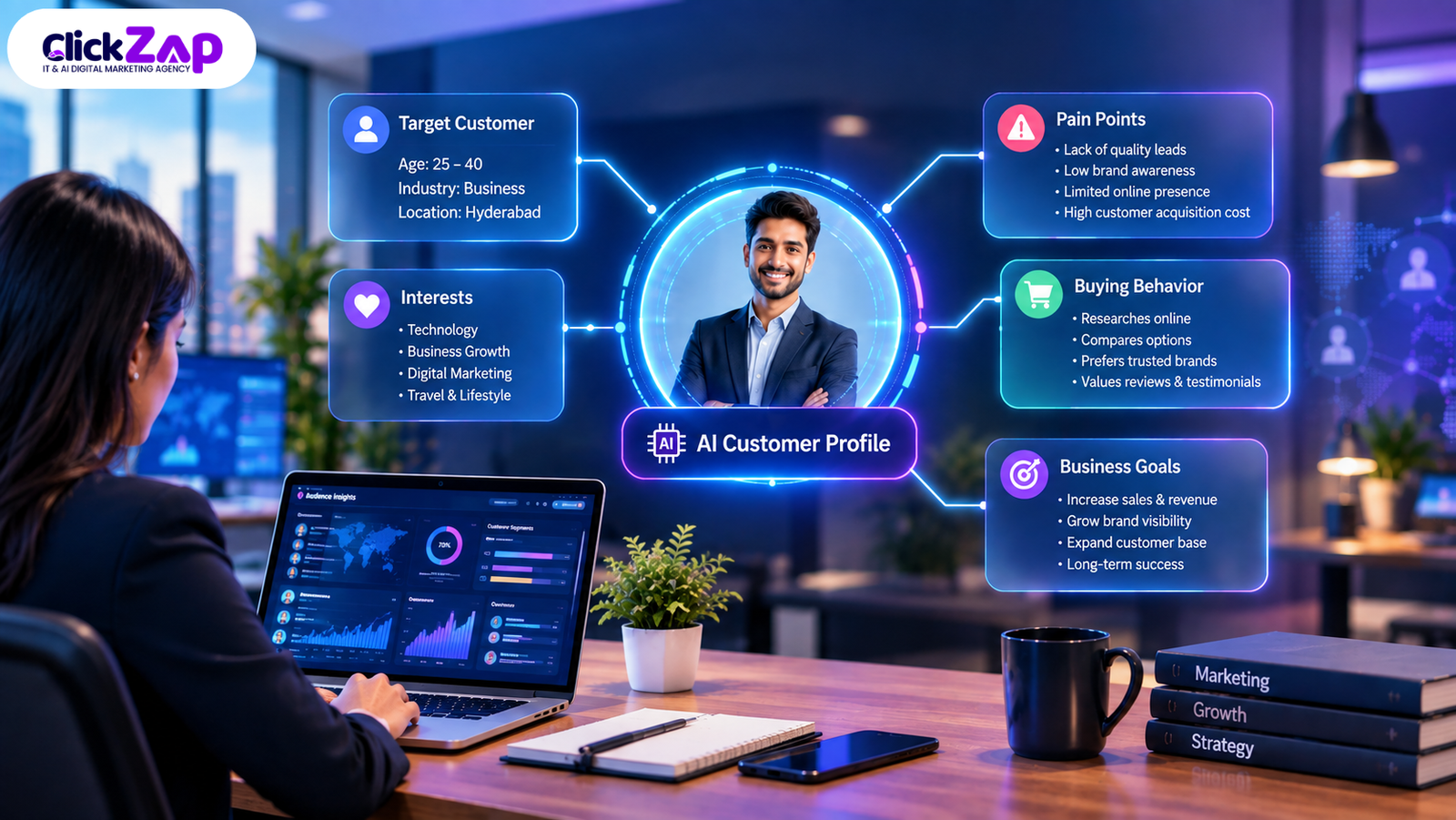
An Ideal Customer Profile (ICP) is a detailed description of the type of customer who gets the most value from your product or service and who, in turn, brings the most value to your business. It typically includes firmographic or demographic details, common problems, goals, buying behavior, and preferred communication channels.
ICP vs. Buyer Persona: What’s the Difference?
These two terms are often used interchangeably, but they aren’t quite the same:
- Ideal Customer Profile (ICP) describes the type of company or customer segment most likely to succeed with your offering often used in B2B contexts to describe firmographics like industry, company size, or budget.
- Buyer Persona goes a level deeper, describing an individual decision maker within that ideal customer, their role, motivations, pain points, and behavior.
In simple terms: the ICP tells you who to target, and the persona tells you how to speak to them.
Why a Clear Target Audience Matters
Without a defined ICP, marketing budgets get spread thin across people who were never likely to convert. A well built ICP is shaped by several factors:
- Demographics (age, location, income, industry)
- Preferences and interests
- Purchasing behavior
- Problems the customer is trying to solve
- Goals they’re working toward
- Where they are in the customer journey
Example: A B2B SaaS company selling HR software might define its ICP as “HR managers at mid sized Indian manufacturing companies who are actively looking to reduce manual payroll work and have budget authority for software purchases under ₹5 lakh annually.”
Digital Marketing Services for Business
Why Businesses Struggle to Identify Their Ideal Customers
Even businesses with plenty of data often struggle to build an accurate ICP. Common reasons include:
- Too much data, not enough insight : website analytics, CRM records, ad platforms, and social media each hold pieces of the picture, but no one has time to connect them manually.
- Poor customer segmentation : audiences get grouped too broadly instead of by meaningful behavior.
- Overly broad targeting : campaigns aim at “everyone who might be interested” instead of the people most likely to buy.
- Limited understanding of customer behavior : many businesses know what customers bought but not why.
- Changing preferences : what worked as a customer profile two years ago may not hold today.
- Disconnected platforms : data sitting in Google Analytics, a CRM, and an ad account rarely gets compared side by side.
- Reliance on assumptions : teams often build personas based on internal opinions rather than actual customer data.
This is exactly the kind of complexity AI is well suited to handle. Instead of manually cross referencing spreadsheets, using AI to find ideal customer profile patterns lets businesses process large volumes of data quickly and surface insights that would otherwise stay hidden.
How AI Finds Ideal Customers
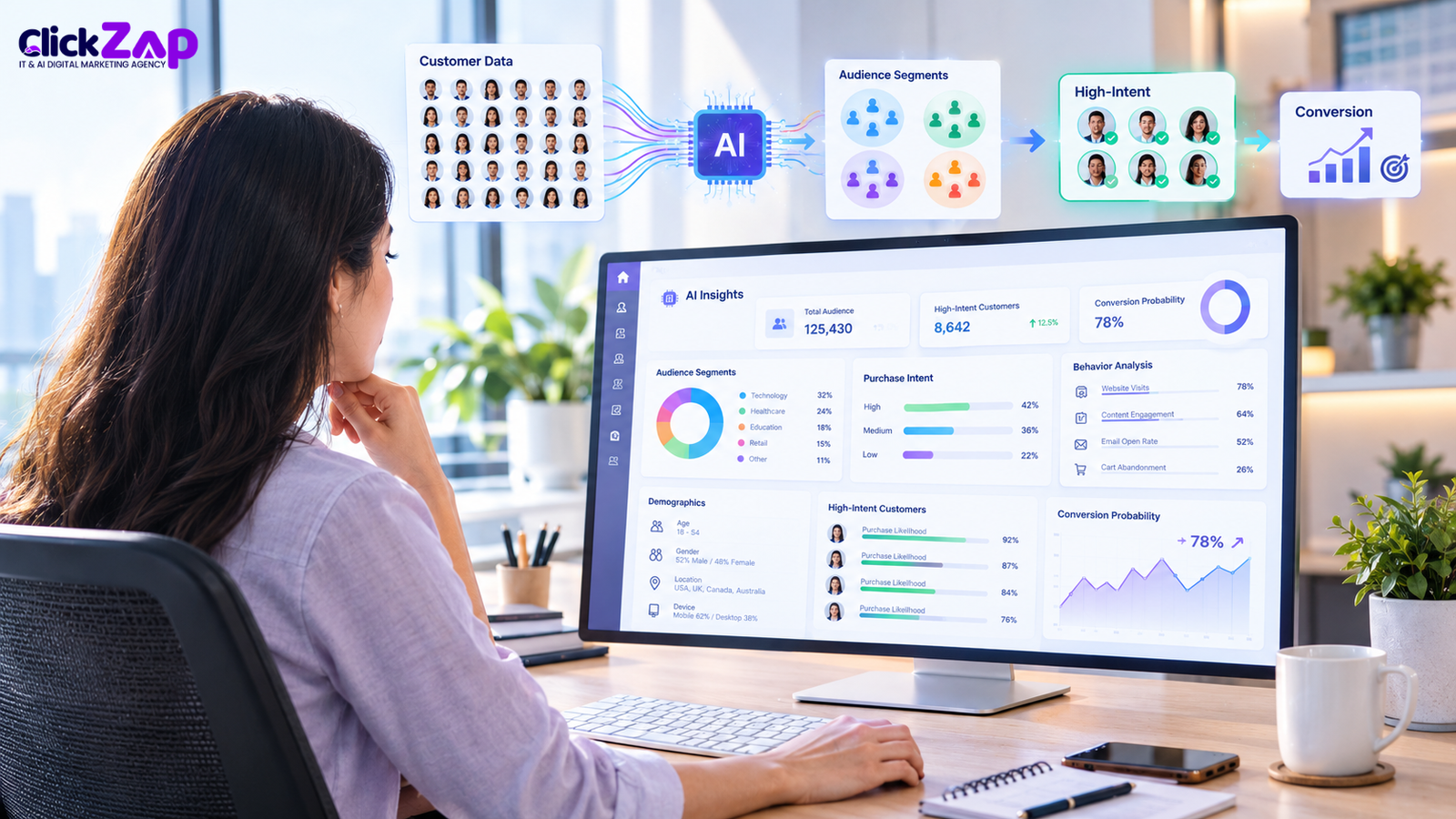
Understanding how AI finds ideal customers starts with looking at the process in stages. Each step builds on the last, turning scattered data points into a usable profile.
1. Collecting Customer Data
The process begins with gathering data from every touchpoint: website behavior, advertising platforms, CRM systems, social media interactions, purchase history, and customer support conversations. The more complete and accurate this data is, the more reliable the resulting profile will be.
2. Analyzing Customer Data
Once data is collected, AI customer profile analysis tools look for patterns across demographics, browsing behavior, interests, and purchasing habits. This is where AI’s ability to process large datasets quickly becomes valuable, spotting correlations that would take a human analyst far longer to find manually.
3. Identifying High Value Customers
Not all customers are equal in value. AI can help highlight which customers are more likely to make repeat purchases, engage consistently, or generate higher lifetime value giving businesses a clearer sense of who to prioritize.
4. Finding Common Customer Patterns
After high value customers are identified, AI looks for what they have in common shared industries, browsing habits, purchase timing, or content preferences. These shared traits form the foundation of the ideal customer profile.
5. Creating an Ideal Customer Profile
The patterns identified are then translated into a practical, usable profile one that marketing and sales teams can actually apply to targeting decisions, ad campaigns, and content strategy.
6. Improving the Profile Over Time
Customer behavior changes, and so should the ICP. AI powered customer profiling isn’t a one time exercise it continuously learns from new customer data and changing behavior.
Together, these steps show AI for ideal customer identification as an ongoing, data driven process rather than a single report generated once and forgotten.
How AI Customer Profile Analysis Works
A simple way to understand AI customer profile analysis is through this flow:
Data → Analysis → Patterns → Segments → ICP → Targeting → Optimization
Each stage depends on the one before it. Raw data is analyzed to find patterns, patterns are grouped into segments, segments inform the ideal customer profile, that profile guides targeting decisions, and results are measured to optimize future campaigns. In practice, this is what it means to use AI to find ideal customer profile insights rather than relying on a single snapshot report.
Some common data points AI may analyze during this process include:
- Age and location
- Industry and job role
- Website behavior and pages visited
- Products viewed
- Purchase history
- Engagement levels
- Ad interactions
- Customer interests
- Repeat purchase frequency
AI Powered Customer Profiling: What Data Should You Use?
The accuracy of any AI powered customer profiling effort depends heavily on the quality and range of data feeding into it.
|
Data Type |
What AI Analyzes |
Why It Matters |
|
Demographic data |
Age, gender, income, education |
Helps define who fits your target market |
|
Geographic data |
City, region, language |
Useful for local and regional targeting |
|
Behavioral data |
Site visits, clicks, time on page |
Reveals interest level and intent |
|
Purchase data |
Order history, frequency, value |
Identifies high value, repeat customers |
|
Website data |
Page paths, bounce rate, conversions |
Shows what content or offers resonate |
|
Advertising data |
Ad clicks, impressions, conversions |
Highlights which campaigns attract the right audience |
|
CRM data |
Deal stage, lead source, notes |
Connects marketing activity to sales outcomes |
|
Social media engagement |
Likes, shares, comments, DMs |
Indicates brand affinity and community interest |
|
Customer preferences |
Stated interests, feedback, surveys |
Adds qualitative context to behavioral data |
Using AI to Create an Ideal Customer Persona
Once an ICP is established, AI customer persona creation helps translate that data into a more human, usable profile. Instead of a spreadsheet of numbers, a good persona reads like a description of a real person your team can picture and design campaigns around.
A well built AI supported persona typically includes:
- Customer characteristics
- Needs and goals
- Pain points
- Interests
- Buying motivations
- Preferred communication channels
- Typical purchasing behavior
- Common objections during the sales process
It’s worth being clear about the role AI plays here: it should support marketers by processing data and surfacing patterns, not replace the human judgment needed to interpret context, tone, and nuance. The best personas combine AI driven data analysis with real conversations your sales and support teams have with customers.
AI Powered Audience Segmentation
Audience segmentation means dividing your broader customer base into smaller, more specific groups based on shared characteristics. AI powered audience segmentation makes this process more dynamic instead of static, manually updated groups; segments can adjust as new behavioral data comes in.
Businesses commonly segment audiences by:
- Demographics
- Interests
- Behavior patterns
- Purchase frequency
- Customer value
- Engagement level
- Website activity
- Stage in the customer lifecycle
The advantage of AI powered audience segmentation is relevance. Rather than sending the same message to everyone, businesses can tailor content, offers, and ad creative to what each specific segment actually responds to improving both engagement and ad spend efficiency.
AI Audience Targeting Strategies That Businesses Can Use
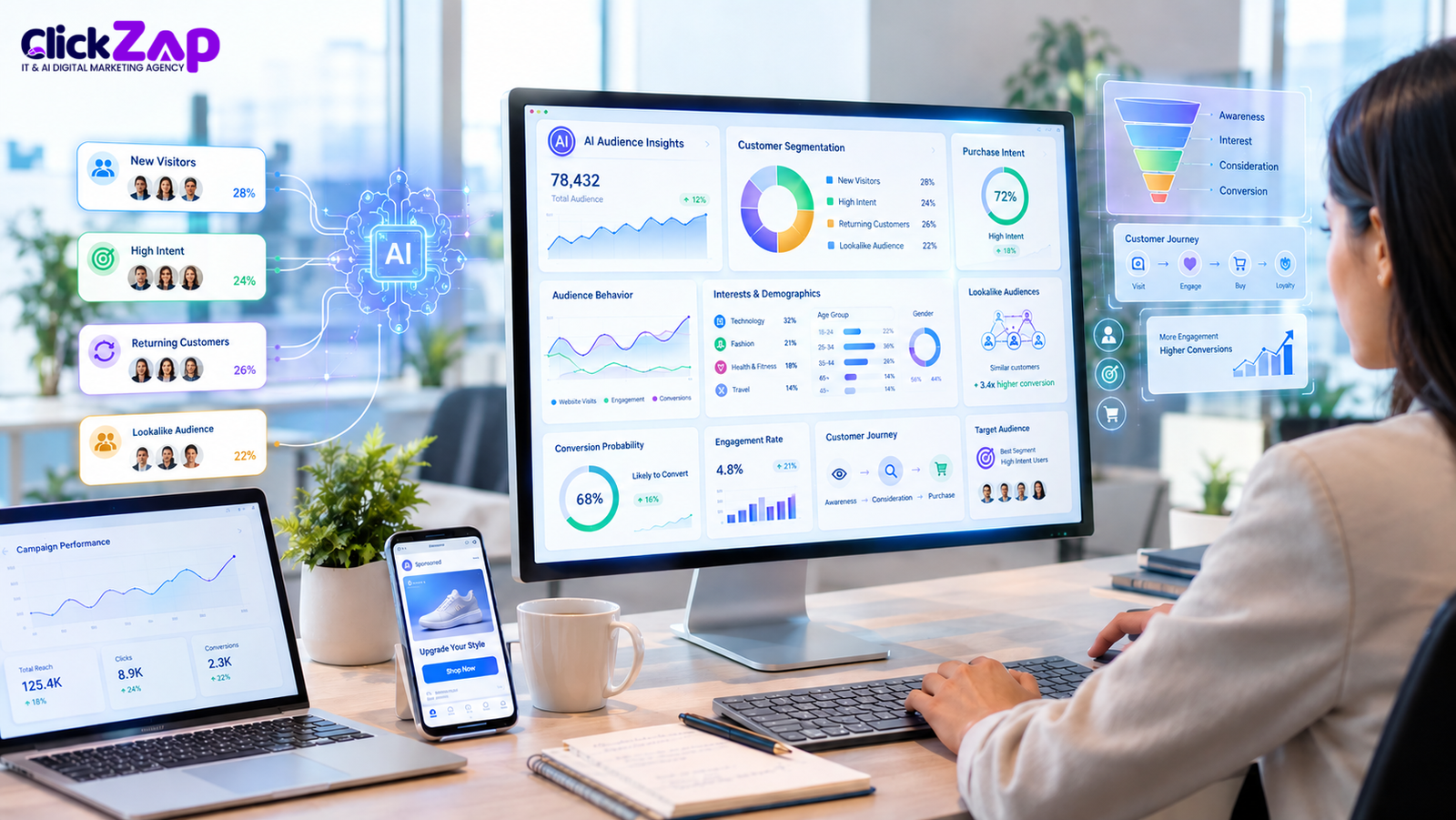
Here are practical AI audience targeting strategies businesses across industries can apply:
Strategy 1: Identify High Intent Customers
AI can flag visitors showing strong buying signals such as repeated pricing page visits so sales teams can prioritize outreach.
Strategy 2: Segment Customers Based on Behavior
Group customers by how they interact with your site or app, then tailor messaging to each group’s specific interests.
Strategy 3: Predict Purchase Intent
By analyzing browsing and engagement patterns, AI can help estimate which leads are closer to making a purchase decision.
Strategy 4: Personalize Marketing Messages
Instead of one generic email or ad, AI informed segments allow for tailored messaging that speaks directly to each group’s needs.
Strategy 5: Create Lookalike Audiences
Platforms like Meta Ads and Google Ads can use existing high value customer data to find new prospects who share similar traits.
Strategy 6: Retarget Engaged Visitors
Visitors who showed interest but didn’t convert can be re-engaged with more relevant ads based on the pages or products they viewed.
Strategy 7: Identify Customers at Risk of Churning
Declining engagement or usage patterns can signal churn risk, allowing businesses to intervene with retention offers before it’s too late.
Strategy 8: Continuously Update Audience Segments
As new data comes in, AI can help keep segments current rather than relying on a static list built months ago.
AI Tools for Customer Profiling and Audience Analysis
A range of platforms support different stages of using AI to find ideal customer profile data. None of them work in isolation; each contributes a different piece of the picture.
Google Analytics 4 helps businesses understand website behavior and the broader customer journey, from first visit to conversion, using event based tracking across devices.
Google Ads provides audience signals, campaign performance data, and conversion information that can inform both targeting decisions and ongoing optimization.
Meta Ads allows businesses to use advertising and audience data including interests and behaviors to reach relevant customer groups across Facebook and Instagram.
Meta Business Suite supports monitoring of social interactions and engagement, giving businesses a view into how audiences respond to content in real time.
HubSpot functions as a CRM and marketing automation platform, helping businesses organize customer data, track the sales pipeline, and build segmented lists for targeted campaigns.
Salesforce offers robust CRM capabilities that support customer data analysis and segmentation, particularly useful for businesses managing complex, multi stage sales processes.
OpenAI’s models can help marketers process and analyze customer information and generate insights, provided they’re used with accurate business data and appropriate data handling safeguards.
ChatGPT is practical for tasks like analyzing structured customer information, identifying patterns in qualitative feedback, brainstorming persona drafts, and testing marketing hypotheses before committing a budget.
Google Gemini can support research, competitive analysis, and broader marketing workflows, helping teams process information faster during the planning stage.
Amazon Personalize offers AI driven recommendation and personalization capabilities, primarily useful for e-commerce businesses looking to deliver more relevant product suggestions and content.
How to Use AI to Find Your Ideal Customer Profile Step by Step
Here’s a practical, ten step process for businesses ready to start using AI to find ideal customer profile insights:
- Define your business goal : Know what you’re optimizing for: more leads, higher-value customers, or better retention.
- Collect customer data : Pull data from your website, CRM, ad platforms, and social channels.
- Clean and organize the data : Remove duplicates and inconsistencies so AI tools can analyze accurate information.
- Analyze customer behavior : Look at browsing patterns, engagement, and purchase history.
- Identify your highest value customers : Determine who generates the most revenue, repeat business, or referrals.
- Find common characteristics : Look for shared traits among your best customers.
- Build your ideal customer profile : Turn those patterns into a clear, documented profile.
- Create audience segments : Break your broader audience into meaningful, actionable groups.
- Apply the insights to advertising and content : Use the ICP to guide ad targeting, messaging, and content strategy.
- Measure and improve continuously : Track results and refine the profile as new data comes in.
Example of AI Based Ideal Customer Targeting
To see this in action, consider a fictional example: a B2B digital marketing agency serving small and mid sized businesses.
Best AI Digital Marketing Agency in Hyderabad
Raw customer data:
Website analytics show most converting visitors come from LinkedIn and organic search, spend time on the “Services” and “Case Studies” pages, and request a consultation after viewing pricing.
Patterns discovered through analysis:
High value clients tend to be founders or marketing heads at companies with 20–150 employees, primarily in IT services, SaaS, and manufacturing, who found the agency through a Google search for a specific service.
Ideal customer characteristics:
Decision makers with budget authority, actively searching for measurable marketing results, currently unhappy with a previous agency or in house effort.
Target audience:
Founders, marketing managers, and business owners at B2B companies in India seeking outsourced digital marketing support.
Customer persona:
“Priya, Marketing Head” manages a lean internal team, needs results within a defined budget, values transparent reporting over vague promises.
Recommended marketing channels:
LinkedIn content and outreach, Google Ads for high intent search terms, and SEO focused blog content addressing specific service questions.
Suggested targeting strategy:
Build LinkedIn lookalike audiences from existing high value clients, retarget website visitors who viewed the pricing page, and prioritize search terms tied to specific pain points.
This example shows how scattered data page visits, industry type, and conversion source can become a clear, actionable targeting strategy once it’s properly analyzed.
Benefits of Using AI for Customer Targeting
When applied thoughtfully, AI can offer several practical advantages:
- Better overall audience understanding
- More accurate customer segmentation
- Data driven customer targeting instead of guesswork
- Improved personalization across campaigns
- Better advertising efficiency and reduced wasted spend
- Faster customer data analysis
- Easier identification of high value audiences
- Clearer understanding of the customer journey
- More relevant marketing campaigns
- Continuous optimization as data evolves
These are directional benefits, not guaranteed results depending heavily on data quality, business context, and how insights from AI to find ideal customer profile efforts are applied.
Limitations and Challenges of AI Customer Profiling
AI customer profiling isn’t without its limitations, and businesses should approach it with realistic expectations:
- Poor quality data leads to poor quality insights, regardless of how advanced the AI tool is.
- Incomplete data can create a skewed or partial picture of the customer base.
- Privacy concerns require careful, compliant handling of customer information.
- Data bias can creep in if historical data reflects narrow or skewed customer samples.
- Over reliance on automation can lead teams to ignore context AI simply can’t capture.
- Incorrect assumptions in how data is interpreted can produce misleading conclusions.
- Changing customer behavior means profiles can go stale if not updated regularly.
- Human oversight is still essential. AI should inform decisions, not make them unsupervised.
Responsible use of customer data, including compliance with relevant privacy regulations, should remain a priority throughout the process.
AI vs Traditional Customer Profiling
|
Factor |
Traditional Profiling |
AI Powered Profiling |
|
Data processing |
Manual, time consuming |
Fast, automated |
|
Speed |
Slower, often quarterly updates |
Near real time |
|
Pattern identification |
Based on analyst experience |
Based on data driven correlations |
|
Segmentation |
Broad, static groups |
Dynamic, behavior based groups |
|
Personalization |
Limited, generalized |
More granular and specific |
|
Scalability |
Harder to scale across large datasets |
Scales well with growing data volume |
|
Continuous optimization |
Infrequent revisions |
Ongoing, as new data arrives |
|
Human involvement |
High, throughout the process |
Still necessary for judgment and strategy |
AI doesn’t eliminate the need for marketing expertise; it changes what that expertise is used for, shifting focus from manual data crunching to strategic interpretation and decision making.
Best Practices for AI Based Ideal Customer Identification
To get reliable results from AI based ideal customer targeting, keep these practices in mind:
- Start with reliable, first party data rather than third party assumptions.
- Define clear business objectives before analyzing data.
- Combine quantitative data with qualitative insights from sales and support teams.
- Avoid targeting decisions based on assumptions alone.
- Regularly update customer segments as behavior changes.
- Validate AI generated insights against real business outcomes.
- Protect customer privacy and follow applicable data regulations.
- Keep humans involved in important strategic decisions.
- Measure campaign performance consistently.
- Continuously refine the ICP rather than treating it as a one time task.
Frequently Asked Questions
What is an ideal customer profile?
An ideal customer profile is a detailed description of the customer or company type most likely to benefit from your product or service and generate the most value for your business.
Can AI identify my ideal customer?
Yes. AI can analyze customer data including demographics, behavior, and purchasing patterns to help identify patterns and build a more accurate ideal customer profile than manual analysis alone.
How does AI find ideal customers?
AI finds ideal customers by collecting and analyzing customer data, identifying high value customers, finding shared patterns among them, and using those patterns to build a usable profile.
How does AI create customer personas?
AI supports customer persona creation by processing data on customer characteristics, behavior, and preferences, then organizing that information into a clear, actionable persona for marketing and sales teams.
What data does AI need for customer profiling?
AI powered customer profiling typically relies on demographic data, behavioral data, purchase history, website activity, advertising data, and CRM records to build an accurate profile.
Conclusion
Guessing who your ideal customer is costs money in wasted ad spend, missed conversions, and marketing messages that never quite land. Using AI to find ideal customer profile insights gives businesses a more reliable path forward, replacing assumptions with patterns drawn from real customer data.
From collecting and analyzing data to building personas, segmenting audiences, and refining targeting strategies over time, AI can support nearly every stage of understanding who your best customers really are as long as it’s paired with sound business judgment and clean, reliable data.
The most effective approach combines AI driven insights with SEO, paid advertising, social media marketing, and a broader digital strategy tailored to your specific audience. If you’re looking to bring these pieces together, ClickZap IT’s digital marketing services can help you turn customer data into a clearer, more targeted growth strategy.
Also Read: AI Powered Customer Segmentation for Marketing: How to Target the Right Audience

0 Comments