
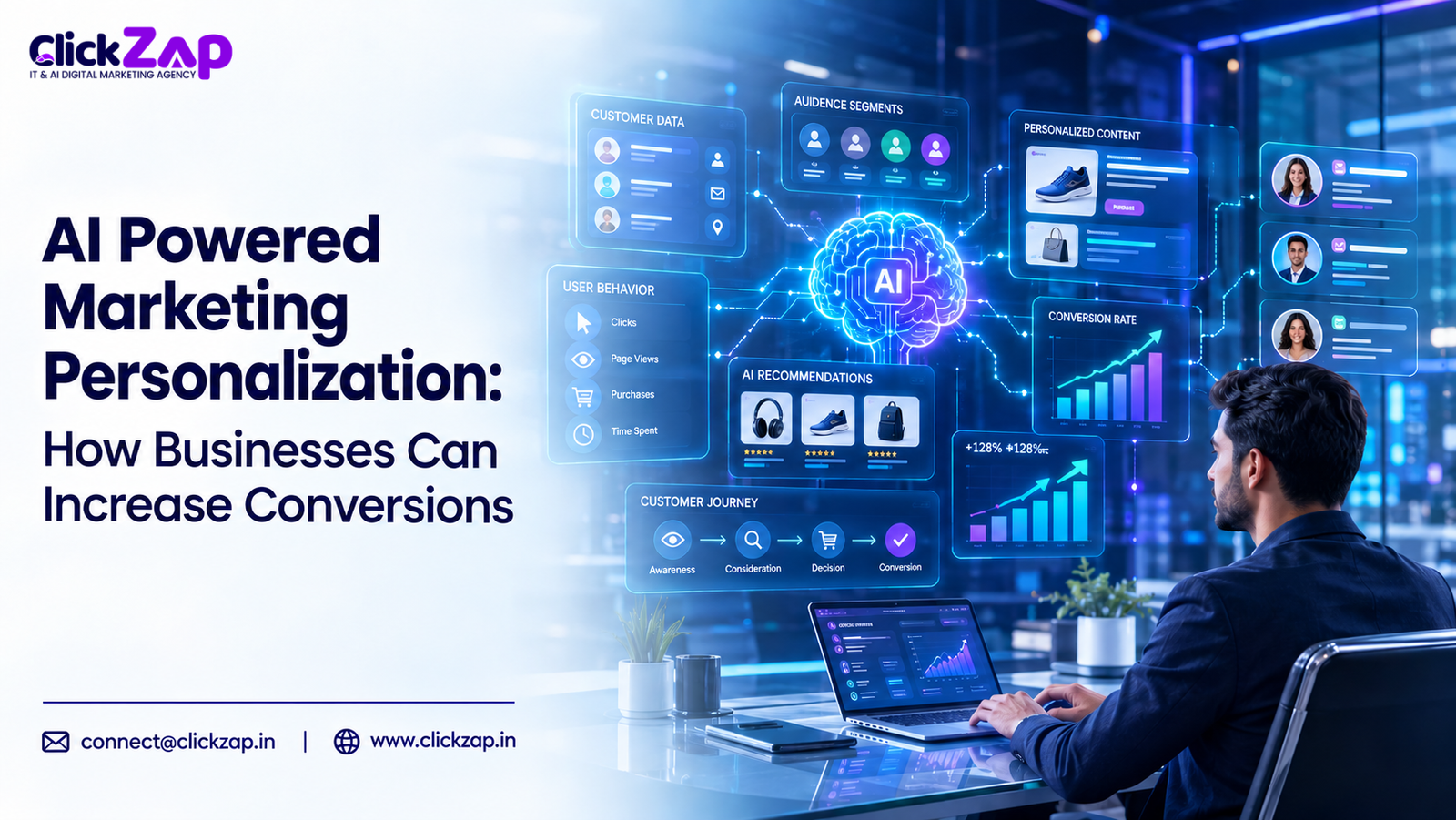
Most people scroll past generic marketing without a second thought. A banner ad that ignores their interests, an email that could have been sent to anyone, a website that looks the same for every visitor none of it feels relevant, so none of it gets attention. This is exactly the gap AI powered marketing personalization is designed to close: customers today expect brands to understand what they want, and when a business fails to deliver that, the customer simply moves on.
This is why generic, one size fits all marketing is becoming less effective. People are exposed to hundreds of marketing messages every day, and only the ones that feel personally relevant tend to break through. At the same time, businesses are sitting on more customer data than ever before website visits, product views, email interactions, search behavior but most of that data goes unused because analyzing it manually isn’t practical at scale.
This is where AI changes the equation. AI powered marketing personalization uses artificial intelligence to study this data, spot patterns in customer behavior, and help businesses shape marketing experiences that feel relevant to each visitor or customer, rather than generic to everyone. Instead of guessing what a customer might want, businesses can use behavioral signals and data analysis to make more informed decisions about content, offers, and messaging.
Done thoughtfully, personalization doesn’t just make marketing feel more relevant it can also support stronger engagement and, over time, better conversion outcomes. This article breaks down what AI powered personalization actually means, how it works, and how businesses across industries can start using it responsibly.
What Is AI Powered Marketing Personalization?
AI powered marketing personalization refers to the use of artificial intelligence to analyze customer data and behavior, then use those insights to deliver more relevant marketing experiences such as personalized content, product recommendations, offers, or messaging.
Traditional personalization is often rule based. A marketer might set up a simple rule like “if a customer bought running shoes, show them running socks next.” This works, but it’s limited. It only covers scenarios that a human has anticipated in advance, and it doesn’t adapt easily as customer behavior changes.
AI powered personalization works differently. Instead of relying only on predefined rules, AI systems can:
- Analyze large volumes of customer data far faster than a human team could
- Identify patterns in behavior that aren’t obvious at first glance
- Continuously learn from new data and adjust recommendations over time
- Apply insights across thousands or millions of customer interactions at once
A simple example: Imagine an online bookstore. A traditional system might recommend bestsellers to every visitor. An AI powered system, on the other hand, might notice that a specific visitor keeps browsing mystery novels in the evening, so it adjusts the homepage to highlight new mystery releases for that visitor specifically without a human ever manually configuring that rule.
Why Is Marketing Personalization Important for Businesses?
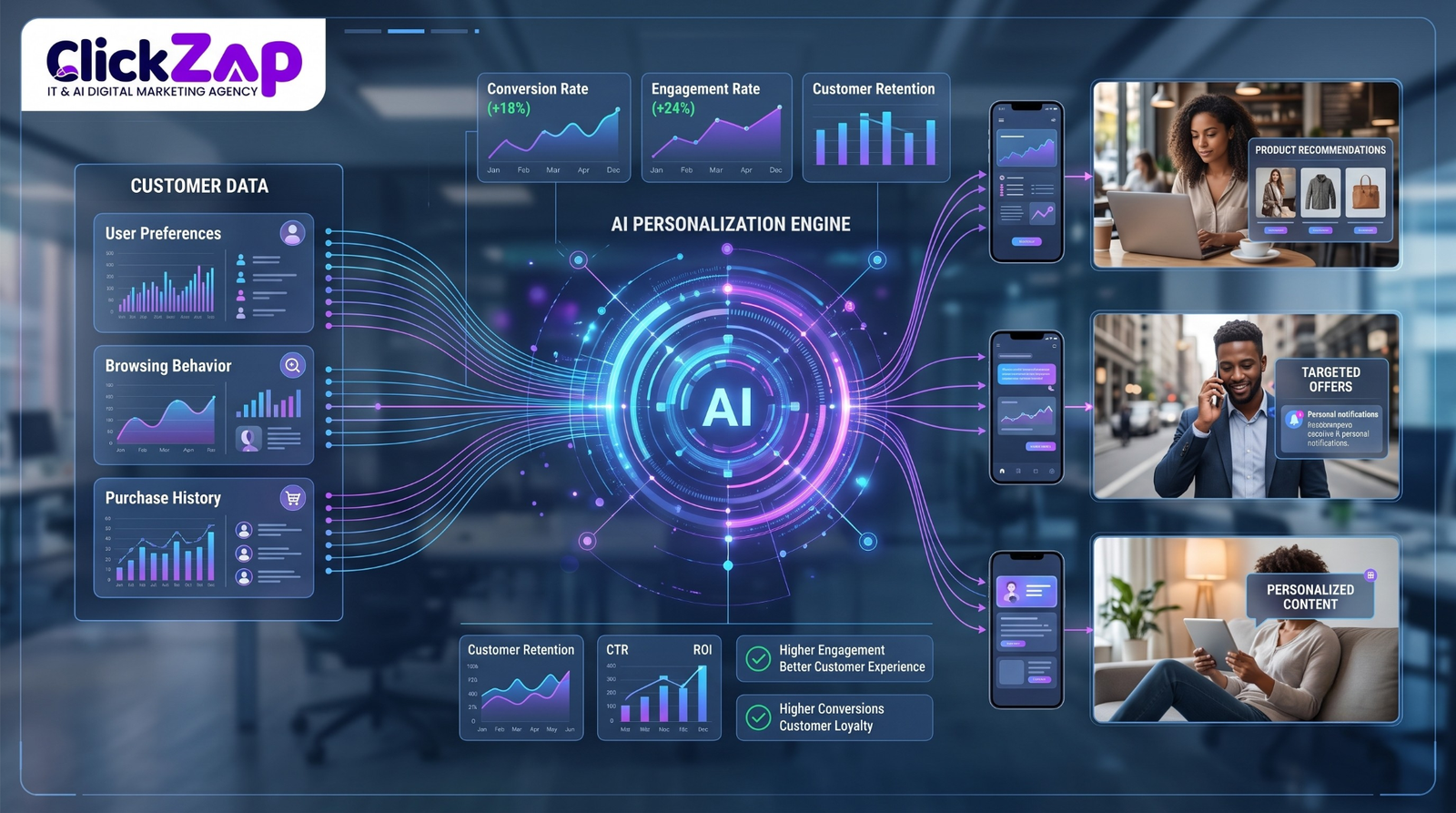
Customers generally respond better to experiences that feel relevant to them. When a website, email, or advertisement reflects something closer to what a person actually cares about, it’s more likely to hold their attention than a generic message sent to everyone.
Personalization matters for a few connected reasons:
- Customer expectations have shifted. People are used to platforms like streaming services and online marketplaces adjusting to their preferences, and they increasingly expect the same from other businesses they interact with.
- Relevant content improves engagement. Content that matches a person’s interests or stage in the buying journey tends to hold attention longer than generic messaging.
- Personalized customer experiences support better journeys. Instead of pushing every visitor through the same path, businesses can guide different customers toward the information or products most relevant to them.
- Marketing efficiency improves. When messaging is more targeted, marketing budgets can be used more purposefully instead of being spread thin across broad, generic campaigns.
- It supports conversion rate optimization. Relevant experiences remove some of the friction that stops a visitor from taking the next step, which is a meaningful part of improving conversion rates over time.
None of this means personalization guarantees results but it does mean businesses that ignore relevance are working with a real disadvantage compared to those that don’t.
Digital Marketing Services for Business
How Does AI Marketing Personalization Work?
Understanding how AI marketing personalization works in practice helps businesses see where to start. It generally follows a step by step process.
Step 1: Collect Customer Data
Businesses gather data through legitimate, transparent methods such as website analytics, app usage, email engagement, purchase history, on site search behavior, and customer provided preferences . This data collection should always align with applicable privacy laws and platform policies, and customers should be informed about what data is collected and why.
Step 2: Analyze Customer Behavior
Once data is collected, AI systems perform customer behavior analysis and customer data analysis to understand patterns such as which products a visitor views repeatedly, what content they engage with, or when they’re most active.
Step 3: Segment Audiences
AI-powered audience segmentation groups customers with similar characteristics or behaviors together. Instead of a handful of broad segments defined manually, AI can identify more nuanced groupings based on actual behavior patterns.
Step 4: Identify Customer Intent
AI looks for signals that may indicate what a customer is trying to accomplish for example, comparing product prices repeatedly might suggest someone is close to a purchase decision, while browsing without adding items to a cart might suggest early stage research.
Step 5: Personalize Marketing Experiences
Based on these insights, businesses can personalize content, offers, product recommendations, and messaging so they’re more closely aligned with what a particular customer or segment seems to care about.
Step 6: Deliver Real Time Personalization
Real time personalization means adjusting experiences as they happen, rather than waiting for the next campaign cycle. Dynamic content personalization can change what a visitor sees on a webpage, in an app, or in an email based on their most recent behavior.
Step 7: Measure and Optimize
Finally, marketers track engagement and conversion metrics to see what’s working, then use those insights to refine segments, messaging, and personalization rules over time. This step is ongoing AI personalization isn’t something businesses “set and forget.”
AI Personalization Strategies Businesses Can Use
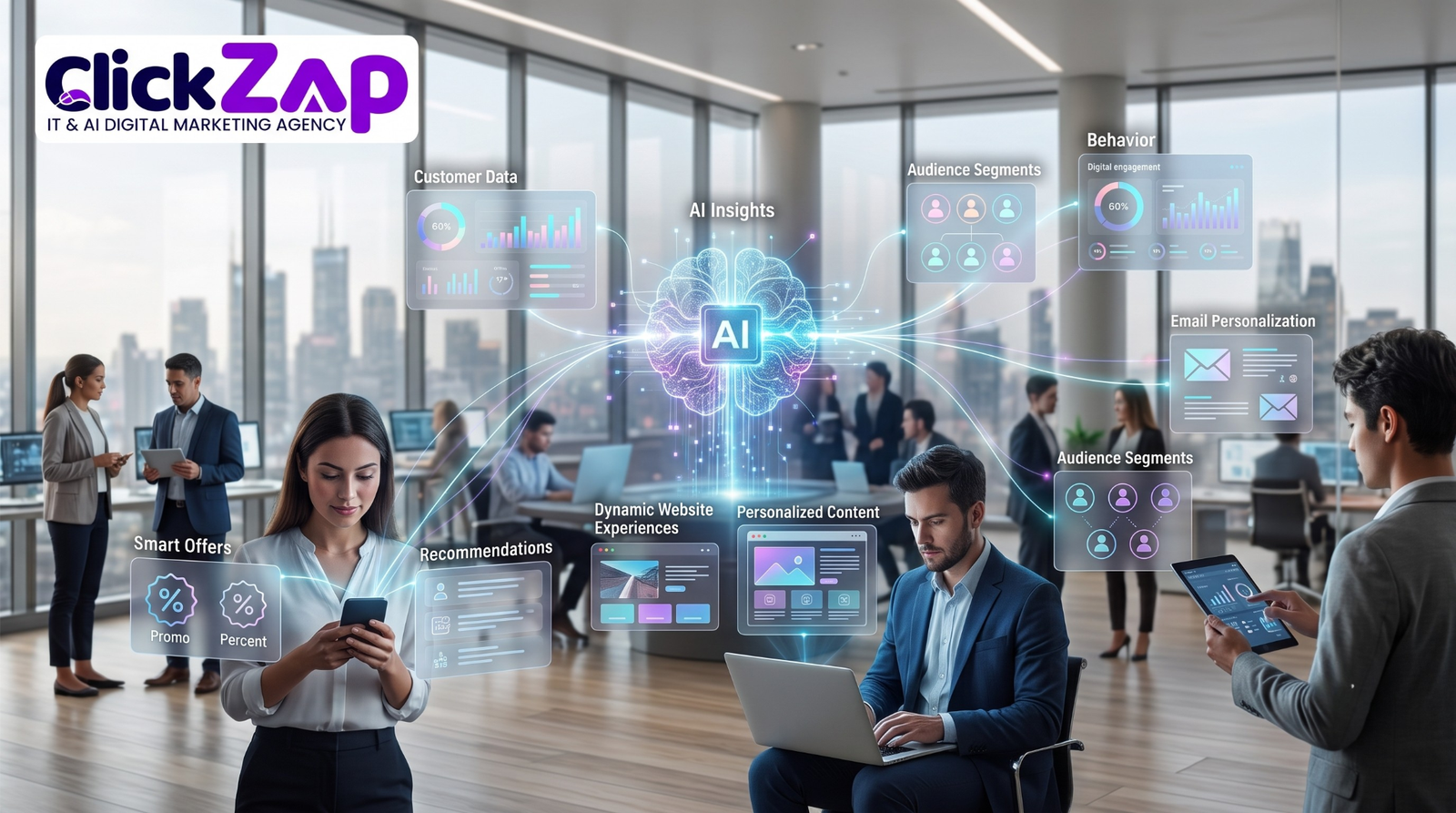
There are several practical ways businesses can apply AI personalization strategies, depending on their goals and resources.
Personalized Content
Businesses can adapt blog recommendations, landing pages, or on site content based on a visitor’s browsing history or expressed interests, helping surface the most relevant information first.
Personalized Product Recommendations
Recommendation systems analyze past purchases, browsing behavior, or similar customer patterns to suggest products or services a visitor is more likely to be interested in.
Customer Journey Personalization
Different stages of the customer journey awareness, consideration, decision, and post purchase can be personalized differently. A first time visitor might see introductory content, while a returning customer might see more advanced offers.
Behavioral Targeting
Behavioral signals, such as pages visited or actions taken, can help marketers deliver messages that reflect what a customer has actually shown interest in, rather than a generic broadcast message.
Dynamic Content Personalization
Website pages, email content, or advertisements can change automatically based on a visitor’s characteristics or behavior for example, showing different homepage banners to new versus returning visitors.
Predictive Customer Behavior
AI can analyze historical patterns to identify signals that may indicate future actions, such as a customer who is likely to churn or one who may be ready for a repeat purchase. These are probability based insights, not certainties.
Real Time Personalization
AI can respond to a customer’s behavior as it happens for instance, adjusting an on-site recommendation the moment a visitor views a specific product category.
How AI Powered Personalization Can Increase Conversions
This is often the main reason businesses explore AI personalization in the first place: its potential to support better conversion outcomes. It’s worth being clear that AI personalization to increase conversions is not a guarantee but it can meaningfully reduce friction and improve relevance across the customer journey.
Here’s how it typically plays out:
- More relevant offers: Instead of the same discount for every visitor, AI can help surface offers more aligned with a customer’s interests or purchase stage.
- Better landing page experiences: Pages that reflect what brought a visitor there in the first place such as the specific product or service they searched for tend to keep visitors engaged longer.
- More relevant advertisements: AI-informed targeting can help ads reach people more likely to be interested in a specific product or service, rather than broadcasting to an undifferentiated audience.
- Personalized email campaigns: Emails segmented by behavior or interest tend to be more relevant than one generic newsletter sent to an entire list.
- Better product recommendations: Recommendations grounded in actual behavior are more likely to resonate than generic bestseller lists.
- Reduced friction in the customer journey: When a customer doesn’t have to sift through irrelevant information to find what they need, they’re more likely to complete their intended action.
- Improved audience targeting: AI can help identify which segments are more likely to respond to a specific campaign, allowing budgets to be allocated more purposefully.
- Better lead nurturing: Personalized follow ups based on a lead’s actual behavior can be more effective than a single generic nurture sequence.
- Improved customer engagement: Relevant experiences tend to hold attention longer, which supports deeper engagement over time.
A practical example: A SaaS company notices, through behavior analysis, that visitors who watch a product demo video are far more likely to sign up for a trial than those who don’t. Using this insight, the company could personalize its website to surface the demo video more prominently for visitors showing early interest signals a small change grounded in actual behavior rather than assumption.
AI Powered Marketing Personalization Across Different Channels
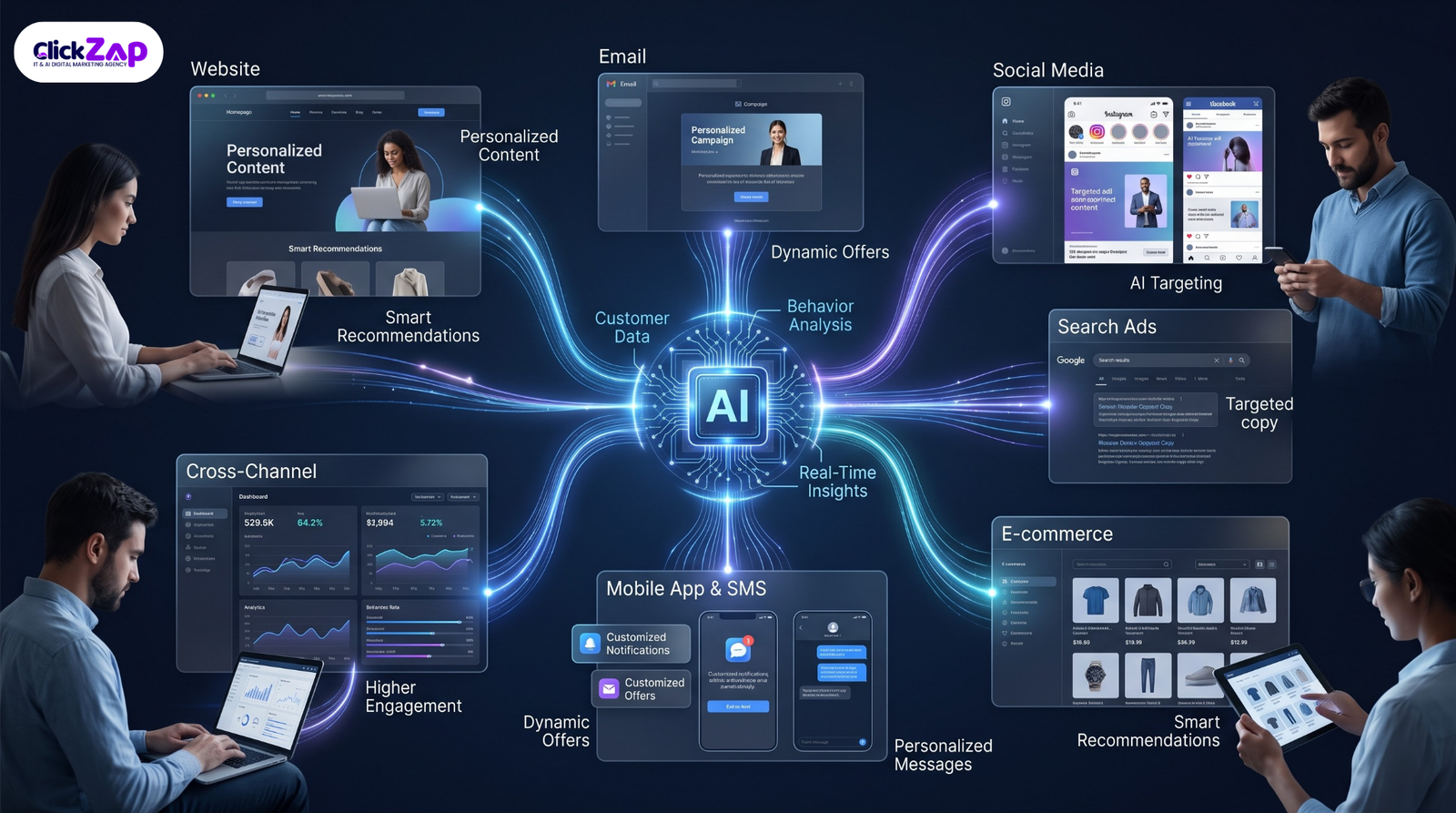
AI personalization isn’t limited to one channel; it can be applied across the marketing ecosystem.
Websites
Homepage banners, product recommendations, and even navigation menus can adjust based on visitor behavior, such as showing relevant categories to returning visitors.
Email Marketing
Email content, subject lines, and send times can be personalized based on a subscriber’s past engagement and interests, rather than sending identical emails to an entire list.
Google Ads
Audience targeting and ad messaging can be informed by behavioral and intent signals, helping ads reach people more likely to be interested in a specific offering.
Meta Ads
Similar to Google Ads, Meta’s advertising tools use behavioral and interest data to help businesses reach more relevant audiences on platforms like Facebook and Instagram.
E-commerce
Product recommendations, personalized search results, and cart recovery messaging can all be shaped by a shopper’s browsing and purchase history.
Social Media
Content scheduling and audience targeting can be informed by engagement patterns, helping businesses share content when and where their audience is most likely to respond.
Content Marketing
Blog and resource recommendations can be tailored to a reader’s past content consumption, helping surface the most relevant articles or guides.
Customer Support
AI powered tools can use customer history to provide more relevant and faster responses, rather than starting every interaction from scratch.
Lead Generation
Forms, landing pages, and follow up sequences can be adjusted based on a lead’s source, behavior, or expressed interests, helping tailor the next step more effectively.
Best AI Digital Marketing Agency in Hyderabad
AI Marketing Personalization Tools and Platforms
Several established technology providers offer tools relevant to AI marketing personalization, though it’s worth understanding that they serve different purposes rather than offering identical capabilities.
|
Platform |
Category |
Relevance to Personalization |
|
OpenAI |
AI models |
Provides generative AI models that can support content generation and conversational personalization |
|
|
Search, ads, and analytics ecosystem |
Offers tools spanning search advertising, analytics, and AI capabilities relevant to marketing |
|
Adobe |
Experience management platform |
Adobe Experience Cloud offers tools for content management and customer experience personalization |
|
Salesforce |
CRM platform |
Provides customer relationship management tools that can inform personalized marketing based on customer data |
|
HubSpot |
CRM and marketing platform |
Offers marketing automation and CRM tools used for segmentation and personalized campaigns |
|
Amazon Web Services (AWS) |
Cloud infrastructure |
Provides cloud infrastructure and machine learning services that can underpin AI powered marketing systems |
|
Meta Platforms |
Advertising platform |
Offers advertising tools with audience targeting capabilities across Facebook and Instagram |
|
Google Analytics |
Analytics platform |
Provides data on visitor behavior that can inform personalization strategies |
|
Google Ads |
Advertising platform |
Offers targeting and bidding tools that can incorporate behavioral and intent signals |
|
Adobe Experience Cloud |
Experience management platform |
A suite of tools specifically focused on managing and personalizing customer experiences |
It’s important not to assume every platform above offers identical personalization features: some are AI model providers, some are analytics tools, some are CRM systems, and some are advertising platforms. Businesses typically combine a few of these tools depending on their specific marketing stack and goals, rather than relying on a single platform for everything.
AI Customer Personalization for E-Commerce
E-commerce is one of the clearest use cases for AI customer personalization, since online stores generate a large volume of behavioral data with every visit.
Common applications include:
- Product recommendations based on browsing and purchase history
- Personalized offers, such as discounts relevant to a shopper’s past category interests
- Search personalization, where search results adjust based on a shopper’s prior behavior
- Cart recovery, using personalized reminders for items left in a cart
- Personalized email campaigns segmented by purchase behavior or browsing interests
- Customer segmentation to group shoppers with similar preferences
- Repeat purchase opportunities, such as reminders timed around a product’s typical usage cycle
- Dynamic website experiences that adjust based on whether a visitor is new or returning
A realistic example: Consider an online store selling home fitness equipment. A visitor who repeatedly views yoga mats and resistance bands, but hasn’t purchased anything yet, might be shown a homepage that highlights yoga and stretching equipment rather than generic best sellers like treadmills. This is a hypothetical scenario, but it illustrates how behavior based personalization can work in an e-commerce context.
AI Powered Customer Experience: How It Helps Businesses
Beyond individual campaigns, AI powered customer experience touches how a business is perceived overall. When done well, personalization can contribute to:
- Relevant recommendations that save customers time
- Faster responses, particularly in customer support scenarios
- Personalized communication that reflects a customer’s history with the business
- Consistent customer journeys across different touchpoints
- Better content discovery, helping customers find what’s genuinely useful to them
- More relevant offers, reducing the number of irrelevant messages a customer receives
- Predictive customer insights that help businesses anticipate needs rather than only reacting to them
It’s worth emphasizing that personalization should be useful, not intrusive. Customers generally welcome relevance, but they can be uncomfortable if personalization feels overly specific or based on data they didn’t expect a business to have. Businesses should aim for personalization that clearly benefits the customer, rather than personalization that feels like surveillance.
Benefits of AI Driven Marketing Personalization
Businesses exploring AI driven marketing personalization can expect several potential advantages, while keeping in mind that outcomes vary by industry, execution, and data quality:
- More relevant customer experiences across touchpoints
- Better audience targeting based on actual behavior rather than assumptions
- Improved engagement with content, offers, and communications
- More efficient marketing campaigns, since messaging is more precisely targeted
- Better customer insights that inform broader business decisions
- Improved lead nurturing through more relevant follow up sequences
- More relevant recommendations that reflect real customer interests
- Better customer journeys that adapt to where a customer actually is in their decision process
- Potentially higher conversion rates as friction is reduced
- More efficient use of marketing resources and budget
Challenges and Limitations of AI Personalization
AI personalization isn’t without its challenges, and businesses should approach it with realistic expectations.
- Data quality: Personalization is only as good as the data behind it. Incomplete or inaccurate data can lead to irrelevant or even incorrect personalization.
- Data privacy: Businesses must be transparent about what data they collect and how it’s used, in line with applicable privacy regulations.
- Customer consent: Personalization efforts should respect customer consent preferences, including opt outs from data collection or specific communication types.
- Data security: Customer data must be protected against breaches, given the sensitivity of behavioral and personal information.
- Integration challenges: Connecting data across multiple platforms website, email, CRM, ads can be technically complex.
- Incorrect personalization: AI systems can sometimes misread signals, leading to recommendations or messaging that miss the mark.
- Algorithmic bias: If training data reflects biased patterns, personalization systems can unintentionally reinforce those biases.
- Over personalization: Excessive personalization can feel intrusive rather than helpful, potentially damaging customer trust.
- Implementation costs: Building or adopting AI personalization tools requires investment in technology, data infrastructure, and often specialized expertise.
- Lack of human oversight: Fully automated personalization without human review can lead to mistakes going unnoticed for longer than they should.
Responsible AI personalization means acknowledging these limitations and building in appropriate governance, rather than treating AI as a fully autonomous, unsupervised system.
Best Practices for AI Powered Personalized Marketing
Businesses looking to get started with AI powered personalized marketing can benefit from a few practical guidelines:
- Start with a clear business objective. Define what you’re trying to improve engagement, lead quality, conversions before choosing tools or tactics.
- Use accurate and relevant customer data. Prioritize data quality over data quantity.
- Respect privacy and consent. Be transparent about data collection and honor customer preferences.
- Segment audiences carefully. Avoid overly broad or overly narrow segments that reduce the value of personalization.
- Test personalized experiences. Use A/B testing to validate whether a personalized approach actually performs better than a generic one.
- Monitor performance continuously. Personalization isn’t a one time setup, it requires ongoing measurement.
- Avoid excessive personalization. Keep personalization helpful and relevant, not intrusive.
- Combine AI insights with human judgment. AI can surface patterns, but human marketers should validate whether those patterns make sense for the brand and audience.
- Continuously optimize campaigns. Use performance data to refine segments, messaging, and offers over time.
- Focus on customer value. Personalization should ultimately make the customer’s experience better, not just serve business goals.
AI Powered Marketing Personalization vs Traditional Personalization
The table below compares traditional personalization approaches with AI-powered approaches across key factors.
|
Factor |
Traditional Personalization |
AI Powered Personalization |
|
Data analysis |
Manual, limited to what a team can process |
Automated analysis of large volumes of data |
|
Audience segmentation |
Broad, predefined segments |
More granular segments based on behavior patterns |
|
Customer insights |
Based on assumptions or limited reporting |
Derived from ongoing behavioral analysis |
|
Real time personalization |
Difficult to achieve manually |
Can adjust experiences as behavior happens |
|
Recommendations |
Rule based (e.g., “if X, then Y”) |
Pattern based, adapting as new data comes in |
|
Scalability |
Limited by team capacity |
Can scale across large customer bases |
|
Automation |
Minimal; relies on manual setup |
High; systems can act on data automatically |
|
Predictive capabilities |
Rare or basic trend spotting |
Can identify probability based behavioral signals |
Real World Example of AI Marketing Personalization
The following is a hypothetical example to illustrate how the process might work in practice.
Imagine an online store selling office furniture. Different visitors arrive with different needs: some are looking for budget desks for a home office, others for ergonomic chairs for a corporate setup.
Here’s how AI personalization could play out:
Customer behavior → A visitor spends time viewing ergonomic chairs and reads a blog post about reducing back pain while working from home.
AI analysis → The system analyzes this behavior alongside browsing patterns from similar visitors.
Audience segment → The visitor is grouped into a segment interested in ergonomic, health conscious home office products.
Personalized experience → On their next visit, the homepage highlights ergonomic chairs and related accessories, and a follow-up email includes a guide on setting up an ergonomic home workspace.
Engagement → The visitor opens the email and clicks through to a product page.
Conversion opportunity → Because the experience reflects the visitor’s actual interest, they’re more likely to consider a purchase than if they’d been shown a generic homepage featuring unrelated furniture categories.
Again, this is a hypothetical scenario meant to illustrate the AI analysis process not a documented case study or guaranteed outcome.
Future of AI Powered Marketing Personalization
Looking ahead, several trends are likely to shape how marketing personalization evolves, though these should be understood as possibilities rather than certainties:
- Generative AI may play a larger role in creating personalized content variations at scale.
- Predictive analytics could become more sophisticated in anticipating customer needs before they’re explicitly expressed.
- Real time customer insights may become more deeply integrated across marketing channels, rather than siloed by platform.
- AI agents could take on more autonomous roles in managing personalized campaigns, with human oversight remaining important.
- Automated campaign optimization may reduce the manual effort required to test and refine personalized experiences.
- Conversational experiences, such as AI powered chat interfaces, may become a more common personalization touchpoint.
- Cross channel personalization could become more seamless, with consistent experiences across website, email, ads, and support.
- More advanced customer journey personalization may allow businesses to adapt experiences at a more granular, individual level.
These developments are still unfolding, and businesses should evaluate new capabilities carefully rather than assuming every new tool will deliver meaningful results for their specific context.
Frequently Asked Questions
What is AI powered marketing personalization?
AI powered marketing personalization is the use of artificial intelligence to analyze customer data and behavior, then apply those insights to deliver more relevant content, offers, and recommendations to individual customers or audience segments.
How does AI personalize marketing?
AI personalizes marketing by analyzing customer data, identifying behavioral patterns, segmenting audiences, and using those insights to adjust content, product recommendations, and messaging for different customers in real time or near real time.
How can AI personalization increase conversions?
AI personalization can support conversions by making offers, content, and recommendations more relevant to each customer, which can reduce friction in the customer journey. It doesn’t guarantee results, but it can improve the relevance of the overall experience.
What are AI marketing personalization tools?
AI marketing personalization tools include CRM platforms like Salesforce and HubSpot, analytics tools like Google Analytics, advertising platforms like Google Ads and Meta, AI models such as those from OpenAI, and experience management platforms like Adobe Experience Cloud.
How does AI improve customer experience?
AI can improve customer experience by delivering more relevant recommendations, faster support responses, and personalized communication while ideally maintaining a consistent, non intrusive experience across every touchpoint a customer interacts with.
Conclusion
AI powered marketing personalization is fundamentally about using customer data and behavioral insights to make marketing more relevant rather than treating every visitor or customer the same way. From audience segmentation to real time content adjustments, AI gives businesses the ability to analyze patterns at a scale that manual processes simply can’t match.
Done responsibly, this kind of personalization can support better customer experiences, stronger engagement, and over time more efficient paths toward conversion. But it isn’t a shortcut or a guarantee. It requires quality data, thoughtful segmentation, respect for customer privacy, and ongoing human oversight to make sure personalization stays useful rather than intrusive.
For businesses exploring how to bring AI powered personalization into their own marketing whether through better audience segmentation, more relevant content, or smarter campaign targeting ClickZap IT works with businesses to build AI powered digital marketing strategies suited to their specific goals. Talk to our digital marketing experts
Also Read: AI to Find Ideal Customer Profile: Smarter Audience Targeting Strategies

0 Comments