
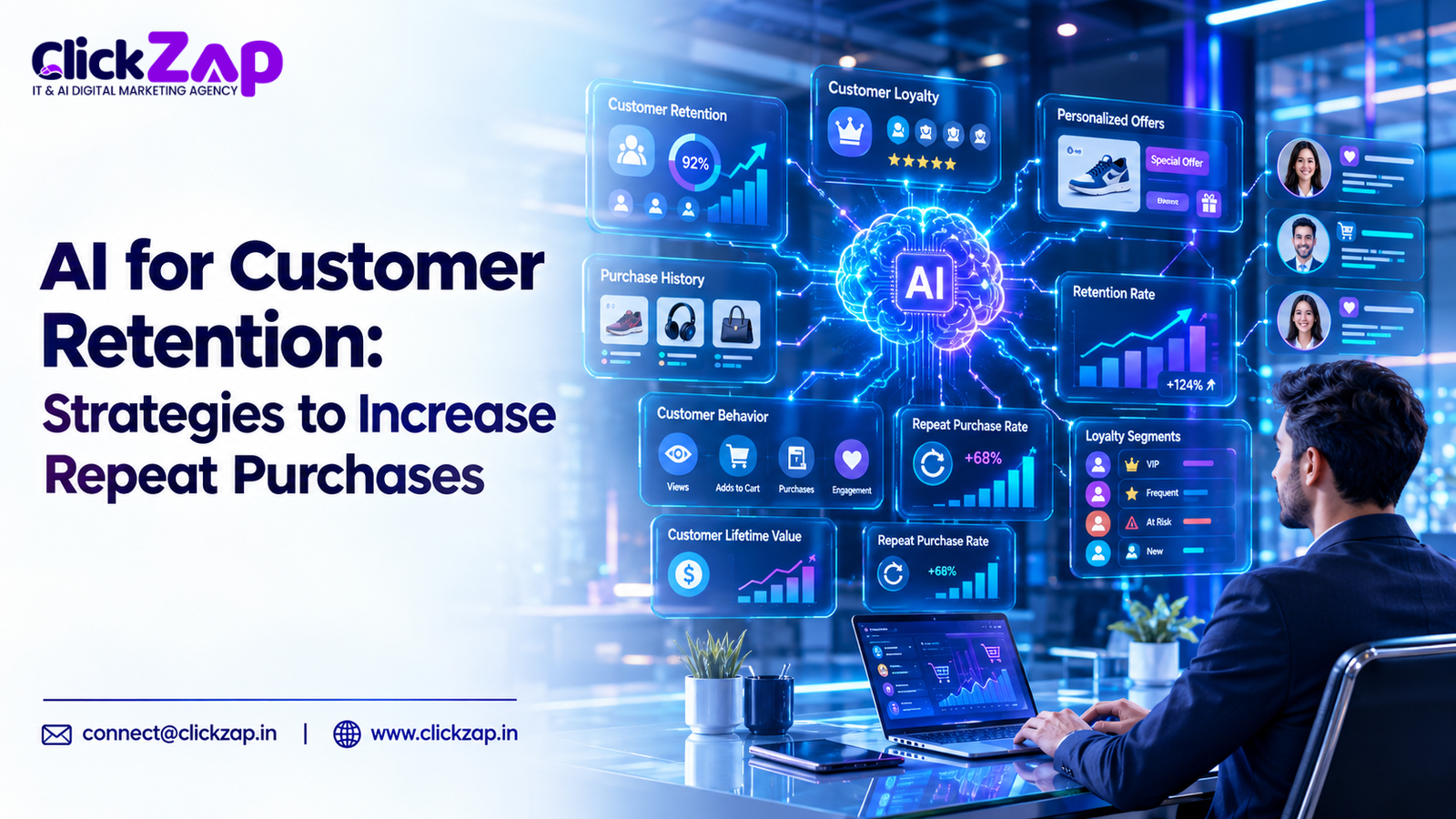
Getting a new customer is expensive. Keeping one is where the real profit lives. Most businesses spend most of their marketing budget chasing first time buyers, then quietly lose a large share of them after a single purchase. This is where AI for customer retention is starting to change the game.
Instead of guessing why customers drift away, businesses can now use AI to understand customer behavior, spot early warning signs of churn, and personalize communication at a scale no team could manage manually. Used well, AI for customer retention helps businesses stay relevant to the people who already know and trust them, and turn one time buyers into repeat customers.
This article breaks down what AI for customer retention actually means, why it matters for growth, and how you can build a practical, AI powered retention strategy without needing a data science team.
What Is AI for Customer Retention?
AI for customer retention refers to the use of artificial intelligence including machine learning, predictive analytics, and generative AI to help businesses keep existing customers engaged, satisfied, and likely to buy again.
In simple terms, AI looks at patterns in customer data purchase history, browsing behavior, email engagement, support interactions and uses those patterns to predict what a customer is likely to do next. It can flag a customer who hasn’t ordered in 60 days as a churn risk, or recognize that a customer who always buys skincare products in March might respond well to a seasonal offer right now.
For example, a small D2C skincare brand might use AI to notice that customers who don’t repurchase within 45 days rarely return at all. That insight lets the brand trigger a personalized reminder email before that window closes, rather than after the customer has already moved on.
This is the core idea behind AI for customer retention: using data to act earlier and more personally than a manual process ever could.
Why Customer Retention Matters for Business Growth
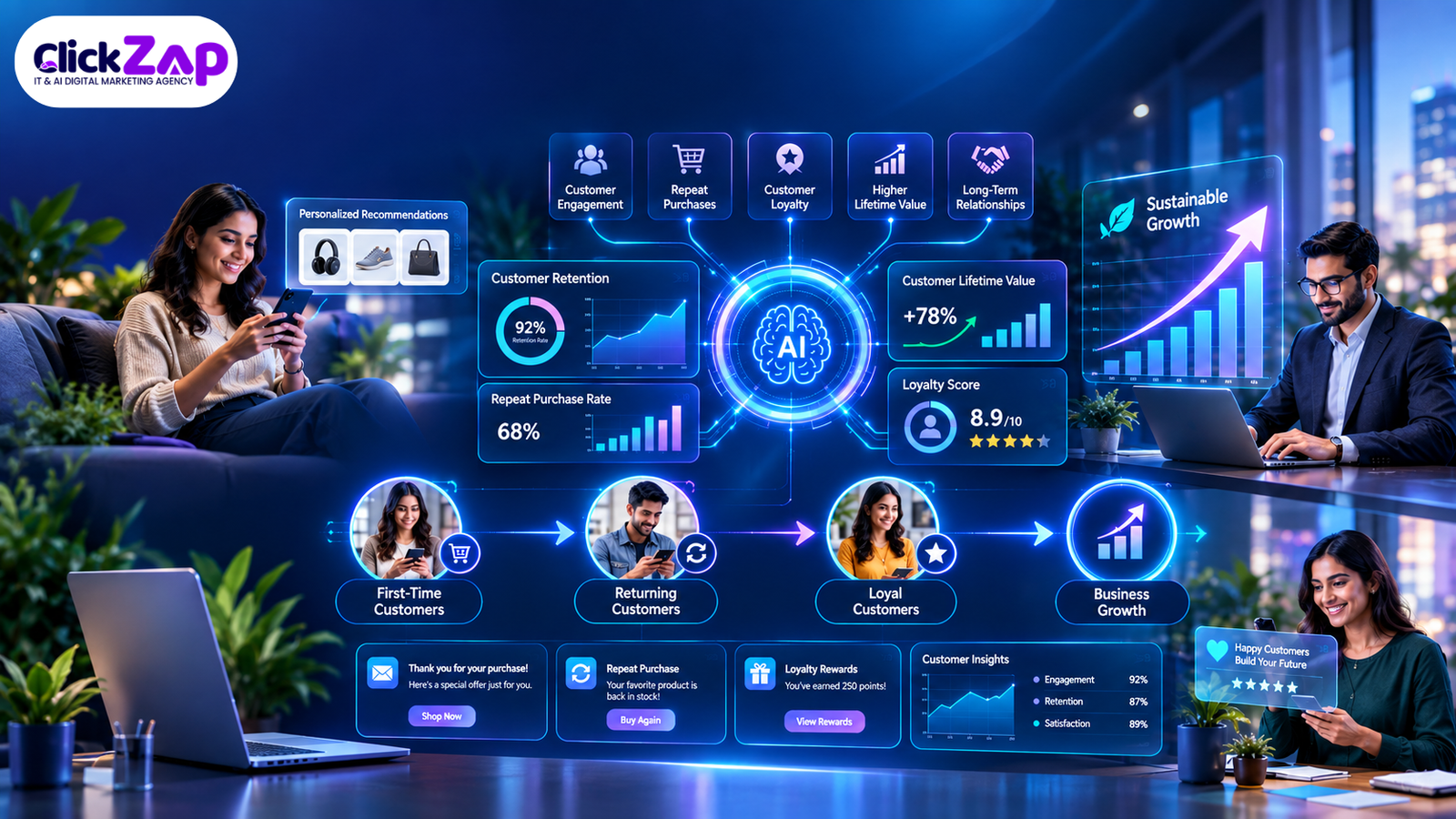
Acquiring a new customer typically costs far more than keeping an existing one. Existing customers already trust your brand, understand your product, and are more likely to try new offerings from you. That combination makes customer retention one of the most efficient levers for sustainable growth.
A few concepts worth understanding here:
- Customer loyalty : the tendency of a customer to keep choosing your brand over competitors, often built through consistent experience and trust.
- Repeat purchases : a direct, measurable sign that a customer found value the first time and is willing to buy again.
- Customer lifetime value (CLV) : the total revenue a business can reasonably expect from one customer across the entire relationship, not just the first sale.
- Customer acquisition versus retention : acquisition brings new customers in; retention keeps them coming back. Both matter, but retention is often the cheaper, higher margin path to growth.
- Customer engagement : how actively a customer interacts with your brand between purchases, through email opens, app usage, or social interactions.
Consider a SaaS company: a customer who renews their subscription for three years is worth far more than three customers who sign up and cancel within a month. Long term relationships compound. That’s why even a small improvement in retention rate can meaningfully change a business’s revenue trajectory over time.
How AI Helps Businesses Retain Customers
AI powered customer retention works across several connected areas from predicting who might leave, to personalizing what you say to keep them engaged.
Predicting Customer Churn
Churn prediction uses AI to identify customers who are showing early signs of disengagement before they actually stop buying. AI models look at signals like declining order frequency, reduced email opens, shorter website visits, or unresolved support tickets, and assign each customer a churn risk score.
For instance, an online grocery brand might notice that customers who skip two consecutive weekly orders have a high chance of not returning. AI driven customer retention tools can flag these customers automatically, giving the marketing team a chance to step in with a relevant offer before it’s too late.
Understanding Customer Behavior
Customer behavior analysis uses AI to study how people interact with your brand what they browse, what they abandon in their cart, how often they open emails, and which products they return to. Instead of treating all customers the same, this analysis reveals distinct behavior patterns.
A fashion e-commerce store, for example, might discover through AI powered customer behavior analysis that customers who view a product three or more times before purchasing respond well to limited time discount nudges, while first-time browsers respond better to educational content.
Creating Personalized Customer Experiences
One of the most visible benefits of AI for customer loyalty is personalization. AI can tailor product recommendations, email content, app notifications, and offers based on what each customer actually cares about, rather than sending the same message to everyone.
A home appliance brand could use AI to recommend a descaling solution to customers who bought a water purifier six months earlier timed around when the filter is likely due for replacement. This kind of relevant, well timed personalization tends to feel helpful rather than intrusive.
Improving Customer Segmentation
AI powered customer segmentation groups customers based on shared behaviors, preferences, or value to the business rather than simple demographics alone. This allows for messaging that actually matches where a customer is in their journey.
For example, instead of one generic “we miss you” email, AI can separate customers into segments such as high value repeat buyers, one time buyers, and price sensitive shoppers, and tailor the retention message for each group differently.
Automating Customer Engagement
AI for reducing customer churn often relies on timely, automated engagement reaching customers at the right moment without requiring a marketer to manually track every interaction. This can include automated replenishment reminders, milestone emails, or behavior triggered messages.
A subscription coffee brand might use AI driven automation to send a “running low?” reminder based on typical consumption patterns for that customer’s order size, rather than a fixed calendar schedule.
Supporting Win Back Campaigns
AI can identify customers who have gone quiet, those who haven’t purchased or engaged in a defined period and help businesses build targeted win back campaigns aimed specifically at bringing them back.
For instance, an online electronics retailer might use AI to identify customers inactive for 90 plus days and trigger a personalized win back email referencing their last purchased category, rather than a generic discount blast sent to the entire list.
Improving Customer Loyalty Programs
AI can make loyalty programs feel more personal by tailoring rewards, point structures, or offers to what each customer values most, instead of applying a single rewards structure to everyone.
A beauty brand’s loyalty program might use AI to offer free shipping to customers who value convenience, while offering bonus loyalty points to customers who respond more to earning rewards based on how each group has historically engaged.
Digital Marketing Services for Business
AI Customer Retention Strategies Businesses Can Use
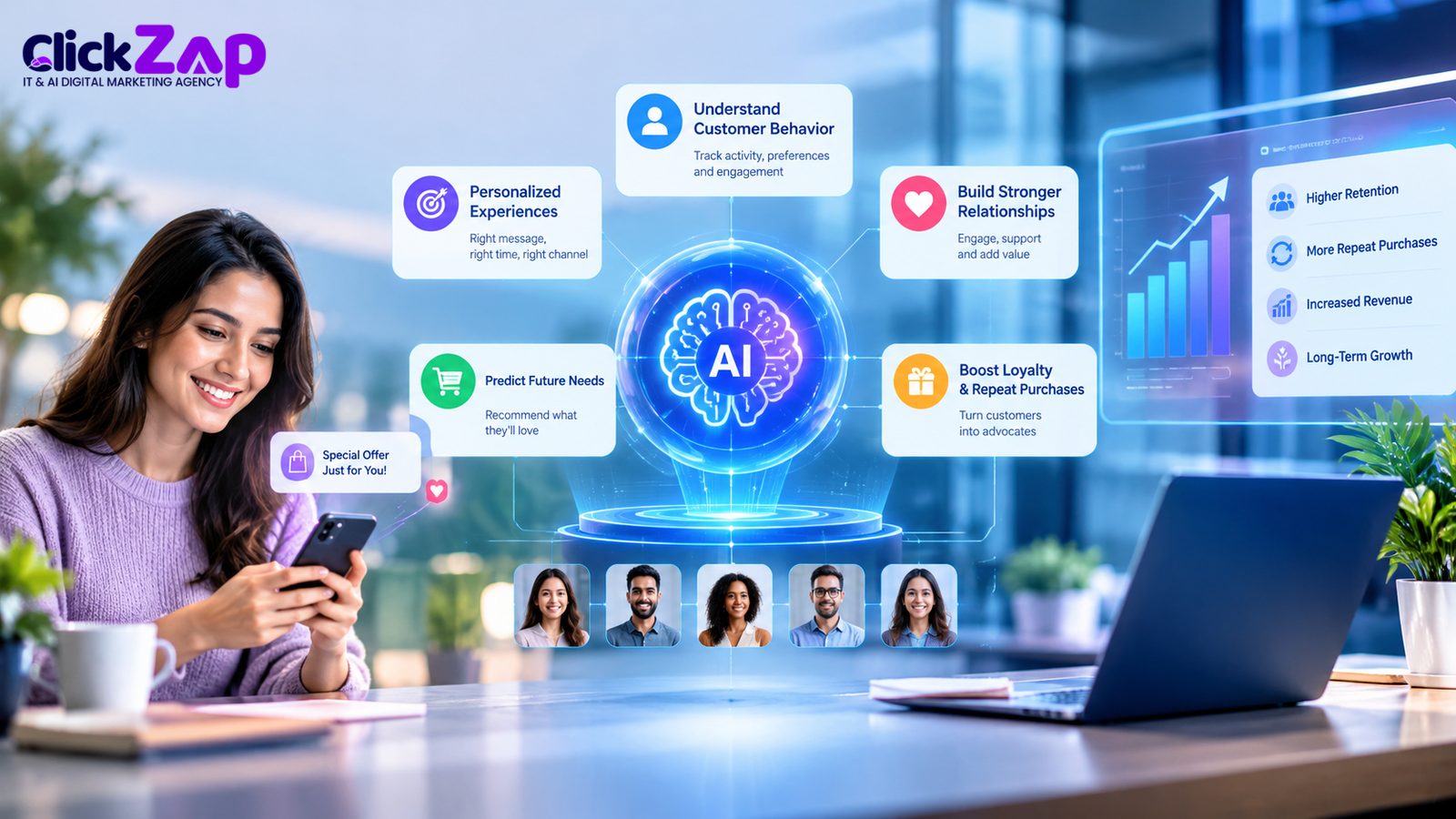
Here are practical AI customer retention strategies businesses of different sizes can apply.
- Use AI for churn prediction
What it means: Scoring customers on their likelihood to stop buying.
How AI helps: It analyzes engagement and purchase signals to flag at risk customers early.
Example: An online pet store identifies customers likely to churn based on declining order frequency and sends a personalized reorder reminder.
Potential benefit: Earlier intervention before a customer fully disengages. - Personalize product recommendations
What it means: Showing each customer products relevant to their history and preferences.
How AI helps: It analyzes past purchases and browsing behavior to suggest relevant items.
Example: A bookstore recommends new releases in genres a customer has previously bought.
Potential benefit: Higher engagement with recommendations that feel relevant, not random. - Segment customers based on behavior
What it means: Grouping customers by how they act, not just who they are.
How AI helps: It clusters customers using purchase frequency, spend, and engagement data.
Example: A skincare brand separates “routine buyers” from “occasional gift buyers” for different messaging.
Potential benefit: More relevant campaigns for each customer group. - Automate personalized email campaigns
What it means: Sending emails tailored to each customer’s stage in their journey.
How AI helps: It determines content, timing, and offers based on individual behavior.
Example: A fitness apparel brand sends different emails to first time buyers versus loyal repeat customers.
Potential benefit: Communication that feels timely rather than generic. - Create AI powered win back campaigns
What it means: Re-engaging customers who have gone inactive.
How AI helps: It identifies inactivity patterns and personalizes the win back offer.
Example: A meal kit service targets lapsed subscribers with a plan reflecting their previous preferences.
Potential benefit: A better chance of reactivating dormant customers. - Use predictive analytics to identify high-value customers
What it means: Recognizing which customers are likely to generate the most long term value.
How AI helps: Predictive analytics forecasts future spending based on past behavior.
Example: An electronics retailer prioritizes personalized service for customers predicted to have high lifetime value.
Potential benefit: Smarter allocation of retention resources. - Personalize loyalty programs
What it means: Tailoring rewards to what each customer actually values.
How AI helps: It analyzes redemption and engagement history to adjust offers.
Example: A café chain offers free items to frequent visitors and discounts to price-sensitive customers.
Potential benefit: A loyalty program that feels rewarding to more customer types. - Optimize customer journeys
What it means: Mapping and improving each touchpoint a customer has with your brand.
How AI helps: It identifies friction points, like drop offs after checkout or unopened emails.
Example: An online furniture store adjusts its post purchase follow up sequence after AI flags a drop in engagement at that stage.
Potential benefit: A smoother path back to repeat purchase. - Use AI powered customer support
What it means: Resolving customer issues faster and more consistently.
How AI helps: Tools like chatbots and AI assisted support triage can speed up responses and flag unhappy customers.
Example: An online retailer uses an AI chatbot to quickly resolve delivery queries, reducing frustration driven churn.
Potential benefit: Fewer unresolved issues pushing customers away. - Analyze customer feedback and sentiment
What it means: Understanding how customers genuinely feel about your brand.
How AI helps: AI can scan reviews, support chats, and survey responses to detect sentiment trends.
Example: A restaurant chain notices repeated sentiment around slow delivery and adjusts operations accordingly.
Potential benefit: Retention issues addressed at the root cause, not just the symptom.
Best AI Digital Marketing Agency in Hyderabad
AI Customer Retention Tools and Platforms
Several platforms can support different parts of an AI powered customer retention strategy. The right mix depends on your business model and existing tech stack.
Google Analytics 4 (GA4) helps businesses understand customer behavior and engagement patterns across their website and app. Its event based tracking can reveal where customers drop off in their journey, which pages drive repeat visits, and how engaged returning customers are compared to new ones useful groundwork for any retention strategy.
HubSpot combines CRM, marketing automation, and customer data in one place. It can help businesses segment customers, automate personalized email sequences, and track engagement history, making it a common choice for building structured retention workflows.
Salesforce offers CRM capabilities along with AI features that can support customer relationship management at scale. Businesses often use it to centralize customer data and coordinate retention activities across sales, support, and marketing teams.
Klaviyo is widely used by e-commerce brands for personalized email and SMS marketing. It supports behavior based segmentation and automation, which makes it well suited to retention tactics like replenishment reminders and win back flows.
Braze focuses on customer engagement across multiple channels, including push notifications, in app messages, and email. It’s often used by businesses that want to deliver personalized, lifecycle based communication as customers move through different stages.
Google Ads and Meta Ads both support remarketing, which can help businesses reconnect with existing customers through targeted ad campaigns for example, showing a relevant offer to past purchasers who haven’t returned recently.
OpenAI, ChatGPT, and Google Gemini are generative AI tools that can assist with customer communication and content personalization. Marketing teams use them to draft retention email copy, brainstorm win back campaign ideas, summarize customer feedback, or support customer service workflows speeding up tasks that would otherwise take much longer manually.
No single platform does everything. Most businesses combine a CRM or engagement tool for customer data and automation, an analytics tool for behavioral insight, and generative AI tools to speed up content and campaign creation.
How AI Can Increase Repeat Purchases
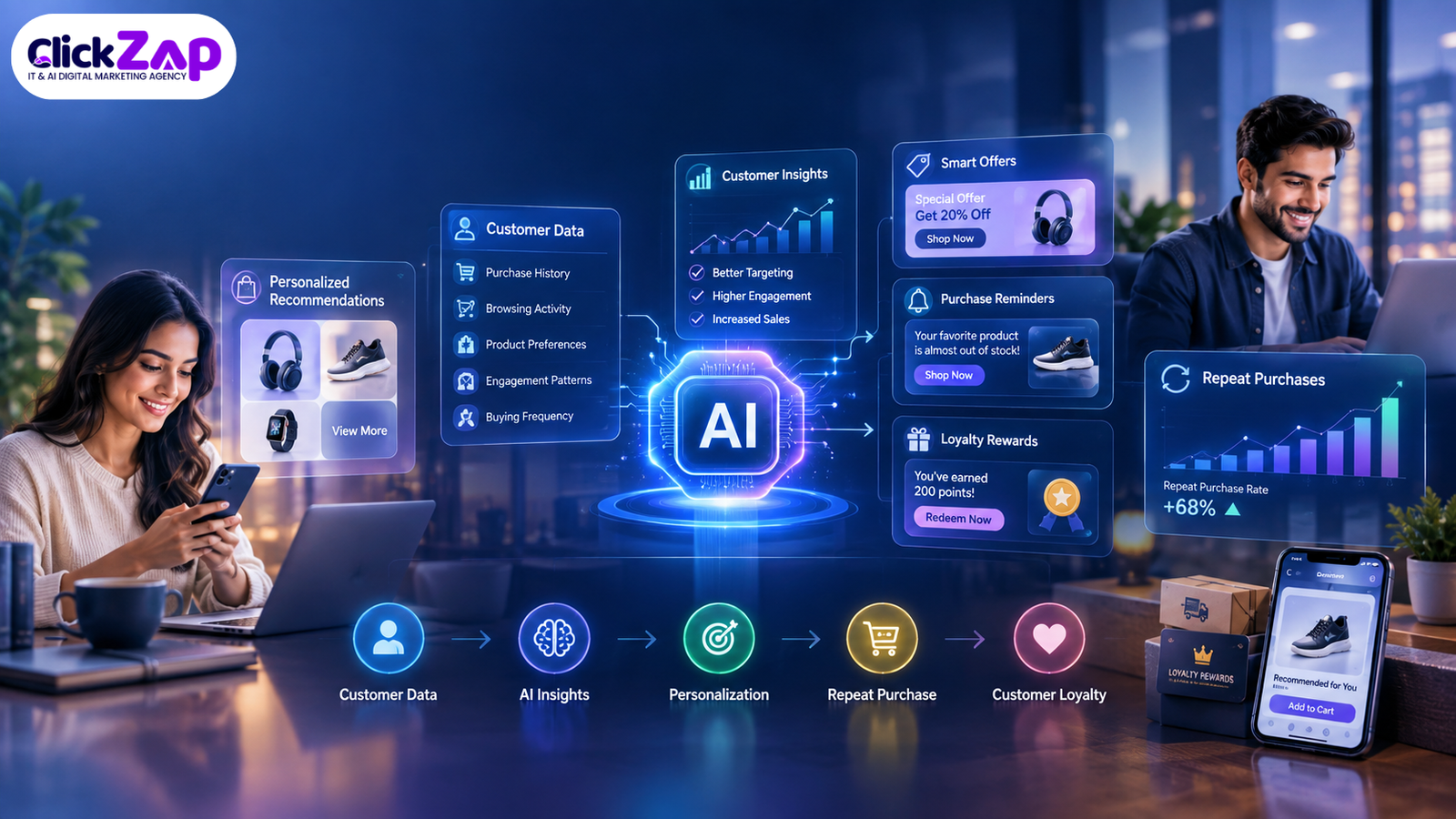
AI for repeat purchases works by making the path back to buying again shorter, more relevant, and better timed.
- Product recommendations: Suggesting items based on past purchases or browsing behavior, so customers see relevant options without searching.
- Personalized offers: Tailoring discounts or bundles to what a specific customer is likely to want, rather than blanket promotions.
- Replenishment reminders: Prompting customers to reorder consumable products around the time they’re likely to run out.
- Cross selling and upselling: Recommending complementary or upgraded products based on what a customer already owns.
- Personalized email campaigns: Sending messages timed and worded around individual customer behavior.
- Customer lifecycle messaging: Adjusting communication based on whether a customer is new, active, at risk, or lapsed.
- Post-purchase engagement: Following up with helpful content, usage tips, or check ins after a purchase to build a stronger relationship.
- Loyalty rewards: Reminding customers of points or rewards they’re close to unlocking, encouraging another purchase.
For an e-commerce brand, this might look like a personalized “you might also like” email sent a week after a purchase. For a service business, it could mean a personalized check in message timed around when a client’s contract is up for renewal. In both cases, the goal is the same: making the next purchase feel like a natural next step, not a cold pitch.
AI for Reducing Customer Churn
Customer churn is when a customer stops buying from or engaging with a business altogether. It’s one of the most costly problems for any business, because every churned customer represents lost future revenue and a wasted acquisition cost.
Common warning signals of churn include declining purchase frequency, reduced email or app engagement, unresolved support complaints, and shrinking order values. Individually, these signals can be easy to miss. Together, they often form a clear pattern.
AI for reducing customer churn works by continuously monitoring these signals and calculating a churn risk score for each customer. When a customer’s risk score crosses a certain threshold, businesses can respond with a targeted retention campaign, a personalized offer, a check in email, or a proactive support outreach before the customer disengages completely.
This proactive approach is what separates AI driven customer retention from traditional methods, which often only notice a customer has left after it’s too late to intervene.
How to Build an AI Powered Customer Retention Strategy
Building an effective AI customer retention strategy doesn’t require a complex setup. Here’s a practical, step by step framework.
Step 1: Collect Customer Data
Start by gathering data from all customer touchpoints purchases, website behavior, email engagement, and support interactions. Clean, consistent data is the foundation of every AI retention effort.
Step 2: Understand Customer Segments
Group your customers based on shared behaviors, such as purchase frequency, spend level, or product category preferences. This creates a base for more targeted retention efforts.
Step 3: Identify Retention Problems
Look for where customers commonly drop off after the first purchase, after a certain time period, or following a specific type of interaction. This tells you where to focus first.
Step 4: Use AI for Predictive Analysis
Apply AI tools to predict churn risk and identify which customers are likely to be high value over time. This helps prioritize where retention efforts will have the most impact.
Step 5: Personalize Customer Experiences
Use the insights from your data to tailor product recommendations, offers, and messaging to individual customer segments rather than a one size fits all approach.
Step 6: Automate Retention Campaigns
Set up automated, behavior triggered campaigns such as win back emails or replenishment reminders so timely outreach doesn’t depend on manual effort.
Step 7: Test and Optimize
Run A/B tests on messaging, timing, and offers. Retention strategies rarely work perfectly the first time, and testing helps refine what actually moves the needle for your audience.
Step 8: Measure Results
Track retention specific metrics regularly to understand what’s working and where to adjust your approach.
How to Measure AI Customer Retention
To know whether your AI customer retention strategies are working, track these key metrics:
- Customer retention rate: The percentage of customers who continue doing business with you over a given period.
- Repeat purchase rate: The share of customers who make more than one purchase.
- Customer churn rate: The percentage of customers who stop buying or engaging within a set timeframe.
- Customer lifetime value (CLV): The total expected revenue from a customer across their relationship with your brand.
- Customer engagement rate: How actively customers interact with your emails, app, or website.
- Purchase frequency: How often, on average, customers buy from you within a given period.
- Reactivation rate: The percentage of previously inactive customers who return after a win-back effort.
- Conversion rate: How often personalized offers or recommendations lead to an actual purchase.
- Revenue from returning customers: The share of total revenue generated by repeat buyers, a strong indicator of retention health.
Tracking these together rather than any single metric in isolation gives a more accurate picture of how well your AI powered customer retention strategy is performing.
Common Mistakes to Avoid When Using AI for Customer Retention
Even with the right tools, businesses can undermine their retention efforts through avoidable mistakes:
- Over personalization: Using customer data in a way that feels invasive rather than helpful can damage trust instead of building it.
- Poor quality customer data: AI predictions are only as good as the data behind them. Inconsistent or outdated data leads to inaccurate insights.
- Sending too many automated messages: Over messaging customers, even with relevant content, can lead to fatigue and unsubscribes.
- Ignoring customer preferences: Failing to respect communication or channel preferences can erode goodwill quickly.
- Treating every customer the same: Applying identical strategies across all segments defeats the purpose of AI powered personalization.
- Relying completely on automation: AI should support human judgment, not fully replace it especially for high value or sensitive customer relationships.
- Not testing campaigns: Skipping A/B testing means missing opportunities to improve what’s already working.
- Ignoring privacy and responsible data usage: Customer trust depends on transparent, responsible handling of personal data, in line with applicable regulations.
Future of AI Powered Customer Retention
AI powered customer retention is likely to keep evolving, though outcomes will always depend on how well each business implements these tools. Some directions worth watching include:
- Predictive customer experiences that anticipate customer needs before they’re explicitly expressed.
- Real time personalization that adjusts offers and content the moment customer behavior changes.
- More intelligent customer segmentation that goes beyond broad categories into more nuanced behavioral patterns.
- Automated lifecycle marketing that adapts messaging continuously as a customer’s relationship with the brand evolves.
- Conversational AI that handles more sophisticated customer interactions, from support to proactive engagement.
- Predictive churn prevention that intervenes earlier and more precisely than current models allow.
- Omnichannel customer engagement that keeps messaging consistent across email, app, ads, and support.
These are reasonable possibilities based on current trends, not guarantees. As with any AI application, results will depend on data quality, business context, and how thoughtfully these tools are implemented.
FAQs
What is AI for customer retention?
AI for customer retention is the use of artificial intelligence to analyze customer data, predict behavior, and personalize communication in order to keep existing customers engaged and encourage repeat purchases. It helps businesses identify at risk customers and respond before they churn.
How can AI increase repeat purchases?
AI increases repeat purchases by personalizing product recommendations, timing offers and reminders around individual customer behavior, and automating relevant follow up communication after a purchase. This makes it easier for customers to find a reason to buy again.
Can AI predict customer churn?
Yes. AI can analyze signals like declining order frequency, reduced engagement, and support complaints to calculate a churn risk score for each customer. This allows businesses to intervene with targeted retention campaigns before a customer fully disengages.
What are the best AI customer retention strategies?
Effective strategies include churn prediction, personalized product recommendations, behavior based segmentation, automated win back campaigns, and AI powered loyalty programs. The best approach usually combines several of these based on the business’s specific customer journey.
Which AI tools can help with customer retention?
Common tools include HubSpot and Salesforce for CRM and automation, Klaviyo and Braze for personalized engagement, Google Analytics 4 for behavior insights, and generative AI tools like ChatGPT or Google Gemini for content and campaign support.
Conclusion
AI for customer retention isn’t about replacing human relationships with automation, it’s about understanding customers well enough to serve them better, earlier, and more personally. From predicting churn to personalizing offers and automating timely engagement, AI gives businesses the tools to turn more first time buyers into loyal, repeat customers.
Results will always depend on your data, your industry, and how well your retention strategy is implemented and maintained. There’s no shortcut that guarantees success, but a thoughtful, AI supported approach puts the odds firmly in your favor.
If you’re looking to build a retention strategy that actually fits your business, ClickZap IT works with businesses on AI powered digital marketing, SEO services, and customer focused growth strategies from setting up the right tracking and segmentation to running personalized campaigns that bring customers back. Reach out to ClickZap IT to talk through what a practical, AI powered retention approach could look like for your business.
Also Read: AI Powered Marketing Personalization: How Businesses Can Increase Conversions
0 Comments