
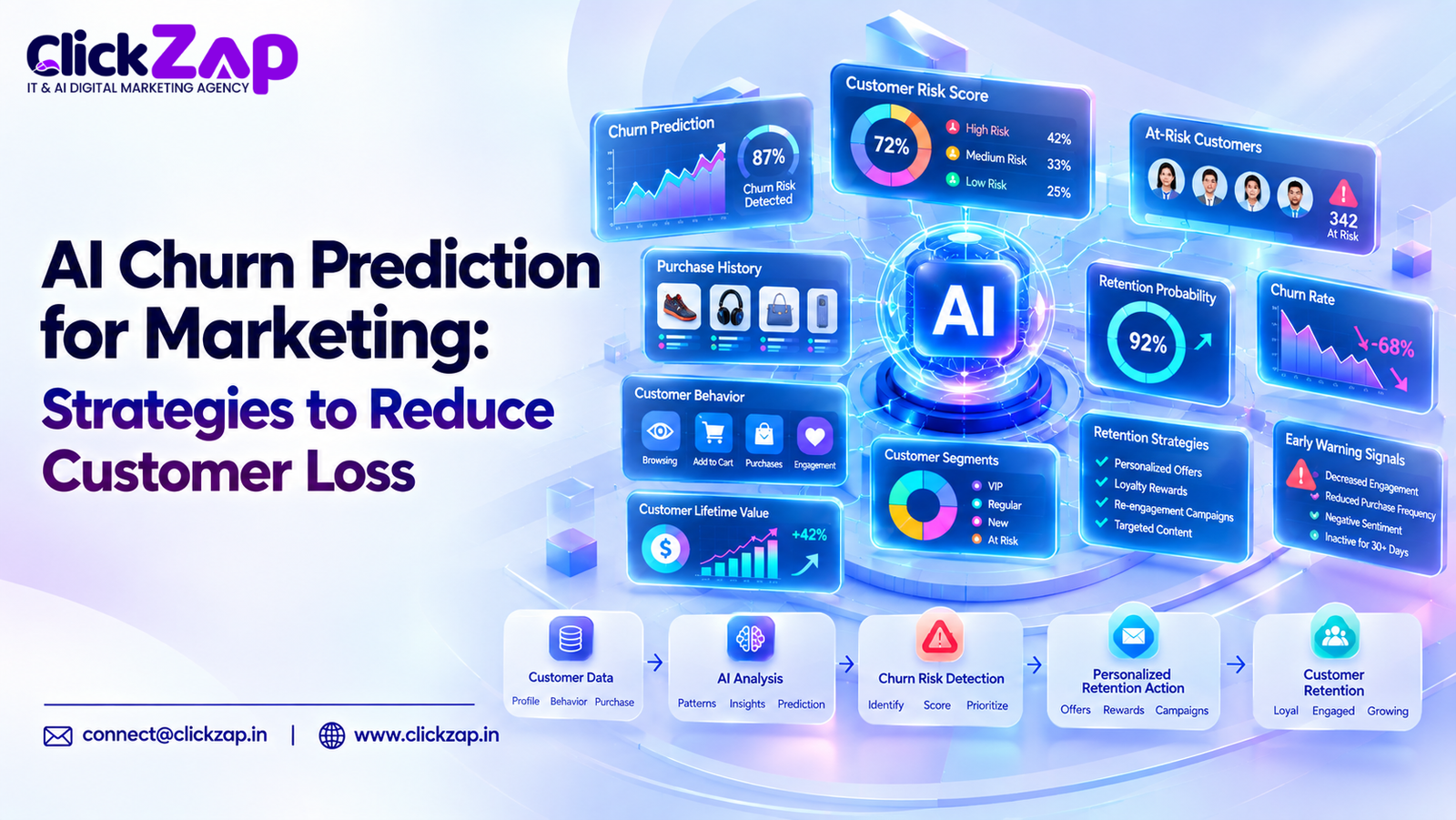
Every business loses customers. Some stop buying because of price, some outgrow the product, and some simply drift away without ever saying why. This slow, quiet loss has a name: customer churn. And for most businesses, it’s more expensive than it looks, because a customer who leaves doesn’t just represent one lost sale, they represent every future purchase, referral, and renewal that will never happen. This is exactly the gap AI churn prediction for marketing is designed to close, giving businesses a way to spot that quiet drift before it turns into a lost customer.
This is where AI churn prediction for marketing changes the equation. Instead of finding out a customer has left after they’ve already cancelled or stopped ordering, marketers can now use customer data, behavioral signals, and predictive analytics to spot the warning signs early while there’s still time to act.
In this guide, you’ll learn what AI churn prediction actually means, how it works, what data it relies on, and how marketing teams can use it to build smarter retention campaigns. We’ll also cover the tools involved, the metrics that matter, and the limitations you should know about before treating any prediction as gospel.
What Is AI Churn Prediction for Marketing?
AI churn prediction for marketing is the use of machine learning models to analyze customer behavior and historical data in order to identify customers who are likely to stop buying, unsubscribe, or disengage before it actually happens. Instead of reacting after a customer leaves, marketing teams can use these predictions to launch targeted retention campaigns while the relationship can still be saved.
Traditional customer churn analysis usually looks backward. A business reviews cancellations or lapsed accounts at the end of the month and tries to understand what went wrong after the fact. AI customer churn prediction flips this approach. It looks at ongoing patterns of declining purchase frequency, reduced website activity, fewer email opens and calculates the probability that a specific customer is heading toward churn.
At the center of this process is churn risk scoring, where each customer is assigned a score based on how closely their current behavior matches the patterns of customers who churned in the past. Marketers can then use this score to prioritize who gets attention first, rather than treating every customer the same way.
Why Customer Churn Matters for Businesses

Customer churn is the rate at which customers stop doing business with a company over a given period. The churn rate is typically calculated by dividing the number of customers lost during a period by the number of customers at the start of that period.
Why does this matter so much? Because acquiring a new customer generally takes more time, budget, and effort than keeping an existing one engaged. Customer retention directly affects customer lifetime value, the total revenue a business can reasonably expect from a customer over the entire relationship. The longer a customer stays, the more valuable that relationship becomes, assuming engagement and satisfaction remain healthy.
Here’s how churn shows up differently across business types:
- E-commerce: A customer who used to order every month suddenly stops browsing the site or opening promotional emails. Without intervention, they may never return.
- SaaS: A user’s login frequency drops, they stop using key features, and their subscription renewal becomes uncertain.
- Subscription businesses: A subscriber skips a renewal reminder or downgrades their plan often an early sign of disengagement.
- Service businesses: A client reduces the frequency of service requests or stops responding to check ins, signaling reduced satisfaction or a shift to a competitor.
In every case, understanding customer behavior early gives a business the chance to respond before the relationship ends.
Digital Marketing Services for Business
How AI Churn Prediction Works
AI churn prediction relies on structured customer data analysis and pattern recognition. While the exact data and modeling approach can vary depending on the business, industry, and available data, the general process usually follows these steps:
- Collect customer data Purchase history, engagement data, support interactions, and other relevant signals are gathered from platforms the business already uses.
- Analyze customer behavior The AI system reviews patterns in how customers interact with the business over time.
- Identify behavioral patterns The model looks for trends that have historically preceded churn, such as reduced purchase frequency or declining engagement.
- Build a customer churn prediction model Using historical data, the model learns which combinations of behaviors are associated with customers who eventually left.
- Assign churn risk scores Each customer is scored based on how similar their current behavior is to churned customers in the past.
- Identify at risk customers Customers above a certain risk threshold are flagged for attention.
- Launch personalized retention campaigns Marketing teams use the insights to create targeted outreach for at risk segments.
- Monitor results and improve the model Campaign outcomes are tracked, and the model is refined as new data comes in.
This is where predictive analytics for customer retention becomes genuinely useful. It turns raw purchase behavior and engagement data into a prioritized action list for the marketing team, rather than a spreadsheet full of numbers no one has time to interpret.
What Customer Data Can AI Use to Predict Churn?

A customer churn prediction model is only as good as the data feeding it. Businesses typically draw on a combination of the following signals:
- Purchase frequency and recency
- Average order value
- Website activity and time on site
- Product or feature usage
- Email open and click rates
- Ad engagement and response
- Customer support interactions and complaint history
- Subscription or membership activity
- Login frequency
- Browsing behavior and abandoned carts
- Sudden changes in established purchase patterns
It’s worth being clear here: businesses should only use data they’ve collected legally and with proper customer consent, respecting applicable privacy regulations. Predictive models work best on clean, relevant, well organized data not on data collected without a clear purpose or stored insecurely.
10 AI Churn Prediction Strategies to Reduce Customer Loss
1. Identify At Risk Customers Early
How it works: AI continuously monitors behavioral signals and flags customers whose patterns are shifting away from their normal engagement.
How AI helps: It can process far more behavioral data points than a manual review, catching subtle shifts a human analyst might miss.
Example: A SaaS customer who used to log in daily now logs in twice a week.
Marketing action: Trigger an automated check in email or in app message before the customer disengages entirely.
2. Use Churn Risk Scoring
How it works: Every customer receives a score reflecting their likelihood of churning, based on historical patterns.
How AI helps: Scoring lets marketing teams prioritize limited time and budget on the customers most likely to leave rather than treating a low risk and high risk customer the same way.
Example: A retail brand sorts customers into low, medium, and high churn risk tiers each month.
Marketing action: Direct retention budget and personal outreach toward high risk segments first.
3. Personalize Retention Campaigns
How it works: Customer data past purchases, preferences, browsing history informs the content of retention messaging.
How AI helps: AI can match relevant offers, content, or product recommendations to each customer’s specific behavior rather than sending generic messages.
Example: A customer who previously bought running shoes receives a message about a new running gear collection, not an unrelated promotion.
Marketing action: Build dynamic email or ad content blocks driven by customer segment and purchase history.
4. Segment Customers Based on Churn Risk
How it works: Customers are grouped by shared characteristics and risk level rather than treated as one large list.
How AI helps: Customer segmentation based on behavior and churn probability is far more precise than segmenting by demographics alone.
Example: “High value, high risk” customers get a different campaign than “low value, low risk” customers.
Marketing action: Build separate retention journeys for each risk segment instead of a single blanket campaign.
5. Detect Changes in Purchase Behavior
How it works: The system compares a customer’s current activity to their own historical baseline.
How AI helps: AI can detect gradual declines not just sudden drop offs that are easy for a human to overlook across thousands of customers.
Example: A customer who typically orders every three weeks hasn’t ordered in eight weeks.
Marketing action: Send a “we miss you” campaign with a relevant reminder or incentive tied to their past purchases.
6. Re-Engage Inactive Customers
How it works: Customers who’ve crossed a defined inactivity threshold are targeted with dedicated win back campaigns.
How AI helps: AI identifies the right inactivity threshold and the right moment to re-engage, based on what’s worked for similar customers before.
Example: A subscription business emails lapsed users with a limited time offer to reactivate their account.
Marketing action: Build an automated re-engagement flow triggered by a defined period of inactivity.
7. Improve Customer Engagement
How it works: AI insights reveal where engagement is breaking down a specific product feature, a stage in the customer journey, or a communication channel.
How AI helps: Rather than guessing, marketers get a data-backed view of exactly where customers are losing interest.
Example: Analysis shows customers who don’t use a specific feature within their first month are more likely to churn.
Marketing action: Create onboarding content or campaigns that guide customers toward that feature early.
8. Use Predictive Analytics for Customer Retention
How it works: Predictive analytics shifts marketing from reacting to churn after it happens to anticipating it in advance.
How AI helps: By forecasting likely churn before it occurs, marketing teams can plan retention campaigns proactively instead of scrambling after cancellations.
Example: A business identifies that customers who haven’t engaged with three consecutive emails have a higher churn probability.
Marketing action: Set that engagement pattern as an automatic trigger for a retention sequence.
9. Optimize Retention Campaign Timing
How it works: Behavioral data reveals the best time to reach different customer segments; not every customer responds to outreach at the same point in their journey.
How AI helps: AI can identify timing patterns across large customer bases that would be difficult to spot manually.
Example: Data shows customers are most responsive to win-back offers in the two weeks after their engagement first drops, not months later.
Marketing action: Align campaigns send schedules with the windows when customers are statistically more likely to respond.
10. Continuously Monitor and Improve Churn Models
How it works: Customer behavior changes over time, so churn prediction models need regular review and retraining.
How AI helps: AI systems can be updated with new data continuously, keeping predictions relevant as market conditions and customer habits shift.
Example: A model built before a major product change may no longer accurately reflect current customer behavior.
Marketing action: Schedule periodic model reviews and update inputs as new behavioral data becomes available.
Together, these AI customer retention strategies move a business from reactive damage control to a proactive approach but they work best as an ongoing process, not a one time project.
How to Predict Customer Churn With AI

Here’s a practical, non technical workflow for businesses getting started:
- Define what churn means for the business. Is it a cancelled subscription, 90 days without a purchase, or something else? This definition shapes everything that follows.
- Collect relevant customer data from your CRM, website analytics, ad platforms, and support systems.
- Clean and organize the data so it’s consistent, accurate, and free of duplicates or gaps.
- Identify important churn signals specific to your business the behaviors that historically preceded a customer leaving.
- Develop or select a customer churn prediction model, either built in house, through a platform, or with support from an analytics partner.
- Create churn risk scores for your active customer base.
- Segment customers based on those risk scores and other relevant attributes.
- Launch retention campaigns tailored to each segment’s risk level and behavior.
- Measure results track how at risk customers respond to your outreach.
- Improve the process continuously, refining your churn definition, data inputs, and campaigns based on what you learn.
This workflow doesn’t require a data science team to get started, even a simplified version, built around a few key behavioral signals, can meaningfully improve how a marketing team prioritizes retention efforts.
Best AI Digital Marketing Agency in Hyderabad
AI Tools and Platforms for Customer Churn Analysis
No single tool “does” churn prediction end to end. Instead, different platforms contribute different pieces of customer data and analysis to the broader workflow.
- Google Analytics 4 (GA4): Provides website and user behavior data session activity, engagement, and conversion paths that can feed into customer behavior analysis.
- Google Ads: Offers audience and campaign performance data useful for identifying disengaged segments and building remarketing strategies around them.
- Meta Ads: Engagement and advertising data from Facebook and Instagram campaigns can help marketers understand which audiences are dropping off.
- Meta Business Suite: Useful for monitoring day to day engagement across Facebook and Instagram, helping teams spot shifts in audience interaction.
- HubSpot: A CRM and marketing platform that consolidates customer interaction history, making it a practical source of data for retention analysis and campaign automation.
- Salesforce: CRM data from Salesforce can provide a detailed view of customer relationships, purchase history, and support interactions relevant to churn analysis.
- Microsoft Power BI: Useful for building dashboards that visualize churn trends, customer segments, and retention metrics in a way that’s easy for teams to interpret.
- OpenAI, ChatGPT, and Google Gemini: Generative AI tools like these can help marketers analyze customer insights, summarize feedback, brainstorm retention campaign ideas, and draft personalized marketing copy. It’s important to be clear here tools like ChatGPT or Gemini don’t automatically predict churn on their own. They assist with analysis, ideation, and content creation, but actual churn prediction modeling requires structured data and a proper modeling workflow.
AI Churn Prediction vs Traditional Customer Churn Analysis
|
Factor |
Traditional Churn Analysis |
AI Churn Prediction |
|
Data analysis |
Manual review, often periodic |
Continuous, automated analysis |
|
Pattern detection |
Limited to obvious trends |
Can detect subtle, complex patterns |
|
Customer segmentation |
Broad, often demographic-based |
Behavior and risk based segmentation |
|
Risk identification |
Usually after churn occurs |
Attempts to identify risk in advance |
|
Personalization |
Limited, generic messaging |
Data driven, more tailored messaging |
|
Campaign activation |
Manual, slower to launch |
Can be automated and triggered faster |
|
Scalability |
Harder to scale across large customer bases |
Better suited to large, complex datasets |
|
Speed of analysis |
Slower, resource intensive |
Faster, ongoing analysis |
|
Predictive capabilities |
Minimal |
Core strength, though not infallible |
It’s worth noting that AI isn’t automatically superior in every situation. For smaller customer bases with limited historical data, simpler manual analysis may be just as practical and more cost effective than building a full predictive model.
Benefits of AI for Customer Retention
- Earlier identification of at risk customers, before they’ve fully disengaged
- More targeted retention campaigns instead of generic, one size fits all messaging
- Better customer segmentation based on actual behavior
- More personalized marketing that reflects real customer preferences
- Improved customer engagement through timely, relevant outreach
- More efficient use of marketing budget and team time
- More informed decision making, backed by data rather than guesswork
- A clearer understanding of customer behavior patterns over time
- Stronger support for long term customer loyalty
- The potential to positively influence customer lifetime value, though results will vary by business
Challenges and Limitations of AI Churn Prediction
AI churn prediction isn’t a guarantee it’s a decision support tool, and it comes with real limitations:
- Poor quality or incomplete data leads to unreliable predictions.
- Incorrect churn definitions can skew the entire model if “churn” isn’t clearly defined for your business.
- Model accuracy limitations mean predictions are probabilities, not certainties.
- False positives and false negatives are inevitable; some flagged customers won’t actually churn, and some who do churn won’t be flagged.
- Changing customer behavior over time can make older models less accurate if they aren’t updated.
- Data privacy and customer consent must be handled responsibly and in line with applicable regulations.
- Integration challenges can arise when customer data lives across multiple disconnected systems.
- Human oversight is still necessary. AI can flag patterns, but marketers need to interpret context and make final decisions.
Treat every prediction as a signal worth investigating, not an automatic verdict on a customer relationship.
Key Metrics to Measure Customer Retention
- Churn rate: The percentage of customers lost over a given period. Formula: (Customers lost ÷ Customers at start of period) × 100.
- Customer retention rate: The percentage of customers a business keeps over a period. Formula: ((Customers at end − New customers) ÷ Customers at start) × 100.
- Customer lifetime value (CLV): The total revenue expected from a customer over the full relationship.
- Repeat purchase rate: The percentage of customers who make more than one purchase.
- Customer engagement: Measured through metrics like email opens, site visits, or app usage frequency.
- Purchase frequency: How often a customer buys within a given timeframe.
- Reactivation rate: The percentage of previously inactive customers who return after a win back campaign.
- Retention campaign performance: Open rates, click through rates, and conversion rates specific to retention focused campaigns.
Example of AI Churn Prediction in Marketing
Here’s an illustrative example not a guaranteed outcome, just one way this might play out in practice.
An e-commerce company notices, through its churn model, that a group of repeat customers shows several overlapping signals: reduced purchase frequency, lower website engagement, fewer email interactions, and longer gaps between orders. The AI system flags this group as at risk based on similarities to customers who churned previously.
From there, the marketing team could:
- Segment these customers into a dedicated “at risk” group.
- Create personalized messaging referencing their past purchases or preferences.
- Launch a retention campaign, perhaps a relevant offer or a simple re-engagement email.
- Monitor how the segment responds over the following weeks.
- Reassess their behavior to see whether engagement improves.
This is one possible workflow, and results will depend heavily on the business, the offer, and the customer relationship itself.
Best Practices for AI Customer Churn Prediction
- Start with a clear, business specific definition of churn.
- Use relevant, reliable, and properly collected customer data.
- Combining AI predictions with human judgment doesn’t automate every decision.
- Avoid overly aggressive or excessive personalization that can feel intrusive.
- Respect customer privacy and consent at every stage.
- Test retention campaigns before scaling them broadly.
- Monitor false predictions and adjust thresholds as needed.
- Update your churn model regularly as customer behavior evolves.
- Measure campaign performance consistently, not just churn rate.
- Focus on overall customer value, not solely on preventing churn at any cost.
Frequently Asked Questions About AI Churn Prediction for Marketing
What is AI churn prediction for marketing?
AI churn prediction for marketing uses machine learning to analyze customer behavior and identify those likely to disengage or leave. Marketers use these insights to launch targeted retention campaigns before a customer actually churns, rather than reacting after the relationship has already ended.
How does AI predict customer churn?
AI analyzes historical and current customer data purchase patterns, engagement levels, and behavioral changes to find patterns associated with past churn. It then assigns each customer a churn risk score reflecting how closely their behavior matches those historical patterns.
What data is needed for customer churn prediction using AI?
Common data sources include purchase history, website activity, email engagement, product usage, support interactions, and subscription activity. The right mix depends on the business, but consistent, accurate, and properly collected data is essential for reliable predictions.
How can AI help reduce customer churn?
AI helps by identifying at risk customers early, enabling personalized and timely retention campaigns, and continuously refining predictions as customer behavior changes. This shifts marketing from a reactive approach to a more proactive, data informed retention strategy.
What is a customer churn prediction model?
A customer churn prediction model is a machine learning system trained on historical customer data to estimate the likelihood that a given customer will churn. It outputs a churn risk score, which marketing teams can use to prioritize retention efforts.
Conclusion
AI churn prediction for marketing isn’t about replacing human judgment, it’s about giving marketing teams an earlier, clearer view of which customers need attention before they’re gone. By combining customer data analysis, predictive analytics, and thoughtful retention campaigns, businesses can move from guessing why customers leave to actually anticipating it and doing something about it while there’s still time.
The businesses that get the most value from AI powered customer retention aren’t the ones chasing the fanciest model. They’re the ones with clean data, a clear definition of churn, and a marketing team willing to act on what the data shows.
Also Read: AI for Customer Retention: Strategies to Increase Repeat Purchases



0 Comments