
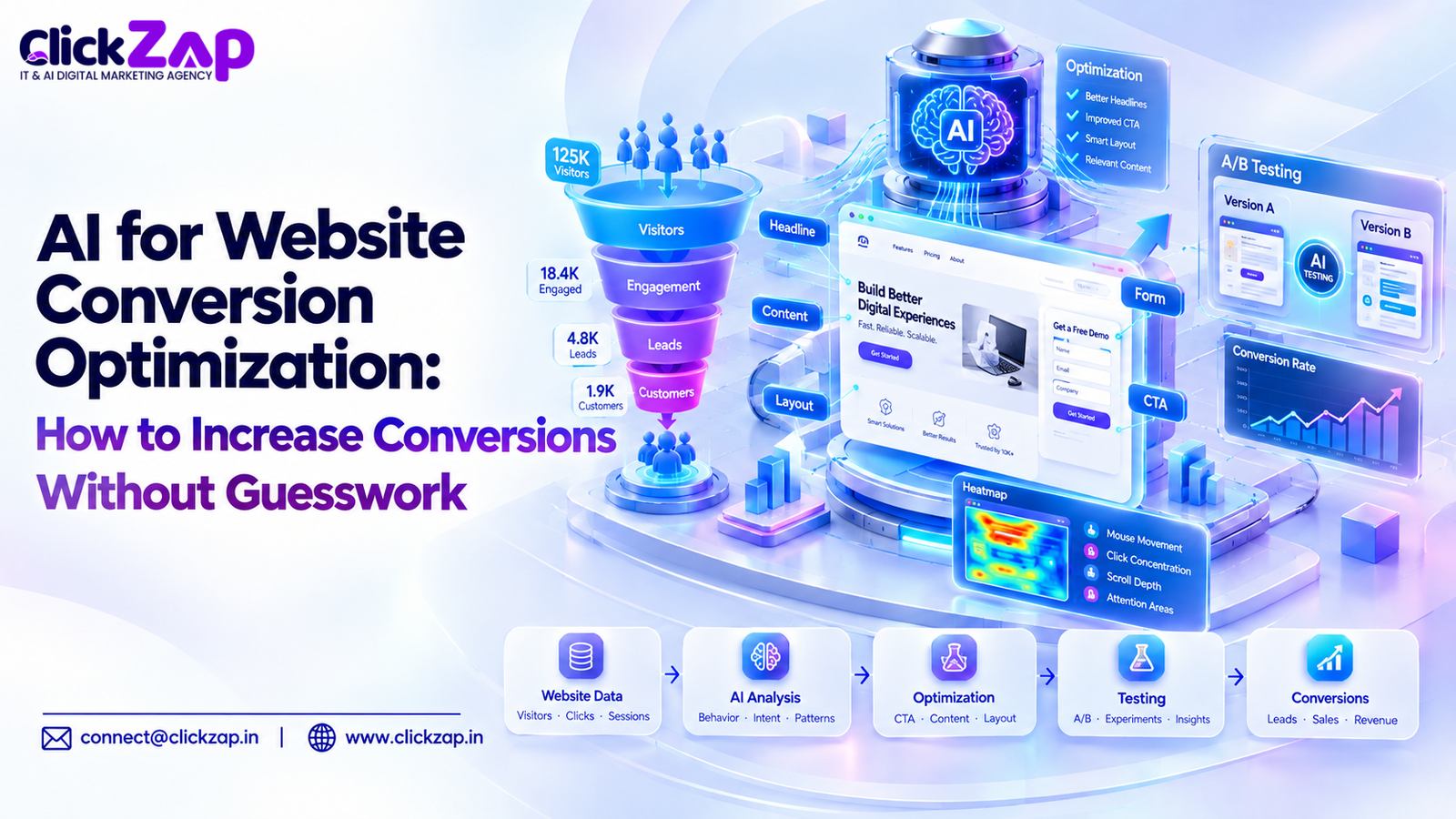
You’re getting traffic. Google Ads is running, SEO is bringing in visitors, maybe social media is doing its job too. But the leads, sales, or sign ups just aren’t showing up at the rate they should and that’s usually the first sign a business needs AI for website conversion optimization. Sound familiar?
This is one of the most common frustrations for business owners and marketers alike. Traffic keeps flowing in, but conversions stay flat. The usual response is to guess: change a headline, swap a button color, rewrite a CTA, and hope something sticks. That’s traditional website optimization in a nutshell: manual analysis, trial and error, and a lot of assumptions about what visitors actually want.
AI for website conversion optimization changes this approach. Instead of guessing, AI analyzes real visitor behavior, spots where people drop off, predicts what’s likely to work, and helps you personalize the experience for different audiences all faster than a human team could do manually.
In this guide, you’ll learn what AI for website conversion optimization actually means, how it works step by step, which tools businesses commonly use, practical AI CRO strategies you can apply, and how to measure whether your optimization efforts are actually paying off.
What Is AI for Website Conversion Optimization?
Let’s break this down into simple parts.
AI (Artificial Intelligence) refers to software that can analyze data, recognize patterns, and make predictions or recommendations often faster and at a larger scale than a person could manage manually.
Conversion Rate Optimization (CRO) is the practice of improving the percentage of website visitors who complete a desired action like making a purchase, filling out a form, booking a demo, or sending an inquiry.
Put the two together, an AI driven CRO is the use of artificial intelligence to analyze website data, understand visitor behavior, and make smarter, faster decisions about how to improve conversions.
AI powered website optimization works by combining several capabilities:
- Website analytics data (what pages people visit, how long they stay)
- Behavioral data (where they click, scroll, and hesitate)
- Predictive analytics (which visitors or pages are likely to convert)
- Automation (testing multiple variations without manual setup for each one)
- Personalization (adjusting the experience based on who’s visiting)
A simple example: Imagine an e-commerce site where AI notices that visitors from mobile devices abandon the checkout page at a much higher rate than desktop visitors. Instead of a marketer manually digging through spreadsheets to spot this, the AI surfaces the pattern quickly and the team can then test a simplified mobile checkout flow to fix it.
Why Website Conversion Optimization Matters
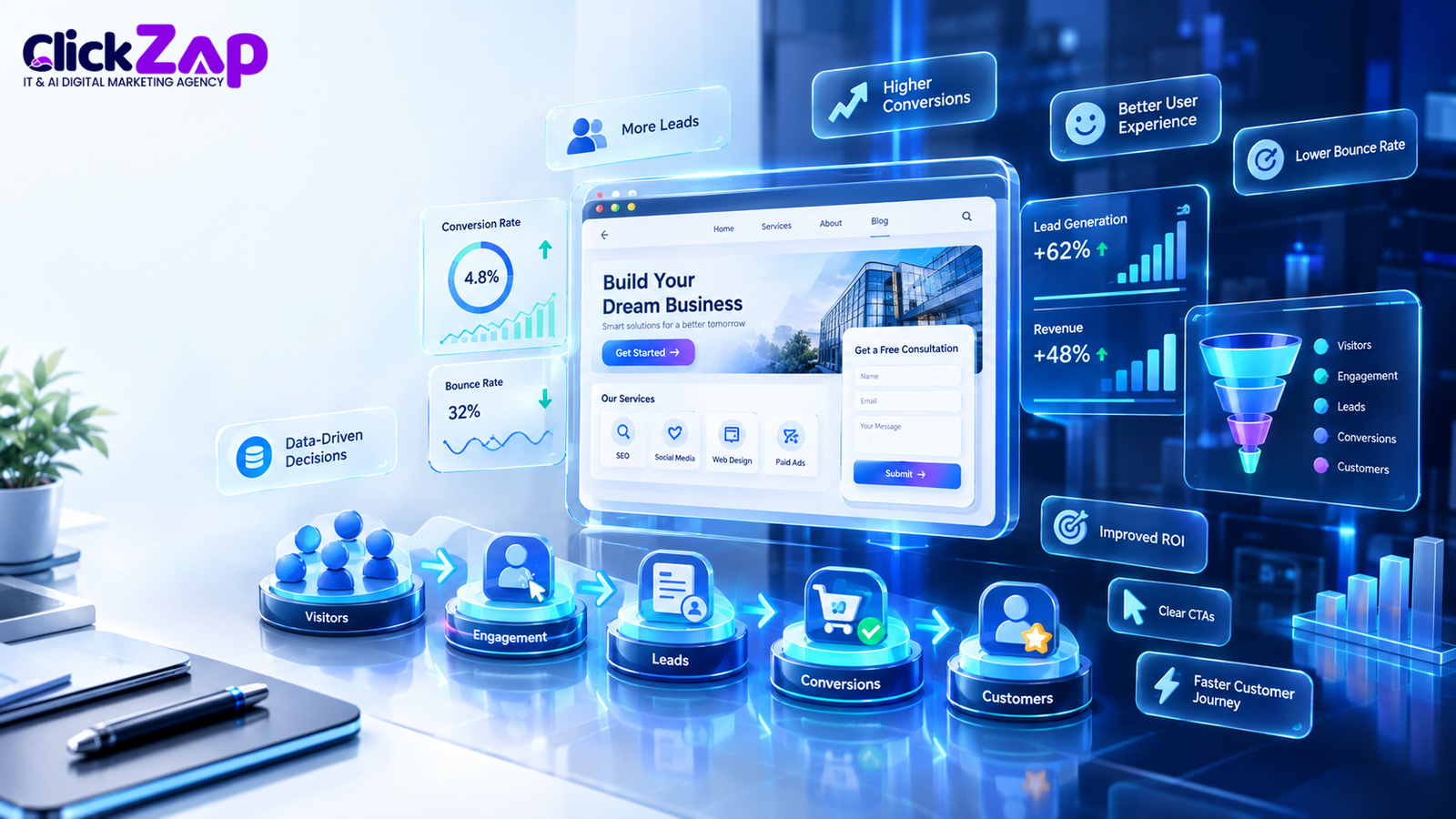
More traffic doesn’t automatically mean more business. A website conversion rate tells you what percentage of visitors actually take a meaningful action: a lead form submission, a sale, a sign up, a demo request, or an inquiry.
Here’s the thing most businesses overlook: if your website converts at 1% and you double your traffic, you’ve doubled your results. But if you improve your conversion rate to 2% without spending more on traffic, you’ve achieved the same outcome often at a much lower cost.
This directly affects:
- Customer acquisition costs (CAC) : a low converting site means you’re paying more, per customer, for the same traffic
- Marketing ROI : every rupee spent on ads or SEO works harder when your site converts better
- Sales and revenue growth : more conversions from the same traffic base means predictable, scalable growth
The core idea is simple: getting more traffic is one growth lever, but converting the traffic you already have is often the faster and cheaper one.
SEO Services for your Business
How AI Changes Traditional Conversion Rate Optimization
Traditional CRO usually depends on a marketer’s intuition, basic analytics reports, and manual A/B test setups. It works but it’s slow, and it relies heavily on assumptions.
AI powered CRO doesn’t replace this process; it makes it faster, more data driven, and more precise.
|
Area |
Traditional CRO |
AI Powered CRO |
|
Analysis |
Manual review of reports |
Automated pattern detection |
|
Decision making |
Based on guesswork/experience |
Based on visitor data and predictions |
|
Segmentation |
Broad, rule based groups |
Predictive, behavior based segments |
|
Website experience |
Mostly static for all visitors |
Personalized website experiences |
|
Testing |
Manual A/B test setup |
AI powered A/B testing at scale |
|
Reporting |
Mostly historical |
Historical + predictive analytics for marketing |
|
Optimization frequency |
Periodic (monthly/quarterly) |
Continuous |
This doesn’t mean AI replaces marketers. It means marketers spend less time digging through data and more time acting on clear insights.
How AI for Website Conversion Optimization Works
Here’s a step by step look at how the process typically unfolds.
1. Collect Website Data
Everything starts with data page views, clicks, sessions, traffic sources, engagement time, form interactions, and completed conversions. Google Analytics 4 (GA4) is the most widely used tool for this, tracking user behavior across the entire site and reporting on which pages and channels actually drive results.
2. Analyze Website Visitor Behavior
Raw numbers only tell part of the story. Tools like Hotjar and Microsoft Clarity add a visual layer through heatmaps and session recordings, showing exactly where visitors click, how far they scroll, and where they hesitate or get stuck. This kind of user behavior analysis often reveals problems that standard analytics reports miss entirely like a CTA button visitors simply never notice.
3. Identify Conversion Barriers
With enough data, patterns start to emerge: high exit rates on a particular page, forms people start filling but never submit, confusing navigation, weak or unclear calls to action, and friction during checkout. AI can flag these barriers automatically, instead of requiring someone to manually spot them across hundreds of sessions.
4. Predict Potential Conversion Opportunities
This is where predictive analytics for marketing comes in. Instead of only reporting what already happened, AI models can estimate which visitors, pages, or audience segments are most likely to convert, helping teams prioritize where to focus optimization efforts first.
5. Recommend or Apply Optimizations
Based on the data, AI tools can suggest or in some cases directly help create improvements to headlines, CTAs, landing pages, forms, content, offers, layouts, and personalization rules across the customer journey.
6. Test and Measure Results
No optimization should be assumed to work. AI powered A/B testing and solid conversion tracking are essential to confirm whether a change actually improved performance or whether it needs to be reversed.
Best Digital Marketing Agency in Hyderabad
AI CRO Strategies That Can Increase Website Conversions
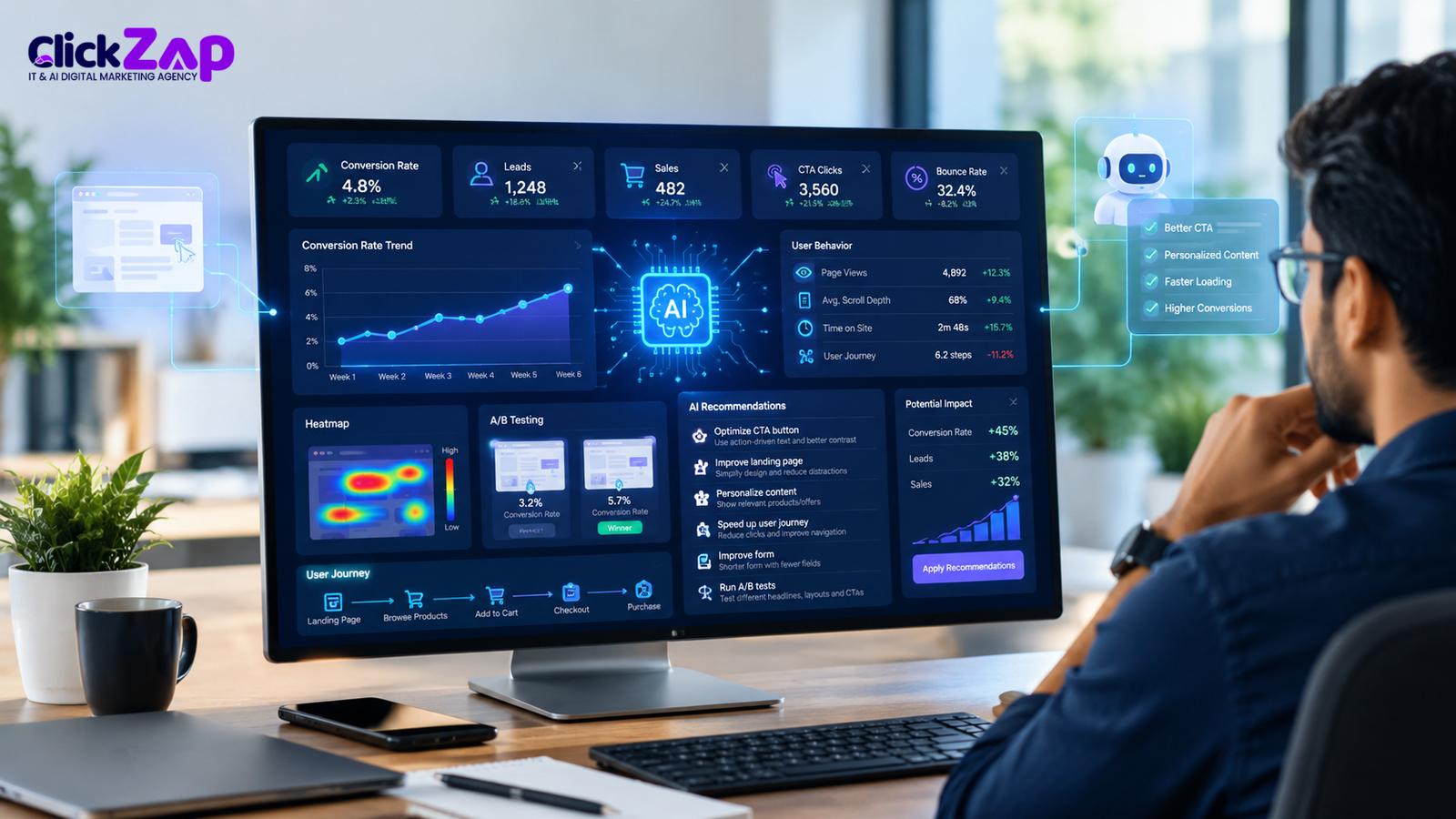
AI Powered Landing Page Optimization
AI tools can analyze landing page performance and flag specific elements that may be holding back conversions: weak headlines, unclear copy, poorly placed CTAs, low quality images, overly long forms, confusing page structure, or missing trust signals like testimonials and certifications.
AI Powered A/B Testing
Rather than testing one variable at a time and waiting weeks for results, AI powered A/B testing can run multiple variations of headlines, CTAs, designs, offers, and layouts simultaneously, then identify which combinations perform best, often much faster than traditional split testing.
AI Website Personalization
AI website personalization tailors the experience based on factors like location, device, traffic source, past behavior, where someone is in the customer journey, interests, or purchase history. A first time visitor from a Google search might see different messaging than a returning visitor who abandoned a product page last week.
AI Based Conversion Funnel Optimization
Rather than optimizing a single page in isolation, AI can analyze the entire path:
Traffic → Landing Page → Engagement → Form/Product Page → Conversion.
This kind of conversion funnel analysis helps identify exactly where visitors are dropping off which is often more valuable than optimizing a page that isn’t actually the bottleneck.
AI for Customer Journey Optimization
Visitors rarely convert in a single session. AI can track behavior across multiple touchpoints blog visits, retargeting ads, email interactions, and return visits to identify friction points across the full customer journey, not just isolated pages.
Predictive Analytics for Conversion Optimization
Predictive models can help identify which visitors are likely converters, which segments carry the highest value, and where potential drop offs are likely to happen next, letting teams act before a problem shows up in the numbers.
AI Website Optimization Tools Businesses Can Use
Google Analytics 4 (GA4) : The foundation for conversion tracking, user behavior analysis, customer journey analysis, and overall website performance measurement.
Google Ads : Campaign and conversion data from Google Ads helps identify which traffic sources and audience segments actually contribute to conversions, not just clicks.
Meta Ads : Similar to Google Ads, Meta’s advertising data supports audience insight and conversion analysis for social driven traffic.
HubSpot : Useful for CRM data, lead tracking, mapping customer journeys, marketing automation, and delivering personalized experiences based on where a contact is in the pipeline.
Optimizely : A widely used experimentation and website optimization platform for running structured, AI assisted tests at scale.
VWO : Supports A/B testing, conversion optimization, broader experimentation programs, and visitor insight collection.
Hotjar : Provides heatmaps, session recordings, user behavior insights, and visitor feedback tools.
Microsoft Clarity : A free tool offering session recordings, heatmaps, rage click detection, and behavior analysis.
OpenAI / ChatGPT : AI assistants like ChatGPT can support CRO work in practical ways: generating test ideas, analyzing qualitative feedback, drafting landing page copy variations, brainstorming CTA options, summarizing user research, and developing CRO hypotheses. It’s worth noting that tools like ChatGPT don’t independently analyze your live website data unless connected to the relevant analytics or tracking tools they’re best used to support human-led CRO work, not replace data collection.
Google Optimize : Historically, Google Optimize was a popular free tool for website experimentation. It was discontinued in 2023, and businesses now rely on alternatives such as Optimizely and VWO for similar experimentation and testing needs.
How AI Can Improve Different Parts of a Website
Homepage Optimization : AI can help identify which sections visitors actually engage with, which are ignored, and where messaging or navigation may be causing early drop off.
Landing Page Optimization : This includes evaluating headlines, CTA placement and wording, form length, trust signals, and overall content clarity for a specific campaign or offer.
Product Pages : For e-commerce sites, this covers product descriptions, recommendations, reviews, how pricing is presented, and friction points that discourage a purchase.
Lead Generation Forms : AI driven insight can reveal whether a form is too long, which fields cause abandonment, and whether the surrounding CTA needs adjustment.
Checkout Pages : Checkout is where a lot of revenue quietly disappears. AI can help identify friction points, abandonment triggers, payment experience issues, and missing trust elements.
Blog Pages : Blog content often attracts informational visitors who aren’t ready to buy yet. AI can help identify natural opportunities to guide these readers toward relevant CTAs and deeper parts of the customer journey.
Example of AI for Website Conversion Optimization
Here’s a hypothetical example to illustrate how this works in practice.
Imagine a business receiving around 50,000 monthly website visitors but converting at a low rate of 0.8%. Using AI driven CRO, the team might:
- Analyze GA4 data to find which pages have unusually high exit rates
- Review Hotjar or Microsoft Clarity recordings on those pages to understand why visitors are leaving
- Discover that a lead form has five required fields, and most users abandon it after the third
- Segment visitors by traffic source and device to see if mobile users are especially affected
- Create a simplified landing page experience with a shorter form for mobile traffic
- Run an AI powered A/B test between the original and simplified versions
- Track conversion data over several weeks to measure the actual impact
- If the shorter form performs better, roll it out more broadly and continue testing other elements
This is a simplified, hypothetical walkthrough real results will vary based on traffic quality, industry, offer, and execution.
Digital Marketing Services for Business
Benefits of AI Powered Conversion Optimization
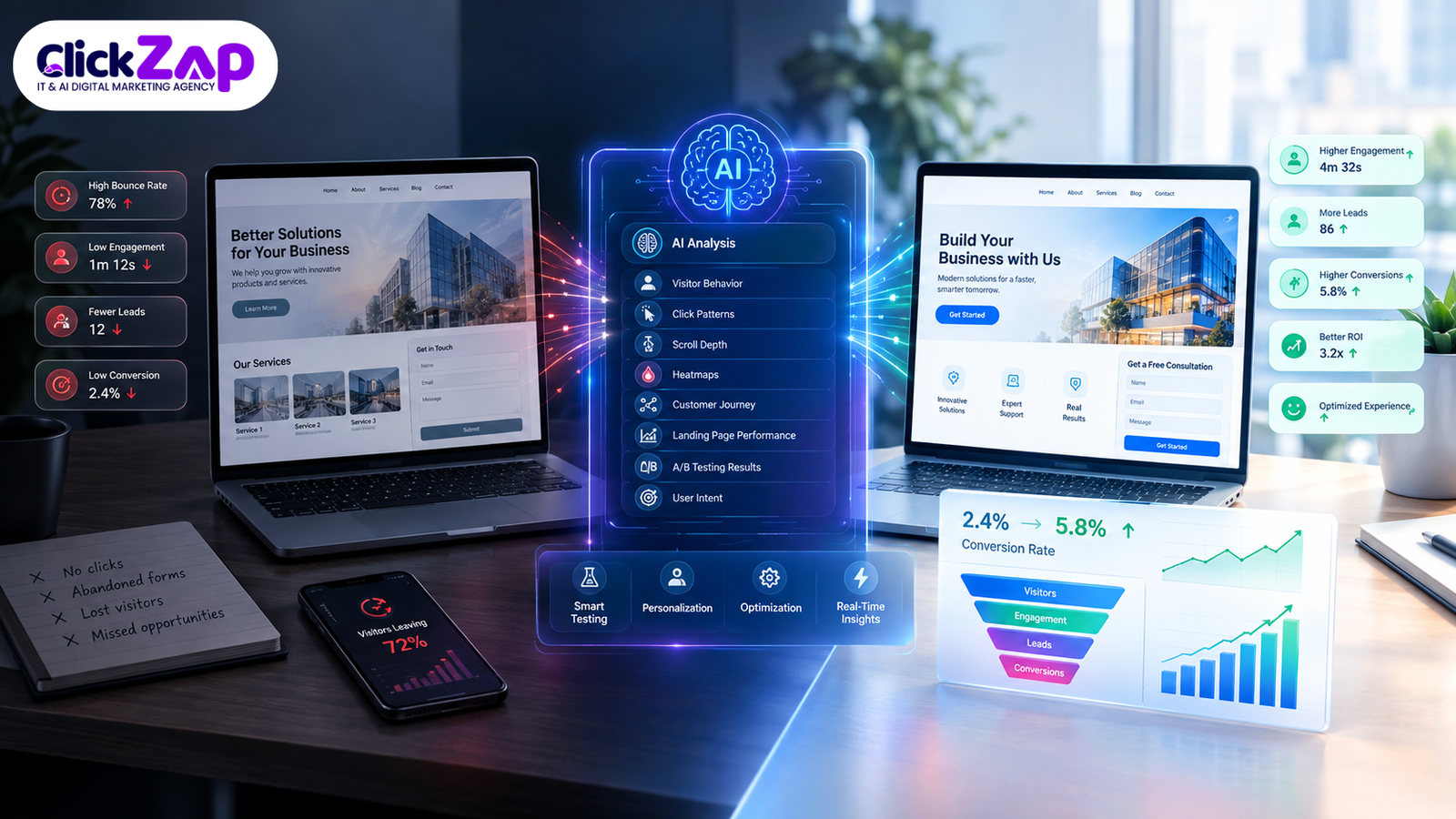
- Faster analysis of large volumes of website data
- Clearer understanding of visitor behavior and intent
- More relevant, personalized website experiences
- Quicker experimentation and testing cycles
- Deeper conversion funnel analysis
- Less reliance on guesswork and assumptions
- Improved overall user experience
- More efficient CRO workflows for lean marketing teams
- Better use of existing marketing data
- Potential improvement in marketing ROI over time
It’s worth being clear here: AI can significantly improve how conversion optimization is done, but it cannot guarantee a specific increase in conversions. Results depend on the quality of data, the business, the offer, and execution.
Challenges and Limitations of AI Driven CRO
AI powered CRO isn’t a magic fix, and it’s worth understanding its limitations:
- Poor quality or incomplete data leads to poor recommendations AI is only as good as the data feeding it
- Incorrect tracking setup can produce misleading insights before optimization even begins
- Privacy concerns around tracking visitor behavior require careful, compliant handling
- Over reliance on automation without human review can lead to strategies that miss business context
- Insufficient conversion volume makes some AI models and tests statistically unreliable
- Incorrect AI recommendations can happen human oversight is still necessary
- Experimentation errors, like running tests with flawed setups, can distort results
- Attribution limitations make it hard to know with certainty which touchpoint drove a conversion
- Customer privacy and consent requirements must be respected throughout data collection and testing
The takeaway: AI should support marketing decisions, not replace human judgment entirely. The strongest results tend to come from AI assisted insight paired with experienced human strategy.
How to Implement AI for Website Conversion Optimization
Step 1: Define the Conversion Goal
Be specific. Are you optimizing for purchases, leads, phone calls, WhatsApp enquiries, demo requests, registrations, or newsletter sign ups? Every part of the strategy depends on this.
Step 2: Set Up Accurate Tracking
Before you optimize anything, make sure GA4 and your conversion tracking are correctly configured. Bad data leads to bad decisions.
Step 3: Understand Visitor Behavior
Use tools like Hotjar or Microsoft Clarity to see how people actually interact with your site, not just what the numbers say.
Step 4: Identify Conversion Problems
Look for funnel drop offs, high exit pages, and behavioral patterns that point to friction.
Step 5: Create CRO Hypotheses
Turn what you’ve learned into specific, testable ideas for example, “shortening the form will reduce abandonment.”
Step 6: Run Experiments
Use A/B testing and experimentation platforms like Optimizely or VWO to test your hypotheses properly.
Step 7: Personalize Experiences
Where it adds real value, create tailored experiences for different visitor segments.
Step 8: Measure Results
Track conversion rate, revenue, lead quality, and other relevant KPIs not just vanity metrics.
Step 9: Continue Optimizing
Conversion rate optimization isn’t a one time project. It’s an ongoing process that should evolve as your traffic, offers, and audience change.
Key Metrics to Measure AI Powered CRO Performance
|
Metric |
What It Tells You |
|
Conversion rate |
Percentage of visitors completing the desired action |
|
Click through rate |
How well CTAs and links are performing |
|
Engagement metrics |
Whether visitors are meaningfully interacting with content |
|
Form completion rate |
How many visitors finish vs. abandon a form |
|
Cart abandonment rate |
Where e-commerce visitors drop off before purchase |
|
Checkout completion rate |
How efficiently checkout converts to sale |
|
Cost per conversion |
Efficiency of your ad and marketing spend |
|
Customer acquisition cost (CAC) |
Total cost to acquire one paying customer |
|
Revenue per visitor |
Average revenue generated per site visitor |
|
Average order value (AOV) |
Typical spend per transaction |
|
Lead to customer rate |
How many leads eventually convert to paying customers |
|
Return on ad spend (ROAS) |
Revenue generated relative to ad spend |
The right KPI to focus on depends entirely on your specific business goal. A SaaS company tracking demo sign ups will prioritize different metrics than an e-commerce store tracking AOV and cart abandonment.
Best Practices for AI Website Conversion Optimization
- Start with reliable, accurately tracked data
- Define one clear conversion goal before optimizing
- Fix tracking issues before making optimization decisions
- Use AI to identify patterns, not to make final decisions alone
- Validate AI recommendations against business context
- Test changes before rolling them out sitewide
- Avoid over personalizing to the point of complexity
- Keep the user experience simple and intuitive
- Protect customer data and stay privacy compliant
- Continuously monitor performance rather than treating CRO as a one time fix
AI for Website Conversion Optimization vs Traditional CRO
|
Area |
Traditional CRO |
AI Powered CRO |
|
Data analysis |
Mostly manual |
AI assisted |
|
Visitor segmentation |
Rule based/manual |
Data driven and predictive |
|
Testing |
Manual setup |
AI assisted experimentation |
|
Personalization |
Limited/static |
Dynamic and behavior based |
|
Funnel analysis |
Periodic |
Continuous/data driven |
|
Insights |
Historical |
Historical + predictive |
|
Optimization |
Human led |
AI assisted + human led |
AI complements traditional CRO; it doesn’t make human marketing expertise unnecessary. The best results still come from combining AI driven insight with strategic judgment.
Frequently Asked Questions
What is AI for website conversion optimization?
It’s the use of artificial intelligence to analyze website data, understand visitor behavior, and identify opportunities to improve the percentage of visitors who take a desired action, such as making a purchase or submitting a form.
How can AI improve website conversion rates?
AI analyzes visitor behavior, identifies friction points in the conversion funnel, predicts which segments are likely to convert, and supports faster, more accurate A/B testing and personalization.
What is AI powered CRO?
AI powered CRO refers to conversion rate optimization strategies that use artificial intelligence to automate data analysis, testing, and personalization, rather than relying entirely on manual processes.
How does AI analyze website visitor behavior?
AI tools use data from heatmaps, session recordings, clicks, scroll depth, and engagement patterns often from tools like Hotjar or Microsoft Clarity to identify how visitors actually interact with a website.
Can AI optimize landing pages?
Yes. AI can help identify weak points in a landing page’s headlines, CTAs, forms, and layout, and support A/B testing to determine which variations perform better.
Conclusion
Getting traffic to your website is only half the equation converting that traffic into leads, sales, and customers is where real growth happens. AI for website conversion optimization gives businesses a faster, more accurate way to understand visitor behavior, identify what’s holding conversions back, personalize experiences, and test ideas with actual data instead of guesswork.
That said, AI works best as a tool that supports smart decision making, not a replacement for it. The most effective conversion optimization comes from combining reliable data, AI driven insight, strong UX, consistent testing, and experienced human strategy.
Want to turn more website visitors into customers? Get in touch with the ClickZap IT team to explore data driven website optimization and AI powered digital marketing strategies for your business.
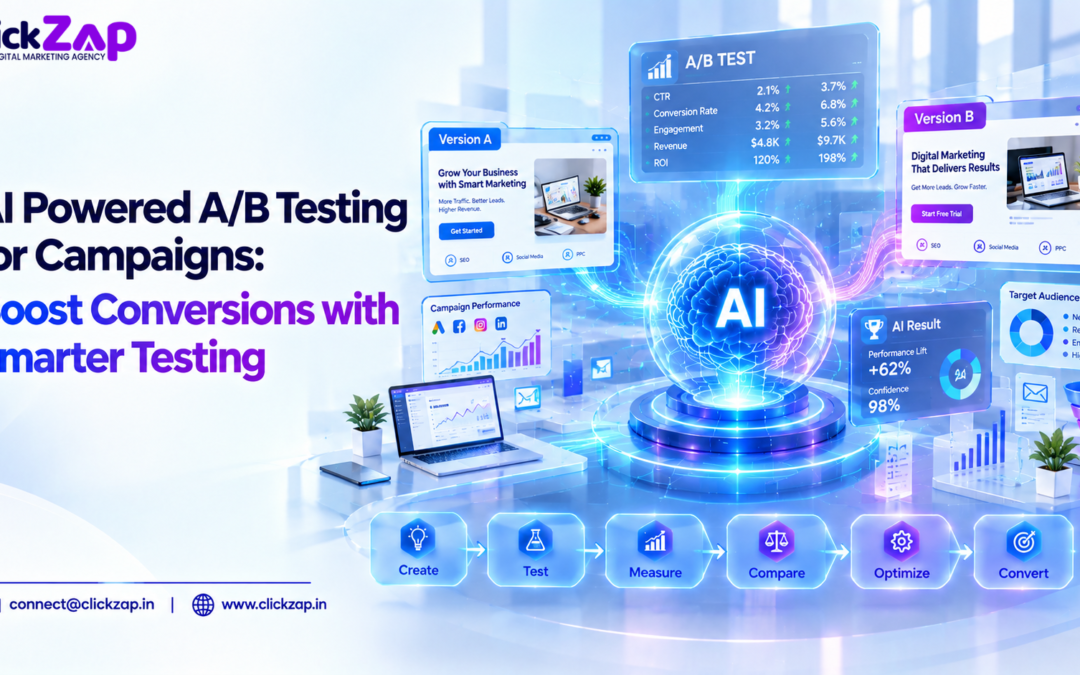
Also Read: AI Powered A/B Testing for Campaigns: Boost Conversions with Smarter Testing
0 Comments