
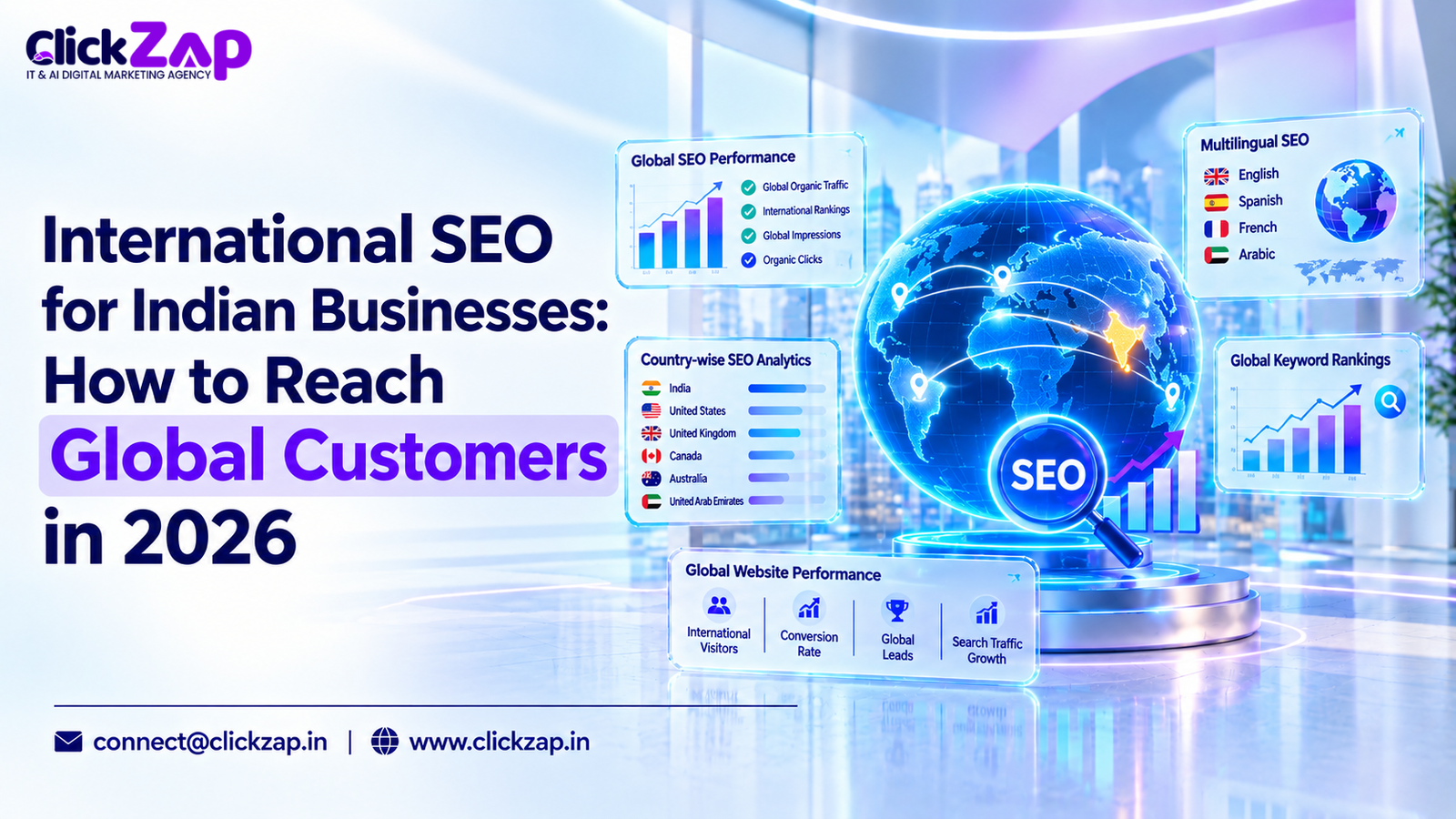
Indian businesses no longer treat exports and overseas clients as a side project. SaaS companies sell to buyers in Texas, manufacturers quote to distributors in Dubai, and IT firms win retainers from London. The buyers in these markets start their search on Google, so the businesses they find are the ones that show up in the right country, in the right language, with the right information. That is the problem international SEO for Indian businesses is built to solve.
The opportunity is large in the USA, UK, UAE, Australia, and Canada. Each market has paying customers and a familiar business language. Each also has local competitors who already rank. Paid ads can open the door, but the cost rises with every click. That is why international SEO for Indian businesses deserves a place in your growth plan. It builds organic traffic from several countries and keeps working after the ad budget stops.
This guide explains what international SEO is, how it works, and the steps to apply it. It also covers the mistakes to avoid and the tools that help. Where Google has published guidance, we say so. Where something is our recommendation, we say that too.
What Is International SEO for Indian Businesses and How Does It Work?
International SEO is the practice of optimizing your website so search engines show the right version of your pages to people in the right countries and languages. It covers site structure, technical signals, content, and links, all aimed at more than one market.
Search engines cannot read your intentions. They infer a page’s target country and language from signals you provide. Google’s documentation on managing multi regional and multilingual sites points to these:
- The language of the content itself. Google reads the visible text, not a language tag in your code.
- Your URL structure. A country code top level domain (ccTLD) such as .co.uk, or a folder such as /uk/, tells Google which audience a page serves.
- Hreflang annotations. Hreflang is a piece of code that tells Google which pages are alternate versions of each other, and which language or region each one serves. We cover it in detail below.
- Local signals. Local currency, local addresses and phone numbers, and links from sites in the target country all help.
Google states that it ignores locational meta tags such as geo.position. Adding them achieves nothing.
Multilingual SEO vs. Multiregional SEO
These two terms describe different problems, and many businesses mix them up.
|
Multilingual SEO |
Multiregional SEO |
|
|
Targets |
Speakers of different languages |
Users in different countries |
|
Example |
English and Arabic pages for the UAE |
English pages for the USA, UK, and Australia |
|
Main challenge |
Translation quality, language specific URLs |
Regional differences in vocabulary, pricing, and regulations |
|
Hreflang example |
en, ar |
en-US, en-GB, en-AU |
Many sites are both. A Canadian version, for instance, may need English and French pages.
A Practical Example
Imagine a Hyderabad based company that sells HR software, and call it “Example HR”. It wants customers in the USA and the UAE.
For the USA, Example HR creates English pages with US spelling (“payroll,” “organization”), prices in US dollars, and references to US compliance needs. For the UAE, it creates English pages with prices in dirhams and content that reflects UAE labor practices. It also adds Arabic pages for decision-makers who prefer to search in Arabic.
Each version lives at its own URL. Hreflang tags link the versions together so Google can show the US page to a searcher in Texas and the UAE page to a searcher in Dubai. Local mentions, directory listings, and reviews then reinforce each market. This example is illustrative, not a client case.
Why Is International SEO Important for Indian Businesses?
Domestic competition in India is intense, and many Indian businesses already serve quality that overseas buyers want at a competitive price. International SEO lets those buyers find you. The main benefits are:
- Reach international customers. Buyers abroad search in their own words. If your site does not match those searches, they will never see you.
- Global brand visibility. Appearing in search results across several countries builds recognition that is hard to buy through ads alone.
- Qualified international leads. Someone searching “outsourced accounting services for US startups” has already decided to buy. Organic search surfaces people with clear intent.
- Organic traffic growth. Each new market adds a fresh pool of searchers without a proportional rise in cost.
- Expanded business opportunities. Markets with higher purchasing power or less competition can improve your margins.
- International brand credibility. A site that speaks like a local, with local currency, spellings, and examples, looks like a serious partner rather than a distant vendor.
- Reduced dependence on paid advertising. Organic rankings do not disappear when the budget does. They do need ongoing maintenance, though.
One honest caveat: international SEO is slow. Rankings in a new market take time, and nobody can promise a date. Treat it as an investment, not a campaign.
SEO Marketing Services for Website
How Can Indian Businesses Reach International Customers Through SEO?

The ten steps below form a workable sequence. Follow them in order, because early decisions (markets, URL structure) are expensive to change later.
1. Identify the Right International Target Markets
Do not pick markets by instinct. Evaluate each candidate on four points:
- Demand: Do people in that country search for what you sell?
- Competition: Who ranks today, and could you realistically compete?
- Purchasing power: Can customers there afford your pricing?
- Business opportunity: Do shipping, payments, regulation, and time zones allow you to serve them well?
Start with one or two markets, not six. A site that serves two countries properly beats one that serves six poorly.
2. Conduct International Keyword Research
International keyword research means finding the words people in a specific country use, not just translating your Indian keywords. The same product has different names in different places. “Chartered accountant” is common in India, while US searchers say “CPA.” Spelling and phrasing change too, as in “colour” and “color,” or “lorry” and “truck.”
Practical steps:
- Open Google Keyword Planner and set the location and language to your target market. This shows country specific search volume.
- Study the search results pages (SERPs) in that country. Look at what type of content ranks: product pages, comparison articles, or directories.
- Use Google Market Finder, if it is available to you, to get a first read on which countries show interest in your category.
- Group keywords by search intent, meaning the goal behind the search (learn, compare, or buy).
3. Implement a Country Specific Website Structure
Your URL structure tells search engines which audience each page serves. Google documents three practical options:
|
Structure |
Example |
Strengths |
Limitations |
|
ccTLD (country code domain) |
example.co.uk |
Clearest country signal, easy to separate sites |
Costly, more to maintain, one country per domain, some domains have strict registration rules |
|
Subdomain |
uk.example.com |
Can use separate servers, simple to set up |
Users may not recognize it as country specific; each subdomain needs its own attention |
|
Subdirectory |
example.com/uk/ |
Easiest to set up and maintain, one host |
Weaker country signal on its own, harder to separate sites |
Google lists URL parameters (example.com?loc=uk) as a fourth option but does not recommend them. Do not use them.
How these pieces work together: the URL structure gives a first signal about the target audience. Hreflang then connects the versions so Google knows they are alternates rather than duplicates. Local content and local links confirm the targeting. No single piece does the whole job.
Our recommendation: for most Indian small and mid-sized businesses starting with two or three markets, subdirectories are the sensible default. One domain keeps all your authority in one place, and you maintain one site. Choose ccTLDs only if you have the budget and a strong reason, such as a plan to build a distinct local brand in each country.
Whatever you choose, stay consistent. Changing structure later means redirects and rebuilt hreflang, which carries real risk.
A note on a retired feature: Google once offered a country targeting setting in Search Console (the International Targeting report). Google has retired that report, so you rely on the signals above rather than a manual setting.
4. Optimize Your Website Using Hreflang Tags
Hreflang is an annotation that tells Google which language and region each version of a page is meant for. It matters because without it, Google may show your UK page to a US searcher, or treat near identical regional pages as duplicates.
Here is a simple example for a pricing page with versions for the USA, the UAE, and a fallback:
html
<link rel=”alternate” hreflang=”en-us” href=”https://example.com/us/pricing/” />
<link rel=”alternate” hreflang=”en-ae” href=”https://example.com/ae/pricing/” />
<link rel=”alternate” hreflang=”x-default” href=”https://example.com/pricing/” />
The rules, based on Google’s documentation:
- Every version must list itself and all the others. If page A points to page B, page B must point back. Google ignores annotations that are not reciprocal.
- Use fully qualified URLs, including https.
- Use correct codes. Language uses ISO 639-1 codes (en, ar) and region uses ISO 3166-1 Alpha-2 codes (US, AE). The region cannot stand alone. A common mistake is “en-uk”; the correct code is “en-GB”.
- x-default is the fallback for users who match no listed version, such as a country selector page.
- Choose one method: HTML tags in the head, HTTP headers (useful for PDFs), or an XML sitemap. Google treats the three as equivalent.
Treat hreflang as a signal rather than a command. Follow the current Google Search Central guidance on localized page versions, and re-check it before each major implementation.
5. Create Localized Website Content
Localization means adapting content to the market, not just converting it to another language. Direct translation fails because it keeps the original market’s assumptions. Localize these elements:
- Language preferences: American, British, and Australian English differ in spelling and phrasing.
- Cultural differences: Examples, humor, imagery, and tone that suit Hyderabad may confuse readers in Toronto.
- Currency and measurements: Show dollars, pounds, or dirhams. Use miles or kilometers, Fahrenheit or Celsius, as locals do.
- Terminology: Use the vocabulary local customers actually search with.
- Customer needs: A US buyer may need to know about compliance and data privacy. A UAE buyer may care about local payment methods and support hours.
- Search intent: The same query can mean different things in different countries, so check the local SERP before you write.
Do not copy the same page across countries with only the currency changed. Pages should be useful in their own right to a person in that market.
6. Optimize Website Content for Multiple Languages
When you add a language, you add a complete version of the site, not a layer of translated text.
- Give each language its own URL, such as /ar/ or /fr/. Do not swap languages on the same URL with scripts or cookies, because Google cannot crawl what it never sees at a distinct address.
- Translate everything that matters: page text, title tags, meta descriptions, headings, image alt text, and navigation.
- Invest in translation quality. Use professional native speakers or have one review machine translated drafts. Poor translation damages trust and conversions.
- Keep each language’s content separate. Do not mix languages on one page apart from short, deliberate terms.
- Right to left languages such as Arabic need layout support in your design, not just translated words.
Google’s guidance states that localized versions are only treated as duplicates if the main content stays untranslated. Properly translated pages are not penalized as duplicates.
7. Build High Quality International Backlinks
A backlink is a link from another website to yours. Search engines treat links from relevant, trusted sites as a sign of credibility, and local links also signal that you belong in a country.
Look for:
- Relevant publications in your target country that cover your industry.
- Business directories that are respected locally, not mass submission lists.
- Industry platforms and associations where buyers in your sector look for vendors.
- Partnerships with local firms that can mention or link to you naturally.
Quality beats quantity. A handful of relevant links from credible UK or US sources is worth more than hundreds from unrelated directories. Avoid buying links. Google’s spam policies treat link schemes as a violation.
8. Improve International Website Performance
Visitors in Sydney or Toronto should not wait longer than visitors in Mumbai.
- Speed: Use a content delivery network (CDN), which stores copies of your site on servers near users. Compress images and limit heavy scripts.
- Hosting: Google’s documentation says server location is not a strong targeting signal, but distance still affects load time. A CDN solves most of this.
- Mobile responsiveness: Many users search on phones. Test on mobile first.
- Core Web Vitals: Google’s page experience metrics are Largest Contentful Paint (loading), Interaction to Next Paint (responsiveness), and Cumulative Layout Shift (visual stability). Google’s “good” thresholds are 2.5 seconds, 200 milliseconds, and 0.1 respectively.
- International user experience: Support local payment methods, show local contact details, and make the language switcher easy to find.
9. Optimize for Local Search Engines and Search Intent
Google handles most searches in the markets listed above, but not everywhere. Baidu leads in mainland China, Yandex in Russia, and Naver has a strong position in South Korea. If you target those markets, learn that engine’s rules separately. Bing also matters in some Western markets and, notably, does read the HTML language attribute and content language signals more than Google does.
Search results also differ by country. The same query can show different results, ads, and features in the USA and the UK. Always check the live SERP for your target market, using a location appropriate setup, before planning content. Look at what formats appear, such as local packs, shopping results, or video, and match what searchers expect.
10. Track International SEO Performance
You cannot improve what you do not measure by country. Track:
- Country wise organic traffic
- International keyword rankings
- Organic conversions and lead generation by country
- Click through rate (CTR) and impressions
- Engagement, such as time on page and bounce behavior
Use Google Search Console to filter the Performance report by country, so you see queries, impressions, clicks, and CTR for each market. Use Google Analytics 4 to see traffic, engagement, and conversions by country and language. Set up conversion events, such as form submissions, so you measure leads rather than just visits.
Review monthly, and judge each market on its own numbers. An average across all countries hides problems.
International SEO for Indian Businesses: Best Practices for 2026
These practices combine Google’s documented guidance with our recommendations. We mark which is which.
- Research the market before writing content. (Recommendation) Check demand, competition, and fit first.
- Do country specific keyword research. (Recommendation) Do not reuse your Indian keyword list.
- Implement hreflang correctly. (Google guidance) Use reciprocal, self referencing annotations with valid codes.
- Keep your URL structure consistent. (Recommendation, aligned with Google’s documentation) Pick one structure and apply it across all markets.
- Publish high quality localized content. (Recommendation) Write for the local reader, not just the local search engine.
- Avoid automatic redirects based only on IP address or browser language. (Google guidance) Google notes that Googlebot crawls mostly from US IP addresses, so forced redirects can stop it from seeing other versions. They also frustrate real users who travel or use VPNs. Offer a visible banner or selector instead.
- Earn relevant international backlinks. (Recommendation) Prioritize relevance over volume.
- Monitor performance by country. (Recommendation) Use Search Console and GA4 separately for each market.
- Keep business information accurate. (Recommendation) Addresses, phone numbers, currencies, and policies should be correct and consistent for each region.
- Follow Google’s latest guidelines. (Google guidance) Documentation changes, so recheck Google Search Central before major projects.
Digital Marketing Services for your’s Business
Common International SEO Mistakes Indian Businesses Should Avoid
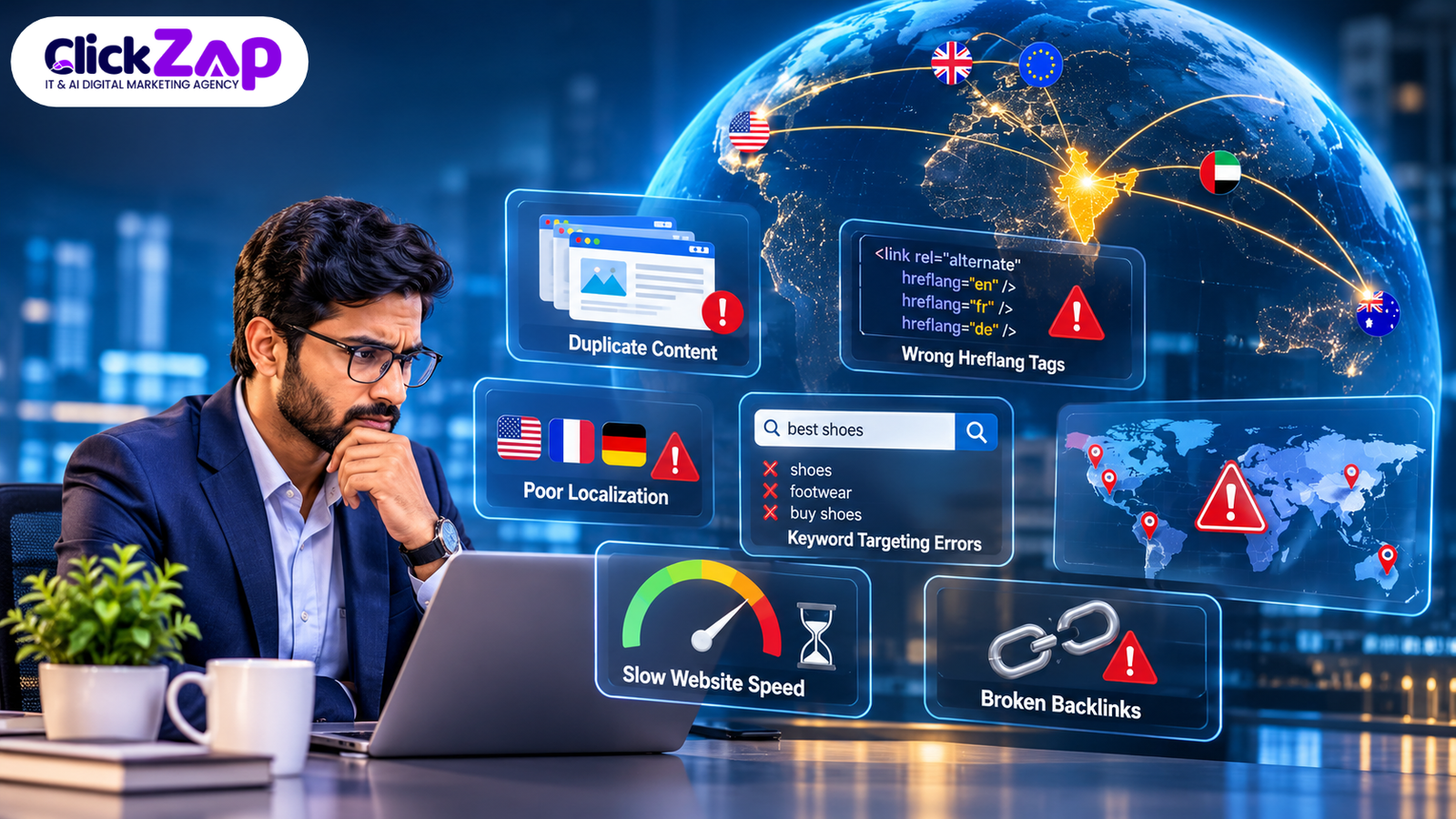
- Identical content across countries. Copying one page to /us/, /uk/, and /au/ with no changes gives users and search engines no reason to prefer any version.
- Automatic translation without human review. Raw machine output often reads badly and can look like low quality scaled content, which Google’s spam policies discourage.
- Incorrect hreflang. Missing return links, wrong codes like “en-uk,” and pointing to redirected or nonindexed URLs are common errors that cause Google to ignore the tags.
- Ignoring local search intent. A page that matches an Indian query may miss what a Canadian searcher wants.
- Wrong domain structure. Launching ten ccTLDs with a small team often leads to neglected sites. Match structure to your capacity.
- Irrelevant international backlinks. Mass directory submissions from unrelated countries add risk, not value.
- Ignoring speed and mobile optimization. A site that is fast in India can be slow from abroad.
- Not tracking country specific performance. If you only look at total traffic, you will not know which market works.
International SEO Tools Every Indian Business Should Know
|
Tool |
What it does |
What it cannot do |
|
Google Search Central |
Google’s official documentation, guidelines, and blog for site owners |
It does not audit your site or give you data about it |
|
Google Search Console |
Shows indexing status, queries, clicks, impressions, and CTR, and lets you filter by country |
It cannot validate hreflang (the older International Targeting report is retired), and it cannot set a country target |
|
Google Analytics 4 |
Shows visitors, engagement, and conversions by country and language |
It does not show rankings or tell you why traffic changed |
| Google Keyword Planner |
Suggests keywords and shows search volume by location and language |
It is built for advertising, may show volume as ranges without active ad spend, and does not reveal true search intent |
|
Google Translate |
Produces quick draft translations and helps you understand foreign language pages |
It cannot adapt tone, culture, terminology, or local intent |
|
Google Market Finder |
Aimed at helping businesses compare potential export markets |
It offers only a first pass view, and Google has changed or retired some tools over time, so confirm availability before relying on it |
Translation tools are not a substitute for localization. They convert words. Localization adapts the offer, examples, currency, and tone for the people reading. Use Google Translate to draft or to check meaning, and let a fluent human finish the work.
How to Choose the Right International SEO Agency in India
If you hire outside help, look for an international SEO agency in India or an international SEO consultant in India that can show real capability. Ask about:
- International SEO experience: Ask them to walk you through how they approached a multi country project, including what went wrong.
- Technical SEO expertise: They should explain hreflang, URL structure, and crawling issues clearly and without jargon.
- International keyword research: They should research by country, not hand you a translated list.
- Multilingual content expertise: Ask who writes and reviews content in each language.
- Localization experience: Look for an understanding of currency, terminology, and cultural adaptation.
- International link building: Ask which sources they target and how they judge quality.
- Transparent reporting: You should see country level data and understand what it means.
- Measurable business results: They should tie work to leads and revenue, and avoid promising fixed rankings. No one can guarantee a position on Google.
ClickZap IT is a digital marketing agency in Hyderabad that helps businesses improve their online visibility through SEO, content marketing, and data driven strategies. If you are comparing partners, our page explains how we approach search. We are also a that supports and, which many businesses pair with organic work while new markets build momentum.
Frequently Asked Questions About International SEO
What is international SEO and how does it work?
International SEO is the process of optimizing a website so search engines show the right page to users in the right country and language. It works by combining signals: URL structure, hreflang annotations, localized content, and local links. Together these help Google match each searcher with the most suitable version of your page.
How can Indian businesses reach international customers through SEO?
Indian businesses reach international customers by choosing target markets, researching country specific keywords, and publishing localized pages on a clear URL structure. Add hreflang tags, earn relevant local backlinks, and measure results by country. Start with one or two markets so you can build quality instead of spreading effort thin.
How do I optimize my website for international markets?
Start by deciding which countries and languages you want to serve. Then pick a URL structure, create localized content, implement hreflang, and check page speed from those regions. Finally, track country level performance in Google Search Console and Google Analytics 4, and adjust each market based on its own results.
What is the difference between multilingual SEO and international SEO?
Multilingual SEO focuses on serving content in multiple languages, while international SEO is the broader practice of targeting users in multiple countries or regions. A site can be one without the other. An English only site targeting the USA and UK is international but not multilingual. International SEO often includes multilingual work.
How do hreflang tags help with international SEO?
Hreflang tags tell Google which versions of a page exist for different languages and regions. This helps Google show the correct version to each searcher and prevents similar regional pages from being treated as duplicates. Hreflang is a signal, not a guarantee, and it only works when every version links back to the others.
Which international SEO strategies are best for Indian businesses?
The best strategy depends on your markets and resources, but a sound starting point is a small number of target countries, subdirectory URLs, correct hreflang, and genuinely localized content. Add relevant local backlinks and country level tracking. This approach is easier to maintain than running many separate domains.
Final Thoughts: Grow Your Business Globally with International SEO
International SEO turns your website into something buyers in other countries can find and trust. The work is methodical. Choose markets deliberately, research keywords country by country, build a clear URL structure, implement hreflang correctly, and write content that fits each audience. Support it with relevant links, fast pages, and monthly tracking.
For international SEO for Indian businesses, the payoff is steady, compounding organic visibility. It takes patience, and no honest agency can promise a ranking date. But a well built international presence continues to bring in leads without a rising ad bill.
Start with market research. Pick one or two countries, and get the technical and content foundation right before you expand. Our guide is a good companion to read.
If you want a clear plan for reaching customers abroad, get in touch with our team at ClickZap IT, and we will help you work out where to start.
Also Read: Website Migration SEO Checklist: A Step by Step Guide to Protect Your Rankings in 2026


0 Comments