
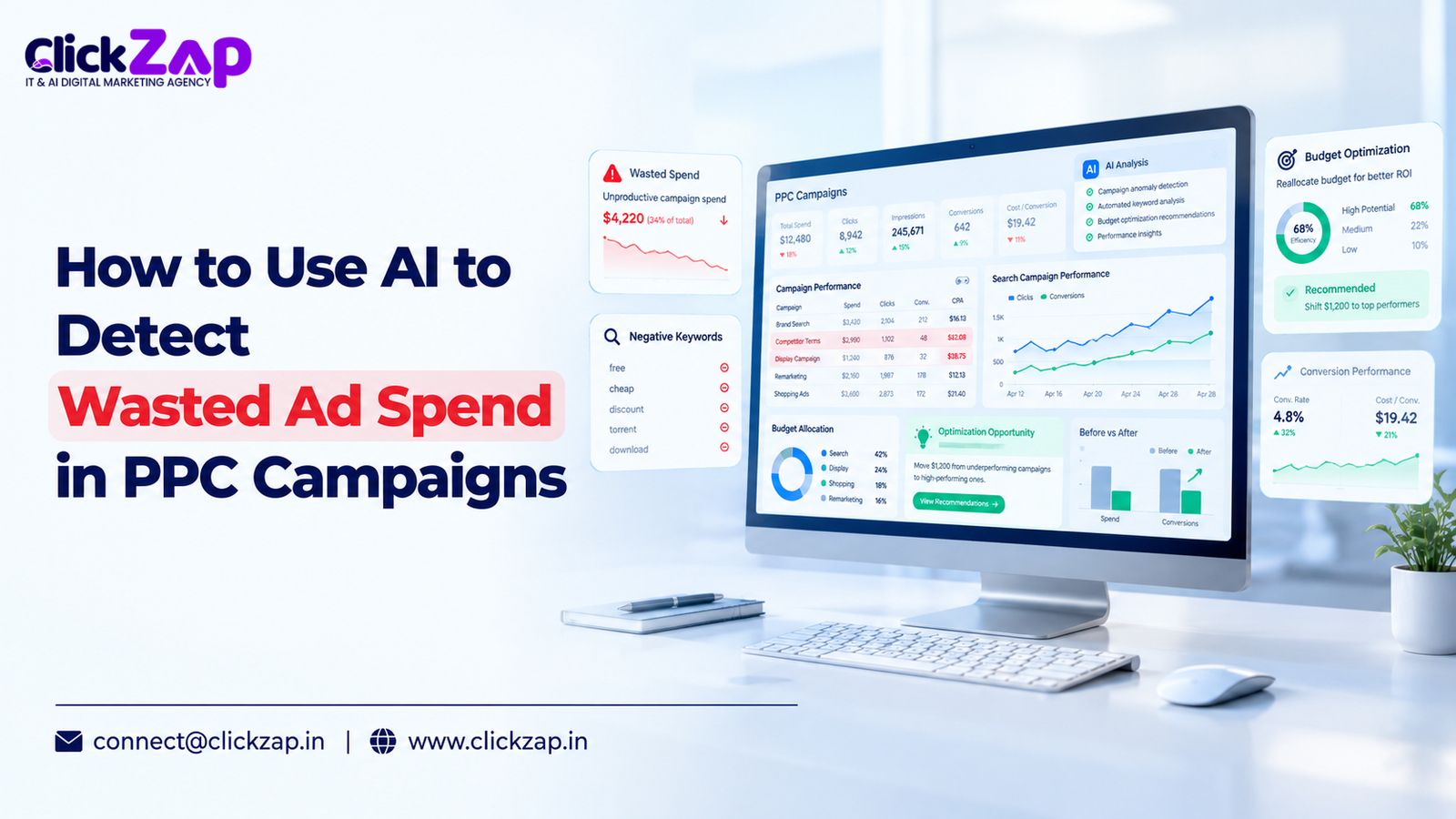
Using AI to detect wasted ad spend in PPC means applying machine learning and automated analysis to scan your PPC data, including search terms, keywords, campaigns, devices, locations, audiences and conversions, and flag spending that is not producing meaningful business results. The AI does not decide what is wasteful. It surfaces patterns a human would take days to find, and you confirm whether each one is real waste before changing anything.
Wasted ad spend is money spent on clicks, impressions or placements that had little realistic chance of contributing to leads, sales or other outcomes you care about. Most accounts leak money through irrelevant search queries, loose match types, broken conversion tracking, and budgets sitting in campaigns that look busy but do not move the business. Using AI to detect wasted ad spend in PPC does not remove that work. It makes the diagnosis faster, more consistent and easier to repeat every week.
This guide explains what waste looks like, why manual reviews miss it, how AI finds it, and a practical workflow you can follow with Google Ads, Google Analytics 4 and an AI assistant. One warning up front: cutting spend is not the goal. Cutting waste is. Those are different things.
What Is Wasted Ad Spend in PPC?
Wasted ad spend is an advertising budget that generates clicks or impressions with little or no contribution to your business goals. PPC stands for pay per click, a model where you pay when someone clicks your ad. Because you pay for the click and not the outcome, every click that never had a chance of converting is a small leak.
Here are simple examples of wasted advertising budget:
- A software company bids on “CRM software” and pays for clicks from people searching “free CRM software download” or “CRM jobs”.
- A Hyderabad dental clinic targets “dentist near me” but its ads show to people two cities away who will never visit.
- A manufacturer’s ad group gets plenty of clicks, but its landing page loads slowly on mobile and nobody fills in the form.
- A campaign reports zero conversions for a month because the conversion tag broke, so the team assumes the campaign failed when it may have worked.
That last example matters. Waste is not always “bad traffic”. Sometimes it is a bad measurement, which leads you to make bad decisions. Both count.
It is also worth separating a few terms that people often blur together:
- Click: someone selected your ad. It says nothing about intent or quality.
- Lead: someone submitted a form, called, or messaged you.
- Qualified lead: a lead your sales team agrees is a realistic buyer.
- Sale: a lead that became revenue.
- Profitable conversion: a sale that earned more than it cost to acquire after margins.
A campaign can produce many leads and still waste money if none of them qualify. This is why “conversions” alone is rarely enough to judge waste.
Why Traditional PPC Analysis Often Misses Wasted Spend

Manual analysis worked when accounts were small. Today, it breaks down for five reasons.
- Manual review does not scale. A mid sized Google Ads account can generate thousands of search terms a month. Nobody reads them all, so people sort by cost, skim the top 50, and move on. The expensive, obvious problems get caught while a long tail of small leaks stays invisible.
- Large datasets hide patterns. Waste is often a combination: mobile users, in one location, on one audience list, between 11 p.m. and 5 a.m. Spotting it in a spreadsheet means slicing data across several dimensions at once, which is slow and easy to get wrong.
- Reporting is delayed. Many teams review performance monthly. By then, a bad match type or a broken tag has been burning a budget for weeks.
- Tracking problems distort the picture. If conversion tracking double counts leads, misses phone calls, or fires on the wrong page, every metric built on it is unreliable. Manual reviewers often trust the dashboard without checking the tag.
- Search terms get overlooked. Keywords are what you bid on. Search terms are what people actually typed. The gap between the two is where most wasted budgets live, and it is the report most often skipped.
How AI to Detect Wasted Ad Spend in PPC Campaigns
Before the details, here is how the pieces fit together, stated plainly:
- Conversion tracking records what happened after a click. It is the data foundation.
- Machine learning is a type of AI that learns patterns from that historical data without being given explicit rules for each case.
- Predictive analytics uses those learned patterns to estimate what is likely to happen next, such as which segments are likely to convert.
- AI powered analysis combines all three: it reads tracked outcomes, finds patterns and anomalies, and produces recommendations a human then verifies.
If the tracking is wrong, the AI learns the wrong patterns. That is the most important sentence in this article, and it is why Step 2 of the workflow below is verification.
Using AI to detect wasted ad spend in PPC typically involves six kinds of analysis.
Search Term and Keyword Analysis
AI can cluster thousands of search terms by meaning rather than exact wording. It might group “free,” “download,” “jobs,” “course” and “salary” queries as low intent themes, even if you never spotted them individually. This is faster than reviewing the search term analysis line by line and is especially useful for negative keyword optimization.
Underperforming Campaign Detection
AI compares each campaign against its own history and against comparable campaigns in the account. A campaign whose cost per conversion is far above the account norm, with no offsetting value, gets flagged. This is how AI identifies underperforming PPC campaigns without anyone sorting a spreadsheet.
Budget Anomaly Identification
Anomaly detection looks for spending that deviates from the expected pattern: a sudden spike in cost with flat conversions, a campaign that now exhausts its budget by 10 a.m., or a drop in conversions while clicks stay steady. The last one often signals a tracking failure, not a performance collapse.
Conversion and Cost Analysis
AI can calculate cost per conversion and conversion rate by many slices at once, then rank which segments consume budget without producing outcomes. It can also highlight when conversion lag, the delay between a click and the eventual conversion, may be making recent data look worse than it really is.
Bid and Audience Performance Analysis
For automated bid optimization, AI can review whether your bid strategy is spending where it should. It can also compare audience segments, for example remarketing lists versus broad prospecting, and show where cost per result diverges sharply.
Predictive Analytics With Machine Learning
Predictive models estimate likely outcomes: which campaigns are likely to miss targets this month, or which segments tend to convert later. Predictive advertising analytics are estimates, not guarantees. They depend on enough historical data, and they perform poorly on new campaigns with little history.
Common Signs of Wasted Ad Spend in Google Ads
These are the warning signs to look for when you want to find wasted spend in Google Ads. None is proof by itself. Each is a prompt to investigate.
- High cost, low converting keywords. Keywords that absorb a large share of budget while producing few or no conversions over a meaningful period.
- Irrelevant search queries. Search terms with no connection to what you sell, usually caused by broad match, loose phrase match or missing negatives.
- Poorly targeted traffic. Clicks from locations, languages or devices that do not match your real customers.
- Underperforming ad groups. Groups with low click through rate (CTR, the percentage of impressions that become clicks), weak ad relevance, or a landing page mismatch.
- Broken conversion tracking. Zero conversions across otherwise healthy campaigns, sudden drops with stable clicks, or conversions that look inflated by duplicates.
- Low quality or invalid clicks. Google Ads filters many invalid clicks automatically, but unusual click patterns, such as spikes from a single region with no engagement, deserve investigation.
- Budget stuck in weak campaigns. Money flowing to campaigns with poor business outcomes while stronger campaigns are limited by budget.
Step by Step Guide to Using AI to Detect Wasted Ad Spend
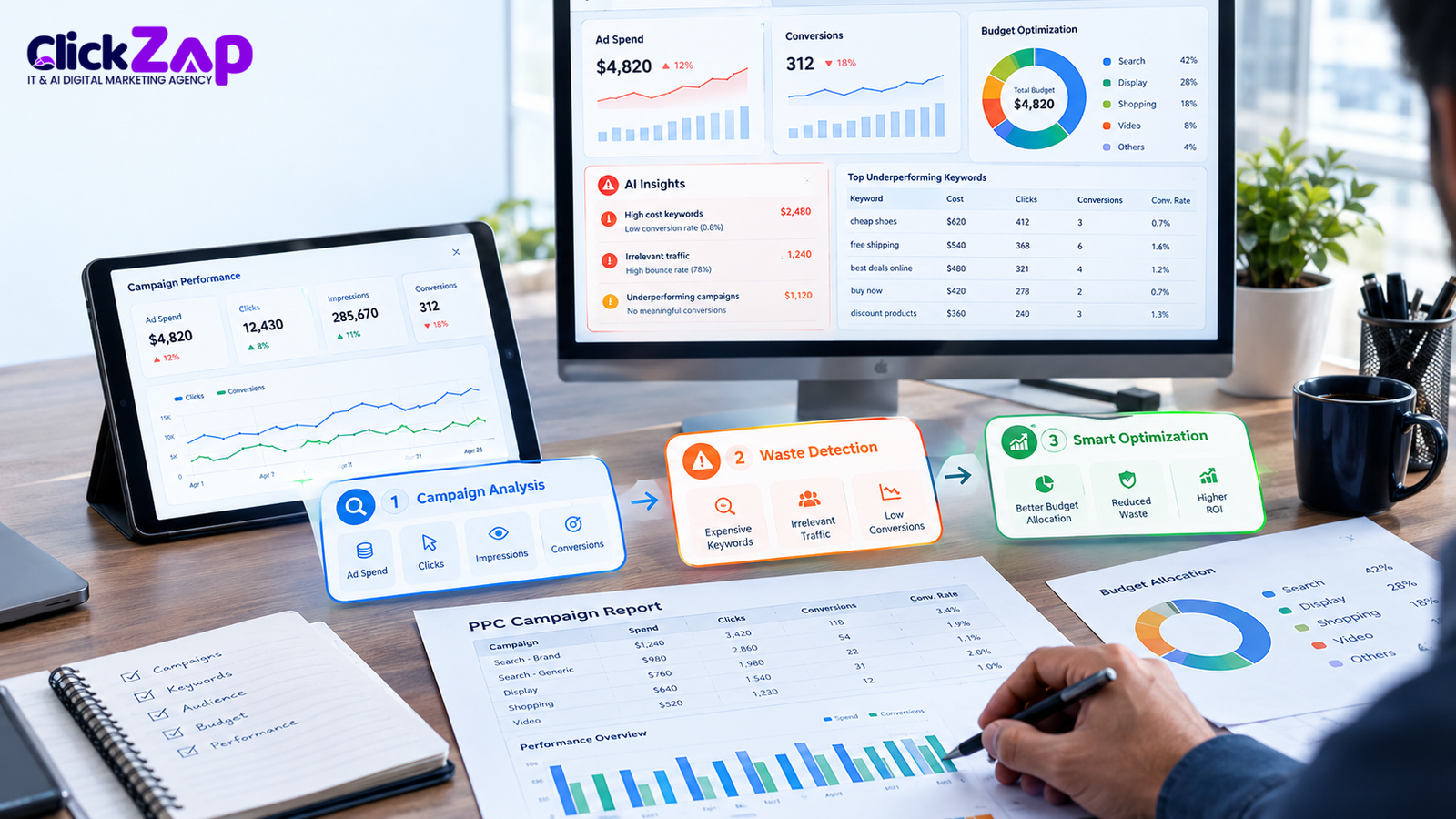
This workflow shows how to analyze PPC campaign spending with AI safely. Use it as a template and adjust for your account size and sales cycle. Using AI to detect wasted ad spend in PPC works best as a repeatable process, not a one off audit.
Step 1: Collect reliable campaign and conversion data
Export at least 60 to 90 days of data where possible: campaign, ad group, keyword, search term, device, location, audience, day and hour. Include cost, clicks, impressions, conversions and conversion value. If you run Microsoft Advertising too, export it separately and keep the datasets labeled, since the two platforms define some metrics differently.
Step 2: Verify conversion tracking
Before any AI analysis, confirm the data is trustworthy. Use Google Tag Manager’s preview mode to confirm tags fire once, on the right action. Check that Google Ads and Google Analytics 4 conversion counts are roughly in line, remembering they use different attribution methods and will not match exactly. Confirm phone calls, WhatsApp clicks and form submissions are all tracked if they matter to you.
Step 3: Analyze search terms and keyword performance
Pull the search terms report and look at cost, clicks and conversions per term. Group terms by theme, either manually or with an AI assistant, and note which themes show consistent spend with no outcomes. This step is the core of how to identify low converting Google Ads keywords.
Step 4: Identify campaigns with unusually high costs or weak outcomes
Compare each campaign’s cost per conversion and ROAS against your target and against other campaigns. Flag outliers in either direction. Also flag campaigns that spend their budget early in the day, since that can mean good hours later in the day are being missed.
Step 5: Compare performance by device, location, audience and time
Segment the flagged campaigns. A campaign may be fine overall but poor on mobile, or strong in Hyderabad and weak elsewhere. Only segments where you have enough volume to say something meaningful. Slicing 10 conversions into twelve buckets produces noise.
Step 6: Use AI to identify patterns and generate recommendations
Feed your cleaned data, or summarized tables, into an AI assistant or analytics workflow. Ask specific questions: which search term themes have high spend and no conversions, which segments have cost per conversion more than 1.5 times the account average, and which days show unusual spend. Treat the output as a list of hypotheses.
Do not paste personal customer data, such as names, phone numbers or emails, into general purpose AI tools. Use aggregated, anonymized data and follow your privacy obligations.
Step 7: Validate recommendations against business goals
Check every recommendation against what you know. Is the “wasteful” keyword actually a top of funnel term that feeds later conversions? Does the sales team say those leads close slowly but at high value? A keyword with no conversions in 30 days is not automatically wasteful. Consider:
- Conversion delay: some conversions are recorded days or weeks after the click.
- Sales cycle length: B2B deals can take months, so form fills may be the only early signal.
- Assisted conversions: a keyword may help a user discover you before another channel closes the deal.
- Lead quality: cheap leads that never buy are worse than expensive leads that do.
Step 8: Apply controlled changes and monitor results
Change one or two things at a time. Add negative keywords, adjust a bid, or move budget, then wait long enough to see results. Record what you changed and when, so you can attribute any shift in performance to the right action. Bid strategies using machine learning need time to relearn, so avoid stacking changes on top of each other.
Best AI Digital Marketing Agency in Hyderabad
Best AI Approaches and Tools for PPC Wasted Spend Analysis
No single tool does everything, and platforms do not all offer the same AI capabilities. The best setup for using AI to detect wasted ad spend in PPC combines several of them. Features and names change often, so check current official documentation before building a process around any of them.
Google Ads. It provides search terms reports, a Recommendations page, and automated bidding strategies such as Target CPA and Target ROAS that use machine learning. Recommendations are generated by Google and are not neutral: some aim to increase spend. Review each one critically. Google Ads Editor helps you apply bulk changes, such as adding hundreds of negative keywords, once you have decided on them.
Google Ads Performance Max. These campaigns run across multiple Google channels using automation. Visibility into where spend goes is more limited than in Search campaigns, though reporting has expanded over time. Review available insights and asset performance carefully, and avoid judging Performance Max on a few days of data.
Google Analytics 4 (GA4). GA4 uses event based measurement and offers automated insights, anomaly alerts and, where eligibility conditions are met, predictive metrics. It helps you see what users did after the click, such as engagement and downstream conversions, which Google Ads alone does not show.
Google Tag Manager. It is not an AI tool, but it is critical for waste detection. It controls how conversion tags are deployed and tested, and many “wasted spend” problems are really tag problems.
Google Looker Studio. It connects Google Ads and GA4 data into dashboards so you can monitor cost, conversions and anomalies in one view. Pair it with a weekly review habit; a dashboard nobody opens finds no waste.
Microsoft Advertising. It offers its own reporting, recommendations and automated bidding, and for some advertisers AI assisted tools. Capabilities differ from Google Ads and vary by market and account, so verify what is available to you in the official help center.
AI assistants and analytics workflows. General purpose AI assistants can analyze exported tables, cluster search terms, summarize anomalies and draft negative keyword lists. They do not have live access to your account unless you connect them, they can misread data, and they can state wrong conclusions confidently. Always verify their math and logic against the source data. For teams in India handling customer data, check consent and data handling rules before uploading anything.
When people ask about AI tools to detect wasted PPC spend, the honest answer is a stack: reliable tracking, the platforms’ own reporting, a dashboard layer, and an analytical layer, whether that is a person, an AI assistant, or both.
How to Reduce Wasted Ad Spend Using AI

Detection is only half of the work. Here is how to act on what AI surfaces.
Negative keyword optimization
Negative keywords tell Google not to show your ads for certain queries. Use AI to group irrelevant search terms into themes (“free,” “jobs,” “tutorial,” competitor names you do not want), then add them at the right level: account, campaign or ad group. Be careful with broad negatives. Adding “free” blocks a useful “free consultation” query if that is your offer.
Search term refinement
Terms that convert well should often become exact or phrase match keywords so you can control bids precisely. Terms that spend without converting may need a negative, a lower bid, or a different landing page.
Budget reallocation
If one campaign consistently delivers cost per conversion well below target but is limited by budget, shifting spend toward it is usually smarter than cutting budget overall. This is how to optimize Google Ads budget using AI in practice: let the analysis point to where marginal spend does the most good.
Conversion tracking improvements
Fix tracking before optimizing. Set up the conversions that actually reflect business value, such as qualified leads, not just page views. Consider enhanced conversions or offline conversion imports so Google sees which clicks became real sales, which improves automated bidding.
Landing page and conversion rate improvements
Sometimes the ad is fine and the page is the leak. If a keyword gets good CTR and poor conversion rate, look at page speed, message match, form length and mobile experience before blaming the keyword.
Bid strategy review
Check whether your bid strategy fits your data volume. Target ROAS with very few conversions gives the algorithm too little to learn from. Review whether targets are realistic and whether the strategy has had a full learning period.
Ongoing monitoring
Waste returns. New search terms appear, competitors change, seasons shift. Build monitoring into your routine instead of treating it as a cleanup project.
Why human review remains essential
AI can recommend. It cannot know your margins, your sales team’s feedback, a pending product launch, or that a “poor” campaign is seeding brand awareness for a big seasonal push. Test changes in a controlled way, and keep a person accountable for each decision.
Important PPC Metrics to Monitor
These metrics support PPC campaign performance analysis. Look at them together; any one metric alone can mislead.
|
Metric |
What It Measures |
Formula |
Watch Out For |
|
CTR (click through rate) |
How often an impression becomes a click |
Clicks ÷ Impressions × 100 |
High CTR with low conversions can signal curiosity clicks or a mismatched landing page |
|
CPC (cost per click) |
Average price paid per click |
Cost ÷ Clicks |
A low CPC is not good if the clicks never convert |
|
Conversion rate |
Share of clicks that complete a goal |
Conversions ÷ Clicks × 100 |
Depends on what you count as a conversion |
|
Cost per conversion |
Average cost to get one conversion |
Cost ÷ Conversions |
Compare against qualified lead or sale cost, not just form fills |
|
ROAS (return on ad spend) |
Attributed revenue per unit of ad spend |
Conversion value ÷ Cost |
Does not account for margins or other costs |
|
Conversion value |
Total value assigned to conversions |
Sum of assigned values |
Only as accurate as the values you set |
ROAS measures attributed revenue relative to ad spend. It does not automatically equal profit. A 4x ROAS on a product with a 20% margin is a loss once you account for the cost of the goods and ad spend. Use ROAS together with margin data to find your break even ROAS before setting targets.
To improve ROAS by reducing wasted ad spend, remember the arithmetic: if you remove spend that produced no value, ROAS improves because the denominator shrinks while revenue stays roughly flat. If the removed spend had been quietly supporting conversions, ROAS can improve on paper while total revenue drops.
Practical Example of AI Powered PPC Waste Detection
Hypothetical example for illustration only. All figures below are illustrative. They are not actual ClickZap IT client results.
Scenario: A B2B SaaS company in Hyderabad runs a Google Ads Search campaign for its CRM product. Over 30 days, the campaign shows the following:
|
Metric (30 days) |
Illustrative value |
|
Spend |
₹60,000 |
|
Clicks |
600 |
|
Average CPC |
₹100 |
|
Impressions |
20,000 |
|
CTR |
3% |
|
Tracked conversions (demo requests) |
6 |
|
Conversion rate |
1% |
|
Cost per conversion |
₹10,000 |
|
Target cost per qualified demo |
₹5,000 |
Step 1: AI flags the campaign. An AI assisted review of the exported data marks this campaign as costing twice the target per conversion. It also notes that about 150 clicks came from search terms containing words such as “free,” “download” and “jobs,” and none of those clicks produced a conversion.
Step 2: The marketer validates the data. Before touching anything, the marketer checks conversion tracking in Google Tag Manager. The demo form tag fires correctly. But the “Chat on WhatsApp” button, which many mobile visitors use to book demos, is not tracked at all. After adding that conversion and reviewing the CRM, the marketer finds 4 additional demo requests that came through WhatsApp from the same period. The true conversion count is 10, so the corrected cost per conversion is ₹6,000, not ₹10,000.
Step 3: The marketer investigates the cause. The campaign is still above target, but the picture has changed: it is less broken than it first looked. The 150 irrelevant clicks, at roughly ₹100 each, cost about ₹15,000 and produced nothing. That is real waste, and it is separate from the tracking issue.
Step 4: A measured adjustment. The marketer adds a focused set of negative keywords for the irrelevant themes and tightens two broad match keywords to phrase match. Nothing else changes, so any difference can be traced to these actions.
Step 5: Monitoring the outcome. After the next 30 days, the marketer reviews the results:
|
Metric (next 30 days) |
Illustrative value |
|
Spend |
₹46,000 |
|
Clicks |
460 |
|
Conversions (including WhatsApp) |
10 |
|
Conversion rate |
about 2.2% |
|
Cost per conversion |
₹4,600 |
In this hypothetical, spend dropped by ₹14,000, conversions held steady, and cost per conversion moved below target. Notice what made this work: the marketer did not just cut the “worst” campaign. They fixed tracking first, removed only the proven waste, changed little, and measured.
Real accounts are messier. Conversions may fall when waste is removed, and that outcome needs its own investigation.
Common Mistakes to Avoid When Using AI for PPC Optimization
- Blindly accepting AI recommendations. An AI suggestion is a hypothesis. Some platform recommendations also benefit the platform, such as broader targeting that raises spend. Judge each one against your goals.
- Pausing keywords on insufficient data. A keyword with 15 clicks and no conversions tells you very little. Wait for enough volume, and consider conversion lag before acting.
- Ignoring tracking errors. The example above shows why. Waste analysis on broken data produces confident wrong answers.
- Optimizing only for clicks or CTR. Cheap clicks and high CTR can coexist with zero business results. Optimize toward qualified leads or profitable sales.
- Ignoring lead quality and margins. A low cost per lead is meaningless if the leads do not buy, or if the margin cannot support the acquisition cost.
- Making too many changes at once. If you change bids, keywords, budgets and landing pages in a single week, you cannot tell what worked.
- Failing to monitor results. Every change should have a review date. Otherwise you are guessing.
Best Practices for Long Term PPC Budget Optimization
Sustainable PPC budget optimization comes from routine, not heroics. Use this checklist and cadence as a starting point.
Monitoring checklist:
- Conversion tracking tested and matching expected volumes
- Search terms report reviewed and negatives updated
- Cost per conversion and ROAS compared with targets by campaign
- Budget limited campaigns that perform well identified
- Device, location and time of day patterns checked where volume allows
- Landing page speed and form performance reviewed
- Unusual spend or conversion changes investigated within days
- Sales team feedback on lead quality collected
- All changes logged with dates and reasons
Suggested review cadence:
|
Frequency |
What to Review |
|
Daily or every few days |
Spend pacing, anomalies, sudden conversion changes |
|
Weekly |
Search terms, negative keywords, budget pacing, bid strategy status |
|
Monthly |
Campaign and ad group performance, budget reallocation, landing pages, lead quality with sales |
|
Quarterly |
Strategy, targets, tracking audit, attribution and margin assumptions |
This rhythm is what turns AI to detect wasted ad spend in PPC from a one time experiment into a habit that protects your budget over time. Adjust it for account size: a small account may only need weekly and monthly reviews.
Frequently Asked Questions
How can AI detect wasted ad spend in PPC campaigns?
AI analyzes campaign data such as search terms, keywords, devices, locations, audiences, costs and conversions to find patterns and anomalies. It can group irrelevant queries, flag campaigns with unusually high cost per conversion, and highlight budget spikes. The results are recommendations that a marketer must verify, especially against conversion tracking and business goals.
How do I find wasted spend in Google Ads?
Start with the search terms report and sort by cost to see which queries consume budget without conversions. Then check campaigns, ad groups, devices and locations for high cost with weak outcomes. Verify that conversion tracking works first, since broken tags make good campaigns look wasteful.
Can AI identify keywords that waste advertising budget?
Yes, AI can flag keywords with high spend and few or no conversions, and cluster low intent search term themes. But a flagged keyword is not automatically wasteful. It may need more data, may assist conversions that happen later, or may drive valuable leads that close slowly. Review conversion lag, assisted conversions and lead quality before pausing it.
What causes wasted ad spend in PPC campaigns?
Common causes include irrelevant search queries from missing negative keywords, overly broad match types, poor audience or location targeting, weak landing pages, and broken or misleading conversion tracking. Budget sitting in weak campaigns while stronger ones are budget limited also causes waste. Invalid clicks can contribute, though Google filters many of them automatically.
Which AI tools can help reduce wasted Google Ads spend?
Useful options include Google Ads reporting and recommendations, Google Analytics 4 insights, and Google Looker Studio dashboards for monitoring. Google Tag Manager supports reliable tracking, and Microsoft Advertising offers its own tools for Bing campaigns. General AI assistants can analyze exported data. Capabilities differ between platforms and change over time, so confirm current features in official documentation.
How can I reduce PPC costs without losing conversions?
Remove proven waste first: irrelevant search terms, broken tracking, and poor performing segments with enough data behind the decision. Reallocate budget toward campaigns that already deliver below your target cost per conversion. Make small changes, monitor results, and avoid broad cuts that may remove valuable conversions.
Conclusion
Wasted ad spend is rarely one big mistake. There are dozens of small leaks: irrelevant queries, weak landing pages, budgets in the wrong places, and tracking that quietly misreports results. AI helps because it can scan large amounts of data quickly and surface patterns that manual reviews miss.
Using AI to detect wasted ad spend in PPC works when three conditions are met. The tracking is reliable, the recommendations are validated against business goals, and changes are made in small, measured steps. Skip any of those and the speed of AI just helps you make mistakes faster.
AI supports better informed PPC decisions. It does not replace judgment about margins, lead quality or strategy. If you want a second set of eyes on your account, you can explore ClickZap IT’s PPC and Google Ads services to see how a structured audit and optimization process works.
Also Read: AI Powered PPC Budget Allocation: Reduce Waste and Improve Results

0 Comments