
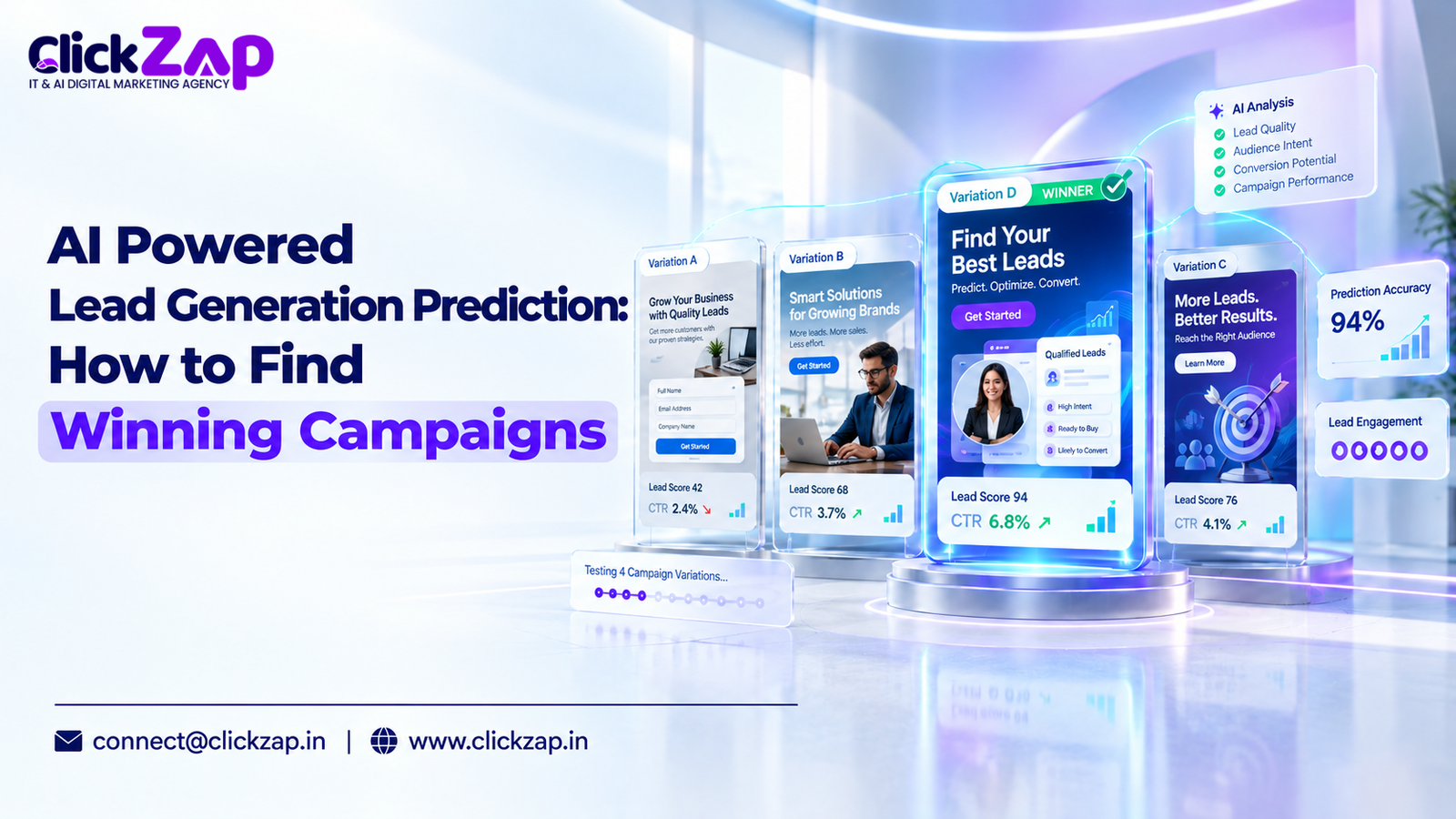
Two campaigns can share the same budget, the same audience size, and the same agency, yet one fills your sales pipeline while the other fills your inbox with form fills that never answer a call. The gap usually comes from lead quality, not lead volume. Volume is easy to buy. Quality is hard to see until weeks later, when the sales team reports back, which is the gap AI Powered Lead Generation Prediction aims to close.
AI Powered Lead Generation Prediction uses machine learning to study your historical campaign and customer data, then estimates which campaigns, audiences, and leads are most likely to convert. The direct answer to the main question is this: AI helps you compare likely outcomes before you commit more budget, and it ranks leads by estimated conversion probability. It cannot guarantee leads, sales, or campaign success, because every estimate rests on past data and the future can change.
In this guide you will learn:
- What lead generation prediction is and how it works
- How predictive lead scoring ranks prospects
- Which tools offer predictive features and which mainly support reporting
- How a worked comparison of two campaigns shows why lead volume can mislead
- How to estimate marketing ROI (return on investment) carefully
- Which limits, privacy duties, and first steps matter most for small businesses
What Is AI Powered Lead Generation Prediction?
AI powered lead generation prediction is the use of machine learning models to estimate how likely a campaign, audience segment, or individual lead is to produce a desired result, such as a qualified enquiry or a sale. It turns historical campaign data into probabilities that marketers can use when they plan.
Three terms often get mixed up. Artificial intelligence (AI) is the broad field of software that performs tasks that normally need human judgment. Machine learning (ML) is a branch of AI where software finds patterns in data instead of following hand written rules. Predictive analytics is the practice of using data, statistics, and ML to estimate what is likely to happen next.
In practice, AI Powered Lead Generation Prediction is predictive analytics for marketing, applied to leads and campaigns, with machine learning doing the pattern finding. You may also see it called lead conversion prediction or lead quality prediction.
A simple business example
Imagine a B2B software company with two years of records. Each lead shows the ad, keyword, and landing page it came from, plus whether it became a paying customer. A model might find that leads from one industry who visit the pricing page twice convert far more often than leads who only download an e-book.
The company does not get a promise. It gets an estimate that shows where to look first and what to test next. That is the realistic value of predictive lead generation analytics.
How Does AI Predict Which Marketing Campaigns Will Generate More Leads?
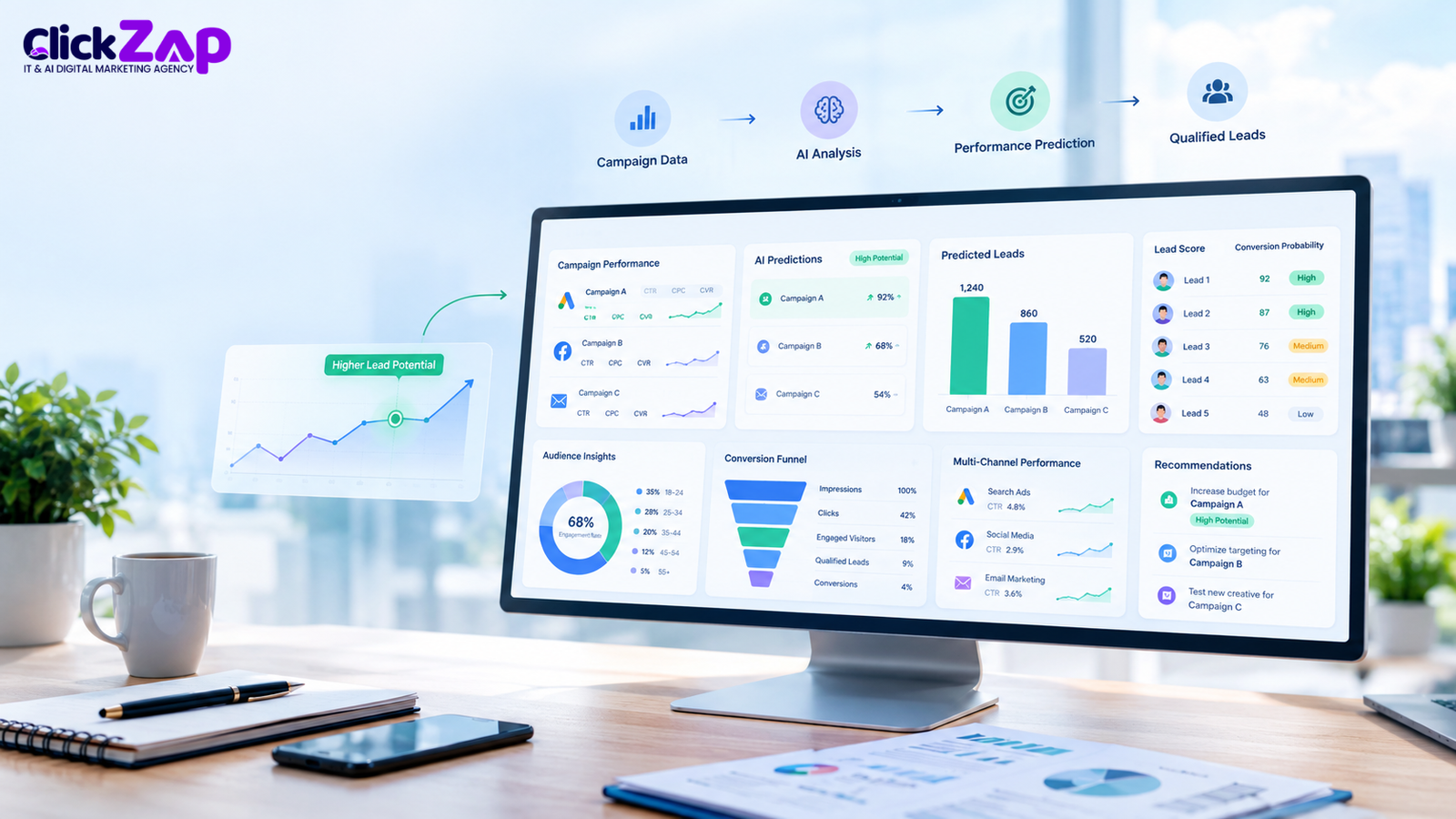
AI predicts campaign performance by learning which combinations of audience, message, channel, and timing produced qualified leads in the past, then estimating how similar campaigns may perform. The output is a range of likely outcomes, not a fixed number. This is the core of marketing campaign performance prediction.
The process follows seven steps:
- Collect historical campaign data. Gather spend, impressions, clicks, leads, and outcomes from your ad platforms, website analytics, and CRM (Customer Relationship Management) system. More complete history gives the model more to learn from.
- Analyze customer behavior and audience characteristics. Customer behavior analysis looks at pages viewed, forms completed, email engagement, location, device, and industry or role for B2B leads.
- Identify patterns tied to lead quality and conversions. The model looks for signals that separate leads who became customers from leads who did not.
- Estimate conversion probabilities. Each lead, audience, or campaign receives an estimated chance of reaching a goal. This is conversion probability analysis.
- Forecast performance. Using those probabilities and your planned budget, the model projects likely leads, qualified leads, and cost per lead. This step is marketing campaign forecasting.
- Apply findings to future campaigns. Teams shift budget, refine targeting, or rewrite offers based on what the model suggests.
- Compare predictions with actual results. Check what the model expected against what happened, then feed the new data back in. Treat AI Powered Lead Generation Prediction as a loop, not a one time report.
Assumptions to state openly: these steps assume your tracking is accurate, your history includes enough conversions to find patterns, and your market stays reasonably stable. When any of those fail, forecasts weaken.
Key Benefits of AI Powered Lead Generation Prediction
The main benefit is better decisions with less guesswork. Predictive analytics for marketing gives teams evidence about where the budget is likely to work harder. The benefits below depend on implementation and data quality, and none is guaranteed.
- Lead quality prediction. Models estimate which leads resemble past customers, so teams can focus on them.
- Audience targeting optimization. Patterns in historical data show which segments tend to convert, which helps refine who sees your ads.
- Smarter budget allocation. Forecasts help compare channels and campaigns before you move.
- Reduced wasted spend. Spotting low quality traffic sources earlier can cut spend that produces leads nobody can sell to.
- Stronger campaign conversion rates. Better targeting, messaging, and follow-up can improve conversion rates over time when tested properly.
- Marketing forecasting. AI marketing forecasting gives planning ranges for leads and costs, which supports clearer targets.
- Lead nurturing automation. Scores can trigger the right email, call, or WhatsApp follow up for each stage.
- Better ROI decisions. Linking lead quality to revenue supports data driven marketing decisions instead of decisions based on lead counts.
A caution applies to all of these. A model trained on thin or messy data produces thin or messy predictions. Fix tracking and CRM hygiene before expecting value.
How Predictive Lead Scoring Helps Identify High Quality Leads
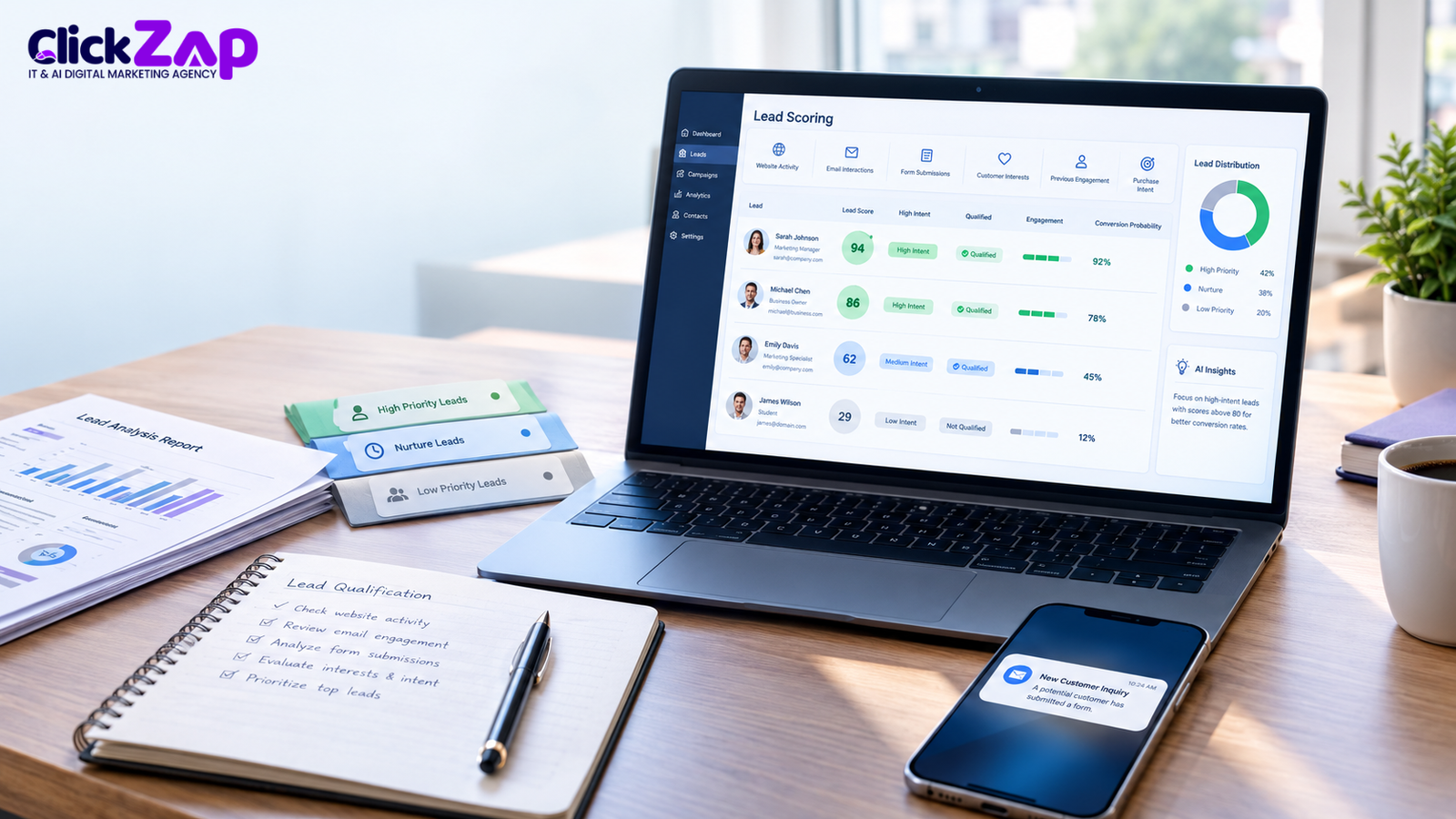
Predictive lead scoring is a method that uses historical conversion data to assign each lead a score showing its estimated likelihood of becoming a customer. Unlike manual scoring, where people assign points by rule, AI powered lead scoring learns the weights from your own past outcomes.
What signals do lead scoring models use?
Lead scoring models usually combine two kinds of signals:
- Fit signals: company size, industry, job title, location, and budget range for B2B; age band or area for local services.
- Behavior signals: pricing page visits, demo or quote requests, email replies, repeat visits, and time since last activity.
The model weighs each signal by how strongly it relates to conversions in your history. A signal that mattered for last year’s customers may matter less now, so models need regular retraining and review.
How do sales teams use the scores?
Scores help sales teams decide who to contact first and how quickly. A common setup groups leads into bands, such as high, medium, and low, with a different follow up plan for each. High scoring leads might get a call within hours, while lower-scoring leads enter a nurturing sequence.
Why scores are estimates, not guarantees
A high score means a lead resembles past converters. It does not mean the lead will buy. Scores can also carry bias from historical data, for example if past sales teams ignored certain regions. Treat scores as a prioritization aid and keep human judgment in the loop.
Best AI Lead Generation Tools for Marketing Campaign Prediction
No single product covers every need, and these AI lead generation tools do not offer the same predictive features. Some predict directly, some optimize bidding, and some mainly store or visualize data. Choosing tools for AI Powered Lead Generation Prediction starts with knowing which job each tool actually does.
Verification note: capabilities, eligibility thresholds, and plan requirements below reflect general product knowledge and should be confirmed against each vendor’s current official documentation before publishing. Items needing confirmation are flagged. Product features and names change often.
|
Tool |
Main role |
Predictive functions directly? |
What it typically needs |
|
Google Analytics 4 |
Web and app analytics |
Yes, limited (predictive metrics and audiences) |
Correct event setup, enough conversion volume |
|
Google Ads |
Ad delivery and bidding |
Yes, for bidding and planning |
Conversion tracking, conversion history |
|
Meta Ads Manager |
Ad delivery on Meta platforms |
Yes, for delivery optimization |
Meta pixel or Conversions API, enough events |
|
HubSpot |
CRM and marketing automation |
Depends on plan and feature (flag) |
CRM data, suitable subscription tier |
|
Salesforce Einstein |
CRM based scoring and insights |
Yes, on eligible editions (flag) |
Sufficient lead history, edition or add on |
|
Microsoft Power BI |
Reporting and visualization |
Mainly reporting, some analytics features |
Connected data sources, modeling skills |
|
Google BigQuery |
Cloud data warehouse |
Yes, through BigQuery ML, if you build models |
SQL skills, data exports, cloud billing |
Google Analytics 4 (GA4)
GA4 is Google’s analytics platform for websites and apps. It helps marketers see how users arrive and what they do. For prediction, GA4 offers predictive metrics such as purchase probability and churn probability, plus predictive audiences built from them.
These features depend on eligibility. Google sets minimum data requirements, commonly described as a minimum number of users who did and did not complete the relevant event in a recent window, and the predictions are built around purchase type events.
Google Ads
Google Ads is Google’s advertising platform. It supports prediction mainly through Smart Bidding, which uses machine learning to set bids at auction time based on likely conversions or conversion value, and through planning tools that estimate possible outcomes. It needs accurate conversion tracking and enough conversion history to work well.
For lead generation, importing offline results from your CRM, such as qualified leads or closed deals, helps bidding optimize toward quality instead of form fills to confirm current eligibility rules for forecasting tools and the supported methods for importing offline conversions. If you need hands-on help, see our PPC advertising services.
Meta Ads Manager
Meta Ads Manager is the interface for running and reporting on ads across Meta’s platforms. Its delivery system uses machine learning to show ads to people it estimates are more likely to take your chosen action. Lead forms and the Conversions API, which sends events from your server or CRM, can supply better outcome data.
It does not offer standalone lead scoring. Its estimates serve delivery and reporting, so pair it with CRM outcomes to judge real lead quality.
HubSpot
HubSpot is a CRM and marketing automation platform. It helps teams store lead data, automate follow up, and report on the funnel. Its lead scoring features can rank contacts, but whether a specific scoring option is machine learning based or rule based, and which subscription tier includes it, changes over time.
Salesforce Einstein
Salesforce Einstein is Salesforce’s set of AI features. Einstein lead scoring builds a model from your own lead conversion history and scores new leads inside the CRM. It needs enough historical leads, including converted ones, and it may require specific editions or add ons.
Microsoft Power BI
Power BI is a business intelligence tool that connects to many data sources and builds dashboards. It supports marketing analysis by combining ad, web, and CRM data in one view. It includes some analytical features, such as forecasting on line charts and visuals that highlight influencing factors, but it is mainly a reporting tool. Real predictive models usually come from other tools or from analysts.
Google BigQuery
BigQuery is Google’s cloud data warehouse. It stores large datasets and lets analysts query them with SQL. Through BigQuery ML, analysts can build and run machine learning models, such as a lead conversion model, using SQL. GA4 can export event data to BigQuery. This route offers the most flexibility but needs technical skill and ongoing cloud costs.
How to Use AI for Lead Generation Campaign Optimization

AI marketing campaign optimization works best as a repeatable workflow: set a goal, feed the system reliable data, test changes, and check predictions against reality. The steps below apply to most paid and organic lead generation programs.
- Define a clear lead generation goal. Pick one measurable outcome, such as qualified leads at a target cost per qualified lead. Vague goals like “more leads” produce vague models.
- Set up conversion tracking. Track form submissions, calls, chats, and bookings in GA4 and in each ad platform. Test every tracked action yourself before trusting the numbers.
- Collect reliable historical data. Export past campaign, lead, and outcome data, and clean duplicates, spam, and test entries.
- Connect ad platform and CRM data. Link Google Ads, Meta Ads Manager, and your CRM so each lead carries its source, campaign, and eventual outcome.
- Identify useful lead quality indicators. Choose the signals that relate to real sales, such as job role, budget, service requested, or pricing page visits.
- Analyze audience segments and performance. Compare segments by cost per qualified lead, not just cost per lead. This is AI campaign performance analysis in practice.
- Test targeting, messaging, landing pages, and offers. Change one variable at a time so you know what caused the result. Our guide to AI landing page optimization for Google Ads covers the landing page side.
- Compare predicted with actual conversions. Record what the model or platform expected, then record what happened. Large gaps point to data, tracking, or market changes.
- Refine using reliable evidence. Adjust budgets and targeting only where results are consistent across enough data. Do not react to a few days of movement.
Practical notes for small businesses
- Use the AI features already inside Google Ads, Meta Ads Manager, and GA4 before buying new software.
- Keep a simple spreadsheet or CRM with a status for every lead: new, contacted, qualified, won, lost.
- With low lead volume, predictions will be rough. Use them as directional hints and rely on a few clear tests.
Practical notes for larger marketing teams
- Build a shared definition of a qualified lead between marketing and sales, and write it down.
- Send CRM outcomes back to ad platforms so bidding learns from quality, not just form fills.
- Consider a data warehouse and dashboards to combine sources, and assign someone to monitor model drift, which means a model slowly losing accuracy as behavior changes.
- Review scoring models for bias on a fixed schedule, and keep an audit trail of changes.
Best AI Digital Marketing Agency in Hyderabad
Practical Example of AI Marketing Campaign Performance Prediction
The comparison below is hypothetical. The figures are invented to illustrate a point and do not come from any real campaign or client.
Assume two lead generation campaigns for a B2B service, each with ₹1,00,000 in advertising spend over the same period.
|
Metric |
Campaign A |
Campaign B |
|
Campaign objective |
Maximize form submissions |
Generate sales ready enquiries |
|
Advertising spend |
₹1,00,000 |
₹1,00,000 |
|
Landing page visitors (assumed) |
10,000 |
5,000 |
|
Leads generated |
500 |
200 |
|
Qualified leads |
40 |
50 |
|
Cost per lead |
₹200 |
₹500 |
|
Cost per qualified lead |
₹2,500 |
₹2,000 |
|
Conversion rate (leads ÷ visitors) |
5.0% |
4.0% |
|
Share of leads that qualified |
8% |
25% |
Why the campaign with the most leads may not win
Campaign A produced 2.5 times as many leads and a lower cost per lead. On a basic report, it looks like the winner. But Campaign B produced more qualified leads from the same spend, at a lower cost per qualified lead.
The lesson is simple. Cost per lead measures how cheaply you collect contact details. Cost per qualified lead measures how cheaply you collect people the business can actually serve. Optimizing for the first can quietly damage the second.
How historical data could estimate future performance
Suppose the team adds ₹50,000 to each campaign. If past patterns hold, Campaign A might produce about 250 more leads, and at an 8% qualification rate that is roughly 20 qualified leads. Campaign B might produce about 100 more leads, and at 25% that is roughly 25 qualified leads.
Those are estimates built on stated assumptions: stable cost per lead, a stable qualification rate, and no change in audience quality. In reality, costs often rise as spend scales and audiences saturate. Actual results may differ, so the team should treat the forecast as a range, then compare it with real outcomes. For more on spotting low value spend, read our post on using AI to detect wasted ad spend in PPC campaigns.
How AI Can Help Predict Marketing ROI
AI can help estimate marketing ROI by linking lead quality, conversion rates, and customer acquisition cost to expected revenue. The result is a forecast range for planning, not a promise. This is the idea behind marketing ROI prediction and AI customer acquisition prediction.
How the pieces connect
The chain runs in one direction. Lead quality affects how many leads become customers. The conversion rate, combined with spend, sets customer acquisition cost (CAC), which is what you pay to win one customer. Revenue per customer then determines return.
Using the hypothetical campaigns above, assume 20% of qualified leads become customers and each customer brings ₹30,000 in revenue. These are invented assumptions for illustration only.
|
Metric (hypothetical) |
Campaign A |
Campaign B |
|
Qualified leads |
40 |
50 |
|
Estimated customers (20%) |
8 |
10 |
|
Estimated CAC |
₹12,500 |
₹10,000 |
|
Estimated revenue |
₹2,40,000 |
₹3,00,000 |
|
Estimated ROI on revenue |
140% |
200% |
The ROI here equals revenue minus spend, divided by spend. A real analysis should use profit or gross margin, not revenue alone, and should include costs beyond ad spend.
Estimated ROI versus actual ROI
Estimated ROI is a forecast made before or during a campaign. Actual ROI is what the business earns after customers pay, refund, or churn. Sales cycles can run for months, so early actual ROI may look incomplete.
Predictive analytics supports budget planning by showing which campaigns have better expected returns, which lets teams move budget in stages. It does not remove uncertainty.
Why revenue and CRM data matter
A model that never sees closed revenue can only learn from proxies such as form fills. Reliable CRM records of deals won, deal values, and lost reasons let predictive customer analytics learn what quality really means for your business. Without them, ROI estimates rest on guesses.
If your team is planning channel budgets, our article on AI powered PPC budget allocation explains how this thinking applies to paid campaigns.
Common Challenges and Limitations of AI Lead Generation Prediction
Treat AI Powered Lead Generation Prediction as decision support. It improves judgment when data is sound and misleads when data is not. The table lists the main limitations and a practical fix for each.
|
Challenge |
Why it matters |
Practical fix |
|
Incomplete or inaccurate data |
Models learn errors as if they were patterns |
Audit forms, deduplicate leads, and standardize CRM fields |
|
Limited historical conversion data |
Few conversions make patterns unreliable |
Use directional insights, extend the data window, and test before scaling |
|
Tracking and attribution problems |
Leads credited to the wrong source distort budget decisions |
Use consistent UTM tags, verify tracking, and compare several attribution views |
|
Shifting audience behavior |
Past patterns may stop applying |
Retrain or review models regularly and watch for drift |
|
Privacy and consent requirements |
Mishandled personal data creates legal and trust risks |
Collect clear consent, minimize data, restrict access, and follow applicable laws |
|
Overreliance on automation |
Teams stop questioning outputs |
Keep human review of budgets, scores, and unusual results |
|
Bias in historical data |
Models can repeat past unfair or narrow patterns |
Review score distributions across segments and adjust inputs |
|
Need for ongoing testing |
A model is a hypothesis, not proof |
Run controlled tests and compare predictions with actual results |
Privacy, consent, and security
Lead data is personal data. Collect only what you need, tell people how you will use it, and honor opt-outs. In India, the Digital Personal Data Protection Act, 2023 sets duties for handling personal data, and other laws such as the GDPR may apply if you market to people in other regions.
Protect stored data with access controls and secure tools. Do not feed sensitive personal information into systems that have not been vetted for it.
How Small Businesses Can Get Started With AI Powered Lead Generation
A small business can start with AI powered lead generation using tools it already owns, a clear goal, and tidy lead records. You do not need a data science team. You do need patience, because predictions improve only as data accumulates. A modest, careful start is the most reliable path into AI Powered Lead Generation Prediction.
- Choose one measurable objective. For example, qualified enquiries at a cost you can afford.
- Set up analytics and conversion tracking. Install GA4, define key actions, and confirm they record correctly.
- Organize lead data in a CRM. Record source, date, status, and outcome for every lead. Even a simple CRM works.
- Start with available AI features. Try Smart Bidding in Google Ads or delivery optimization in Meta Ads Manager once you have tracking in place and some conversions.
- Test one change at a time. Change an audience, an offer, or a landing page, never all three together.
- Monitor qualified leads and cost per acquisition. Judge success by the leads that become customers, not by raw volume.
- Expand only when results support it. Add tools or budget after you see consistent gains, and keep checking predictions against actual results.
If you want expert support while building these foundations, explore our digital marketing services in Hyderabad or our SEO services for the organic side of lead generation.
Frequently Asked Questions
How can AI predict which marketing campaigns will generate more leads?
AI studies your historical campaign data to find patterns linking audiences, messages, channels, and timing to qualified leads. It then estimates how similar future campaigns may perform. These are probability based forecasts, not promises. Accuracy depends on clean tracking, enough past conversions, and stable market conditions, so teams should compare predictions with actual results and adjust.
What is predictive analytics in lead generation?
Predictive analytics in lead generation is the use of statistics and machine learning to estimate which leads or campaigns are likely to convert. It draws on past outcomes, such as which prospects became customers, and applies those patterns to new data. The result is a probability or score that helps teams prioritize follow up and plan spend.
Which AI tools are best for predicting lead generation results?
The best tool depends on your data and budget, because tools differ in what they predict. Google Analytics 4 offers predictive metrics, Google Ads and Meta Ads Manager use machine learning for bidding and delivery, HubSpot and Salesforce Einstein offer CRM based scoring on eligible plans, and Power BI and BigQuery support analysis and custom models. Confirm current features before buying.
How does AI powered lead scoring improve conversion rates?
It helps sales teams contact the most promising leads first, which can raise the share of leads that convert. A model ranks prospects by estimated conversion probability using fit and behavior signals. Gains are not automatic. They depend on score accuracy, fast follow up, and a clear definition of a qualified lead, so test scoring against actual outcomes.
Can AI predict the ROI of a marketing campaign?
AI can estimate likely ROI, but it cannot guarantee it. Models combine predicted conversion rates, customer acquisition cost, and expected revenue per customer to produce a range. Estimates improve when revenue and CRM data are accurate and complete. Always compare the forecast with actual revenue after the campaign, and expect differences when markets or audiences shift.
How can small businesses use AI to generate better quality leads?
Start with one measurable goal, such as qualified leads at a target cost. Set up conversion tracking, record lead outcomes in a CRM, and use the AI features already inside your ad platforms and analytics. Change one variable at a time, such as audience or landing page, and review qualified leads, not just form fills, before adding tools or budget.
Conclusion
AI supports better lead generation decisions by turning historical data into estimates: which campaigns may perform, which leads deserve fast follow up, and where budget may work harder. Predictive lead scoring, marketing forecasting, and ongoing optimization all rely on the same foundation of accurate tracking, clean CRM data, and honest comparison of predictions with actual results.
AI Powered Lead Generation Prediction will not guarantee leads, sales, or campaign success. Used with human review, privacy discipline, and steady testing, it helps teams spend less on leads that will never convert and learn faster from the ones that do.
If you want a partner to plan, run, and analyze data driven campaigns, get in touch with our team. ClickZap IT supports SEO, PPC, paid advertising, and AI powered digital marketing strategies for businesses that want clearer insight into lead quality and campaign performance.
Also Read: AI Powered Ad Creative Testing: How to Find Winning Ad Variations
0 Comments