
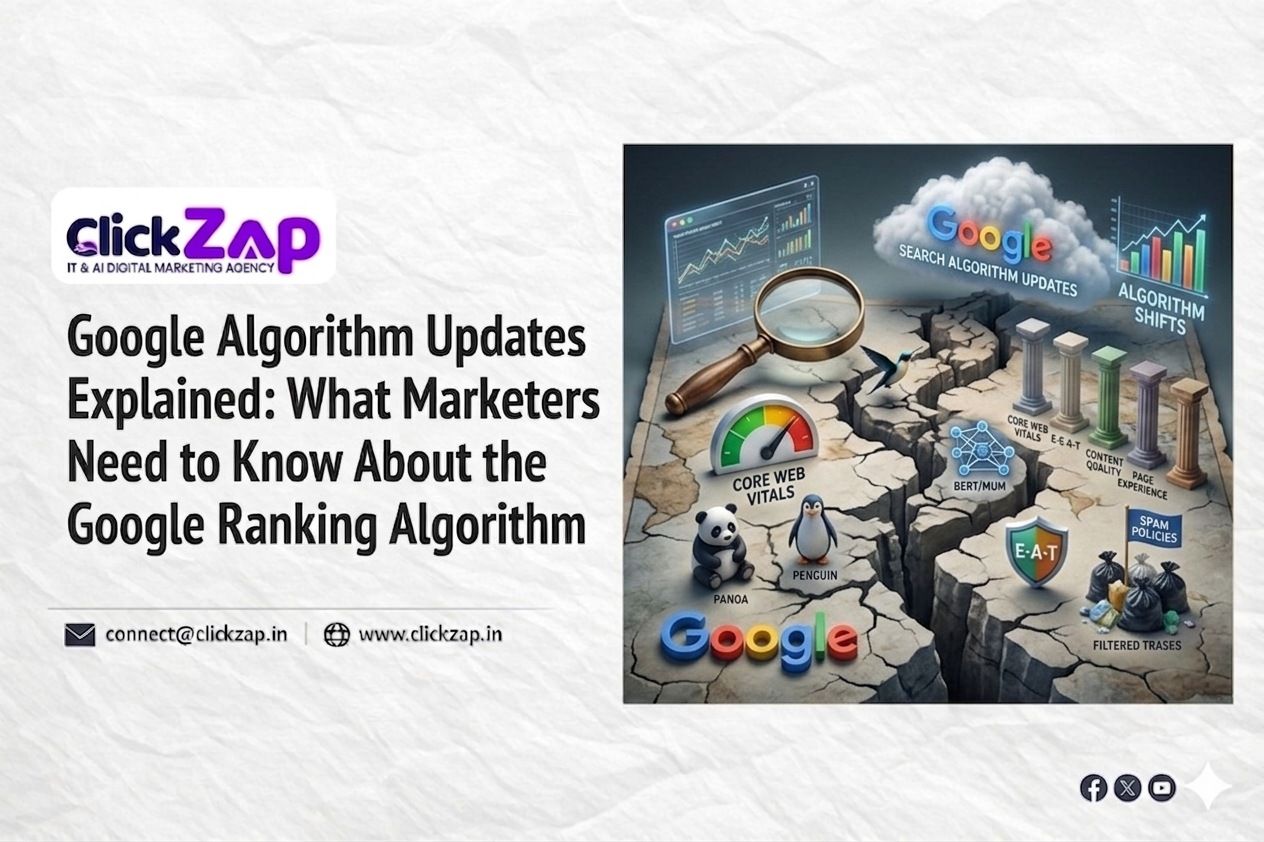
If you woke up to a 40% drop in organic traffic overnight, you are not alone and you are not penalized (probably). You are experiencing the force of a Google ranking algorithm update.
For nearly two decades, Google has been refining how it discovers, evaluates, and ranks content. But in 2026, how Google ranking algorithm works is no longer just about keywords or backlinks. It’s about E-E-A-T, user experience, and answering questions before users finish typing them.
In this guide, you’ll learn exactly how Google core updates are explained in plain English, the real impact of Google ranking algorithm updates on SEO, and a step-by-step framework to recover whether you run a blog, an e-commerce store, or a SaaS company.
How the Google Ranking Algorithm Actually Works (Simplified)
Before we dissect updates, let’s demystify the engine itself.
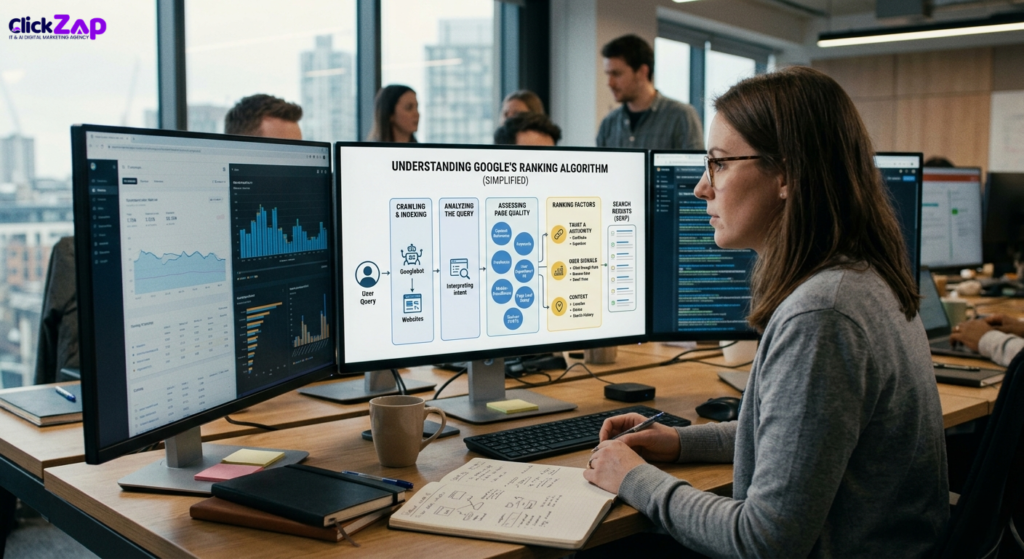
The Google ranking algorithm is not one algorithm. It is a system of systems. When you search for “best running shoes,” Google runs multiple sub-algorithms in parallel:
- Crawling & Indexing (Googlebot discovers pages)
- Query interpretation (BERT and MUM understand intent)
- Retrieval (finds relevant pages from the index)
- Ranking (hundreds of signals decide order)
- Re-ranking (freshness, location, device adjustments)
Key insight for marketers: The old “TF-IDF” model is dead. Today, entity-based SEO matters more. Google understands that “Apple” (fruit) and “Apple” (company) are different entities based on context.
Primary Ranking Factors in 2026
| Factor | Weight (Est.) | What Changed |
| Relevance (content + entities) | Very High | Semantic matching, not exact match |
| E-E-A-T signals | Very High | Author bios, citations, fact-checking |
| User experience (UX) signals | High | Core Web Vitals, mobile usability |
| Backlink quality | Medium-High | Authority > quantity |
| Brand demand | Medium | Branded search volume signals trust |
Major Google Core Updates Explained (2003–2026)
To understand Google search updates guide, you must know history not for nostalgia, but because older updates still influence penalties today.
The Classic Era (Panda, Penguin, Hummingbird)
- Panda Update (2011): Targeted thin content, content farms, and low-value pages. Fix: Remove duplicate or auto-generated content.
- Penguin Update (2012): Targeted spammy backlinks and exact-match anchor text. Fix: Disavow toxic links.
- Hummingbird (2013): Shifted from keyword strings to conversational search and entity recognition. Fix: Write naturally, not for robots.
The AI Era (BERT, Helpful Content, Core Updates)
- BERT (2019): Understands prepositions and context (e.g., “you can park on a driveway but in a garage”). Fix: Write for clarity, not keywords.
- Helpful Content Update (2022 ongoing): Rewards “people-first” content. Punishes SEO-first content. Fix: Remove fluff. Add original research.
- August 2024 Core Update: Targeted small/medium sites with low E-E-A-T. Fix: Add author credentials, external citations.
Real-world case study: A health blog lost 67% traffic after the March 2024 Core Update. They added medical reviewer bios, cited peer-reviewed studies, and recovered in 5 months.
Impact of Google ranking algorithm Updates on SEO: 3 Critical Shifts for 2026
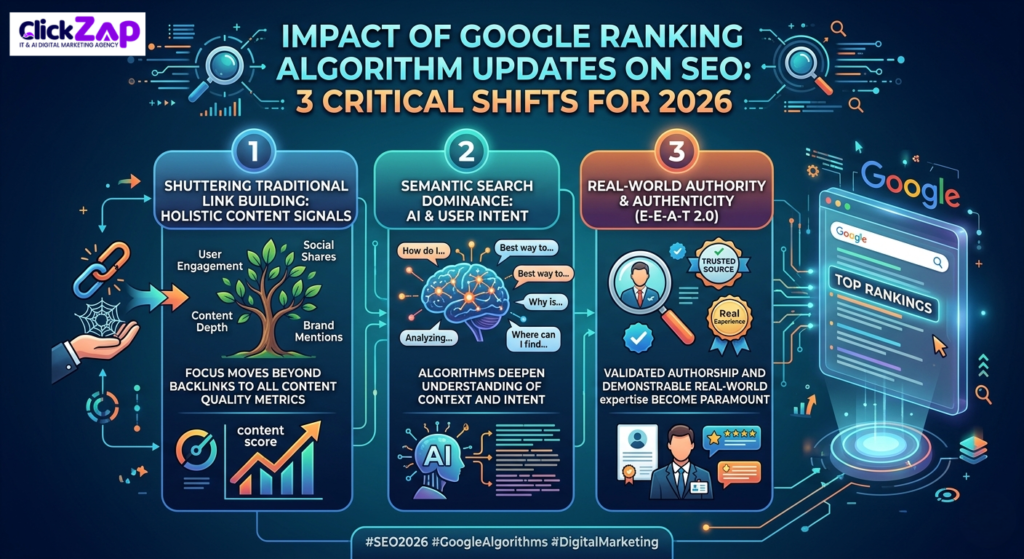
1. Content Quality Signals > Keyword Density
You can rank without a single exact-match keyword if you satisfy content quality signals: completeness, originality, and usefulness.
What works in 2026:
- Original data (surveys, case studies, screenshots)
- Clear answers to “people also ask” queries
- Structured data (FAQ, HowTo, QAPage)
2. User Experience (UX) Signals Are Ranking Factors
Google can measure user experience (UX) signals via Chrome data: time on page, scroll depth, pogo-sticking (clicking back to results).
SEO ranking factors 2026 include:
- Mobile-first indexing (mandatory)
- Largest Contentful Paint < 2.5s
- No intrusive interstitials
3. E-E-A-T Is Not Just for YMYL
Experience, Expertise, Authority, Trust (E-E-A-T) now applies to travel blogs, tech reviews, and local services.
How to demonstrate E-E-A-T:
- About page with real people and locations
- Author boxes with LinkedIn/X profiles
- Outbound links to high-authority domains (.gov, .edu, major publications)
Google Penalties and Fixes: How to Recover from Google ranking algorithm Updates
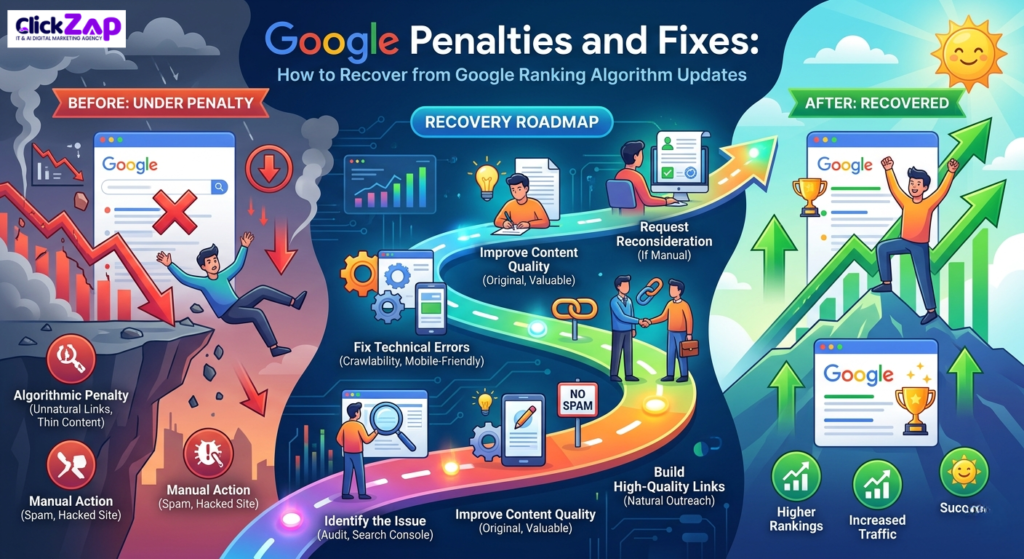
You don’t always receive a manual penalty. Most traffic drops are from algorithmic devaluation Google didn’t punish you; it just decided others are better.
Step-by-step recovery framework
Step 1: Verify the drop
Open Google Analytics and Google Search Console. Check if the drop aligns with a confirmed update (track on Search Engine Roundtable or MozCast).
Step 2: Run a gap analysis
Compare your top 10 landing pages (before vs. after) using Google Search Console performance report. Look for:
- Queries that lost impressions
- Pages that lost average position
Step 3: Audit for common triggers
| Trigger | What to check | Tool |
| Thin content | Pages with <300 words | Screaming Frog |
| Slow UX | Core Web Vitals fail | PageSpeed Insights |
| Toxic backlinks | Low-quality referring domains | Google Ads disavow tool |
Step 4: Fix and re-crawl
- Improve content depth (add examples, visuals, FAQs)
- Remove or noindex low-value pages
- Request re-indexing in Google Search Console
Step 5: Wait (2–4 weeks)
Most core updates roll out over 2 weeks, but full impact can take 30 days. Do not panic-redesign your site.
Pro tip: Never “chase” an update by making 100 changes in one day. You won’t know what worked. Test one section of your site first.
Google Ranking Algorithm Update Impact on Websites: By Industry
Different verticals feel updates differently.
| Industry | Sensitivity | Most impactful update |
| Health & Finance | Very High | E-E-A-T / Core Updates |
| E-commerce | Medium | Product Reviews Update |
| Local Services | Low-Medium | Vicinity Update (proximity) |
| News/Media | High | Helpful Content Update |
| SaaS/B2B | Medium | Link spam updates |
How to Use AI Tools to Survive (and Thrive) Under Google Updates
This is where AI Optimization (AIO) meets Generative Engine Optimization (GEO).
Use AI for content auditing, not bulk generation
- Tool: SurferSEO – Analyze top-ranking pages for entity density
- Workflow: Export SERP features → Identify gaps → Write human-first draft → AI polish (grammar, clarity)
Optimize for AI citations (GEO)
Google’s Search Generative Experience (SGE) and Bing Chat cite specific sources. To be cited:
- Use tables and bulleted lists (LLMs parse them easily)
- Attribute data (e.g., “According to a 2025 SEMrush study…”)
- Write definitive, comparative statements (“X is better than Y because…”)
Automate monitoring (AIO)
Set up Google Search Console weekly exports. Use Looker Studio + GPT to flag:
- Pages with 20%+ impression loss
- Queries with position drop from 3→9
FAQ’s:
Q1: How often does Google update its ranking algorithm?
Google makes thousands of “tweaks” per year, but major Google core updates happen 4–6 times annually. Minor updates are daily.
Q2: How long does it take for a site to recover from a Google update?
If you fix the root cause (e.g., thin content), recovery can take 2–4 weeks. After a core update, you must wait for the next core update to see full recovery.
Q3: Does Google penalize AI-generated content?
No. Google penalizes low-quality content, regardless of origin. AI-written content that lacks E-E-A-T, original data, or human review will drop.
Q4: What are the most important SEO ranking factors for 2026?
- Search intent match (informational vs. commercial)
- E-E-A-T signals (author authority, site reputation)
- Core Web Vitals (especially LCP and CLS)
- Internal linking structure (topic clusters)
Q5: How can I check if my site has a Google penalty?
Go to Google Search Console → Security & Manual Actions → “No issues detected” is good. For algorithmic drops, compare traffic dates to known update calendars.
Q6: Does Google Ads affect organic ranking?
No. Google has explicitly stated that Google Ads spend does not improve organic search ranking. However, brand search volume (driven by ads) can indirectly signal authority.
Q7: What is the difference between Panda, Penguin, and a Core Update?
Panda and Penguin were specific filters targeting thin content and bad links. Modern core updates are broad changes to the entire Google ranking algorithm that affect multiple factors at once.
Q8: How do I optimize for voice search in 2026?
Use conversational question-based keywords (“how to fix…”, “what is the best way to…”). Target “position zero” with direct, 40–50 word answers followed by a source.
Conclusion:
You don’t need to fear Google ranking algorithm updates explained by doom-scrolling Twitter. You need a repeatable process.
Days 1–3: Diagnose
- Compare Google Analytics (Acquisition → Search Console) week-over-week
- Identify which page types lost traffic (blogs, product pages, landing pages)
Days 4–10: Audit & Fix
- Run Google Search Console “Performance” report → Filter by date range
- Export queries with CTR drop → Manually review top 5 affected pages
- Improve content: add original examples, update statistics, embed a short video
Days 11–20: Enhance UX
- Check Core Web Vitals in Google Search Console → “Core Web Vitals” report
- Optimize images (WebP format, lazy loading)
- Add internal links from high-authority pages to struggling pages
Days 21–30: Monitor & Scale
- Re-submit updated pages via Google Search Console URL inspection
- Build one new piece of topic cluster content around a keyword that survived the update
- Set up weekly automated alerts for organic traffic changes.
0 Comments