
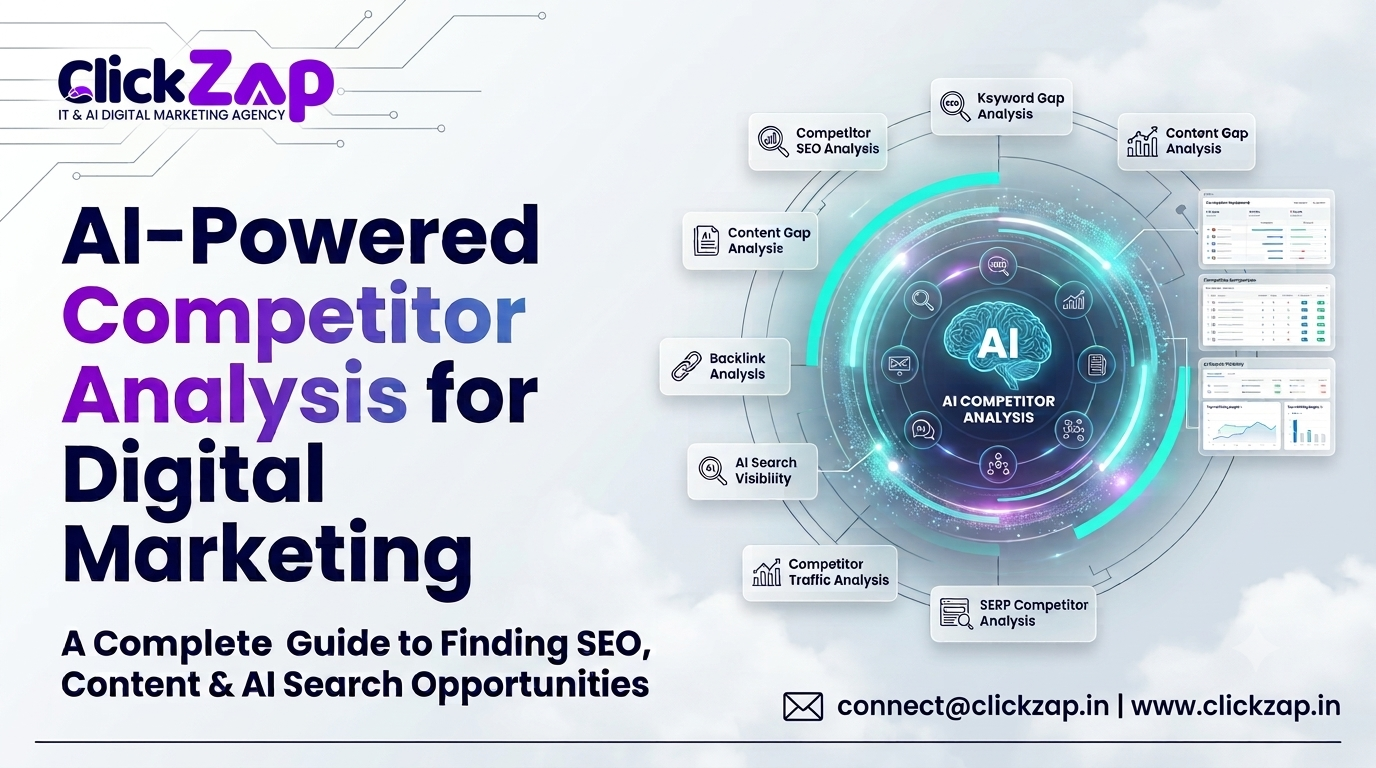
AI powered competitor analysis for digital marketing
Your competitors are not just showing up on page one of Google anymore. They are showing up inside ChatGPT answers, Google AI Overviews, and Perplexity summaries, often without you even realizing it. Traditional competitor analysis, the kind built around spreadsheets, manual keyword lists, and quarterly reports, simply cannot keep pace with how fast the search landscape is changing. This is exactly where AI powered competitor analysis for digital marketing comes in, giving you a real time view of where your competitors are winning and where you still have room to move.
This is where AI powered competitor analysis for digital marketing changes the game. Instead of spending days manually pulling data from a dozen tabs, AI can process competitor websites, keyword rankings, content libraries, backlink profiles, ad campaigns, and social media activity in a fraction of the time and surface patterns a human analyst might miss entirely.
In this guide, you will learn what AI powered competitor analysis actually means, why it matters, and how it differs from traditional research. You will also get a step by step process for analyzing competitor SEO, content, backlinks, traffic, PPC, and social strategies, plus a dedicated look at how competitors show up in AI search. By the end, you will have a practical framework for turning competitor data into a real marketing strategy.
What Is AI Powered Competitor Analysis for Digital Marketing?
AI powered competitor analysis is the use of artificial intelligence tools to collect, process, and interpret data about competitor websites, content, keywords, backlinks, traffic, ads, and social presence helping marketers identify strategic opportunities faster and more accurately than manual research alone.
Competitor analysis, at its core, means studying what other businesses in your space are doing so you can understand the competitive landscape and find your own openings. Traditionally, this meant a marketer manually reviewing competitor websites, running keyword searches one at a time, and compiling findings into a document.
AI changes this by processing far larger volumes of data at once. It can scan thousands of keywords, hundreds of pages, and multiple competitor domains simultaneously, then group findings into patterns, content themes, keyword clusters, ranking trends that would take a human analyst much longer to spot manually. The marketer’s job shifts from data collection to interpretation: reviewing what the AI surfaces and deciding which insights are worth acting on.
This connects directly to SEO, content marketing, PPC, and competitive intelligence as a whole. AI does not replace strategy, it accelerates the research that strategy depends on.
Why Is AI Competitor Analysis Important for Digital Marketing?
Competitor research using AI matters because speed and depth both improve at the same time. Here is what that looks like in practice:
- Faster competitor research — analysis that once took days can often be narrowed to hours
- Better competitor benchmarking — comparing your site against several competitors on the same metrics at once
- Keyword opportunity discovery — spotting ranking keywords you have not targeted yet
- Content gap identification — finding topics competitors cover that you do not
- Backlink opportunity discovery — surfacing referring domains worth pursuing
- Traffic source understanding — seeing whether competitors lean on organic, paid, or referral traffic
- SERP monitoring — tracking ranking movement and new entrants in your space
- Paid advertising analysis — reviewing competitor ad copy, keywords, and landing pages
- Social media performance insight — understanding what content formats competitors lean on
- Improved search visibility — using findings to close visibility gaps
- Trend identification — catching shifts in topics or formats before they become obvious
- Data-driven decisions — replacing guesswork with evidence
For example, if a competitor suddenly ranks for a cluster of new keywords, AI assisted monitoring can flag that shift early, giving you time to respond rather than noticing months later.
Traditional Competitor Analysis vs AI Powered Competitor Analysis
| Area | Traditional Approach | AI Powered Approach |
| Data collection | Manual, tool by tool | Automated, multi source |
| Speed | Slow, often weeks | Fast, often hours or days |
| Keyword research | One keyword at a time | Bulk keyword and cluster analysis |
| Content analysis | Manual page by page review | Pattern and gap detection at scale |
| SEO analysis | Spreadsheet based tracking | Automated ranking and intent analysis |
| Backlink analysis | Manual domain review | Bulk referring domain comparison |
| Traffic analysis | Estimates from single tools | Cross referenced traffic and channel data |
| Competitor monitoring | Periodic manual checks | Ongoing, near continuous tracking |
| Pattern identification | Dependent on analyst experience | AI assisted pattern surfacing |
| Scalability | Limited by analyst time | Scales across many competitors at once |
| Decision making | Slower, reactive | Faster, more proactive |
AI does not remove the need for human judgment, it removes the bottleneck of manual data gathering so marketers can spend more time deciding what to do with the findings.
How to Perform AI Powered Competitor Analysis Step by Step
1. Identify Your Real Digital Competitors
Not every business you compete with commercially is the one you compete with in search results, and not every SERP competitor is a real business rival. It helps to separate them into categories:
- Direct competitors — businesses selling the same product or service to the same audience
- Indirect competitors — businesses solving the same problem differently
- SERP competitors — sites ranking for your target keywords, regardless of industry
- Content competitors — publishers or blogs competing for the same reader attention
- AI search competitors — brands being cited or mentioned in AI generated answers for your topics
A local software vendor, for instance, might commercially compete with two or three companies, but in Google Search they may be competing with review sites, comparison blogs, and even Reddit threads. Mapping this distinction correctly is the foundation for everything that follows.
2. Analyze Competitor Websites Using AI
Website structure often reveals strategy. AI assisted analysis can help evaluate:
- Overall site architecture and navigation
- Landing page structure and messaging
- Content architecture and topic organization
- User experience and page flow
- Conversion paths and calls to action
- Product or service page depth
- Blog structure and publishing cadence
- Internal linking patterns
Reviewing these elements across several competitors at once rather than one at a time makes it easier to spot which structural choices are common practice versus which ones are genuine differentiators.
3. Perform AI SEO Competitor Analysis
AI SEO competitor analysis focuses on how competitors earn and hold their search visibility. This includes identifying:
- Which keywords competitors currently rank for
- Keyword clusters and topic groupings
- Search intent behind their top ranking pages
- High value pages driving the most visibility
- SERP feature opportunities, including featured snippets
- Long tail keyword patterns
- Broader competitor SEO strategy signals
Competitor keyword analysis using AI is particularly useful here, since it can group thousands of ranking keywords into intent based clusters far faster than manual tagging.
4. Find Keyword Gaps Using AI
Keyword gap analysis means identifying keywords your competitors rank for that your website does not target at all. The process generally looks like this:
- Pull the full ranking keyword list for two or three close competitors
- Compare that list against your own ranking keywords
- Isolate keywords where competitors rank and you do not
- Use AI to classify those keywords by search intent
- Prioritize based on relevance, intent, and realistic ranking opportunity
Example: Suppose three competitors all rank on page one for a commercial intent keyword related to your core service, and your site has no page targeting it at all. That is a direct keyword gap and a clear content opportunity worth prioritizing over a long list of lower intent terms.
5. Discover Content Gaps Using AI
Content gap analysis goes beyond keywords to look at topic coverage. AI can help identify:
- Topics competitors cover that you have not addressed
- Search intent that is underserved across the competitive landscape
- Competitor articles that are thin, outdated, or poorly structured
- Missing FAQ sections
- Missing supporting or cluster topics
- Opportunities to build stronger topic clusters
- New content formats worth testing
Competitor content analysis using AI works well alongside AI competitor gap analysis, since gaps often show up at both the keyword level and the topic level simultaneously.
6. Analyze Competitor Backlinks
Backlink gap analysis looks at where competitors are earning links that you are not. This can surface:
- Referring domains linking to multiple competitors but not to you
- Industry publications open to contributions or mentions
- Guest posting opportunities
- Resource or “best of” pages worth being listed on
- Digital PR angles based on what has earned coverage before
- General link building prospects worth outreach
7. Analyze Competitor Traffic and Search Visibility
Understanding where competitor traffic actually comes from helps you judge how much of their visibility is organic versus paid or referral driven. This typically involves reviewing:
- Organic traffic trends over time
- Paid traffic share
- Referral traffic sources
- Top performing pages by estimated traffic
- Overall search visibility trends
- Audience behavior signals where available
Tools such as Similarweb are commonly used for traffic and audience estimates, while Semrush and Ahrefs help connect that traffic data back to specific ranking keywords and pages. Google Analytics and Google Search Console remain the most reliable sources for your own first party data, which should always be used to validate third party estimates rather than replace them.
8. Perform PPC Competitor Analysis
PPC competitor analysis looks at how competitors approach paid search, including:
- Which keywords they are bidding on
- How their ad messaging is structured
- What landing pages their ads point to
- What offers or promotions they lead with
- The search intent behind their paid campaigns
- Recurring campaign themes over time
Tools like SpyFu are built specifically for this kind of paid search research, while Google Ads’ own auction insights can add first party context when you are running campaigns in the same space.
9. Analyze Competitor Social Media Strategies
Social platforms reveal a different side of competitor strategy. It is worth reviewing:
- Content formats they rely on most
- Posting frequency and consistency
- Engagement levels relative to follower count
- Recurring topics and themes
- Audience reactions and comment sentiment
- Video strategy specifically, given its growing weight on most platforms
- Overall brand positioning and tone
10. Analyze Competitors in AI Search
This is one of the newest and most important parts of competitor analysis. Generative Engine Optimization (GEO) is the practice of optimizing content so it is more likely to be understood, referenced, or cited by AI systems such as ChatGPT, Google AI Overviews, Google Gemini, and Perplexity.
To analyze competitors in AI search, businesses can look at:
- Which brands are being mentioned in AI generated answers for relevant queries
- Which competitors are being cited as sources
- What topics or questions tend to trigger AI generated answers in your space
- What types of sources AI systems appear to rely on most
- Which entities are consistently associated with competitors
- What content characteristics clarity, structure, factual depth may increase the likelihood of being referenced
It is important to be realistic here: no tool or technique can guarantee that a brand will be cited by an AI system. What businesses can do is study patterns in how competitors show up and use those patterns to inform their own content and entity strategy.
Best AI Competitor Analysis Tools for Digital Marketing
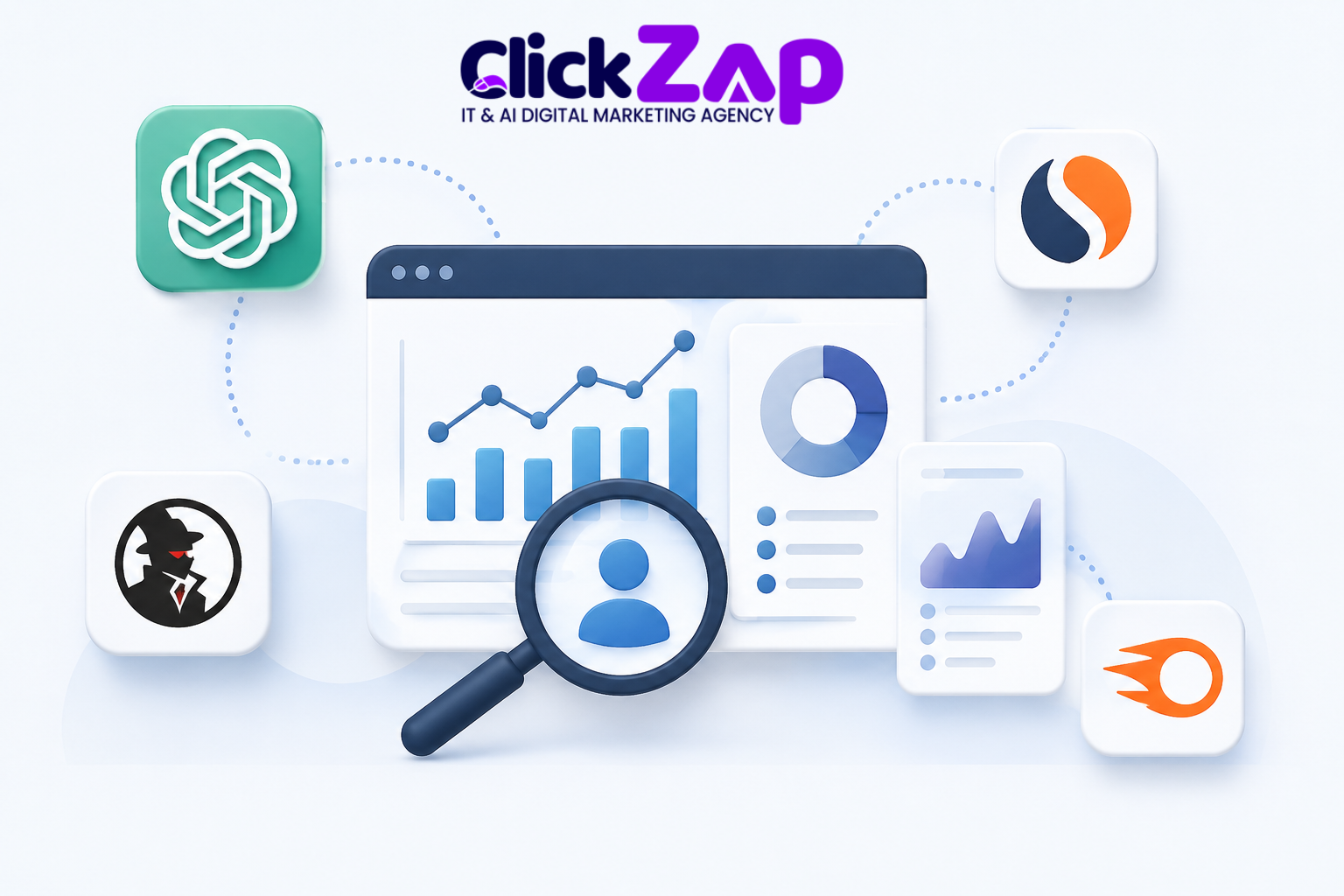
Semrush is widely used for SEO competitor research, covering keyword gaps, backlink analysis, and traffic related insights in a single platform, making it a strong starting point for broad competitive analysis.
Ahrefs is particularly strong for competitor keyword research, backlink data, and content analysis, and is often used alongside Semrush for cross checking findings.
Similarweb focuses on traffic estimation, audience insights, and channel breakdowns, which is useful for understanding where competitor traffic actually originates.
SpyFu specializes in competitor PPC and paid keyword research, making it a go to option when the focus is specifically on paid search strategy.
ChatGPT can be used to interpret raw competitor data, brainstorm content gap ideas, support SWOT style analysis, explore competitor positioning, analyze search intent patterns, and help shape content strategy. Since ChatGPT’s outputs are generated from patterns rather than verified data, findings should always be checked against a reliable SEO or analytics tool before being acted on.
For first party validation, Google Search, Google Ads, Google Analytics, and Google Search Console remain essential; they show what is actually happening on your own site and campaigns, rather than estimates about competitors.
How AI Helps Find Competitor SEO, Content & AI Search Opportunities
SEO Opportunities
AI-assisted research can surface keyword gaps, SERP feature opportunities, backlink gaps, technical SEO observations, internal linking opportunities, and search intent gaps that manual review might miss.
Content Opportunities
This includes content gaps, underdeveloped topic clusters, long tail content ideas, missing FAQ sections, outdated competitor content worth outranking, and opportunities to publish in stronger or more useful formats.
AI Search Opportunities
Here the focus shifts to entity optimization, building topical authority, publishing genuinely helpful and factual content, giving clear direct answers, using structured information, and positioning original insight and first hand expertise all core components of a solid GEO strategy.
How to Turn Competitor Insights Into a Digital Marketing Strategy
Research alone does not move the needle. A practical framework looks like this:
Discover → Analyze → Identify Gaps → Prioritize → Create → Optimize → Measure → Monitor
Competitor insights gathered through this process can directly shape:
- SEO strategy — which keywords and pages to prioritize
- Content marketing strategy — which topics and formats to publish
- PPC strategy — which keywords and offers to test
- Social media strategy — which formats and topics to lean into
- Website strategy — structural or UX improvements worth making
- GEO strategy — how to structure content for AI search visibility
- Conversion optimization — where competitor landing pages outperform your own
Common Mistakes to Avoid in AI Competitor Research
- Copying competitor strategies instead of using them as inspiration
- Blindly targeting every competitor keyword regardless of relevance
- Trusting AI-generated data without verifying it against a trusted tool
- Focusing only on rankings while ignoring underlying search intent
- Ignoring how competitors appear in AI search altogether
- Analyzing only one competitor instead of a representative set
- Overlooking what your own customers actually need
- Relying on outdated competitor data
- Confusing estimated traffic figures with exact, verified numbers
Competitor research should inform original strategy not become a template for copying what already exists.
AI Competitor Analysis Best Practices
- Define your business objectives before starting any research
- Analyze multiple competitor types, not just the obvious direct ones
- Combine AI tools with trusted SEO platforms for verification
- Double check important data points before acting on them
- Keep search intent central to every keyword or content decision
- Look for gaps, not just where competitors already rank well
- Monitor competitors on an ongoing basis, not just once a quarter
- Study competitor weaknesses as closely as their strengths
- Prioritize opportunities based on real business value
- Use competitor insight to inspire better original content, not duplicate content
Frequently Asked Questions
What is AI powered competitor analysis?
AI powered competitor analysis uses artificial intelligence to collect and interpret data about competitor websites, keywords, content, backlinks, and ads. It helps marketers process large amounts of competitive data quickly and identify actionable SEO, content, and marketing opportunities.
How does AI help with competitor analysis?
AI helps by processing large datasets, keyword lists, content libraries, backlink profiles far faster than manual review. It groups findings into patterns, such as keyword clusters or content gaps, allowing marketers to focus their time on strategic decisions rather than raw data collection.
What are the best AI competitor analysis tools?
Commonly used tools include Semrush and Ahrefs for SEO and backlink research, Similarweb for traffic and audience data, SpyFu for PPC analysis, and ChatGPT for interpreting data and brainstorming content strategy. Each tool serves a different part of the research process.
How can AI find competitor keyword gaps?
AI can compare your ranking keyword list against competitors’ lists to isolate keywords they rank for that you do not. It can then classify those keywords by search intent, helping you prioritize which gaps are worth targeting first based on relevance and opportunity.
Can ChatGPT be used for competitor research?
Yes, ChatGPT can help interpret competitor data, brainstorm content gaps, and support positioning analysis. However, it does not have live access to verified ranking or traffic data, so its outputs should always be checked against a dedicated SEO or analytics tool.
Conclusion
AI powered competitor analysis for digital marketing has moved from a nice to have into a core part of how modern marketing teams operate. It reveals SEO opportunities faster, uncovers content gaps that manual review often misses, and adds a clear layer of insight into PPC and social media performance. With AI search platforms like ChatGPT, Google AI Overviews, and Perplexity now shaping how people find information, understanding how competitors show up in AI search and applying solid GEO practices has become just as important as traditional rankings.
The businesses that get the most value from this approach are the ones that pair AI driven research with reliable, verified marketing data rather than relying on AI alone. Used this way, competitor analysis stops being a one time report and becomes an ongoing input into smarter SEO, content, and search strategy.
If you’re looking to turn competitor insights into a real growth plan, ClickZap IT‘s AI powered digital marketing services can help you find and act on the opportunities your competitors are missing.
Also Read: AI Marketing Automation Services in Hyderabad: A Complete Guide for Businesses in 2026
0 Comments