
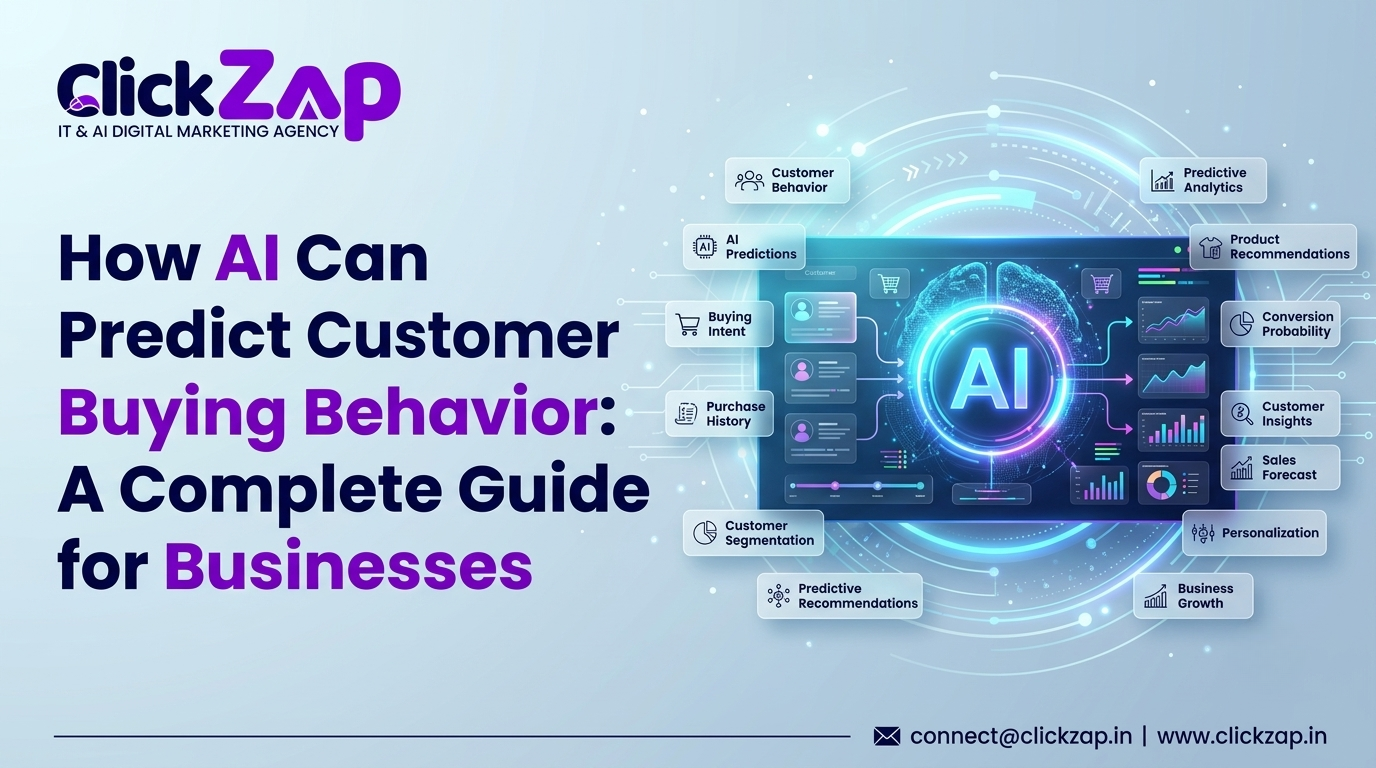
How AI Can Predict Customer Buying Behavior
For decades, businesses have tried to guess what customers will buy next. They relied on sales history, market research, gut instinct, and simple surveys. These methods worked, but only up to a point. They were slow, backward looking, and often missed the small signals that show a customer is ready to buy. That’s why more companies are now turning to AI to predict customer buying behavior before it happens.
This is exactly where AI changes the game. How AI can predict customer buying behavior comes down to one core idea: AI systems study large amounts of customer data past purchases, browsing habits, engagement, and demographics and use machine learning to spot patterns that predict what a customer is likely to do next. Instead of reacting after a sale happens, businesses can act before it happens.
Traditional methods can only look backward. AI based customer behavior prediction looks forward. It processes data from websites, CRM systems, email campaigns, and apps in real time, then turns that data into a purchase probability score for each customer.
In this guide, you’ll learn:
- What customer buying behavior actually means
- How AI and machine learning predict what customers will buy
- What data AI uses, and which buying signals matter most
- How predictive analytics supports segmentation, lead scoring, churn prediction, and more
- Real world examples across industries
- The benefits, limitations, and future of AI customer prediction
- A step by step framework to implement it in your business
Whether you’re a small business owner or a marketing manager at an enterprise, this guide is written to be practical, not theoretical.
What Is Customer Buying Behavior?

Customer buying behavior refers to the decisions and actions customers take before, during, and after a purchase. It includes what they buy, why they buy it, when they buy it, and how they choose between options.
Several factors influence buying behavior, including:
Customer preferences — brand, price range, product features
Past purchases — what a customer has bought before
Browsing behavior — pages viewed, time spent, products compared
Engagement — email opens, ad clicks, social interactions
Demographics — age, location, income level, job role
Customer journey stage — awareness, consideration, or decision
Buying signals — actions that suggest purchase intent, like visiting a pricing page
Purchase intent — how ready a customer is to buy right now
A simple example: Imagine a customer visits an online shoe store three times in a week, views the same pair of running shoes each time, and opens two promotional emails about running gear. Individually, each action seems minor. Together, they paint a clear picture that this customer is showing strong purchase intent. AI is built to catch exactly these kinds of patterns, at scale, across thousands of customers at once.
How AI Can Predict Customer Buying Behavior
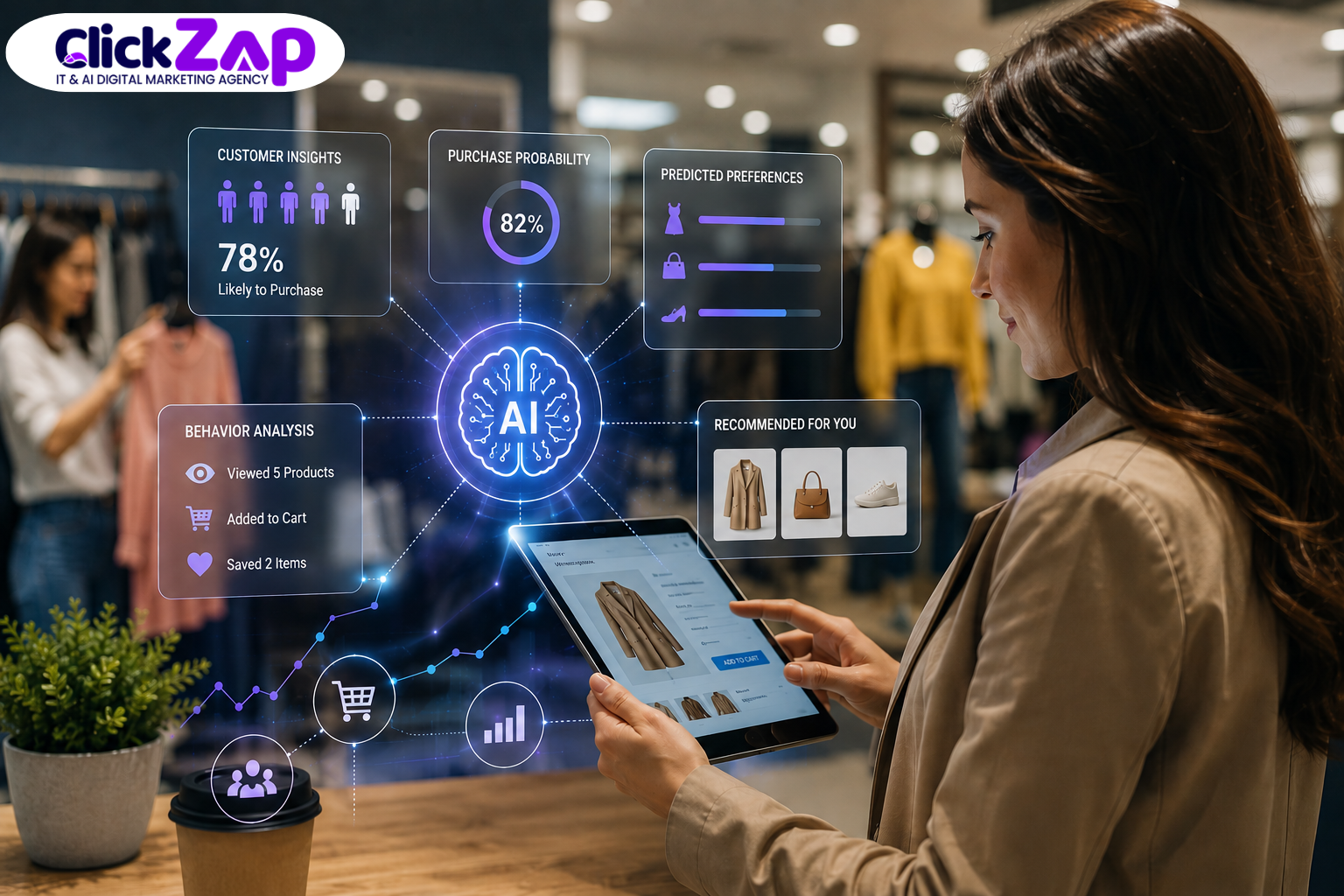
How AI can predict customer buying behavior in one sentence: AI collects customer data, processes it, identifies behavioral patterns, and applies machine learning to calculate the probability that a specific customer will take a specific action, such as making a purchase.
This happens through a clear process:
Customer Data → Data Processing → Behavioral Analysis → Machine Learning → Predictive Modeling → Purchase Probability → Marketing Action
Here’s what happens at each stage:
Customer Data — Raw information is gathered from every touchpoint: website visits, purchases, emails, support tickets, and app activity.
Data Processing — The data is cleaned, organized, and structured so it can be analyzed consistently.
Behavioral Analysis — The system studies patterns in how customers browse, engage, and interact over time.
Machine Learning — Algorithms learn from historical outcomes to recognize what patterns tend to lead to a sale.
Predictive Modeling — The system builds a model that can apply those learned patterns to new, current customer behavior.
Purchase Probability — Each customer is assigned a likelihood score, showing how likely they are to buy soon.
Marketing Action — Businesses use this score to trigger personalized emails, targeted ads, retargeting campaigns, or sales outreach.
This is the foundation of AI customer behavior prediction and it works continuously, updating as new data comes in.
How Does AI Predict What Customers Will Buy?

To understand predicting customer behavior using AI, it helps to break down the technology into its core components.
Data Collection
AI systems need data to learn from. Businesses typically collect this data from sources such as:
- Websites and landing pages
- Google Analytics
- CRM systems
- eCommerce platforms
- Email marketing campaigns
- Social media interactions
- Customer support conversations
- Transaction and order history
- Mobile applications
The more relevant and accurate this data is, the more reliable the predictions become.
Data Processing
Raw customer data is often messy duplicated records, missing fields, or inconsistent formats. Before AI can use it, the data must be cleaned, standardized, and organized into a usable structure. This step is unglamorous but essential; poor data processing leads to poor predictions, regardless of how advanced the AI model is.
Behavioral Pattern Detection
Once data is organized, machine learning models scan it for behavioral patterns and recurring sequences of actions that humans might overlook. For example, a model might notice that customers who view a product page, then a comparison page, then a shipping policy page within 48 hours convert at a much higher rate than customers who don’t follow that path.
Predictive Modeling
Predictive models take these patterns and turn them into forward looking estimates. Instead of just describing what happened in the past, they estimate what is likely to happen next such as whether a specific customer will make a purchase within the next 7 days.
Purchase Probability
The output of predictive modeling is typically a probability score, often expressed as a percentage or a “high/medium/low” likelihood rating. This score helps businesses decide who to prioritize.
Marketing Activation
Predictions only create value when they’re acted on. Businesses connect these scores to marketing systems to trigger personalized emails, dynamic website content, targeted ads, or direct sales follow up turning a prediction into a real business outcome.
What Customer Data Does AI Use to Predict Buying Behavior?
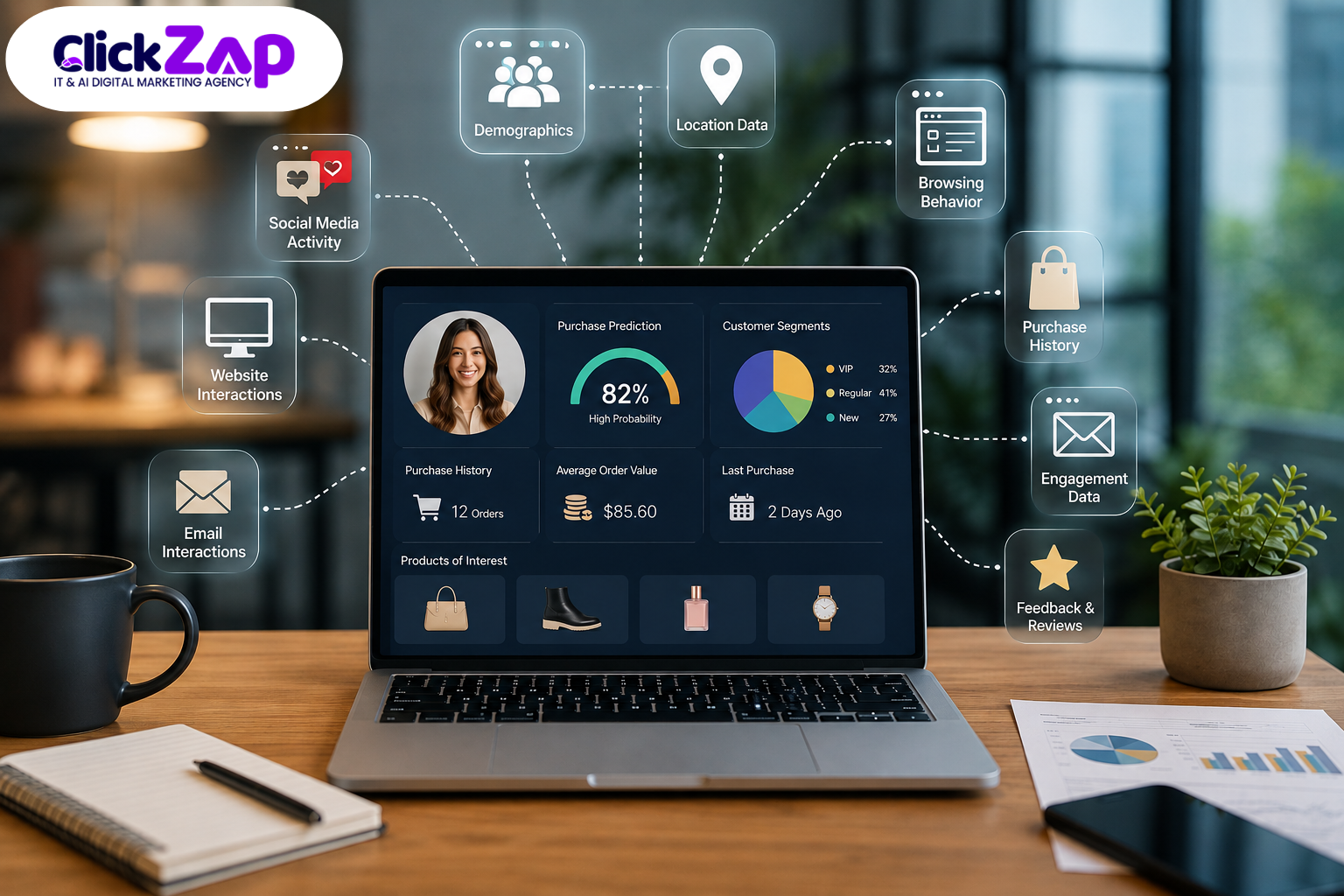
AI systems draw from several categories of customer data to build accurate predictions:
- Demographic data — age, gender, location, income, job title
- Transaction data — order history, average order value, purchase frequency
- Behavioral data — clicks, scrolls, time on page, session frequency
- Website activity — pages visited, navigation paths, exit points
- Search behavior — on-site search terms and repeated queries
- Email engagement — opens, clicks, unsubscribes
- Product interactions — items viewed, added to cart, or wish listed
- Customer service interactions — support tickets, chat conversations
- Social engagement — likes, shares, comments, and ad interactions
- Customer journey data — the full path from first visit to purchase
- Historical purchase data — past buying patterns and seasonality
Data quality matters more than data quantity. A smaller dataset of clean, relevant, well organized data will usually produce better predictions than a massive dataset full of duplicates, outdated records, or irrelevant fields.
Buying Signals AI Can Detect
Buying signals are specific actions that indicate a customer may be close to making a purchase. AI is particularly good at spotting these signals because it can monitor them continuously, across every customer, without manual effort.
Common buying signals include:
- Repeated views of the same product
- Adding items to a cart
- Abandoned carts
- Increased frequency of website visits
- Visits to pricing or plans pages
- Downloading product brochures or spec sheets
- Higher than usual email engagement
- Repeated searches for the same product category
- Comparing multiple products or plans
- A general increase in overall engagement
- Previous purchases of related products
No single signal guarantees a purchase. AI’s strength lies in combining multiple signals to build a more reliable estimate of purchase intent much like a salesperson reading several small cues in a conversation, except at scale and in real time.
AI Purchase Intent Prediction Explained
Purchase intent is the degree to which a customer is ready to buy, right now. AI purchase intent prediction works by analyzing recent behavior not just historical activity to judge how close a customer is to making a decision.
There’s an important difference between interest and intent:
- Interest means a customer is aware of and curious about a product.
- Intent means a customer is actively evaluating a purchase decision.
This is closely tied to customer purchase propensity, a score representing how likely a specific customer is to buy within a given timeframe. AI models calculate propensity by weighing recent behavioral signals more heavily than older ones.
Example: A B2B software company might see two leads who both downloaded a whitepaper six months ago. One lead has taken no further action since. The other has visited the pricing page twice this week and requested a product demo. AI purchase intent prediction would rank the second lead far higher, helping the sales team prioritize their time on the customer who’s actually ready to talk.
Machine Learning for Customer Buying Behavior Prediction
Machine learning customer behavior prediction relies on a few core techniques. You don’t need to understand the math to use these tools effectively just what each technique is generally used for:
- Classification — Sorts customers into categories, such as “likely to buy” vs. “unlikely to buy.”
- Regression — Estimates numeric values, such as predicted order value or time until next purchase.
- Clustering — Groups customers with similar behaviors together, useful for segmentation.
- Predictive modeling — Combines multiple techniques to forecast future actions based on past patterns.
- Pattern recognition — Identifies recurring behavioral sequences across large customer datasets.
- Recommendation systems — Suggest products or content based on a customer’s behavior and similar customers’ behavior.
In practice, businesses rarely build these models from scratch. Most use existing platforms and tools discussed later in this article that apply these techniques behind the scenes.
How Predictive Analytics Helps Businesses Understand Customers
Predictive analytics for customer behavior goes beyond just purchase prediction. It supports several connected business functions:
- Customer segmentation — Grouping customers by shared traits or behaviors, such as “frequent buyers” or “price sensitive shoppers,” so marketing can be tailored to each group.
- Lead scoring — Ranking leads by how likely they are to convert, helping sales teams focus on the most promising prospects first.
- Purchase prediction — Estimating which customers are likely to buy, and roughly when.
- Churn prediction — Identifying customers who show signs of disengagement, such as reduced logins or fewer purchases, so businesses can intervene before they leave.
- Customer lifetime value (CLV) prediction — Estimating the total future value a customer is likely to bring, which helps prioritize retention efforts.
- Demand forecasting — Predicting product demand to guide inventory and supply planning.
- Product recommendations — Suggesting relevant products based on browsing and purchase history.
- Marketing personalization — Tailoring messaging, offers, and content to individual customer behavior.
- Cross selling and upselling — Identifying the right moment and the right customer to offer complementary or upgraded products.
For example, a subscription based business might use churn prediction to flag customers whose usage has dropped over the past month, then trigger a re-engagement email before that customer cancels.
Real World Examples of AI Predicting Customer Buying Behavior
Ecommerce
An online retailer uses browsing and purchase history to identify customers likely to buy a specific product, then serves them a personalized homepage banner or follow up email instead of a generic promotion.
SaaS
A software company scores incoming leads based on activity like demo requests, pricing page visits, and email engagement, helping the sales team focus on leads most likely to convert to paying customers.
Retail
A retail chain analyzes purchase patterns and seasonal trends to predict product demand at different store locations, supporting smarter inventory decisions.
Travel
A travel company analyzes past bookings and search behavior to personalize offers, such as suggesting a relevant destination or travel package based on a customer’s browsing history.
Digital Marketing
Marketing teams use behavioral data to identify high intent audiences, then build targeted ad campaigns around those segments instead of broad, untargeted advertising.
These examples reflect realistic, common applications; actual results vary by business, data quality, and implementation.
How Businesses Can Use AI for Predictive Marketing
Once predictions are in place, businesses can apply them across several marketing activities:
- Personalized product recommendations based on browsing and purchase history
- Targeted advertising aimed at high intent audience segments
- Email personalization tailored to individual behavior and preferences
- Lead prioritization so sales teams focus on the most promising prospects
- Retargeting customers who showed interest but didn’t convert
- Customer segmentation for more relevant messaging
- Dynamic offers adjusted based on predicted purchase readiness
- Cross selling and upselling at the right moment in the customer journey
- Customer retention campaigns aimed at at risk customers
This is where AI predictive analytics for marketing becomes a practical tool rather than a technical concept; it connects data science directly to marketing decisions. Businesses exploring this approach often start by reviewing their AI powered digital marketing strategy to identify where predictive data could improve existing campaigns.
AI Tools and Platforms for Customer Behavior Prediction
Several technologies and platforms can support AI based customer behavior analysis, depending on a business’s needs:
- OpenAI (ChatGPT) and Google Gemini generative AI tools that can assist with analyzing text based customer feedback, generating personalized content, and supporting customer service automation.
- Google Analytics tracks website behavior and can feed behavioral data into predictive systems.
- Google Cloud, Microsoft Azure, and Amazon Web Services (AWS) cloud platforms that offer machine learning and data infrastructure businesses can use to build or run predictive models at scale.
- Salesforce and HubSpot CRM platforms that combine customer data with built in analytics and automation features to support lead scoring and personalization.
- IBM Watson is an AI platform offering various data analysis and machine learning capabilities for enterprise use cases.
- CRM platforms in general store customer interaction history that predictive models rely on.
- Customer Data Platforms (CDPs) unify customer data from multiple sources into a single profile, which is often a prerequisite for accurate prediction.
Businesses typically don’t use all of these at once. Most combine a CRM, an analytics tool, and sometimes a cloud AI service, depending on their size, budget, and technical resources. Each platform serves a different function: a CDP unifying data is not the same as a machine learning service running predictive models, even though they often work together.
Benefits of AI Customer Buying Behavior Prediction
When implemented well, AI customer buying behavior prediction can offer meaningful business advantages:
- Better customer insights — a clearer picture of what drives customer decisions
- More accurate targeting — reaching the right customers with the right message
- Improved personalization — tailoring experiences instead of using generic messaging
- Higher marketing efficiency — focusing budget on high probability opportunities
- Better lead prioritization — helping sales teams focus their time effectively
- Improved customer experience — offering relevant content instead of irrelevant ads
- Increased conversion opportunities — reaching customers closer to their decision point
- Better retention — catching disengagement signals early
- More effective sales forecasting — using data driven estimates instead of guesswork
- Improved marketing ROI — reducing wasted spend on low intent audiences
These are potential outcomes, not guarantees. Results depend on data quality, implementation, and how predictions are used.
Challenges and Limitations of Predicting Customer Behavior With AI
It’s important to be realistic: AI customer behavior prediction is powerful, but not perfect. Businesses should be aware of common challenges:
- Data quality — inaccurate or incomplete data leads to unreliable predictions
- Data privacy — customer data must be collected and used in compliance with privacy regulations
- Customer consent — businesses need proper consent mechanisms for data collection
- Bias in AI models — models trained on biased or unrepresentative data can produce skewed predictions
- Incomplete customer data — gaps in data reduce accuracy
- Changing customer preferences — behavior shifts over time, and models need regular updates
- Model accuracy — predictions are probabilistic estimates, not certainties
- Integration challenges — connecting multiple data sources and platforms can be technically complex
- Implementation costs — building or licensing predictive systems requires investment
- Over reliance on predictions — human judgment is still needed; AI should support decisions, not replace them entirely
AI predictions represent probabilities, not guarantees. A high purchase probability score means a customer is statistically more likely to buy it does not mean they definitely will.
How to Implement AI Customer Behavior Prediction in Your Business
Here’s a practical, step by step framework businesses can follow:
- Define the business objective — Decide what you want to predict: purchases, churn, lead quality, or something else.
- Identify relevant customer data — Determine which data sources are relevant to your goal.
- Clean and organize the data — Remove duplicates, fill gaps where possible, and standardize formats.
- Segment customers — Group customers by shared characteristics or behaviors as a starting point.
- Identify buying signals — Determine which actions matter most for your specific business and industry.
- Select AI or predictive analytics tools — Choose platforms that fit your data infrastructure, budget, and technical capacity.
- Build and test predictive models — Start with a pilot model and validate its accuracy against known outcomes.
- Create customer predictions — Generate purchase probability scores or segments for your active customer base.
- Connect predictions to marketing campaigns — Feed predictions into email, ad, and CRM systems to trigger personalized actions.
- Measure and improve performance — Track results, refine the model, and adjust as customer behavior evolves.
This process works best as an ongoing cycle rather than a one time project. Customer behavior changes, and predictive models need regular review to stay accurate.
AI Customer Behavior Prediction vs Traditional Customer Analysis
| Factor | Traditional Analysis | AI Powered Analysis |
| Data processing | Manual, spreadsheet based, time consuming | Automated and continuous |
| Scale | Limited to smaller datasets | Can process large volumes of data |
| Pattern detection | Relies on human observation | Detects subtle, complex patterns automatically |
| Real time analysis | Usually delayed, based on periodic reports | Can analyze behavior as it happens |
| Personalization | Broad, segment level personalization | Individual level personalization |
| Predictive capabilities | Limited, based on historical trends | Forward looking, probability-based predictions |
| Automation | Requires manual execution | Can trigger automated marketing actions |
| Decision support | Relies heavily on analyst judgment | Combines data driven insights with human judgment |
Both approaches have value. AI doesn’t eliminate the need for human strategy, it gives marketers better information to make decisions faster.
Future of AI in Customer Buying Behavior Prediction
Looking ahead, several trends are likely to shape how businesses use customer behavior forecasting with AI:
- Real time predictive marketing — Predictions updating instantly as customer behavior changes
- More advanced personalization — Deeper individual level customization across channels
- AI powered customer journey analysis — More detailed mapping of the full path to purchase
- Predictive recommendations — Smarter, more context aware product suggestions
- Automated marketing decisions — Systems that adjust campaigns automatically based on predictions
- Generative AI integration — Tools like ChatGPT and Gemini supporting content personalization and customer analysis
- More sophisticated customer intelligence — Combining multiple data types for a fuller customer picture
- AI assisted sales forecasting — More accurate demand and revenue projections
- Predictive customer experience — Anticipating customer needs before they’re expressed
These are reasonable directions based on current technology trends, not guaranteed outcomes. Businesses that build strong data foundations now will be better positioned to adopt these capabilities as they mature.
Frequently Asked Questions
How can AI predict customer buying behavior?
AI predicts customer buying behavior by analyzing data such as browsing history, past purchases, and engagement patterns. Machine learning models identify patterns in this data and calculate a probability score showing how likely a customer is to make a purchase.
What data does AI use to predict customer purchases?
AI uses demographic data, transaction history, website activity, email engagement, search behavior, and customer service interactions. Combining multiple data types generally produces more accurate predictions than relying on a single data source.
Can AI predict what a customer will buy?
AI can estimate the likelihood that a customer will buy a specific product or category, based on their behavior and similar customers’ patterns. It provides a probability, not a certainty, so predictions should guide decisions rather than replace judgment.
What is AI purchase intent prediction?
AI purchase intent prediction identifies how close a customer is to making a purchase decision, based on recent behavioral signals like pricing page visits, product comparisons, or repeated searches, rather than just general interest.
How accurate is AI customer behavior prediction?
Accuracy varies based on data quality, model design, and how much relevant data is available. Predictions are probabilistic estimates that improve over time but should never be treated as guaranteed outcomes.
Bringing It All Together
How AI can predict customer buying behavior ultimately comes down to combining quality data, the right technology, and clear marketing strategy. AI doesn’t replace marketing expertise, it enhances it by surfacing insights that would be difficult or impossible to find manually.
Businesses that want to explore predictive analytics don’t need to overhaul everything at once. Starting with a single use case like lead scoring or churn prediction and expanding from there is often the most practical path.
If your business is exploring how to combine AI, data, and predictive analytics with digital marketing, ClickZap IT works with businesses to build data informed, AI supported marketing strategies. Whether you’re looking to improve targeting, personalization, or lead generation, exploring ClickZap IT digital marketing services is a reasonable next step.
Also Read: How to Use AI for Google Business Profile Optimization to Get More Local Leads
0 Comments