
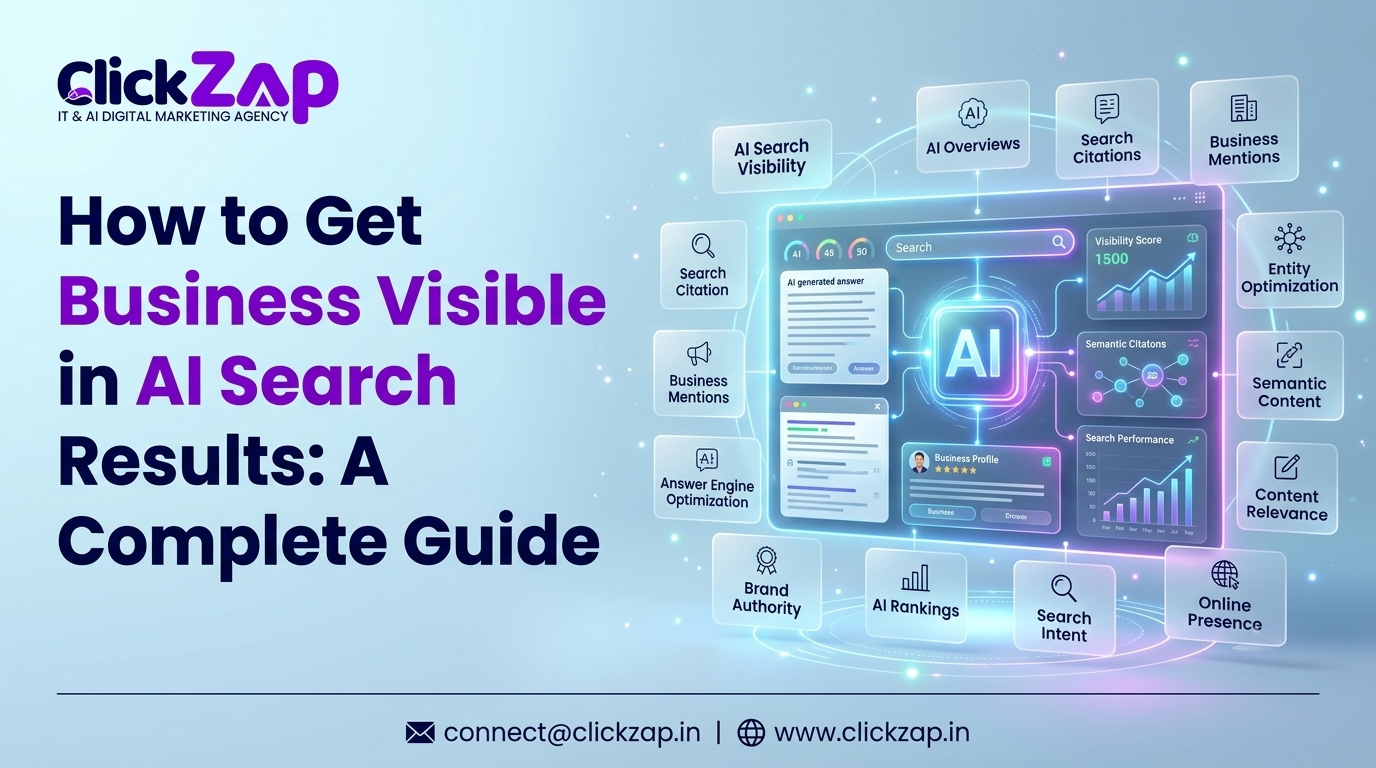
Search behavior is changing faster than most businesses realize. People no longer only type a keyword into Google and scroll through ten blue links; they ask questions directly to AI powered systems and expect a clear, ready made answer. Google’s AI Overviews, Google AI Mode, ChatGPT, Perplexity, Gemini, Claude, and Microsoft Copilot are increasingly the first and sometimes only stop in a customer’s research journey. This is exactly why understanding how to get business visible in AI search results has become essential for brands that want to stay part of that conversation.
This shift matters for every business, not just large enterprises. If an AI system can’t find, understand, or trust your business, it simply won’t mention you no matter how good your product or service is. That’s why understanding how to get business visible in AI search results has become one of the most important digital marketing priorities for 2026 and beyond.
This guide breaks down what AI search visibility actually means, why it matters, and most importantly the practical, realistic steps businesses can take to improve their chances of being mentioned, cited, or recommended by AI search systems. We’ll also cover how AI search optimization fits alongside traditional SEO, rather than replacing it.
What Is AI Search Visibility?
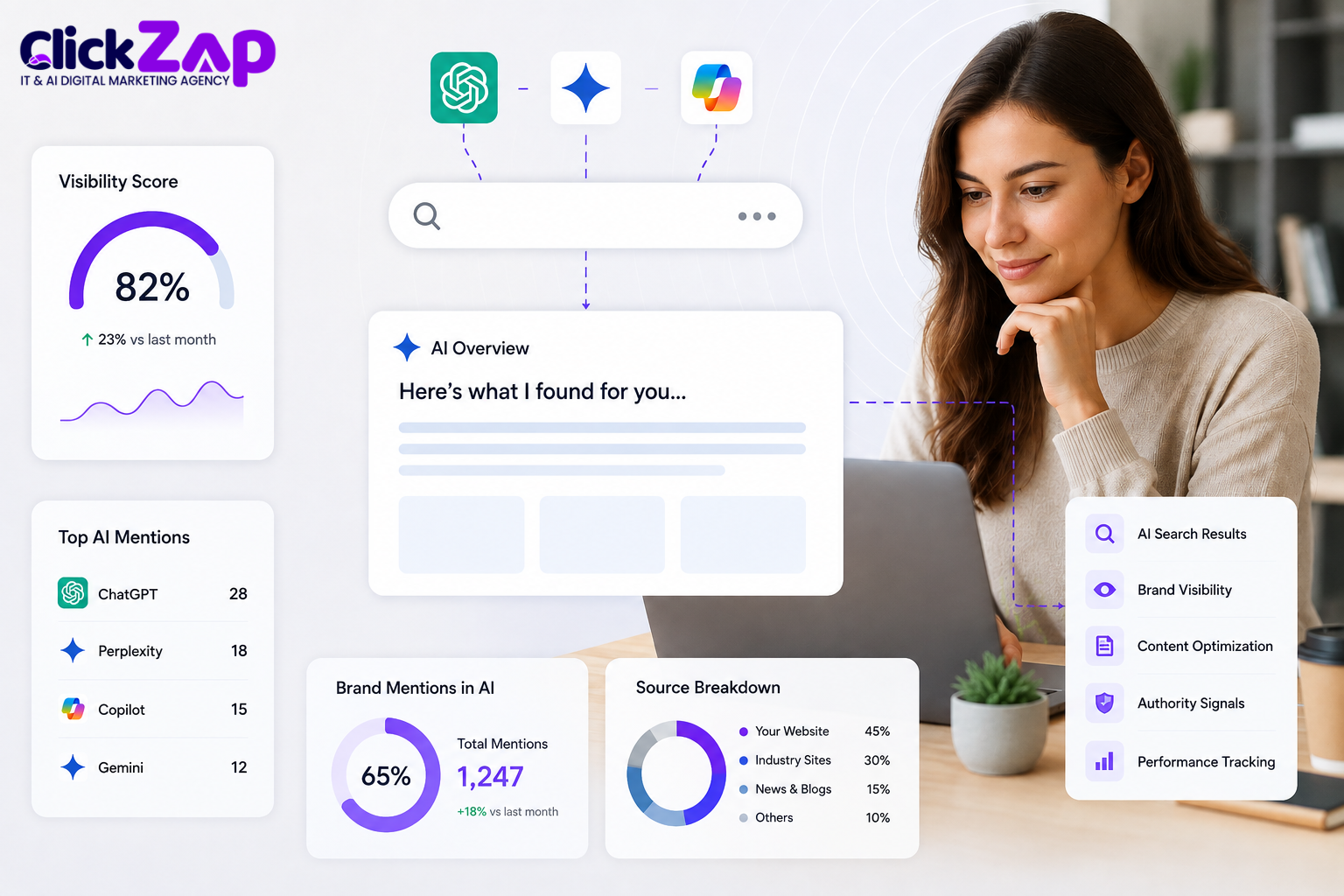
AI search visibility is how easily an AI powered search system can find, understand, and reference your business when answering a user’s question. It covers whether your brand appears in AI generated answers, whether your content gets cited as a source, and whether your business gets recommended when someone asks an AI tool for suggestions in your category.
This is different from traditional search visibility, which is largely about ranking on a results page. Traditional SEO measures success through rankings, click through rates, and organic traffic. AI search visibility is measured differently through AI citations, brand mentions, and whether you appear in AI generated recommendations when a user asks for options.
Here’s a simple example. Imagine a user asks an AI assistant, “What’s the best digital marketing agency in Hyderabad for a small e-commerce business?” The AI system doesn’t run a traditional keyword match; it draws on a combination of web content, structured data, third party mentions, and contextual understanding to generate an answer. A business that has clear, well structured information about its services, industry focus, and expertise reinforced by credible third party references has a better chance of being part of that answer than a business with thin or inconsistent information online.
Why AI Search Visibility Matters for Businesses
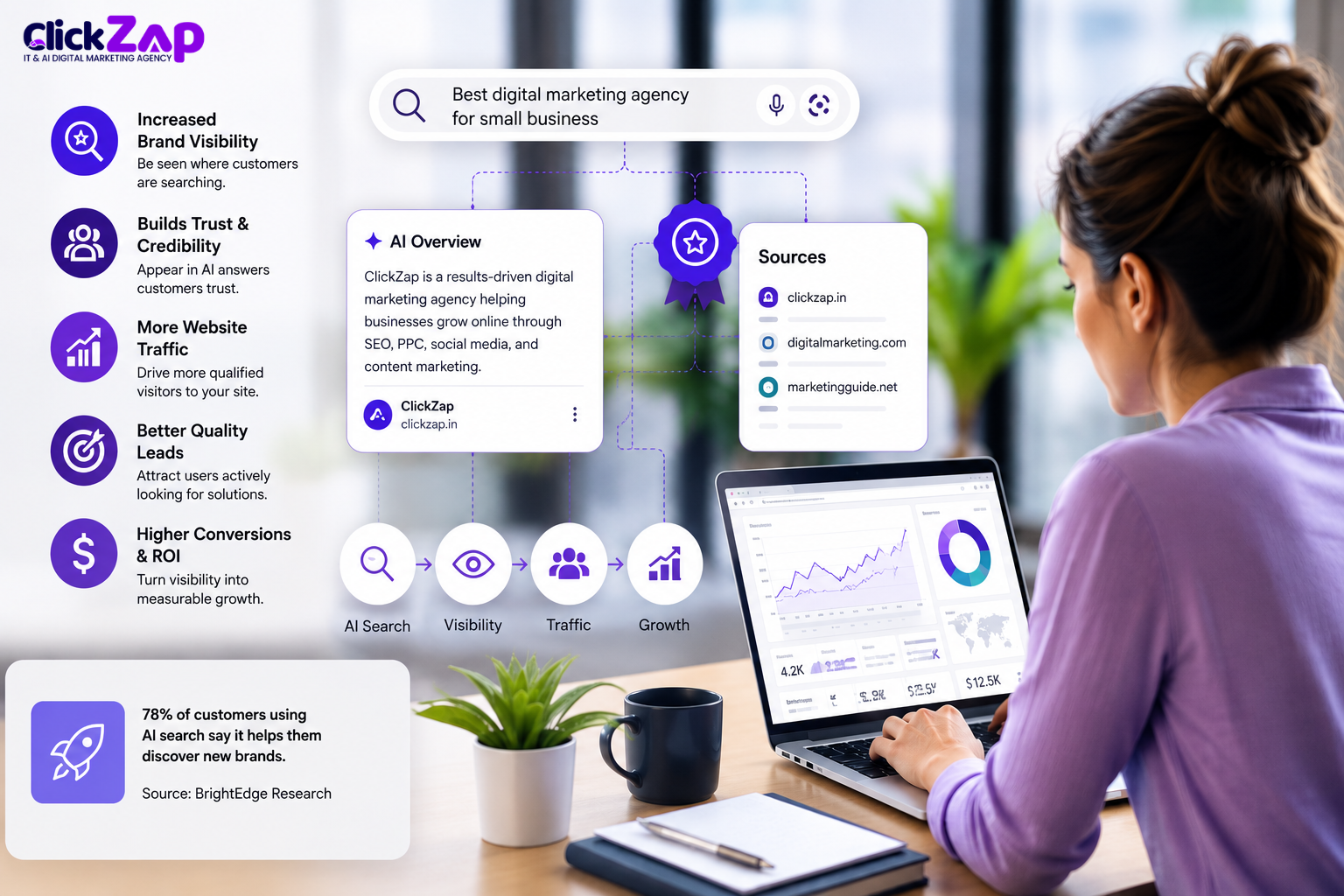
Customer search behavior is shifting toward answering first experiences. Instead of clicking through multiple websites to compare options, many users now get a synthesized answer directly from an AI system sometimes without visiting any website at all. This is often called a “zero click” experience, and it’s becoming more common across both traditional search and standalone AI assistants.Understanding how to get business visible in AI search results early gives businesses a meaningful head start before this behavior becomes the norm across every industry.
For businesses, this shift has several implications:
- Brand discovery increasingly happens through AI generated answers, not just search result pages.
- Trust and authority signals matter more, because AI systems tend to favor sources that appear credible, consistent, and well referenced.
- Referral traffic patterns are changing some AI platforms link to sources, while others simply summarize information without a click through.
- Brand awareness can grow even without direct traffic, since being mentioned by name in an AI answer still puts a business in front of a potential customer.
- Leads and conversions can follow when a business is presented as a credible option or is directly recommended.
- Competitive advantage goes to businesses that adapt early, since AI search visibility is still a developing space with less competition than traditional SEO.
It’s important to be realistic here: no agency or strategy can guarantee that an AI system will mention or recommend a specific business. What businesses can do is build the kind of authoritative, well structured, and well referenced online presence that improves their odds of being included in relevant answers.
How AI Search Engines Find and Understand Businesses
AI powered search systems don’t rely on a single signal. They draw on a mix of sources to build an understanding of what a business does, who it serves, and whether it can be trusted as a reference point. Understanding these sources helps explain why a multi channel approach works better than focusing on just one tactic and why learning how to get business visible in AI search results requires looking at your entire online footprint, not just your website.
Common sources AI systems may draw from include:
- Website content — service pages, blog articles, FAQs, and about pages that clearly explain what a business offers
- Structured data — machine readable code (schema markup) that helps systems understand entities, offerings, and relationships
- Business information — name, location, services, and contact details, especially when consistent across the web
- Third-party websites — directories, review platforms, industry publications, and news coverage
- Reviews — customer feedback that signals reputation and reliability
- Digital PR — earned coverage in credible publications that reinforces authority
- Brand mentions — references to a business across the web, even without a direct link
- Authoritative publications and industry websites — sources that carry topical credibility
- Social and professional profiles — LinkedIn, industry associations, and other verifiable presences
- Entity relationships — how a business connects to people, products, locations, and related topics
- Topical authority — the depth and consistency of a business’s expertise on a given subject
It’s important to understand that different AI systems use different underlying technologies, data sources, and update cycles. Google AI Overviews and Google AI Mode draw heavily on Google’s own search index, while tools like ChatGPT, Perplexity, Gemini, Claude, and Microsoft Copilot may combine web browsing, licensed data partnerships, and their own training data. This means there is no single guaranteed formula for appearing in AI answers and any strategy should focus on strengthening a business’s overall online presence rather than chasing one platform’s specific behavior.
How to Get Business Visible in AI Search Results
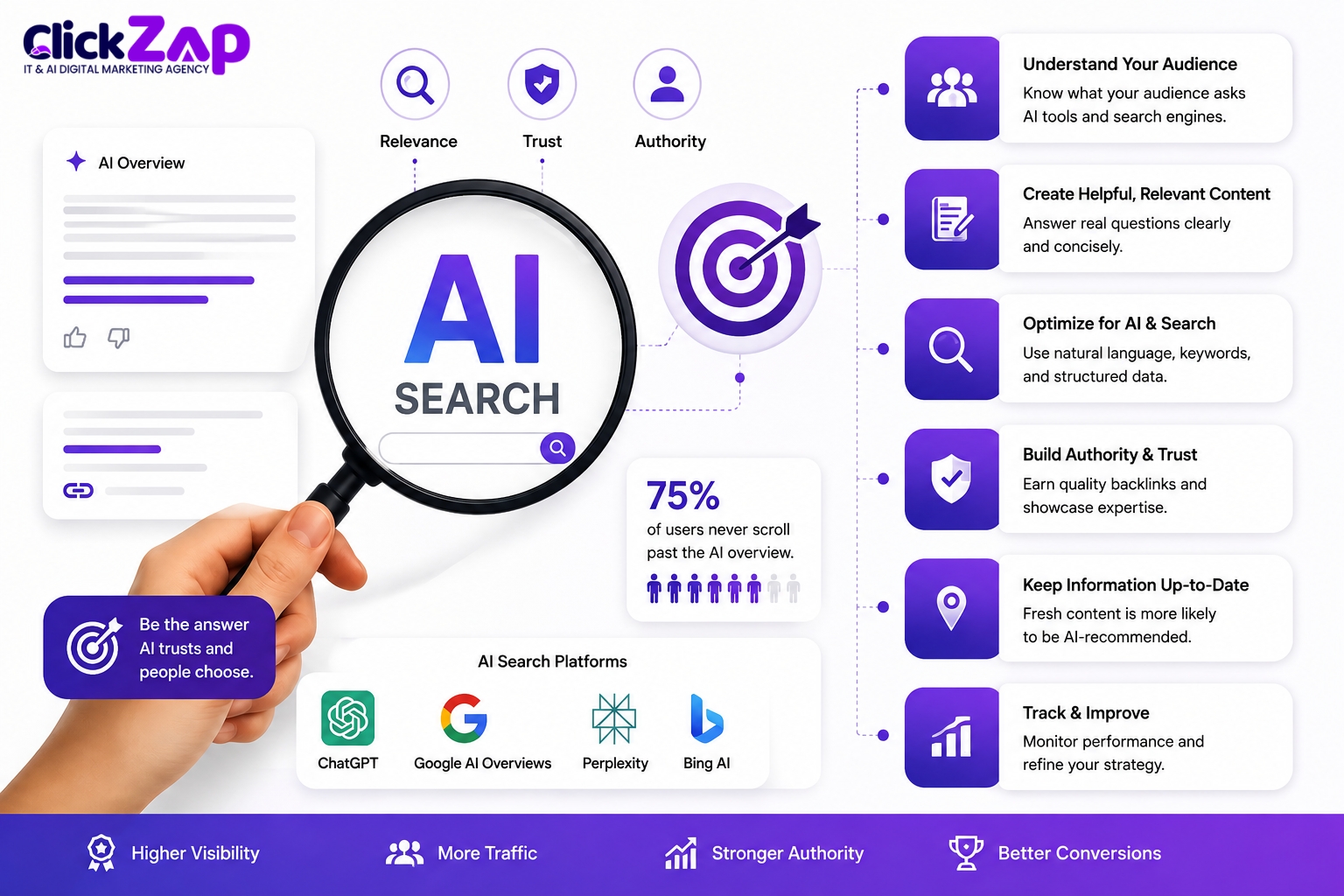
This section covers the practical, actionable strategies businesses can use to improve their AI search visibility. None of these tactics work in isolation; they reinforce each other, and consistency across all of them is what tends to produce results over time.
Build Strong Topical Authority
Topical authority means being recognized as a genuine, comprehensive source of information on a subject, not just a business with a few scattered blog posts. AI systems, like traditional search engines, tend to favor sources that demonstrate depth rather than surface level coverage.
To build topical authority:
- Create topic clusters: a central pillar page covering a core subject, supported by related articles that go deeper into specific subtopics
- Publish pillar pages that comprehensively answer the main questions in your industry
- Add FAQs that address the specific, smaller questions customers actually ask
- Include expert insights from your team, backed by real experience
- Where possible, contribute original research or data specific to your industry or local market
- Write comprehensive guides rather than short, surface level posts
Create Authoritative, Helpful Content
Content created purely to target a keyword rarely performs well with AI systems, because they’re specifically designed to identify content that directly and accurately answers a question. Authoritative content should:
- Give clear, direct answers early in the piece
- Provide accurate, verifiable information
- Include original insights, not just a rehash of what’s already published elsewhere
- Back up claims with evidence and examples
- Feature expert commentary, ideally attributed to a named person with relevant credentials
- Stay updated outdated content is less useful to both readers and AI systems
- Use strong structure, with clear headings, short paragraphs, and logical flow
Optimize for Natural Language Questions
People don’t type into AI systems the way they type into a search bar; they ask full, conversational questions. Structuring content around these natural language questions increases the likelihood that it will be understood and used as a source.
Examples of the question formats to build content around:
- “What is…”
- “How do I…”
- “Which is best…”
- “What should I choose…”
- “What are the benefits of…”
- “What is the difference between…”
- “How much does… cost”
- “Is it worth…”
FAQ style and conversational content works well here because it mirrors how people actually phrase queries to AI assistants, making it easier for these systems to extract a relevant, direct answer.
Strengthen Your Business Entity
Entity optimization means making sure that AI systems and search engines have a clear, consistent, and accurate understanding of who your business is as a distinct “entity,” not just a website. In practical terms, this involves:
- Using a consistent business name everywhere it appears online
- Maintaining clear website information, including a well written about page
- Providing accurate and easy to find contact information
- Clarifying organization details what you do, who you serve, where you operate
- Including author information on content, especially for expertise driven pieces
- Writing a clear, consistent brand description that can be reused across platforms
- Keeping profiles consistent across directories, social platforms, and review sites
- Listing relevant industry associations or certifications where applicable
- Encouraging relevant third party references that reinforce who you are and what you do
Use Structured Data
Structured data is a standardized code format added to a website that helps search engines and AI systems understand content in a machine readable way. Instead of guessing what a page is about, structured data explicitly labels information for example, marking a phone number as a phone number, or a service description as a service.
Relevant schema types for most businesses include:
- Organization — core business information
- LocalBusiness — address, hours, and location details for local businesses
- Product — for e-commerce listings
- Service — for service based businesses
- Article — for blog and content pages
- FAQPage — for FAQ sections
- Person — for author or team member profiles
- BreadcrumbList — for site navigation structure
It’s worth being clear about what structured data can and can’t do: it helps machines understand your content more accurately, but it does not guarantee an AI citation or a higher ranking. It’s a supporting tactic, not a shortcut.
Build High Quality Brand Mentions and Digital PR
Independent, credible references to a business even without a direct backlink can contribute meaningfully to how AI systems and search engines understand its authority and relevance. This is where digital PR plays a growing role in AI search optimization.
Effective approaches include:
- Securing coverage in relevant industry publications
- Participating in expert interviews or being quoted as a source
- Writing guest contributions for credible, relevant sites
- Earning news coverage for genuine business milestones or insights
- Getting listed in reputable industry directories
- Engaging with relevant industry associations
- Building thought leadership through consistent, expert level commentary
The emphasis here should always be on quality and relevance rather than volume. A handful of mentions from credible, topically relevant sources is far more valuable than dozens of low quality, unrelated mentions and mass link building tactics can actively work against a business’s credibility.
Strengthen Your Google Search Presence
Traditional SEO is not being replaced by AI search optimization; it remains foundational. Google AI Overviews and Google AI Mode are built on top of Google’s search infrastructure, which means the same fundamentals that support strong Google Search rankings also support AI search visibility.
Key areas to maintain:
- Technical SEO — clean site structure, fast performance, and proper indexing
- Search intent alignment — making sure content actually matches what searchers want
- Content quality — accurate, useful, well organized information
- Internal linking — helping both users and search systems navigate related content
- Backlinks — earned links from credible, relevant sources
- Page experience — usability, mobile friendliness, and load speed
- Crawlability and indexability — ensuring search engines can actually access and index your pages
- Local SEO — especially important for location based businesses
- Google Business Profile — a well maintained, accurate profile for businesses that serve local customers
AI search optimization should complement traditional SEO, not replace it. Businesses that neglect core SEO fundamentals while chasing AI specific tactics tend to see weaker results overall.
Keep Business Information Consistent
Consistency is one of the simplest but most overlooked factors in AI search visibility. When your business name, website, address, phone number, services, description, and team information vary across different platforms, it becomes harder for AI systems to confidently connect the dots and treat your business as a single, trustworthy entity.
Make sure the following stay consistent everywhere your business appears online:
- Business name
- Website URL
- Address
- Phone number
- Services offered
- Company description
- Founders and team information
- Industry classification
- Contact details
GEO vs SEO vs AEO: What’s the Difference?
These three terms are often used interchangeably, but they describe distinct and complementary approaches.
SEO (Search Engine Optimization) focuses on optimizing content and websites to rank well in traditional search engine results pages, using factors like keywords, backlinks, technical performance, and content quality.
AEO (Answer Engine Optimization) focuses on structuring content to provide direct, clear answers to specific questions, optimized for answer oriented search experiences like featured snippets, voice search, and AI generated direct answers.
GEO (Generative Engine Optimization) focuses on improving the likelihood that a brand, website, or piece of content is represented accurately and prominently within generative AI responses to the answers produced by tools like ChatGPT, Gemini, Claude, Perplexity, and Google AI Mode.
| Approach |
Primary Goal |
Typical Output |
Key Focus Areas |
|
SEO |
Rank in search results |
Ranked listing on a results page |
Keywords, backlinks, technical SEO, content quality |
|
AEO |
Provide direct answers |
Featured snippet, voice answer, direct response |
Clear structure, concise answers, FAQ content |
|
GEO |
Be represented in AI generated responses |
Mention, citation, or recommendation within an AI answer |
Entity clarity, authority, structured data, brand mentions |
These approaches overlap significantly and work best as part of one integrated strategy rather than three separate efforts. Strong SEO fundamentals support AEO, and both support GEO because AI systems ultimately draw on the same signals of authority, clarity, and trustworthiness that traditional search has valued for years.
How to Get Your Business Recommended by AI
Getting recommended by an AI system isn’t something a business can force but it can meaningfully increase its chances through consistent, credible groundwork. The businesses that tend to appear in AI generated recommendations typically share a few characteristics: a strong reputation, relevant topical authority, consistent entity information, high quality content, and third party validation.This is ultimately the practical goal behind how to get business visible in AI search results turning general online authority into real chances of being named when it matters.
Practical factors that can improve your chances include:
- A strong, consistent reputation across review platforms and third party sites
- Relevant authority in your specific industry or niche, rather than trying to be everything to everyone
- Consistent entity information across your website and external platforms
- High quality, genuinely useful content that answers real customer questions
- Third party mentions from credible, relevant sources
- Positive, recent reviews where relevant to your business type
- Industry recognition, such as awards, certifications, or association memberships
- Clear service information that leaves no ambiguity about what you offer
- Strong topical relevance to the specific questions your ideal customers are asking
- Ongoing digital PR efforts that build credible mentions over time
- Solid search visibility in traditional search, which often feeds into AI systems
It’s important to set realistic expectations: no business can guarantee being recommended by ChatGPT, Google AI Mode, Gemini, Perplexity, Claude, or any other AI system. What businesses can do is increase their chances, improve discoverability, make their business easier for AI systems to understand, and strengthen their online authority which, over time, improves the probability of being included in relevant answers.
How to Optimize Your Website for AI Search
Beyond content strategy, your website itself needs to be structured in a way that’s easy for both AI systems and human visitors to understand. Use this practical checklist:
- Clear, logical site architecture
- Descriptive, specific page titles
- Helpful, well organized headings
- Concise answers near the top of relevant pages
- Semantic content that uses natural, topic relevant language
- Strategic internal linking between related pages
- Properly implemented structured data
- Visible author information on content pages
- Clear company information, including an accessible about page
- Dedicated, detailed service pages
- Genuinely useful FAQ content
- Original research or data where possible
- Supporting statistics and evidence for claims
- Regularly updated content
- Strong mobile usability
- Fast loading speeds
- Confirmed crawlability
- Confirmed indexability
- HTTPS security
- Clear, accessible contact information
Common AI Search Optimization Mistakes
Avoiding these common mistakes is often just as important as implementing the right strategies:
- Keyword stuffing — unnaturally repeating phrases instead of writing for readability; focus on natural language and search intent instead.
- Publishing generic AI generated content without expertise — content that lacks a genuine point of view or expert input is easy for both readers and AI systems to identify as low value.
- Creating content solely for AI systems — content should serve real human readers first; anything else tends to feel hollow and underperforms.
- Ignoring traditional SEO — AI search optimization builds on SEO fundamentals, not around them.
- Using low quality backlinks — spammy or irrelevant links can damage credibility rather than build it.
- Creating fake brand mentions — artificial or purchased mentions are a significant credibility risk and can backfire.
- Publishing inaccurate information — accuracy is essential for trust with both readers and AI systems.
- Ignoring entity consistency — mismatched business details across platforms create confusion for AI systems trying to verify who you are.
- Neglecting technical SEO — even great content underperforms on a technically weak website.
- Expecting instant AI citations — building authority takes time; there are no shortcuts.
- Making unsupported claims — claims of guaranteed rankings or guaranteed AI recommendations are misleading and unrealistic.
- Creating hundreds of low value pages — quantity without quality dilutes topical authority rather than strengthening it.
How to Measure AI Search Visibility
Measuring AI search visibility is inherently harder than tracking traditional keyword rankings, since AI generated answers can vary by user, location, device, time, and even the specific AI model or version being used. That said, there are practical indicators businesses can track:
- Brand mentions across the web and within AI generated answers
- AI citations instances where your content is directly referenced as a source
- Referral traffic from AI platforms that do link to sources
- Organic traffic trends from traditional search
- Search impressions in tools like Google Search Console
- Branded searches an increase can signal growing brand awareness
- Third party mentions across directories, publications, and review sites
- Content visibility for key topics and questions in your industry
- Share of visibility for the specific questions most important to your business
- Leads and conversions tied to organic and referral channels
- Broader changes in search behavior among your target audience
One practical approach is to manually test important commercial and informational queries across relevant AI search platforms on a regular basis, while keeping in mind that results can vary significantly based on the user, their location, the time of the query, the specific model version, and the surrounding context. This makes ongoing monitoring more useful than a single one time check.
AI Search Visibility Checklist for Businesses
- Confirm your site is crawlable and indexable
- Improve page speed and mobile usability
- Implement Organization and Local Business structured data
- Add FAQ Page schema to relevant FAQ sections
- Create or update a clear, detailed about page
- Ensure consistent business name, address, and phone number across the web
- Build topic clusters around your core services
- Publish comprehensive, expert backed content
- Add natural language, question based FAQ content
- Include author bios and credentials on content pages
- Pursue relevant digital PR and industry mentions
- Monitor and respond to customer reviews
- Strengthen internal linking between related pages
- Optimize and regularly update your Google Business Profile (if local)
- Keep content fresh and factually accurate
- Track brand mentions and AI citations where possible
- Test key customer questions across major AI search platforms
- Audit competitor visibility in AI generated answers
- Maintain strong technical SEO fundamentals sitewide
- Review and refresh your AI search strategy quarterly, since platforms evolve quickly
Frequently Asked Questions
How do I get my business visible in AI search results?
Focus on building topical authority, publishing authoritative content, using structured data, maintaining consistent business information, and earning credible third party mentions. There’s no single tactic visibility comes from the combined strength of your content, entity clarity, and online authority.
How do I appear in AI search results?
Appearing in AI search results starts with making your business easy for AI systems to understand through clear website content, structured data, and consistent information combined with strong topical relevance to the questions your customers actually ask.
How do I improve AI search visibility?
Improve AI search visibility by strengthening topical authority, keeping business information consistent across platforms, earning quality brand mentions, using structured data correctly, and maintaining solid traditional SEO fundamentals.
Can SEO help my business appear in AI search?
Yes. Traditional SEO remains foundational, since many AI systems including Google AI Overviews and Google AI Mode draw on the same web content, indexing, and authority signals used in traditional search.
What is Generative Engine Optimization?
Generative Engine Optimization (GEO) is the practice of improving the likelihood that a brand, website, or piece of content is represented accurately and prominently in AI generated responses from tools like ChatGPT, Gemini, Claude, and Perplexity.
How ClickZap IT Can Help With AI Search Optimization
Navigating the shift toward AI powered search doesn’t have to be something businesses figure out alone. At ClickZap IT, we help businesses build the kind of integrated online presence that supports visibility across both traditional and AI powered search combining SEO, GEO, AEO, content strategy, technical SEO, entity optimization, local SEO, digital PR, content marketing, website optimization, and overall brand visibility into one coordinated strategy.
Rather than treating AI search optimization as a separate, isolated tactic, we focus on strengthening the fundamentals that matter across every search environment: clear, authoritative content; a technically sound and well structured website; consistent business information; and credible third party recognition. This integrated approach helps businesses stay visible as search behavior continues to evolve whether a customer is searching on Google, asking an AI assistant, or somewhere in between.
If you’re ready to prepare your business for the changing search landscape, explore ClickZap IT digital marketing services or get in touch with our team to talk through where your business currently stands and what a tailored strategy could look like.
Conclusion
AI search visibility is quickly becoming a core part of how businesses get discovered, evaluated, and recommended online. But it’s not a separate discipline that replaces everything that came before it; it builds directly on the same foundations that have always mattered in digital marketing: helpful content, technical soundness, and genuine authority.
Learning how to get business visible in AI search results means combining several elements into one coherent strategy: Technical SEO, Helpful Content, Topical Authority, Entity Optimization, Structured Data, Digital PR, Brand Authority, AEO, and GEO. No single tactic works in isolation, and no strategy can promise guaranteed results, since AI search systems are still evolving rapidly and behave differently across platforms.
The actionable takeaway for businesses is straightforward: start by strengthening your website’s fundamentals, build genuinely authoritative content around the questions your customers are already asking, keep your business information consistent everywhere it appears, and earn credible mentions over time. Businesses that build this foundation now will be far better positioned as AI powered search continues to shape how customers find and choose the businesses they trust.
Read More: How AI Can Predict Customer Buying Behavior: A Complete Guide for Businesses
0 Comments