
How to Use AI for Facebook and Instagram Ad Targeting
There was a time when running a Facebook or Instagram ad campaign meant manually stacking interests, guessing at age ranges, and hoping the audience you built in Ads Manager actually matched the people who’d buy from you. That approach still exists, but it’s no longer the whole story.
AI for Facebook and Instagram ad targeting has changed how businesses find, reach, and convert potential customers on Meta’s platforms. Instead of relying purely on manual assumptions, advertisers now lean on machine learning, behavioral signals, and automated optimization to help identify people who are more likely to take a meaningful action whether that’s filling out a form, making a purchase, or booking a call.
This guide breaks down what AI powered ad targeting actually is, how it works across Facebook and Instagram, how Meta’s automation tools fit into the picture, and how businesses can use these capabilities without losing control of their strategy. Along the way, we’ll cover practical setup steps, common mistakes, and how to know when it’s time to bring in outside help.
What Is AI for Facebook and Instagram Ad Targeting?
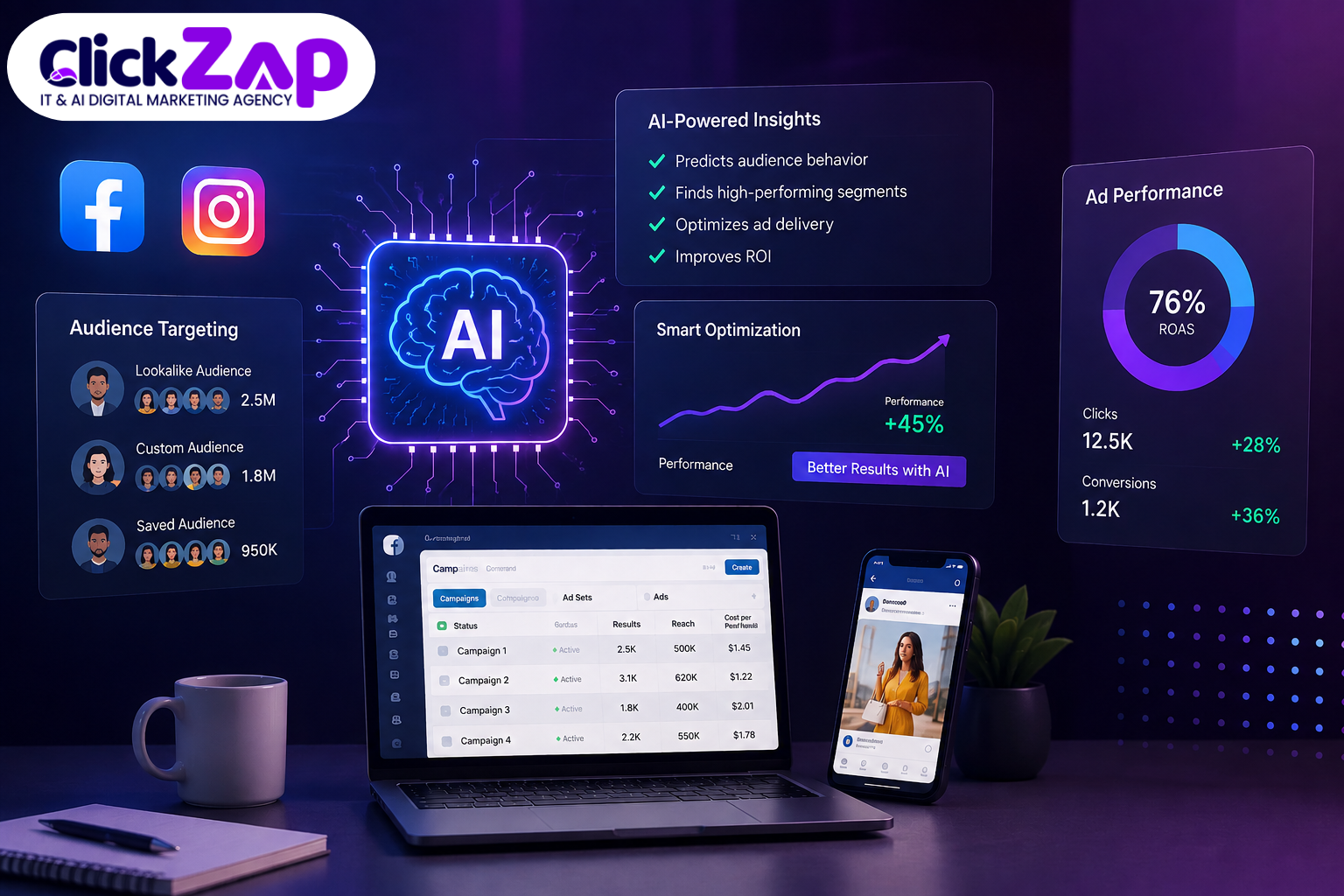
AI powered ad targeting refers to the use of machine learning systems to help identify, reach, and optimize toward audiences who are more likely to respond to an ad. Instead of an advertiser manually selecting every targeting parameter, the platform’s algorithms analyze signals like past engagement, website behavior, and conversion data to inform who sees an ad and how the budget is allocated.
A few core concepts show up throughout this process:
- Machine learning — systems that improve their predictions over time based on new data
- Automated audience targeting — letting the platform identify relevant users rather than manually building every audience segment
- Predictive audience targeting — using patterns from past behavior to estimate who is likely to convert
- Audience optimization — continuously refining who an ad is shown to based on performance
- Campaign optimization — adjusting delivery, bidding, and creative rotation to improve results over time
The key difference between traditional and AI powered targeting comes down to how much of the decision making is manual versus data assisted.
|
Traditional Ad Targeting |
AI Powered Ad Targeting |
| Manual audience selection |
AI assisted audience discovery |
| Fixed targeting assumptions |
Dynamic audience optimization |
|
Manual optimization |
Automated optimization |
|
Limited signals |
Multiple behavioral and conversion signals |
|
Slower testing |
Faster optimization |
It’s worth being clear here: AI powered targeting doesn’t automatically outperform manual targeting in every scenario. Results still depend heavily on data quality, campaign structure, creative quality, the strength of the offer, tracking accuracy, and budget. AI can improve how efficiently a campaign learns and adapts but it can’t fix a weak offer or bad tracking on its own.
How Does AI Target Audiences on Facebook and Instagram?
AI powered targeting on Meta’s platforms generally follows a repeating cycle: collect signals, identify patterns, predict likely outcomes, deliver ads, and optimize based on results.
- Data and audience signals. The process starts with signals like ad interactions, page engagement, video views, website activity, app events, and conversion data. These signals give the system context about who is engaging and how.
- User behavior and engagement. Actions like clicking, commenting, saving a post, or spending time on a Reel all provide behavioral clues about interest and intent.
- Website activity and conversion data. When tracking is set up correctly, actions taken on a business’s website such as adding to cart or submitting a lead form feed back into the system as conversion signals.
- Customer data. Businesses can upload existing customer information to build audiences based on real purchasing or engagement history.
- Machine learning and audience prediction. The system analyzes these combined signals to estimate which users are statistically more likely to take the desired action.
- Ad delivery. Based on those predictions, ads are shown to a mix of users the system believes are relevant, testing and adjusting delivery as data comes in.
- Continuous optimization. As more data accumulates clicks, conversions, engagement the system refines its predictions and adjusts targeting and delivery accordingly.
This is where terms like automated audience targeting, machine learning advertising, and data driven audience targeting come into play; they all describe pieces of this same feedback loop.
How Meta Uses AI for Advertising
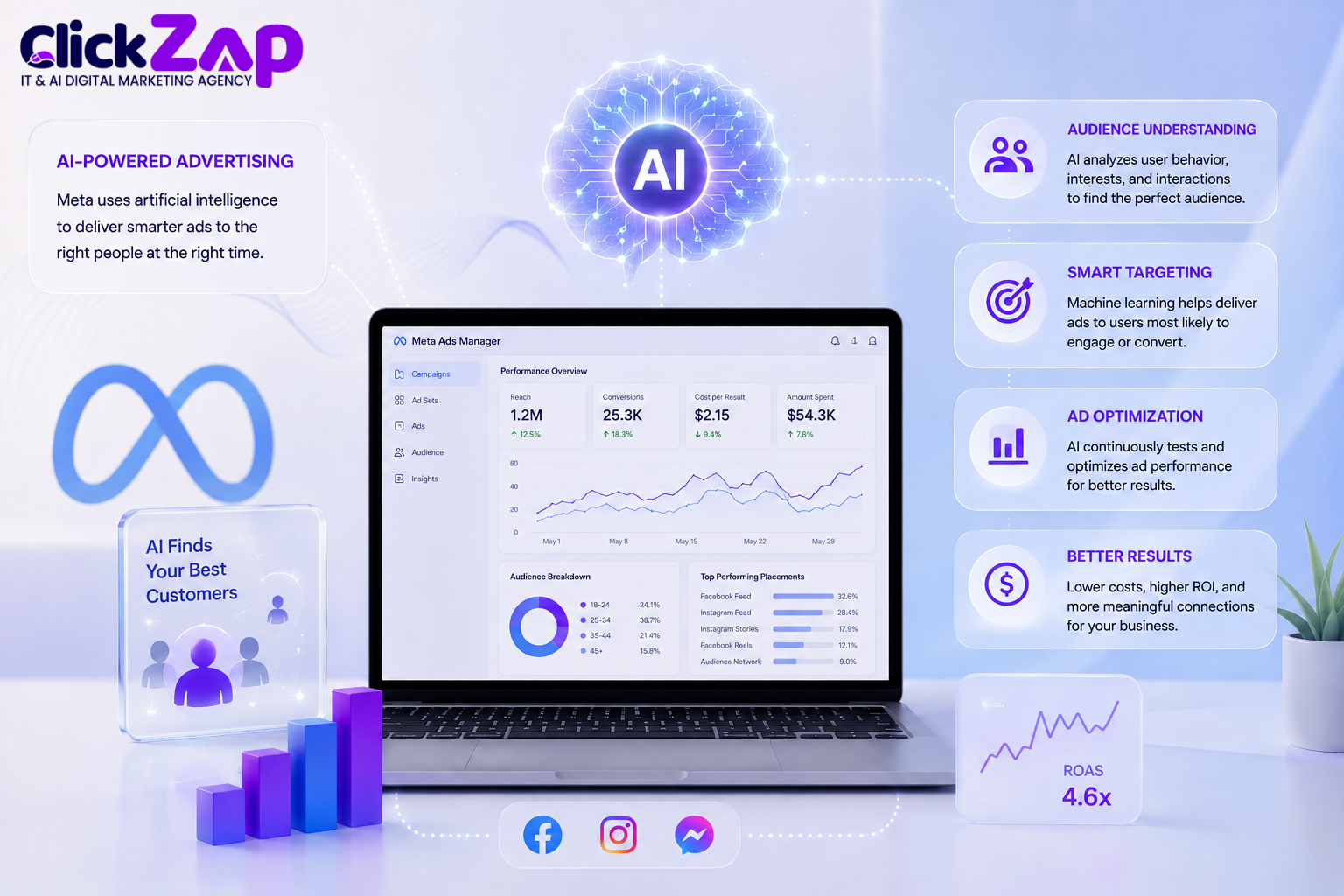
Meta’s advertising ecosystem spanning Facebook, Instagram, Meta Ads Manager, and Meta Business Suite is built around machine learning at nearly every stage, from audience suggestions to ad delivery and bidding.
In practice, advertisers still provide the core inputs: the campaign objective, creative assets, budget, audience signals (like Custom Audiences or pixel data), and conversion events. Meta’s systems then use that information, along with in platform behavioral data, to help determine which users within the eligible audience are more likely to respond to a given ad.
Tools like Meta Advantage+ Audience are part of this shift toward more automated, AI assisted targeting, where advertisers provide guidance and signals rather than manually building every audience from scratch.
It’s important to be accurate here: Meta doesn’t publicly disclose the full mechanics of its internal algorithms, and results can vary based on account history, tracking setup, industry, and competition. What’s publicly documented is that Meta’s systems are designed to use available signals to optimize ad delivery toward an advertiser’s stated objective, not that any specific outcome is guaranteed.
AI Facebook Ad Targeting: How It Works
For Facebook specifically, AI assisted targeting draws on a combination of engagement signals, website behavior, and audience tools that advertisers set up themselves.
Key inputs include:
- Engagement with a Facebook Page or past ads
- Website behavior tracked through the Meta Pixel
- Customer lists uploaded as Custom Audiences
- Conversion activity, such as purchases or form submissions
- Lookalike Audiences built from top performing customer segments
- AI assisted audience expansion, where the system finds relevant users beyond a narrow manual audience
Practical example: A local plumbing company wants more qualified leads through Facebook lead forms. Instead of manually guessing which interests and demographics to target, the business sets up conversion tracking for form submissions, uploads a list of past customers as a Custom Audience, and lets Meta’s systems identify users who share behavioral similarities with people who’ve already converted. Over time, as more leads come in, the algorithm has more data to refine who it shows the ad to, helping the campaign move from broad guesses toward a more informed, evolving audience.
AI Instagram Ad Targeting: How It Works
Instagram targeting draws on a similar signal set, but with some platform specific behaviors layered in Reels interactions, Feed engagement, Story views, and profile activity all contribute to how the system understands user interest.
Relevant signals include:
- Reels and Feed interactions (likes, shares, saves, watch time)
- Profile visits and follows
- Website behavior connected through the pixel or Conversions API
- Conversion signals like purchases or sign ups
- Creative performance across formats (video vs. static image vs. carousel)
Practical example: An ecommerce apparel brand runs several creative variations short form video, carousel product shots, and influencer style Reels. As the campaign runs, AI assisted optimization identifies which creative formats and audiences are producing more purchases, then shifts delivery to favor the combinations performing best. The brand doesn’t have to manually A/B test every permutation the system helps surface patterns based on real engagement and conversion data.
AI Targeting for Meta Ads: Key Features Businesses Should Know
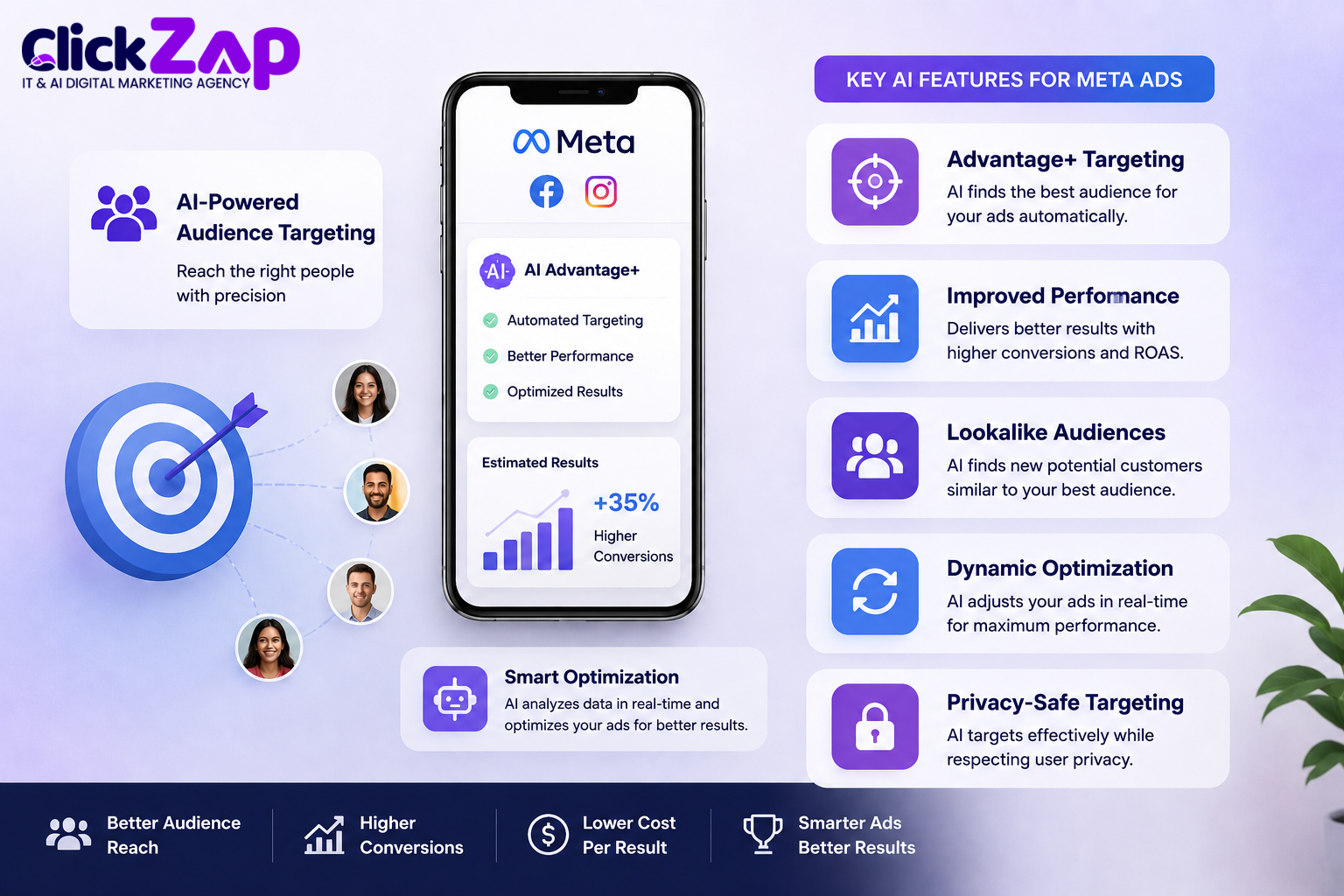
Meta Advantage+ Audience
Advantage+ Audience is Meta’s more automated approach to audience targeting, where the system uses audience signals including any input targeting details an advertiser provides, like age range or location combined with broader behavioral data to find relevant users. Rather than manually restricting an audience to a narrow interest list, advertisers can let the system search more broadly for people likely to convert, based on conversion signals from the account.
Meta Custom Audiences
Custom Audiences let businesses build targeting groups from data they already have: customer lists, website visitors, app users, or people who’ve engaged with a Facebook or Instagram profile. These serve as a foundation for retargeting and for building Lookalike Audiences.
Meta Lookalike Audiences
Lookalike Audiences use a source audience such as past purchasers to help identify new users who share similar characteristics or behaviors. This is one of the more direct ways businesses put machine learning to work: instead of manually researching a new audience, they let the platform extrapolate from existing customer data.
Meta Pixel
The Meta Pixel is a piece of code placed on a website that tracks actions like page views, add to carts, and purchases. This data becomes a conversion signal that helps inform delivery and optimization; it does not give an advertiser access to individual users’ private browsing history elsewhere on the web.
Conversions API
Conversions API sends conversion data directly from a business’s server to Meta, complementing browser based Pixel tracking. This matters because browser restrictions, ad blockers, and cookie limitations can cause some Pixel events to be missed. Server side tracking through Conversions API helps fill in those gaps so optimization is based on more complete conversion data; it’s a tracking reliability tool, not a way to access unlimited customer information.
What Data Does AI Use for Facebook and Instagram Ad Targeting?
AI powered targeting draws on several categories of signals available to the advertising platform:
- Ad interactions — clicks, views, likes, comments, shares
- Content engagement — Reels views, Story interactions, saves
- Website activity — page views, add to carts, form starts
- Conversion events — purchases, leads, sign ups, app installs
- Customer provided data — uploaded customer lists for Custom Audiences
- App activity — in app events for businesses with mobile apps
- Audience characteristics — broad demographic and interest data available on the platform
- Campaign performance signals — historical results from prior ads
- Contextual and behavioral signals — general activity patterns available to the ad system
It’s important to note that privacy regulations, platform policies, device level settings, and consent requirements all affect what data can actually be collected and used. Advertisers don’t have access to unrestricted personal data; they work within the signals the platform makes available under its own privacy and compliance framework.
How to Use AI for Facebook and Instagram Ad Targeting: Step by Step Process
Step 1: Define the campaign objective. Start with a clear business outcome: leads, sales, website conversions, app installs, engagement, or traffic. The objective shapes how the algorithm optimizes delivery.
Step 2: Identify the ideal customer. Even with AI assisted targeting, understanding who the ideal customer is, their pain points, buying triggers, and typical behavior helps inform creative, offers, and initial audience signals.
Step 3: Set up accurate tracking. Install the Meta Pixel and configure Conversions API so conversion events are captured reliably. Poor tracking undermines everything downstream.
Step 4: Build useful first party audiences. Upload customer lists, connect website visitor data, and identify engaged users to create a foundation for Custom and Lookalike Audiences.
Step 5: Use AI assisted audience targeting. Test Advantage+ Audience or broader automated targeting options alongside more defined audiences to see what performs best for the account.
Step 6: Provide strong creative inputs. AI driven targeting cannot compensate for weak creative. Strong images, videos, Reels, compelling hooks, clear offers, and direct CTAs all still matter arguably more than ever, since creative quality influences who engages and what the algorithm learns from.
Step 7: Allow the algorithm to learn. Campaigns generally need a sufficient volume of conversion data before optimization stabilizes. Constantly editing budgets, audiences, or creativity can reset this learning process and hurt performance.
Step 8: Monitor performance. Track metrics tied to business outcomes, not just surface level engagement.
Step 9: Test and optimize. Continue testing creative variations, audience segments, landing pages, and offers AI powered delivery works best when it has strong options to optimize between.
AI Audience Optimization vs Manual Audience Targeting
Neither approach is universally “better” ; they solve different problems.
|
Factor |
Manual Targeting |
AI Powered Targeting |
| Audience research |
Human led |
Data assisted |
|
Optimization |
Manual |
Automated/AI assisted |
|
Scaling |
Requires more management |
Can scale more efficiently |
|
Testing |
Manual |
Algorithm assisted |
|
Control |
Higher |
Can be broader |
| Data requirements |
Moderate |
Often benefits from stronger conversion data |
Manual targeting can still make sense for niche B2B audiences, smaller budgets where data volume is limited, or highly specific campaigns where an advertiser has strong reason to restrict delivery. AI powered targeting tends to perform well when there’s solid conversion data feeding the system and the business wants to scale delivery efficiently without manually managing dozens of audience segments.
Benefits of Using AI for Facebook and Instagram Ad Targeting
- Better audience discovery — surfacing relevant users a manual list might miss
- Automated optimization — continuous adjustments without constant manual intervention
- Faster testing cycles — the system can evaluate combinations more quickly than manual A/B testing
- More efficient ad delivery — budget shifts toward what’s performing
- Data driven targeting — decisions grounded in actual behavior and conversion signals
- Personalized advertising — creative and delivery can be matched more closely to user interest
- Easier campaign scaling — less manual audience building required as budgets grow
- Reduced manual workload — frees up time for strategy, creative, and offer development
- Better use of conversion signals — turns tracking data into actionable optimization
- Continuous optimization — campaigns keep adjusting as new data comes in
None of this guarantees a specific return on ad spend or a set number of conversions; performance still depends on the full marketing picture, not targeting alone.
Need help figuring out where your current campaigns stand? Talking through your setup with a specialist can clarify whether targeting, tracking, or creative is holding performance back.
Common Mistakes to Avoid When Using AI for Meta Ads
- Giving AI poor quality data. If conversion tracking is inaccurate, the system optimizes toward the wrong signal.
- Incorrect tracking setup. A misconfigured Pixel or missing Conversions API events limits what the algorithm can learn.
- Weak creativity. No amount of targeting sophistication fixes an ad that doesn’t capture attention or communicate value.
- Changing campaigns too frequently. Frequent edits can reset the learning phase and slow optimization.
- Over restricting audiences. Layering too many manual exclusions on top of AI assisted targeting can limit the system’s ability to find relevant users.
- Ignoring landing page experience. Driving traffic to a slow or confusing page wastes the value of well targeted clicks.
- Optimizing for cheap leads instead of qualified ones. A low cost per lead means little if lead quality is poor.
- Failing to monitor conversion quality. Tracking volume without reviewing actual lead or sales quality can hide underlying problems.
- Relying completely on automation. Human oversight is still needed for strategy, budget decisions, and creative direction.
- Not testing creative variations. AI assisted delivery performs better with multiple creative options to evaluate.
- Ignoring privacy and platform policies. Non compliant tracking or targeting can limit account performance or lead to disapprovals.
Best AI Tools for Meta Ads
Rather than ranking specific products, it’s more useful to understand the categories of tools that typically support AI powered Meta advertising:
- Meta’s native AI and automation features — Advantage+ Audience, automated bidding, and campaign optimization tools built into Ads Manager
- AI creative tools — platforms that assist with generating or testing ad variations
- Copywriting tools — AI assisted tools for drafting ad copy and headlines
- Analytics tools — platforms that help interpret campaign performance data
- Conversion tracking tools — server side tracking and tag management solutions
- Marketing automation platforms — tools that connect ad data with CRM and email systems
- Reporting tools — dashboards that consolidate performance across channels
- Customer data platforms — tools that organize first party data for use in Custom Audiences
The right combination depends on business goals, campaign size, budget, technical resources, and the existing marketing stack. There’s no single tool that works best for every business, and claims of guaranteed performance improvements from any specific tool should be treated with skepticism.
How to Measure AI Powered Facebook and Instagram Ad Performance
Meaningful measurement goes beyond surface level engagement metrics. Useful indicators include:
- CTR (click through rate) — how often people click after seeing an ad
- CPC (cost per click)
- CPM (cost per thousand impressions)
- Conversion rate
- Cost per lead
- Cost per acquisition
- ROAS (return on ad spend)
- Revenue
- Lead quality — not just volume, but how many leads are sales ready
- Customer acquisition cost
- Frequency — how often the same user sees an ad
- Engagement rate
Clicks and impressions can look encouraging while the business side of the campaign underdelivers. Businesses get a clearer picture by connecting ad performance data back to actual leads, sales, and revenue, not just platform reported engagement.
AI Powered Ad Targeting for Different Types of Businesses
Ecommerce. AI assisted targeting can help identify users likely to complete a purchase, using signals like add to cart behavior, past purchases, and product page engagement to inform Lookalike Audiences and dynamic ad delivery.
Local Businesses. Local service providers can combine location-based targeting with conversion data from calls, form fills, or bookings to help the system identify nearby users likely to take action.
B2B Companies. With typically longer sales cycles, B2B advertisers can use content engagement, website visits, and lead form conversions as signals, feeding the algorithm the type of activity that correlates with a qualified prospect.
Service Businesses. Businesses that rely on consultations or calls can use conversion tracking tied to booking or contact actions, helping the system prioritize users likely to complete those specific steps.
Startups. Smaller teams often benefit from automation simply because it reduces the manual workload of building and managing dozens of audience segments letting a lean team focus on creative, offers, and strategy while the platform handles more of the delivery optimization.
AI for Facebook and Instagram Ad Targeting: Is It Worth It?
For most businesses running Meta Ads today, some level of AI-assisted targeting is worth using; it’s increasingly built into how the platform functions by default. But it isn’t a substitute for the fundamentals that have always driven advertising performance:
- A clear strategy and defined objective
- Real market and customer research
- A compelling, relevant offer
- High quality creative
- Accurate tracking
- Landing pages that convert
- Human judgment in reviewing performance and making decisions
- Ongoing conversion rate optimization
The strongest results typically come from combining AI powered platform optimization with these fundamentals not from treating automation as a replacement for strategy.
When Should You Hire a Digital Marketing Agency for Meta Ads?
AI powered targeting can meaningfully improve how efficiently a campaign learns and optimizes, but it still requires setup, monitoring, and strategic decisions that automation alone doesn’t handle. It may be worth bringing in outside expertise when:
- Ad spend keeps increasing without a corresponding improvement in results
- Leads are coming in, but quality is inconsistent or low
- Campaigns feel difficult to manage or interpret
- Tracking seems unreliable or inconsistent with actual sales
- Meta Ads reporting is confusing or hard to act on
- Creative testing isn’t happening consistently
- The business wants to scale spend but isn’t confident in the current setup
- There isn’t an internal team with dedicated paid advertising expertise
This is where a digital marketing agency can add value not by promising guaranteed outcomes, but by bringing structured processes around strategy, campaign setup, audience targeting, creative testing, tracking accuracy, and ongoing performance analysis. ClickZap IT works with businesses on exactly this kind of Meta Ads management helping teams set up tracking correctly, structure campaigns around real business objectives, and interpret performance data so decisions are based on what’s actually happening, not just surface level metrics.
Want to build a more data driven paid advertising strategy? Talking through your current setup with a specialist is often the fastest way to identify what’s working and what’s holding your campaigns back.
Frequently Asked Questions
What is AI for Facebook and Instagram ad targeting?
AI for Facebook and Instagram ad targeting refers to using machine learning to help identify and reach users likely to respond to an ad. Instead of manually selecting every audience parameter, advertisers provide signals like conversion data and creativity while the platform’s systems help optimize delivery toward people more likely to convert.
How does AI improve Facebook ad targeting?
AI improves Facebook ad targeting by analyzing engagement, website, and conversion signals to identify patterns among users likely to take a desired action. This allows for more dynamic audience discovery and faster optimization compared to relying solely on manually selected demographics and interests.
How does AI improve Instagram ad targeting?
On Instagram, AI assisted targeting draws on signals like Reels and Feed engagement, profile activity, and conversion data to help identify relevant audiences. It also helps determine which creative formats and messages perform best, shifting delivery toward combinations that drive results.
Is AI targeting better than manual targeting?
Not universally. AI powered targeting can improve efficiency and scale, especially with strong conversion data, but manual targeting still has a place for niche audiences or smaller budgets. Performance depends on data quality, tracking, creativity, and strength not targeting methods alone.
What is Meta Advantage+ Audience?
Meta Advantage+ Audience is an automated targeting option that uses audience signals and available behavioral data to help identify relevant users, rather than relying solely on manually defined interest or demographic targeting. Advertisers can still provide input details to guide the system.
Final Thoughts
AI for Facebook and Instagram ad targeting has shifted how businesses approach paid social advertising: audience discovery, ad delivery, testing, and optimization are increasingly automated and data driven rather than fully manual. Tools like Meta Advantage+ Audience, Custom Audiences, Lookalike Audiences, the Meta Pixel, and Conversions API all play a role in feeding the system the signals it needs to work effectively.
But AI powered targeting works best as part of a broader strategy not as a replacement for one. Strong tracking, quality creative, a clear offer, effective landing pages, ongoing testing, and human oversight all still matter, arguably more than ever, since they directly influence what the algorithm has to learn from.
If your business is exploring how to use AI for Facebook and Instagram advertising more effectively or you’re not sure whether your current campaigns are set up to take advantage of it, the ClickZap IT team can help you review your strategy, tracking, and targeting approach to find where the real opportunities are.
Also Read : How to Get Business Visible in AI Search Results: A Complete Guide
0 Comments