
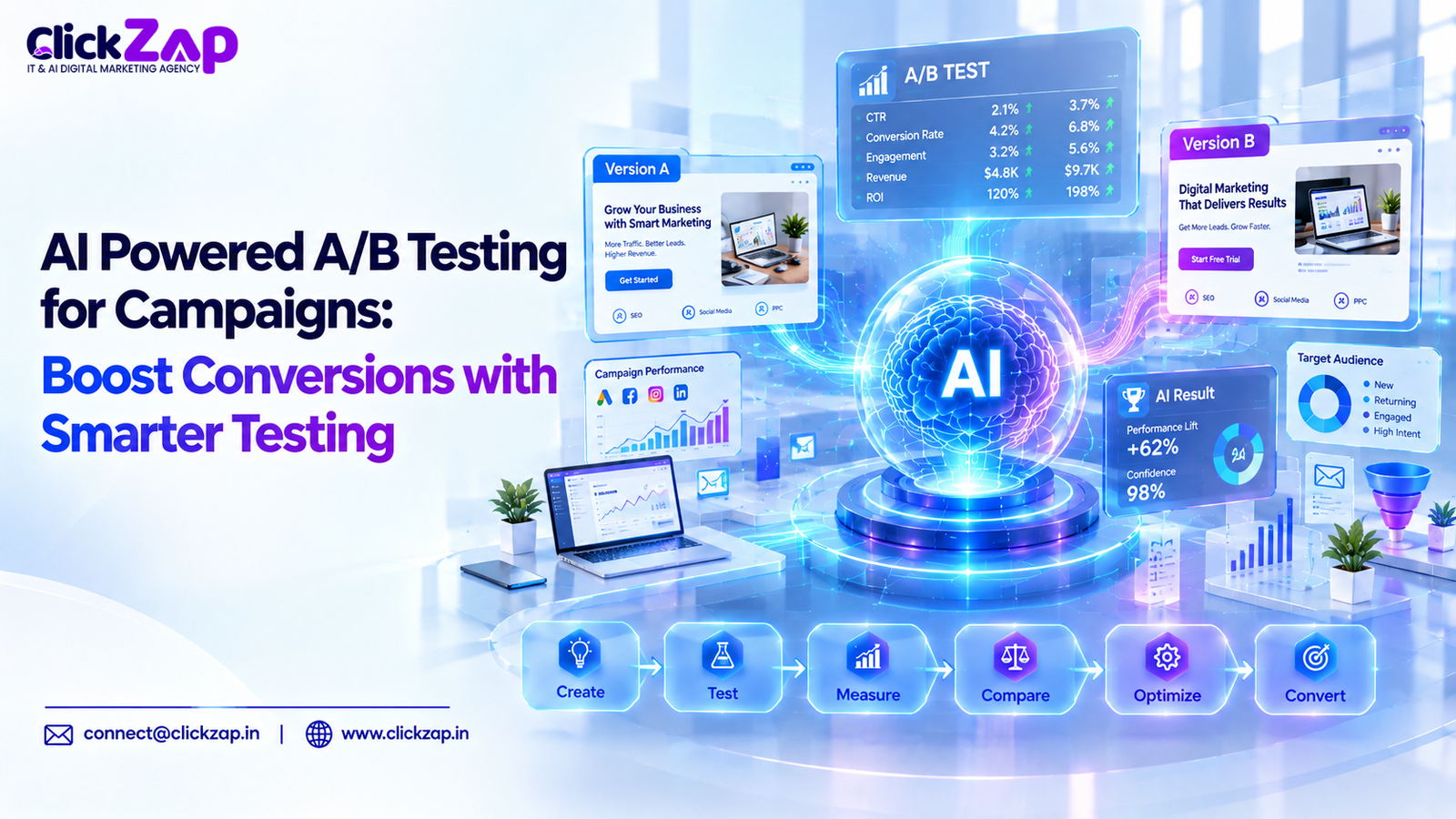
Most businesses guess. They pick a headline because it “sounds right,” choose an image because someone on the team likes it, and launch a campaign hoping for the best. The problem is simple: assumptions don’t scale, and they don’t improve over time. That’s exactly the gap AI powered A/B testing for campaigns is built to close, replacing guesswork with a repeatable way to test what actually works.
A/B testing has been the standard way to remove guesswork from marketing for years. You show one audience version A, another audience version B, and let the data decide which one performs better. It works but doing it manually is slow, and most businesses only get around to testing a fraction of what they could.
This is where AI powered A/B testing for campaigns changes the equation. Instead of manually building every variation, waiting weeks for enough data, and analyzing results by hand, AI helps marketers create variations faster, spot patterns sooner, and shift traffic toward what’s working without replacing the judgment that good marketing still needs. In this guide, we’ll break down what A/B testing is, how AI changes the process, what you can test, and how to build a testing strategy that actually improves campaign performance over time.
What Is A/B Testing?
A/B testing is a method of comparing two versions of a marketing asset like an ad, email, or landing page to see which one gets a better response from real users.
How Split Testing Works
Split testing (another name for A/B testing) works by dividing your audience into groups and showing each group a different version of the same asset. One version is called the control; this is your original, existing version. The other is the variant, a modified version with one changed element, such as a different headline or CTA button.
Control vs. Variant
The control acts as your baseline. The variant is your experiment. By changing only one element at a time, you can be confident that any difference in performance is actually caused by that change, not by something else.
How Traffic Is Divided
Typically, traffic is split evenly for example, 50% of visitors see the control and 50% see the variant. Some tools allow uneven splits, such as 80/20, especially when a business wants to limit exposure to an untested variation.
How Conversion Rates Are Compared
Once both versions have run for a period of time, marketers compare the conversion rate to the percentage of visitors who completed a desired action, like filling out a form or making a purchase between the control and the variant.
Why Statistical Significance Matters
A variant might appear to perform better simply by chance, especially with small amounts of traffic. Statistical significance is a way of checking whether the difference in results is reliable enough to act on, rather than a random fluctuation. Without it, businesses risk making decisions based on noise instead of real performance differences.
Simple example: A business runs two versions of a Google Ads landing page. The control has the headline “Get a Free Marketing Consultation.” The variant says “Book Your Free Strategy Call Today.” After running both for two weeks with enough traffic, the business compares conversion rates to see which headline led to more form submissions.
What Is AI Powered A/B Testing?

AI powered A/B testing is the use of artificial intelligence to help plan, create, run, and analyze A/B tests for marketing campaigns making the process faster and reducing manual effort at every stage.
Rather than replacing the tester, AI acts as a support system throughout the experiment. It can help marketers:
- Analyze campaign data to spot early trends
- Identify patterns in user behavior across variations
- Generate multiple test variations of headlines, copy, or creative
- Compare campaign performance across several variants at once
- Detect high performing variations sooner
- Adjust traffic allocation dynamically as results come in
- Automate repetitive testing tasks like setup and reporting
- Support faster campaign optimization overall
For example, instead of a marketer manually writing five headline variations and monitoring each one by hand, AI powered A/B testing for campaigns can help generate those variations and continuously analyze which one is trending toward a win while the marketer still decides what to test and what to do with the results.
AI Powered A/B Testing vs. Traditional A/B Testing
The core idea behind A/B testing hasn’t changed. What’s different is how much of the process can now be supported by AI.
|
Area |
Traditional A/B Testing |
AI Powered A/B Testing |
|
Test creation |
Manually built, one variation at a time |
AI can help generate multiple variations quickly |
|
Data analysis |
Reviewed manually, often after the test ends |
Continuously analyzed as data comes in |
|
Variation generation |
Limited by time and team bandwidth |
AI can suggest several variations based on patterns |
|
Traffic allocation |
Usually fixed (e.g., 50/50) for the full test |
Can be adjusted dynamically based on performance |
|
Testing speed |
Slower, limited by manual setup |
Faster setup and quicker pattern recognition |
|
Campaign optimization |
Happens after the test concludes |
Can happen progressively during the test |
|
Human involvement |
High at every step |
Still essential, but focused on strategy and review |
|
Scalability |
Difficult to test many variables at once |
Easier to run more tests across more campaigns |
It’s important to be clear: AI does not replace marketers in this process. AI supports marketers by handling the repetitive, data heavy parts of testing generating options, crunching numbers, and flagging trends so marketers can spend more time on strategy, brand judgment, and final decisions.
How AI Powered A/B Testing Works

Running an AI assisted experiment generally follows the same structure as traditional testing, with AI support layered into several steps.
- Define the campaign goal. Decide what success looks like: more leads, more sales, lower cost per click, and so on.
- Select the element to test. Choose one variable, such as a headline, CTA, or image.
- Create the control and variant. Build your original version and your first alternative.
- Generate additional variations with AI. Use AI tools to produce extra headline, copy, or creative options based on the original.
- Launch the experiment. Set the test live across your chosen platform, such as Google Ads or a landing page tool.
- Allocate traffic. Decide how visitors are split across versions, and let AI adjust this over time if the platform supports it.
- Collect campaign data. Gather performance data such as clicks, conversions, and engagement.
- Analyze conversion rate and other metrics. Review how each version is performing against your goal.
- Evaluate statistical significance. Confirm the results are reliable, not random.
- Identify useful insights. Understand why a version performed better, not just that it did.
- Apply the winning insight. Roll out the better performing version, or apply the learning to future campaigns.
- Continue testing and optimizing. Treat testing as an ongoing habit, not a one time task.
Best AI Digital Marketing Agency in Hyderabad
What Can You Test with AI?
AI campaign testing can be applied across nearly every part of a marketing campaign.
Ad Creative Testing
- Headlines
- Images
- Videos
- CTAs
- Ad copy
- Offers
Landing Page Optimization
- Headlines
- Hero sections
- Forms
- CTA buttons
- Page layouts
- Product messaging
Email Marketing
- Subject lines
- Email copy
- CTAs
- Offers
- Send time variations
Social Media Campaigns
- Creative formats
- Captions
- CTAs
- Audience messaging
Paid Advertising
AI campaign testing can support structured experiments across platforms like Google Ads and Meta Ads, helping marketers test ad copy, creative, and audience combinations without manually building every version from scratch.
Benefits of AI Powered A/B Testing for Campaigns
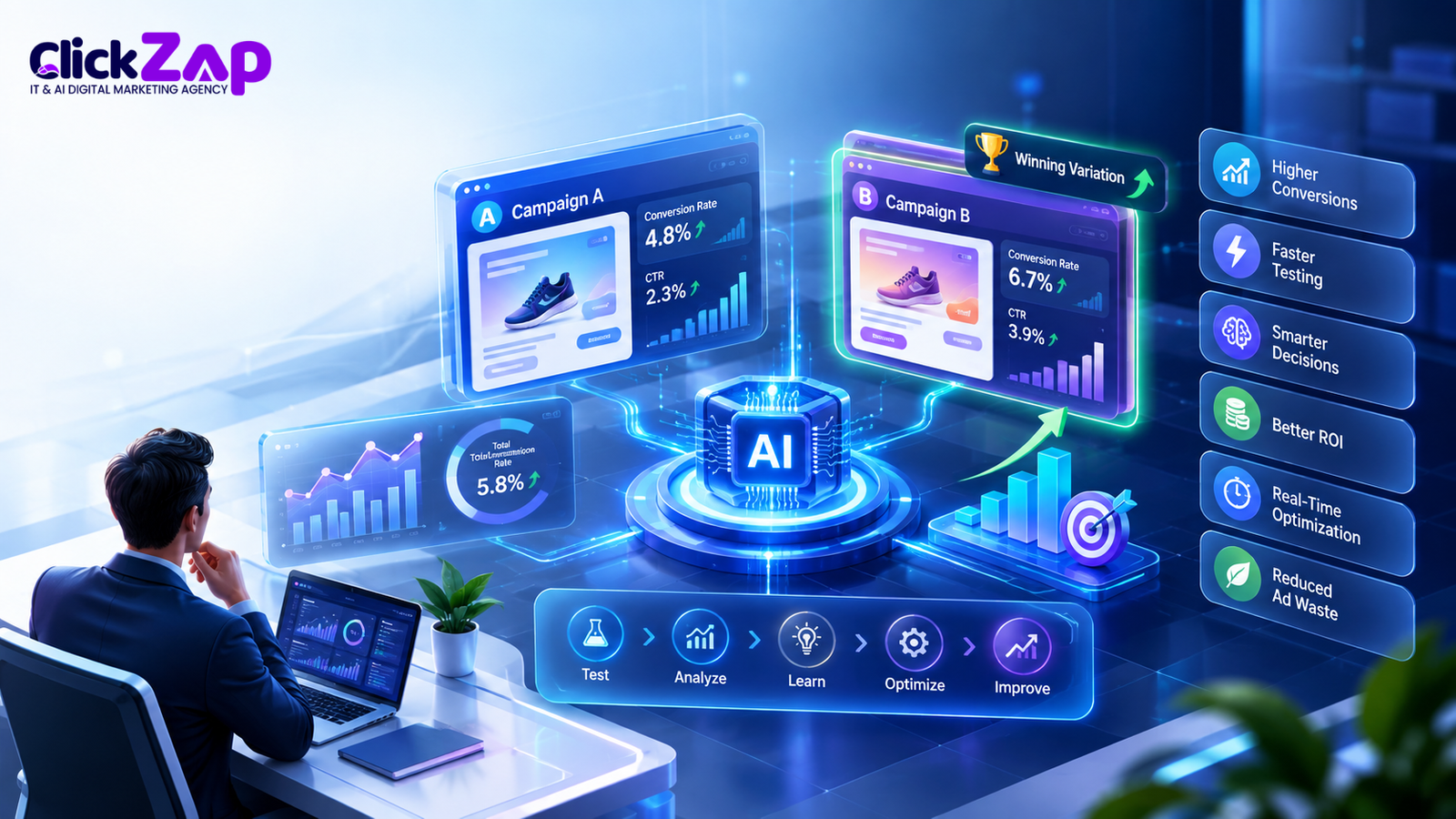
When applied correctly, AI powered campaign optimization offers several practical advantages:
- Faster marketing experiments, since variations can be generated quickly
- More test variations, without adding to a team’s manual workload
- Better campaign performance over time as testing becomes routine
- Improved conversion rates through more informed, data backed changes
- More efficient conversion rate optimization across multiple campaigns
- Automated testing for repetitive setup and reporting tasks
- Faster identification of useful patterns in user behavior
- Reduced manual work for marketing teams
- Better use of campaign data that would otherwise go unanalyzed
- More informed marketing decisions based on evidence, not assumptions
- Continuous campaign optimization instead of one off testing
AI conversion optimization works best when it’s treated as an ongoing process not a single test, but a habit built into how campaigns are managed. This is where AI powered campaign optimization delivers the most value: consistent, incremental improvement over time.
How AI Generates Campaign Variations
One of the most practical uses of AI in this process is generating multiple variations of campaign assets quickly. AI tools can help produce different versions of:
- Ad headlines
- Ad copy
- Landing page headlines
- CTAs
- Product descriptions
- Email subject lines
- Promotional messages
For instance, a marketer could ask an AI tool to generate five alternative headlines based on a proven performing original, then select the strongest options to test.
However, AI generated variations should always be reviewed by marketers before launch. AI can produce copy that reads well but misses the brand’s tone, includes inaccurate claims, or doesn’t align with compliance requirements. Human review for accuracy, brand voice, compliance, and relevance remains a necessary step. AI speeds up creation, but people still decide what actually goes live.
AI A/B Testing Tools Marketers Can Consider
Several platforms support AI assisted experimentation, each with a slightly different focus. This isn’t a ranking, the right tool depends on your setup, budget, and campaign type.
Optimizely is a widely used experimentation platform that supports A/B testing and feature experimentation for websites and digital products.
VWO offers A/B testing, behavior analytics, and conversion rate optimization tools aimed at improving on site experiences.
Adobe Target provides testing and personalization capabilities, often used by businesses already working within the Adobe ecosystem.
AB Tasty combines experimentation with personalization features for websites and digital experiences.
Alongside dedicated testing tools, analytics and behavioral data platforms play a supporting role:
- Google Analytics 4 (GA4) helps marketers understand how users move through a site and where conversions happen.
- Microsoft Clarity offers session recordings and heatmaps that reveal how users actually interact with a page.
- Mixpanel focuses on product and user behavior analytics, useful for understanding engagement patterns over time.
For AI assisted content or variation generation, tools built on models from providers like OpenAI are increasingly used to draft headline, copy, and CTA variations that marketers can then test and refine.
Using AI A/B Testing with Google Ads and Meta Ads
Google Ads
On Google Ads, marketers can approach AI assisted testing by experimenting with:
- Ad copy variations
- Headlines
- Descriptions
- Landing pages
- Audience or campaign experiments
- Conversion performance across variations
Meta Ads
On Meta Ads, testing typically focuses on:
- Creative variations (images and video)
- Primary text
- Headlines
- CTAs
- Audience testing
- Landing page experiences after the click
Platform features and experiment options change frequently, so marketers should always verify current testing capabilities directly within Google Ads and Meta Ads before building a testing plan around them.
Key Metrics to Track
Choosing the right metrics depends entirely on your campaign objective; not every test should be judged by the same number.
|
Metric |
What It Measures |
|
Conversion rate |
Percentage of users completing the desired action |
|
Click through rate (CTR) |
Percentage of users who clicked after seeing the ad |
|
Cost per conversion |
How much each conversion costs |
|
Cost per click (CPC) |
Average cost for each click received |
|
Return on ad spend (ROAS) |
Revenue generated relative to ad spend |
|
Engagement rate |
Likes, shares, comments, or interactions relative to reach |
|
Revenue or lead volume |
Total business outcome from the campaign |
A high CTR with a low conversion rate can be misleading; it might mean the ad is appealing but the landing page isn’t converting. Always choose metrics based on what the campaign is actually meant to achieve.
Understanding Statistical Significance
Statistical significance tells you whether a difference in results is real, or just the product of chance.
Here’s why it matters:
- Enough data is needed before a result can be trusted, small sample sizes are unreliable.
- Avoid making decisions too early. A variant that looks like it’s winning on day two might not hold up by day ten.
- Random fluctuations can produce misleading results, especially with low traffic volumes.
- Conversion volume matters; a handful of conversions isn’t enough to draw firm conclusions.
- An apparent winner may not always be a reliable winner. Confirming significance protects you from acting on noise.
In simple terms: give your test enough time and enough traffic before deciding a version has “won.”
Common AI A/B Testing Mistakes to Avoid
- Testing too many things at once, making it unclear what actually caused a change
- Ending experiments too early, before reaching statistical significance
- Making decisions from too little data
- Ignoring the campaign objective in favor of vanity metrics
- Changing multiple variables without a clear testing structure
- Trusting AI generated variations without human review
- Focusing only on CTR while ignoring conversion quality
- Ignoring conversion quality, such as lead relevance or purchase value
- Failing to document experiment results for future reference
- Not continuing to test after an initial improvement, and assuming the work is done
Best Practices for AI Driven A/B Testing
- Start with one clear objective for every test
- Test meaningful variables, not minor cosmetic changes
- Build a clear control and variant before launching
- Use relevant audience segments so results reflect real user behavior
- Give experiments enough time and traffic to reach reliable conclusions
- Monitor conversion quality, not just conversion volume
- Combine AI insights with human judgment before making final calls
- Track results consistently across campaigns
- Document successful and unsuccessful tests for future reference
- Continue running marketing experiments as an ongoing practice, not a one time project
Practical Example of AI A/B Testing
Consider a business running a lead generation campaign with two landing page versions.
Control: Original headline “Get a Free Marketing Consultation” with a standard “Submit” CTA button.
Variant: AI assisted alternative headline “See How We Can Grow Your Business” with a “Book My Free Call” CTA button.
Here’s how the test plays out:
- Traffic is divided roughly 50/50 between the control and variant.
- Metrics tracked include conversion rate, form submissions, and cost per conversion.
- Conversion rates are compared after the test has run long enough to gather meaningful data.
- Statistical significance is considered before declaring a winner, to rule out random variation.
- The insight is applied: if the variant performs reliably better, the business updates the live page and carries the learning perhaps that action oriented CTAs outperform generic ones into future campaign optimization.
This kind of simple, structured test is easy for a small business owner to run and understand, and it builds a foundation for more advanced testing over time.
How to Build an AI A/B Testing Strategy
A practical framework for building AI A/B testing into your marketing process:
Goal → Hypothesis → Variations → Experiment → Data → Analysis → Insight → Optimization → Retest
- Goal: Define what you’re trying to improve conversions, cost efficiency, engagement.
- Hypothesis: Form a clear idea of what change might improve results, and why.
- Variations: Use AI to help generate multiple versions to test against your hypothesis.
- Experiment: Launch the test with a clear control and variant setup.
- Data: Collect performance data across the test period.
- Analysis: Review results against your original goal and metrics.
- Insight: Extract the “why” behind the results, not just the outcome.
- Optimization: Apply what you’ve learned to the live campaign or future tests.
- Retest: Treat this as a cycle one test’s insight becomes the next test’s hypothesis.
Frequently Asked Questions
What is AI powered A/B testing?
AI powered A/B testing is the use of artificial intelligence to help create test variations, analyze campaign data, and support faster, more informed decisions during marketing experiments.
How does AI improve A/B testing?
AI improves A/B testing by speeding up variation creation, analyzing performance data continuously, identifying patterns sooner, and helping adjust traffic allocation reducing manual effort while keeping marketers in control of final decisions.
What can you A/B test in a marketing campaign?
You can test ad creative, headlines, CTAs, landing pages, email subject lines, social media captions, and audience targeting, among other campaign elements.
What are the best AI A/B testing tools?
There’s no single “best” tool platforms like Optimizely, VWO, Adobe Target, and AB Tasty each offer different testing and personalization capabilities, often paired with analytics tools like GA4, Microsoft Clarity, or Mixpanel.
Can AI automate A/B testing?
AI can automate parts of A/B testing, such as generating variations and analyzing data, but human oversight is still needed to interpret results, ensure brand accuracy, and make final strategic decisions.
Conclusion
AI powered A/B testing for campaigns doesn’t replace good marketing judgment; it supports it. By helping marketers generate variations faster, analyze campaign data continuously, identify patterns sooner, and optimize campaigns on an ongoing basis, AI makes the testing process more efficient without taking the decision making out of human hands.
The businesses that benefit most from AI powered A/B testing for campaigns are the ones that treat testing as a habit, not a one time task combining AI’s speed with human judgment about brand, audience, and business goals.
If your business needs help building a structured testing and campaign optimization process, the team at ClickZap IT can help you get started and connect with us to talk through your next campaign.
Also Read: AI for Customer Journey Mapping: How Businesses Can Create Better Customer Experiences
0 Comments