
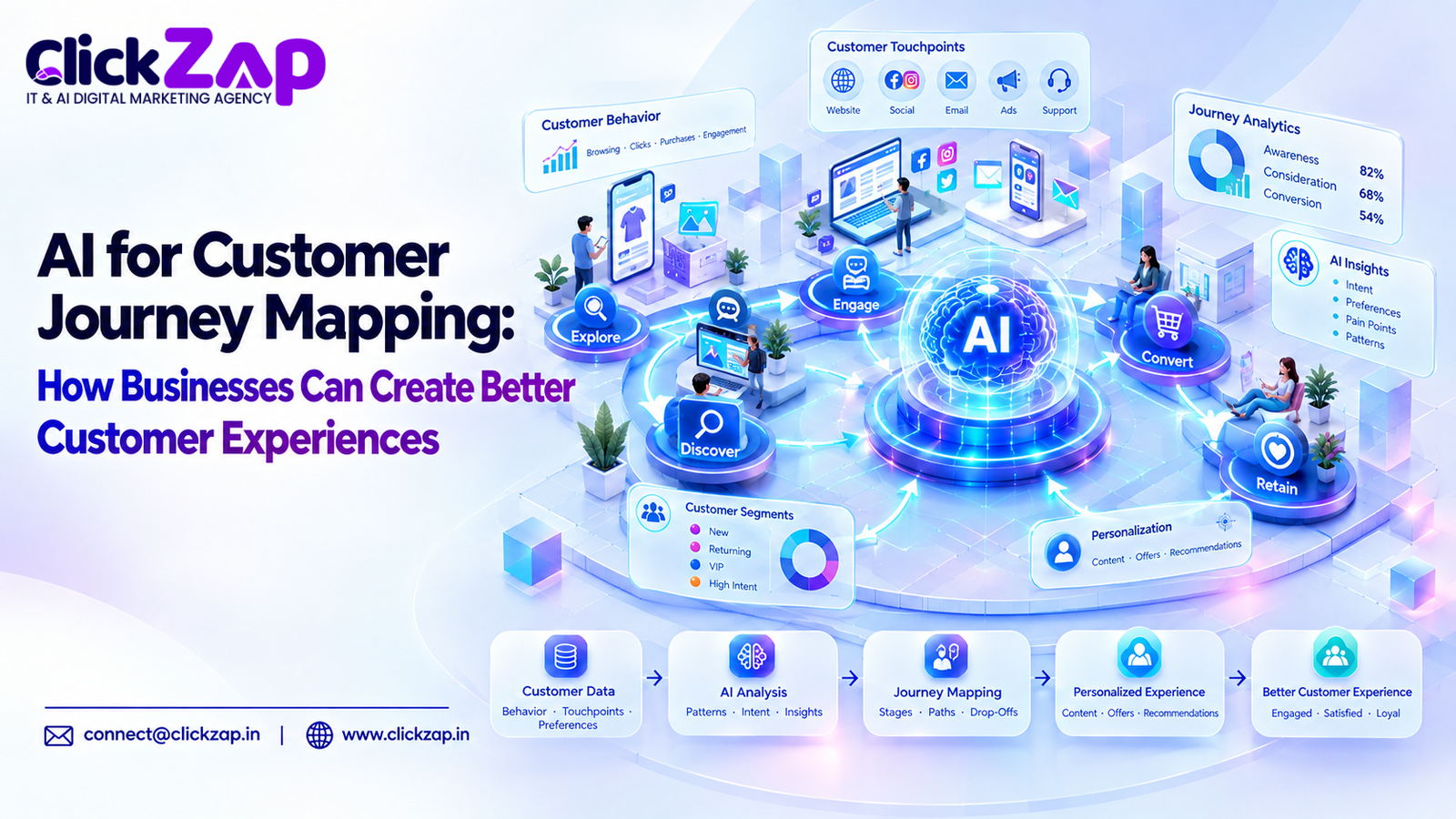
Every customer who buys from your business follows a path. This path often called the customer journey includes every interaction a person has with your brand, from the first search on Google to the moment they become a repeat customer. Understanding this journey has always mattered, but doing it well has never been harder. This is exactly why more businesses are turning to AI for Customer Journey Mapping to make sense of that path with clarity instead of guesswork.
As businesses grow, they collect data from dozens of sources: websites, ad platforms, social media, email, CRMs, and support tickets. Mapping this manually with spreadsheets and static diagrams quickly becomes unmanageable. A journey map built last quarter may already be outdated by the time it’s finished.
This is where AI for Customer Journey Mapping changes the picture. Instead of relying on assumptions or delayed reports, AI can process large volumes of customer data continuously, spot patterns across touchpoints, and surface insights that would take a human team weeks to find manually.
Used well, AI for Customer Journey Mapping helps businesses understand what customers actually do, not just what they’re assumed to do and use that understanding to build more personalized, efficient, and consistent customer experiences.
This article breaks down what AI powered journey mapping actually involves, how it works in practice, the tools commonly used, and the realistic challenges businesses should plan for.
What Is AI for Customer Journey Mapping?
AI customer journey mapping is the process of using artificial intelligence to collect, connect, and analyze data about how customers interact with a business across different channels then turning that data into a clearer picture of the customer’s path.
Traditional journey mapping is built manually. A marketing team interviews customers, reviews basic analytics, and draws a static diagram of assumed stages. It’s useful, but it’s a snapshot accurate for a moment, then increasingly disconnected from reality as customer behavior shifts.
AI powered customer journey mapping works differently. Instead of a one time exercise, it becomes an ongoing process:
- Data collection is automated. AI tools pull data from websites, ad platforms, CRMs, and support systems without manual entry.
- Pattern recognition happens at scale. AI can review thousands of customer sessions and identify common paths, drop off points, and behavior trends that aren’t obvious from a single dashboard.
- Channels get connected. AI can link a customer’s ad click, website visit, email open, and purchase into one continuous journey, rather than treating each channel as a separate data silo.
- Insights update continuously. As new data comes in, the journey mapping with AI process reflects current behavior rather than last quarter’s assumptions.
The result of AI customer journey analysis isn’t a static poster on a wall, it’s a living, data backed understanding of how real customers move through real decisions.
What Are the Main Customer Journey Stages?
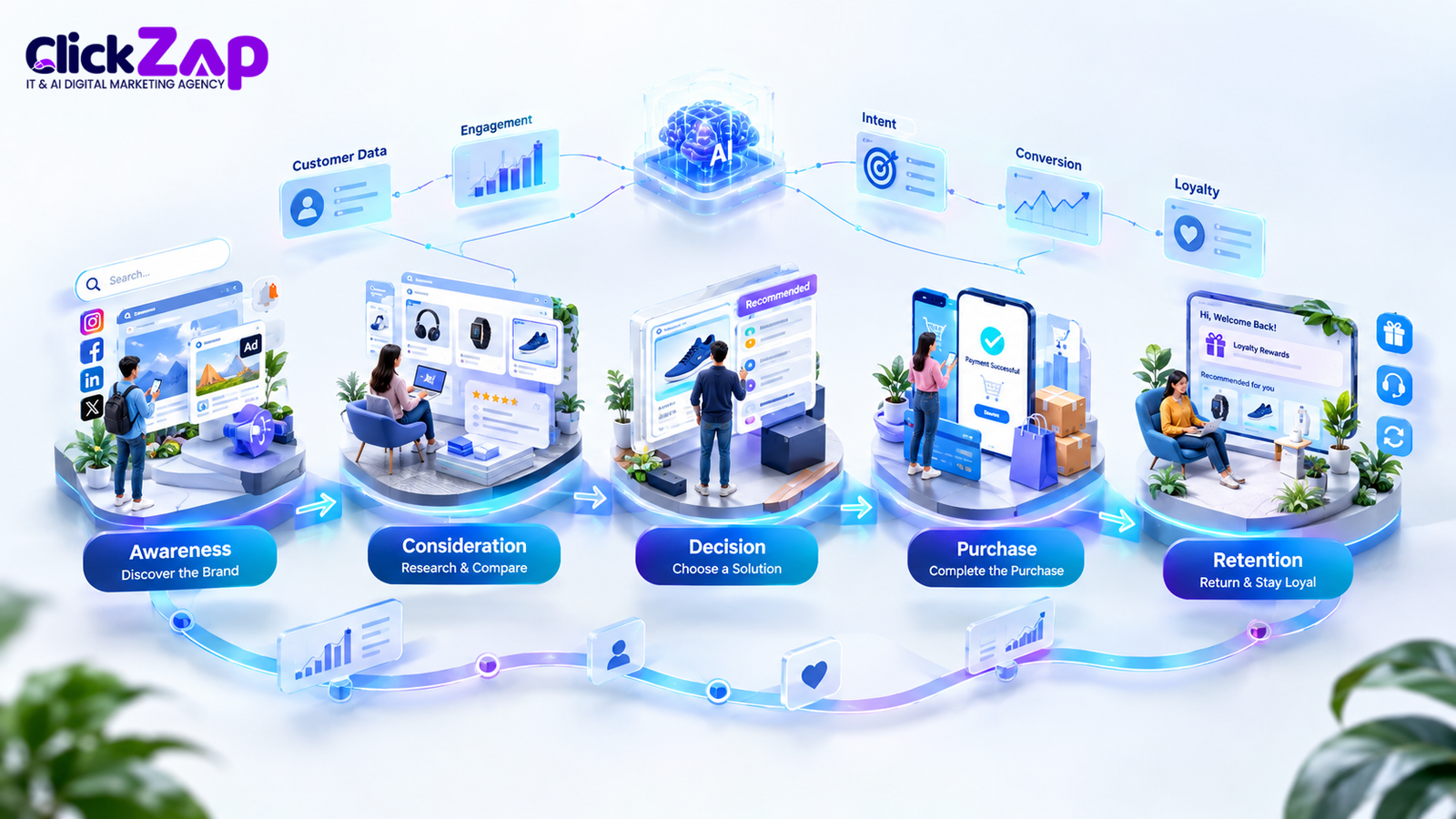
Most customer journeys move through a series of recognizable stages, even though not every customer follows them in a straight line.
- Awareness : The customer becomes aware of a problem or discovers your brand, often through search, social media, or advertising.
- Consideration : The customer researches options, compares products or services, and evaluates whether your business fits their needs.
- Decision : The customer narrows down choices and prepares to make a purchase decision.
- Purchase : The customer completes a transaction.
- Onboarding : The customer starts using the product or service and forms early impressions.
- Retention : The customer continues engaging, repurchasing, or renewing.
- Advocacy : The customer recommends the brand to others or leaves reviews.
Customer expectations shift at every stage. Someone in the awareness stage wants clear, helpful information. Someone at the checkout wants a fast, frictionless process. A customer in the retention stage expects the business to remember their history and preferences.
Example: Suppose a business sells accounting software. A user discovers the brand through a Google Ads campaign (awareness), reads a comparison blog post (consideration), signs up for a free trial (decision), converts to a paid plan (purchase), completes onboarding videos (onboarding), and renews their subscription after three months (retention). AI can track this entire sequence across ad platforms, the website, email, and the product itself connecting activity that would otherwise sit in separate reports and flag, for instance, that trial users who watch the second onboarding video convert to paid plans at a noticeably higher rate.
Digital Marketing Services for Business
How AI Changes Traditional Customer Journey Mapping
The shift from manual to AI powered journey mapping affects nearly every part of the process.
|
Traditional Journey Mapping |
AI Powered Journey Mapping |
|
Manual data collection |
Automated data collection |
|
Static customer personas |
Dynamic customer segments |
|
Limited data analysis |
Large scale data analysis |
|
Periodic insights |
Real time customer insights |
|
Manual journey updates |
Automated journey updates |
|
Basic touchpoint analysis |
Advanced customer interaction analysis |
|
Reactive decisions |
Predictive customer analytics |
In simple terms: traditional mapping tells you what customers were probably doing a few months ago. AI driven customer journey mapping tells you what customers are doing now, and gives early signals about what they’re likely to do next while still requiring human judgment to interpret and act on those signals correctly.
How AI Analyzes Customer Journey Data
AI customer journey analysis draws on many different types of customer journey data, including:
- Website activity (pages visited, time spent, scroll behavior)
- Search behavior (keywords used, search intent)
- Advertising interactions (clicks, impressions, conversions)
- Product views and cart activity
- Purchase history
- Email engagement (opens, clicks, unsubscribes)
- Social media interactions
- Customer support conversations
- Customer feedback and survey responses
- CRM records
- Repeat purchase patterns
- Customer sentiment expressed in reviews or messages
AI systems process this customer interaction analysis by identifying correlations a human analyst might miss for example, noticing that customers who contact support before purchasing convert at a different rate than those who don’t, or that a specific email subject line consistently precedes higher website engagement.
Customer feedback analysis and customer sentiment analysis add another layer. Instead of manually reading through hundreds of reviews or support tickets, AI tools can categorize feedback by topic and tone, helping businesses spot recurring complaints or praise faster than manual review would allow.
None of this replaces human interpretation. AI surfaces patterns; people still need to decide what those patterns mean for the business and what to do about them.
Best AI Digital Marketing Agency in Hyderabad
How AI Identifies Customer Touchpoints and Pain Points
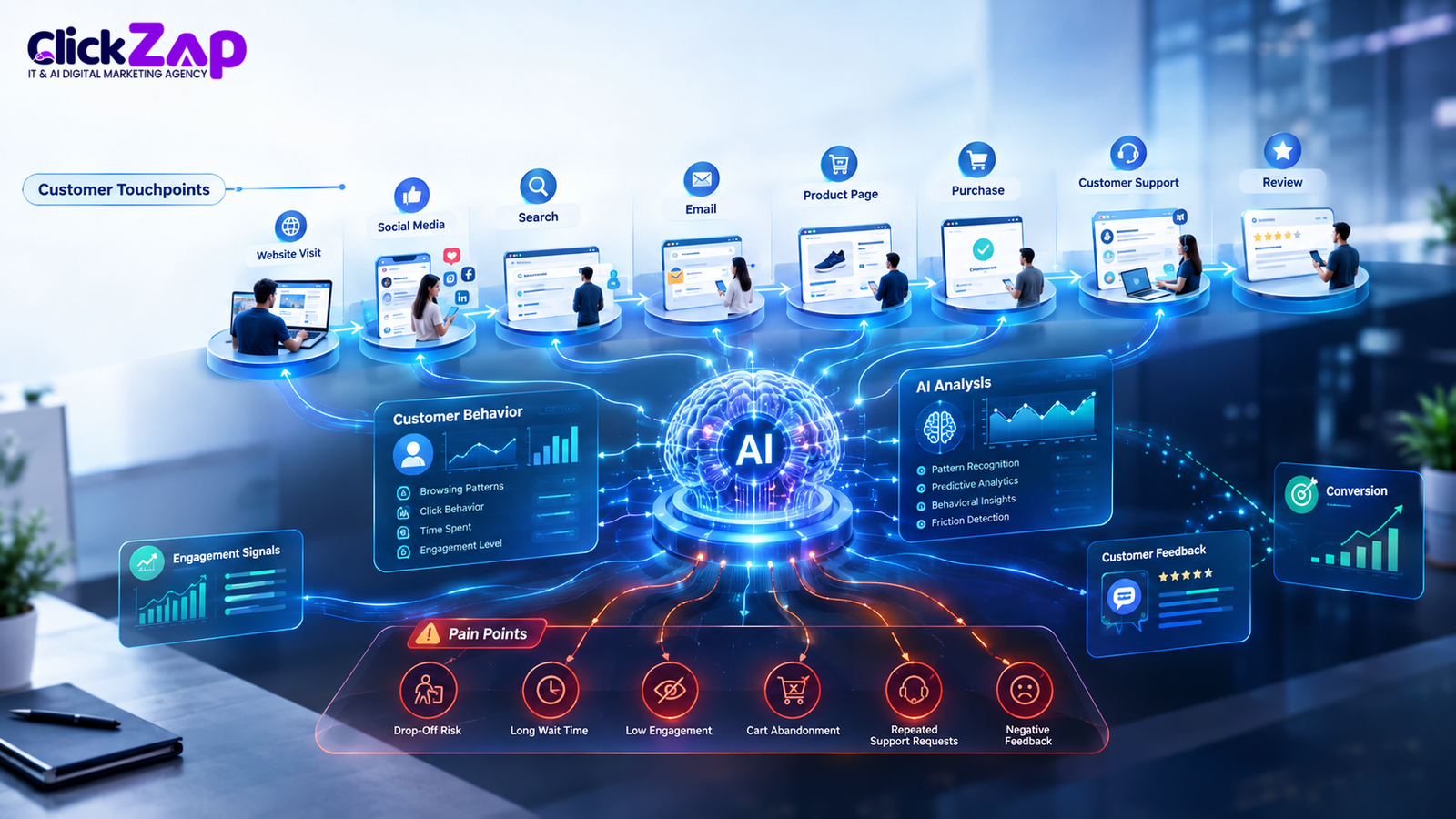
A customer touchpoint is any point of contact between a customer and a business. Common touchpoints include:
- Google Search
- Website and landing pages
- Social media profiles and posts
- Online advertisements
- WhatsApp or other messaging apps
- Sales calls
- Customer support (chat, phone, email)
- Checkout process
- Post purchase communication
AI can review activity across these touchpoints to identify:
- Customer pain points : recurring moments of friction or confusion
- Drop off points : stages where customers frequently exit the journey
- Friction in the buying process : confusing forms, slow pages, unclear pricing
- Repeated customer questions : common support queries that signal missing information elsewhere
- Poor performing touchpoints : channels or pages with unusually low engagement or conversion
- Abandoned journeys ; customers who started a process but didn’t finish
For example, if AI analysis shows a large percentage of customers abandon checkout after reaching the shipping cost page, that’s a specific, actionable pain point one a business can address by adjusting pricing transparency earlier in the journey, rather than guessing at the cause.
Benefits of AI for Customer Journey Mapping
Better Customer Journey Insights
AI can review far more data than a person can manually, surfacing patterns across touchpoints, time periods, and customer segments that would otherwise stay hidden in separate reports.
Improved Customer Experience
By identifying where customers struggle, businesses can address specific problems: a confusing page, a slow response time, an unclear offer rather than making broad, unfocused changes.
Personalized Experiences
AI can help tailor content, offers, and recommendations to what a specific customer or segment has shown interest in, rather than showing the same generic experience to everyone.
Faster Decision Making
Instead of waiting for a monthly or quarterly report, teams can review AI generated insights on an ongoing basis and adjust campaigns or processes sooner.
Better Customer Journey Optimization
AI can highlight exactly where in the journey customers are dropping off, making it easier to prioritize which parts of the experience need attention first.
Predictive Customer Analytics
By analyzing historical patterns, AI can flag customers who show early signs of high purchase intent or early signs of disengagement before those outcomes actually happen.
Real Time Customer Insights
AI systems can react to changes in customer behavior as they happen, rather than businesses discovering shifts weeks later in a scheduled report.
Increased Marketing Efficiency
By showing which channels and touchpoints genuinely contribute to conversions, AI helps businesses allocate marketing budgets toward what’s actually working.
How AI Can Personalize the Customer Journey
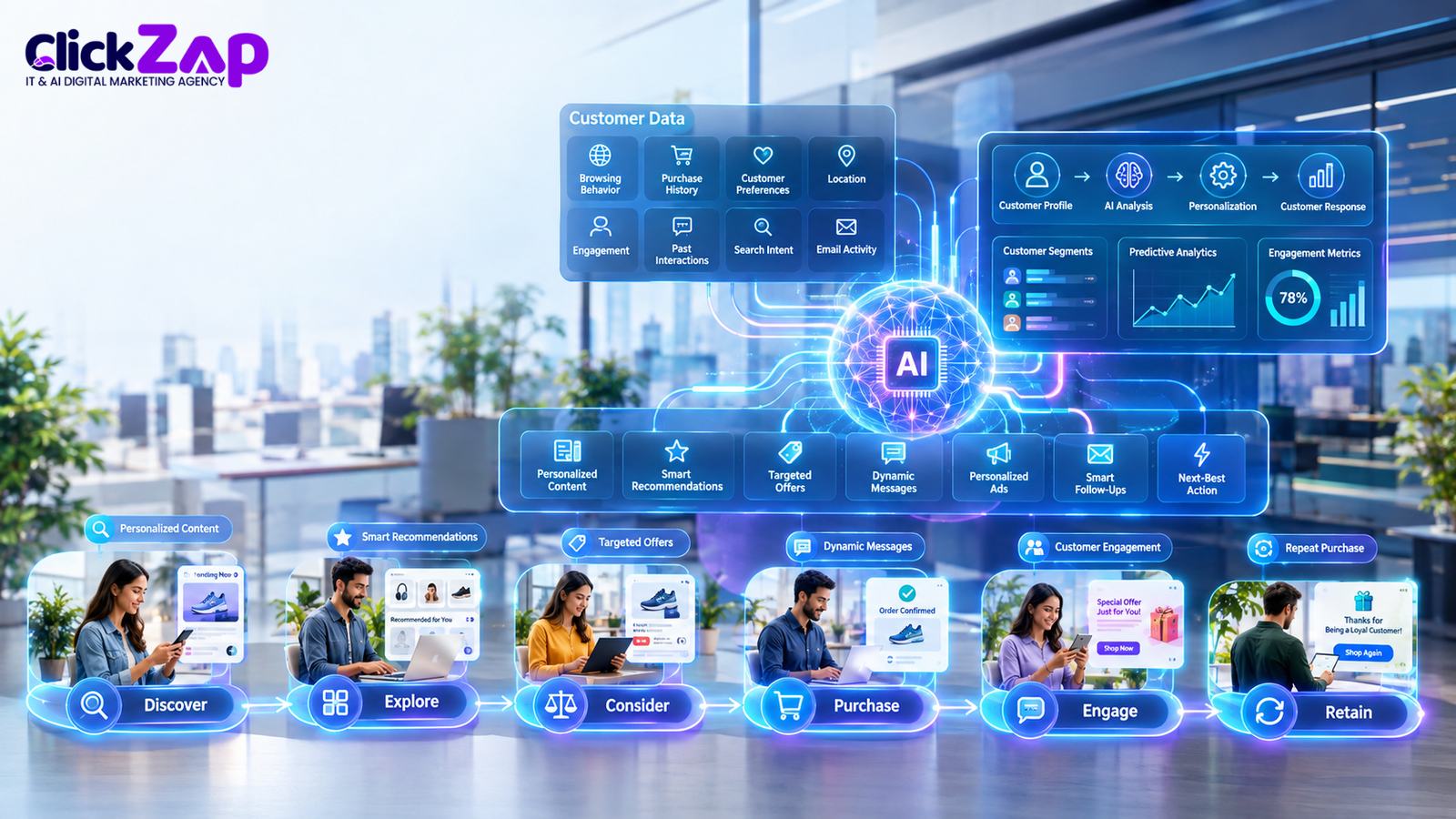
Customer experience personalization means adjusting what a customer sees and experiences based on their behavior, preferences, and history instead of showing everyone the same generic journey.
AI can help personalize:
- Website content and product recommendations
- Email campaigns and subject lines
- Advertising creative and targeting
- Offers and discounts
- Landing pages
- Follow up messages
- Customer support responses
- Retention and win back campaigns
Practical example: A customer visits an online store several times, views a specific product category, adds an item to their cart, and leaves without purchasing. AI systems can recognize this pattern and prompt the business to send a relevant follow up such as a reminder email showing the exact product left in the cart, rather than a generic newsletter. This kind of targeted response is far more likely to bring the customer back than a one size fits all message.
Personalization built on AI customer journey optimization works best when it stays genuinely relevant. Over personalization or repetitive retargeting can feel intrusive, so businesses need to balance relevance with restraint.
How AI Uses Predictive Analytics to Improve Customer Journeys
Predictive customer analytics uses historical and real time data to estimate the likelihood of future customer actions. This doesn’t mean AI can guarantee what a customer will do, it means AI can identify patterns that suggest a probable direction.
Common predictions businesses use AI for include:
- Purchase likelihood
- Churn risk (the chance a customer will stop engaging or cancel)
- Repeat purchase probability
- Product interest
- Conversion likelihood
- Customer engagement level
- Next best action (what offer or message is likely to be most relevant)
It’s important to be clear: these are probability based estimates drawn from available data, not guarantees. A customer flagged as “high churn risk” might still renew, and one flagged as “likely to purchase” might not. Predictive analytics should guide priorities and inform decisions, not replace judgment about individual customer relationships.
AI Customer Journey Mapping Tools and Platforms
Businesses don’t need a single, dedicated “AI journey mapping tool” to get started. Many existing marketing, analytics, and CRM platforms already contribute pieces of the picture when used together.
- Google Analytics 4 (GA4) tracks website behavior and customer interactions, helping businesses understand how visitors move through a site.
- Google Ads provides data on ad clicks, impressions, and conversions useful for understanding how paid search fits into the awareness and consideration stages.
- Meta Ads offers similar insight for paid social campaigns, including engagement and conversion data across Facebook and Instagram.
- Meta Business Suite helps track organic and paid social interactions in one place.
- HubSpot combines CRM, marketing, and sales data, making it useful for connecting early stage marketing touchpoints with later sales activity.
- Salesforce centralizes customer and sales records, which is valuable for understanding journeys that involve a sales team.
- Microsoft Power BI helps businesses visualize and explore data pulled from multiple sources in dashboard form.
- Adobe Experience Cloud and Adobe Analytics offer deeper digital analytics and customer experience tracking, typically used by larger organizations with complex data needs.
- OpenAI, ChatGPT, Google Gemini, and Microsoft Copilot can support journey mapping work indirectly for example, helping teams analyze exported data, summarize customer feedback themes, or draft journey documentation faster.
- Amazon Personalize is built specifically for generating personalized product and content recommendations based on customer behavior.
- Mixpanel focuses on product analytics, tracking how users interact with a website or app at a granular, event by event level.
Not every platform listed here is a dedicated customer journey mapping tool. Most businesses combine two or three of these commonly an analytics platform, a CRM, and an AI assistant for analysis to build a workable, AI supported view of the customer journey.
How Businesses Can Use AI for Customer Journey Optimization
A practical, step by step approach helps make AI customer journey optimization manageable rather than overwhelming.
Step 1: Collect Customer Journey Data
Identify and connect the data sources that matter most to website analytics, ad platforms, CRM records, and support logs.
Step 2: Identify Customer Touchpoints
Map out where customers interact with the business, across both digital and offline channels where possible.
Step 3: Analyze Customer Behavior
Use AI tools to review the collected data and identify recurring patterns and trends.
Step 4: Find Customer Pain Points
Look for specific stages where customers experience friction, confusion, or delay.
Step 5: Segment Customers
Group customers based on behavior, needs, purchase history, or lifecycle stage rather than treating all customers the same.
Step 6: Personalize the Experience
Use segment and behavior data to create more relevant content, offers, and communication.
Step 7: Automate Customer Journey Actions
Set up automated triggers such as follow up emails or retargeting ads based on specific customer behaviors.
Step 8: Measure and Optimize
Track the results of changes and continue refining the journey based on what the data shows.
This isn’t a one time project. Each step feeds back into the next, and the process should repeat as customer behavior and business goals evolve.
Real World Example of AI Powered Customer Journey Mapping
Consider an eCommerce business selling home fitness equipment:
- A customer discovers a product through a Google Ads campaign.
- They visit the website and browse several products.
- They leave without purchasing.
- Days later, they return through a Meta Ads retargeting campaign.
- They add a product to their cart.
- They abandon checkout at the shipping cost step.
- The business sends a relevant follow up email addressing shipping concerns.
- The customer completes the purchase.
- They receive a personalized post purchase recommendation for a complementary product.
AI can analyze each of these touchpoints individually and as a connected sequence identifying, for instance, that checkout abandonment tends to spike at the shipping cost step specifically, or that follow up emails sent within 24 hours convert better than those sent later. These insights let the business make targeted improvements rather than broad, unfocused changes to the entire funnel.
Common Challenges of AI Customer Journey Mapping
AI is a powerful tool for journey mapping, but it isn’t a perfect or automatic solution. Common challenges include:
- Poor quality customer data inaccurate or incomplete data leads to inaccurate insights.
- Data silos are information trapped in separate systems that don’t communicate with each other.
- Incomplete customer profiles gaps in data that make it hard to see the full picture.
- Privacy and consent requirements businesses must collect and use customer data responsibly and in compliance with relevant regulations.
- Integration difficulties connecting multiple platforms can be technically complex.
- Incorrect or misleading data patterns correlation isn’t always causation, and AI can highlight patterns that don’t hold real business meaning.
- Over reliance on automated insights treating every AI output as fact without human review.
- Difficulty measuring offline interactions in person sales, phone calls, and word of mouth are harder to capture in digital journey data.
- Need for human oversight AI can identify patterns, but people need to judge what actions make sense.
- Cost and implementation complexity setting up integrated systems takes time, budget, and technical resources.
Because of these challenges, businesses get the best results by combining AI generated insights with human judgment, industry context, and direct customer relationships, not by treating AI output as the final word.
Best Practices for Using AI in Customer Journey Mapping
- Start with clear business objectives before choosing tools or data sources.
- Keep customer data organized and consistently structured.
- Connect the data sources that are most relevant to your specific customer journey.
- Focus first on the touchpoints that matter most to conversion and retention.
- Monitor data quality regularly insights are only as good as the data behind them.
- Use AI insights alongside human expertise and business context.
- Test personalization strategies before rolling them out at scale.
- Protect customer privacy and follow applicable data regulations.
- Continuously measure customer experience rather than treating it as a one time audit.
- Update customer journey maps regularly as customer behavior changes.
Future of AI Customer Journey Mapping
AI’s role in customer journey mapping is likely to keep expanding, particularly in areas such as:
- Real time customer journey analysis becoming more standard, not just available to large enterprises
- More advanced personalization across channels
- Predictive customer experiences that anticipate needs earlier in the journey
- AI powered journey automation handling more routine follow up actions
- Conversational AI playing a larger role in customer support and guidance
- AI agents that can take limited actions on a business’s behalf within defined rules
- Better cross channel customer understanding as data integration improves
- More intelligent customer segmentation based on behavior rather than broad demographics
- Increasingly automated customer journey optimization workflows
These developments will likely make journey mapping more accessible to smaller businesses over time, though the fundamentals of clean data, clear objectives, and human oversight will remain just as important as the technology itself.
FAQs About AI for Customer Journey Mapping
What is AI for customer journey mapping?
AI for customer journey mapping is the use of artificial intelligence to collect, connect, and analyze customer data across touchpoints, helping businesses understand and improve how customers move from awareness to purchase and beyond.
How does AI improve customer journey mapping?
AI improves journey mapping by automating data collection, analyzing behavior at scale, connecting interactions across channels, and updating insights in real time instead of relying on periodic manual reviews.
What data does AI use for customer journey analysis?
AI typically analyzes website activity, advertising interactions, email engagement, CRM records, purchase history, customer support conversations, and feedback to build a picture of the customer journey.
Can AI predict customer behavior?
AI can estimate the likelihood of certain customer actions, such as purchase or churn, based on patterns in historical and real time data. These are probability based predictions, not guarantees.
What are the benefits of AI powered customer journey mapping?
Key benefits include better insights, improved personalization, faster decision making, predictive analytics, real time visibility into customer behavior, and more efficient marketing spend.
Which tools can businesses use for AI customer journey mapping?
Businesses commonly combine analytics platforms like GA4, CRMs like HubSpot or Salesforce, advertising platforms like Google Ads and Meta Ads, and AI assistants like ChatGPT or Gemini to support journey mapping and analysis.
Conclusion
Understanding the customer journey isn’t optional anymore; it’s the foundation of good marketing and good customer experience. As data volume grows, AI for Customer Journey Mapping gives businesses a practical way to keep up: analyzing customer behavior across touchpoints, identifying pain points, and surfacing opportunities that manual methods simply can’t match at scale.
AI won’t replace the judgment, context, and relationships that businesses bring to their customers but it can make the process of understanding those customers faster, more accurate, and more actionable. Combined with personalization and predictive analytics, AI powered journey mapping helps businesses move from reacting to customer behavior to genuinely anticipating it.
Businesses looking to improve their digital customer journey can work with a digital marketing agency to connect customer data, optimize touchpoints, improve campaigns, and create more personalized experiences. At ClickZap IT, we help businesses across Hyderabad and beyond turn scattered customer data into clearer, AI-informed journey insights from SEO and PPC to WhatsApp and content marketing that meet customers at the right touchpoint. If that’s where your business is headed, get in touch with our team to talk through what an AI supported customer journey strategy could look like for you.
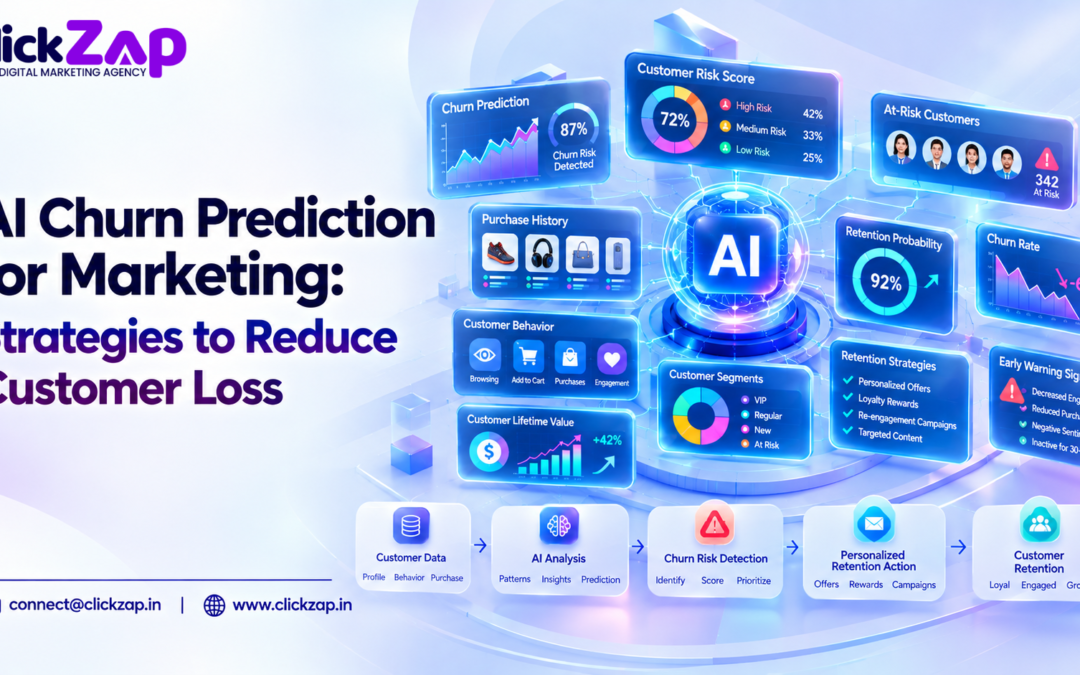
Also Read: AI Churn Prediction for Marketing: Strategies to Reduce Customer Loss
0 Comments