
You paid for the clicks and the visitors arrived, but most of them left without filling in the form, calling, or sending a WhatsApp message. This is the most common landing page problem, and it’s where AI Landing Page CRO helps: traffic does not equal leads, and a page can get thousands of visitors and still convert poorly because of weak messaging, a buried CTA, slow loading, a cluttered mobile layout, the wrong audience, or a leaky conversion funnel.
AI Landing Page CRO is one way to fix this. It uses data, automation, predictive insights, personalization, and testing to find out why visitors don’t convert and what to change. It doesn’t replace strategy. It makes analysis faster and testing sharper.
This guide explains how it works, which tools fit where, and how to start.
What Is AI Landing Page CRO?
AI Landing Page CRO is the practice of using AI tools and machine learning to analyze visitor behavior, find conversion problems, test improvements, and personalize landing pages so more visitors take the action you want.
Here are the four terms in plain language:
- AI: software that finds patterns in data, makes predictions, or generates content.
- Landing page: a page built for one goal, usually where ad or campaign traffic arrives.
- CRO (conversion rate optimization): improving the percentage of visitors who take a desired action.
- Landing page conversion rate: conversions divided by visitors, multiplied by 100. If 200 of 10,000 visitors convert, your rate is 2%.
Traditional CRO vs AI assisted CRO: a simple example
Traditional approach: A marketer sees a 2% conversion rate. They export analytics reports, watch a few session recordings, guess the headline is weak, rewrite it, and run a test for several weeks.
AI assisted approach: Behavior data from analytics and session recordings is summarized by AI tools. Patterns get flagged, such as mobile users abandoning at the fourth form field. AI helps draft headline variations. A testing platform splits traffic between versions. The marketer reviews results against lead quality and decides what to ship.
The difference is speed and scale. The judgment still belongs to a human. Whether you call it AI landing page optimization or AI conversion rate optimization, the idea is the same: better evidence, faster decisions.
Why Landing Page CRO Matters for Businesses
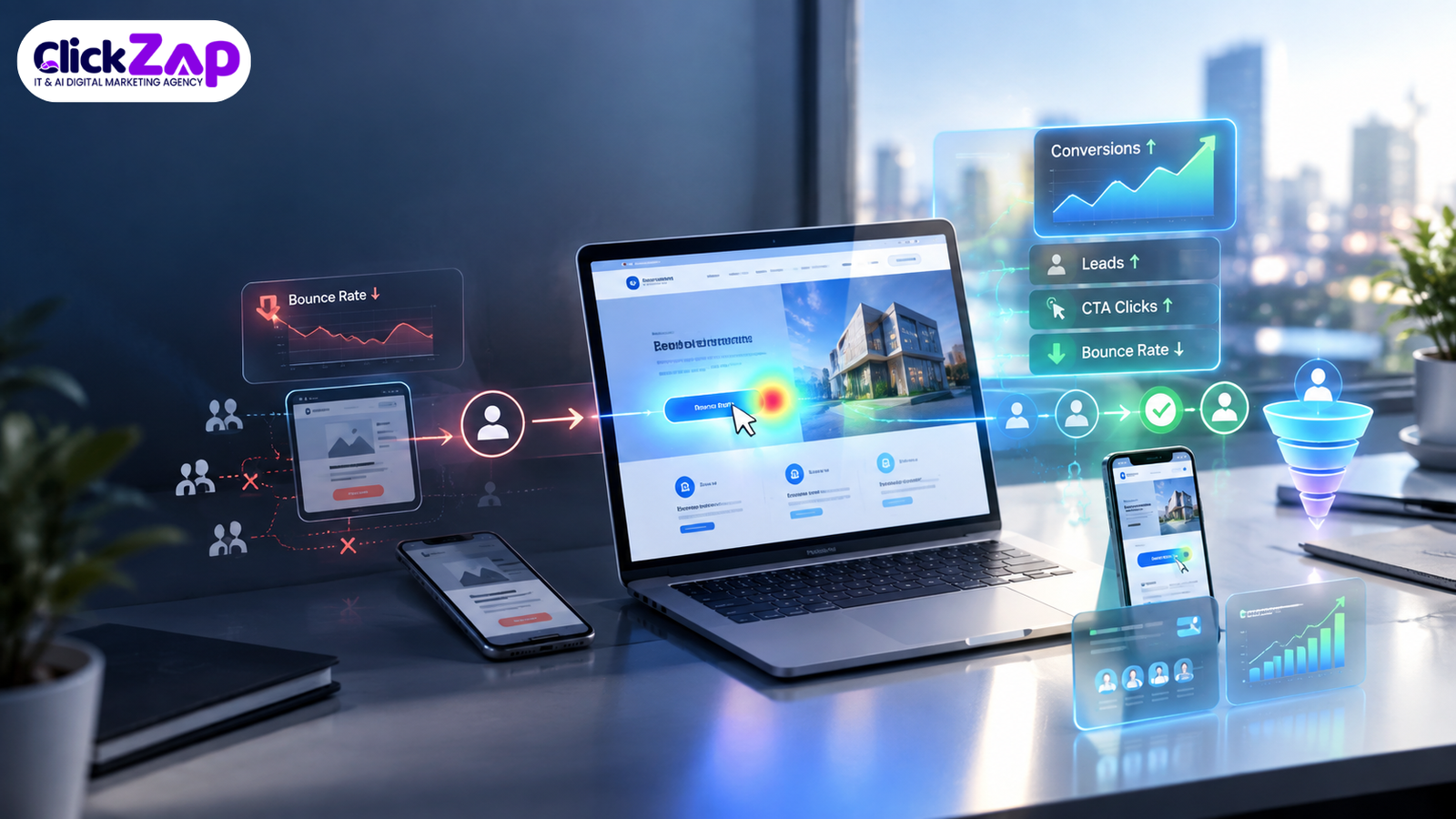
Getting more traffic is an expensive way to grow. Converting more of the traffic you already have is usually cheaper.
Here is what landing page CRO can improve:
- More leads from existing traffic: the same ad spend produces more enquiries.
- Better return on ad spend: more conversions per rupee spent.
- Lower customer acquisition cost: each lead costs less.
- Better user experience: visitors find what they need faster.
- Improved lead quality: clearer messaging attracts people who actually fit your offer.
- More sales opportunities: better leads give your sales team more to work with.
- Stronger conversion funnel performance: fewer visitors drop out between click and enquiry.
Consider this illustrative math. You spend ₹50,000 to bring 5,000 visitors to a page. At a 2% conversion rate, you get 100 leads at ₹500 each. If better messaging and a shorter form lift the rate to 3%, you get 150 leads at about ₹333 each. Same budget, no extra traffic. This is an example, not a promise. Real results depend on your offer, audience, and page.
How AI Improves Landing Page Conversions
AI helps in six main areas. Each one addresses a different reason visitors leave without converting.
AI Powered User Behavior Analysis
User behavior analysis shows what visitors actually do on your page, not what you assume they do.
You can analyze:
- Click behavior: what people click, including things that aren’t clickable
- Scroll depth: how far down the page visitors go
- Time on page: whether visitors read or bounce
- Exit behavior: where they leave
- Form interactions: which fields cause hesitation or abandonment
- Device behavior: how mobile, tablet, and desktop visitors differ
- Traffic sources: how visitors from Google Ads, Meta Ads, or organic search behave
Google Analytics 4 (GA4) tracks events, sources, devices, and conversions. Microsoft Clarity and Hotjar add heatmaps and session recordings so you can see behavior visually. Some of these tools now offer AI assisted summaries and pattern detection, though features change, so check current availability.
The value is in the patterns. If 70% of mobile visitors leave before reaching your CTA, you have a mobile layout problem, not a traffic problem.
AI Powered A/B Testing
A/B testing means showing two versions of a page to different visitors and seeing which converts better.
You can test:
- Headlines
- CTA buttons
- Images
- Forms
- Page layouts
- Offers
- Content
Manual testing is slow. You form a guess, build a variant, wait, and repeat. AI can speed this up by suggesting what to test, generating variations, and in some platforms shifting traffic toward better performing versions automatically. This is often called automated A/B testing or AI powered A/B testing.
Platforms like Optimizely and VWO are built for experimentation. Both have added AI-assisted features, but the level of automation varies by plan and product. AI doesn’t remove the need for enough traffic to reach reliable results.
AI Landing Page Personalization
Personalization means showing different visitors different content based on who they are or how they arrived.
AI can help tailor pages by:
- Audience: a startup founder and a procurement manager need different messages.
- Location: a Hyderabad visitor may respond to local proof and local phone numbers.
- Device: mobile visitors may need a tap to call the button first.
- Traffic source: a Meta Ads visitor and a Google Ads visitor arrive with different intent.
- Previous interactions: returning visitors don’t need the same introduction.
- Customer characteristics: industry, company size, or past purchases.
- Funnel stage: first time visitors need trust, ready to buy visitors need a clear next step.
Personalization works because relevance drives action. A page that speaks directly to a visitor’s situation feels easier to trust.
AI Powered CTA Optimization
Your call to action is the moment of decision. AI can help evaluate:
- Wording: “Submit” vs “Get My Free Audit”
- Placement: above the fold, after key benefits, or sticky on mobile
- Visibility: contrast, size, and surrounding whitespace
- Design: button shape, color, and clarity
- Number of CTAs: too many competing actions cause hesitation
- User intent: a visitor comparing options needs a different CTA than one ready to book
Simple examples:
- Change “Submit” to “Book My Free Consultation.”
- Move the CTA button closer to the pricing or proof section.
- Replace three competing CTAs with one primary action.
- Add a WhatsApp button for mobile users who prefer chat over forms.
Never treat any CTA change as universal. Test it with your audience.
AI for Landing Page User Experience
Landing page user experience decides whether a visitor stays or leaves. AI assisted analysis can help flag problems such as:
- Confusing navigation
- Long forms
- Weak messaging
- Poor content structure
- Mobile usability problems
- Slow loading elements
- Distracting design elements
Rage clicks, dead clicks, and sudden exits in session recordings often point to these issues. For example, if visitors repeatedly tap a non clickable image, they expect it to do something. Better UX supports conversion rate improvement because it removes friction between visitor intent and action.
Predictive Analytics for Conversion Optimization
Predictive analytics uses past and current data to estimate what is likely to happen next.
Applied to landing pages, it can help identify:
- High value visitors: those resembling your best customers
- Visitors likely to convert: based on behavior patterns
- Visitors likely to leave: so you can adjust the experience
- High performing traffic sources: where to spend more
- Conversion opportunities: segments or pages that are underperforming
GA4 offers predictive metrics in some cases, but they need enough data and meet eligibility conditions. Predictions are estimates, not facts. Use them to prioritize, then validate with testing.
Best AI Digital Marketing Agency in Hyderabad
AI Landing Page CRO vs Traditional CRO
|
Area |
Traditional CRO |
AI Powered CRO |
|
Data analysis |
Manual review of reports and dashboards |
Automated pattern detection across large datasets |
|
Testing |
Manual setup, one test at a time |
Faster variant creation, automated traffic allocation in some tools |
|
Personalization |
Broad segments, mostly rule based |
More granular, data driven segments |
|
User behavior analysis |
Sampling recordings and heatmaps by hand |
AI assisted summaries and pattern flagging |
|
Optimization speed |
Slower cycles |
Faster cycles, still limited by traffic |
|
Decision making |
Experience and intuition |
Data backed suggestions reviewed by humans |
|
Scalability |
Hard to scale across many pages |
Easier to scale across pages and campaigns |
|
Reporting |
Manual reports |
Automated dashboards and insights |
AI is not always better. Small sites with low traffic may get more value from a good manual audit than from advanced automation. The strongest setup combines both.
Best AI CRO Strategies for Landing Pages
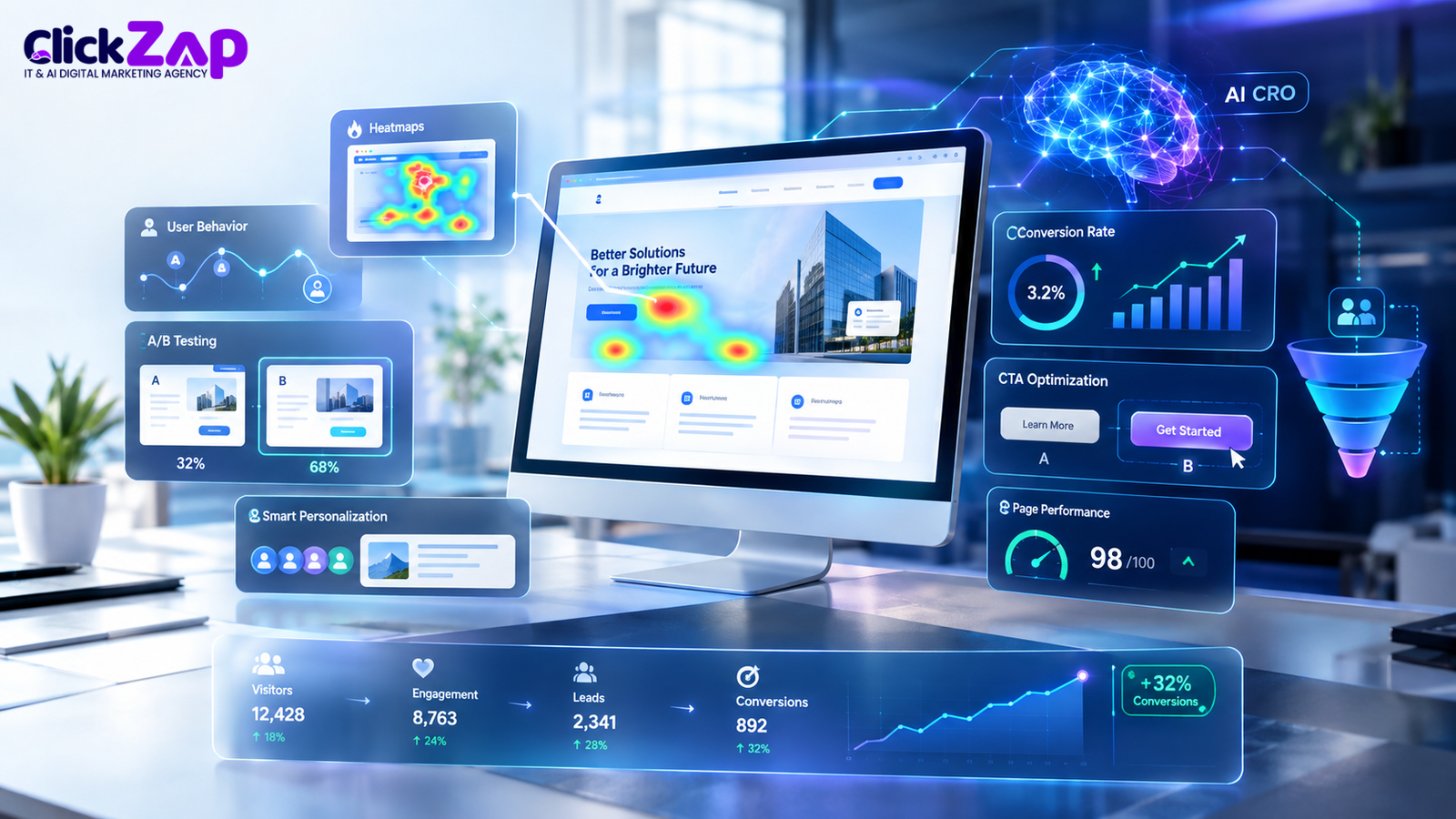
These are the practical moves that tend to matter most for AI CRO for landing pages:
- Analyze visitor behavior. Start with what people actually do, not opinions.
- Identify conversion bottlenecks. Find the exact step where visitors drop off.
- Improve landing page messaging. Say clearly what you offer, who it’s for, and why it’s worth acting on.
- Optimize headlines. Your headline should confirm the visitor is in the right place within seconds.
- Improve CTA placement. Put the next step where the visitor is most convinced.
- Reduce unnecessary form fields. Every extra field adds friction. Ask only what you need to qualify the lead.
- Personalize landing page content. Match the message to source, audience, or intent.
- Run AI powered A/B tests. Test one meaningful change at a time when possible.
- Improve mobile experience. Most Indian ad traffic is mobile. Check tap targets, form usability, and load time.
- Match landing page content with ad intent. If the ad promises “free SEO audit,” the page must lead with that.
- Improve page speed. Compress images, reduce scripts, and remove heavy elements.
- Continuously monitor conversions. Set alerts for sudden drops.
AI CRO Tools for Landing Page Optimization
These tools serve different purposes. Treating them all as “CRO tools” leads to bad decisions. Here they are by category.
Analytics and User Behavior
- Google Analytics 4: an analytics platform. It measures traffic, events, and conversions. It uses machine learning for some features but is not a testing or page building tool.
- Microsoft Clarity: a free behavior analytics tool with heatmaps and session recordings. It offers some AI assisted summaries.
- Hotjar: heatmaps, recordings, and surveys for understanding visitor behavior and feedback.
CRO and A/B Testing
- Optimizely: an experimentation platform for testing and personalization.
- VWO: a testing and conversion platform that combines experiments with behavior insights.
- Google Optimize: a historical tool. Google discontinued it in September 2023, so it is not a current option. Businesses that used it moved to other platforms that integrate with GA4.
Landing Page and Conversion Platforms
- Unbounce: a landing page builder that offers AI based features such as smart traffic routing and copy assistance. Check current features before committing.
CRM and Customer Data
- HubSpot: a CRM with forms, landing pages, and marketing automation. Its main value in CRO is connecting a landing page lead to what happened next.
- Salesforce: an enterprise CRM. It helps you see which leads became opportunities and revenue, which shows lead quality, not just lead volume.
Advertising Platforms
- Google Ads: uses automation and AI for bidding and campaign optimization. It shows search terms and ad intent, which guide landing page messaging. It does not optimize the page itself.
- Meta Ads: offers automated targeting and creative tools. Its audience and creative data help you match the page to the ad. It also doesn’t optimize the page.
Generative AI and AI Assistants
- OpenAI (ChatGPT), Google Gemini, and Microsoft Copilot: general purpose assistants. They can draft headline variations, summarize exported data, suggest test hypotheses, and rewrite form copy. They do not see your live visitors unless you give them data. Avoid pasting personal customer data into public tools.
How they work together
A workable AI assisted workflow looks like this: Google Ads and Meta Ads bring traffic. Unbounce or HubSpot hosts the page. GA4 measures conversions, while Clarity or Hotjar shows behavior. An AI assistant helps turn findings into test ideas. Optimizely or VWO runs the tests. Your CRM shows which variant produced better leads.
How to Use AI for Landing Page Optimization Step by Step
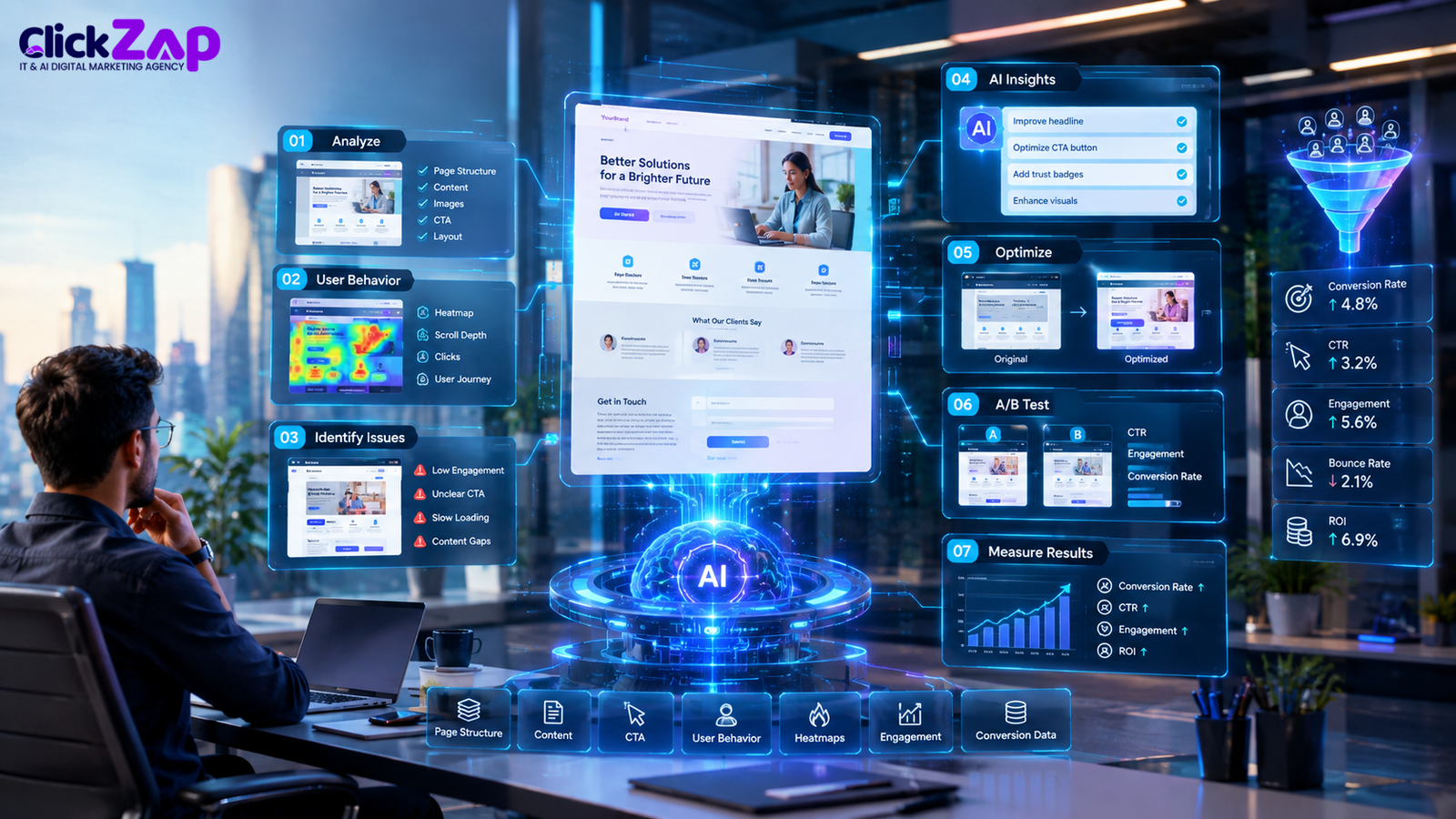
Step 1: Define the Conversion Goal
Pick one primary goal per page:
- Form submission
- Phone call
- WhatsApp enquiry
- Product purchase
- Demo booking
- Consultation request
Step 2: Collect Landing Page Data
Pull together analytics data from GA4, campaign data from Google Ads and Meta Ads, heatmaps and session recordings, and CRM outcomes. Clean, connected data makes AI-driven landing page optimization useful. Messy data makes it misleading.
Step 3: Identify Conversion Problems
Look for:
- High bounce rates: visitors leave immediately
- Weak CTAs: low clicks on the main button
- Form abandonment: people start but don’t finish
- Poor mobile performance: mobile converts far below desktop
- Low engagement: little scrolling or interaction
- Message mismatch: the page doesn’t match the ad
Step 4: Use AI to Generate Optimization Insights
Feed your findings into an AI assistant or your CRO platform. Ask it to spot patterns, suggest hypotheses, and rank likely causes. Treat outputs as ideas to test, not answers.
Step 5: Test Changes
Run A/B tests on the highest-impact changes first. Let tests run long enough to collect meaningful data.
Step 6: Personalize the Experience
Once you know what works, create versions for key segments, such as different traffic sources or industries.
Step 7: Measure Results
Track conversion rate, cost per lead, and lead quality together. A higher rate means little if leads are worse.
Step 8: Continuously Improve
CRO is a cycle, not a one time project. Audiences, ads, and competitors change. Your page should keep changing with them.
Landing Page Metrics to Monitor With AI
|
Metric |
Why it matters |
|
Landing page conversion rate |
Your core performance indicator |
|
Bounce rate |
Shows whether the page matches visitor expectations |
|
Engagement rate |
Shows whether visitors actually interact |
|
Click through rate |
Measures ad and CTA appeal |
|
Form completion rate |
Reveals form friction |
|
Cost per lead |
Shows the efficiency of your spend |
|
Conversion value |
Connects conversions to revenue |
|
Return on ad spend |
Shows whether campaigns are profitable |
|
Average engagement time |
Signals content relevance |
|
Lead quality |
Shows whether leads turn into customers |
Bounce rate definitions differ across tools. In GA4, bounce rate is the inverse of engagement rate, so compare like with like.
Example: AI Assisted CRO for a Hyderabad Lead Gen Business
This is an illustrative scenario, not a real client result.
A Hyderabad based business runs Google Ads and Meta Ads to generate leads. Its landing page receives 10,000 visitors and produces 200 leads. That is a 2% conversion rate.
After connecting analytics, heatmaps, and ad data, an AI assisted review might surface:
- Weak headline: it describes the company, not the visitor’s problem.
- Poor CTA: the button says “Submit” and sits below several sections.
- Long form: eight fields, with high drop off at the phone number field.
- Mobile UX issues: buttons are hard to tap and the page loads slowly.
- Traffic message mismatch: Meta Ads visitors arrive from a discount focused ad but land on a page about premium services.
- High exit sections: most visitors leave at a long text block before the pricing section.
The business could then:
- Rewrite the headline around the visitor’s specific problem.
- Change the CTA to “Get My Free Quote” and move it higher.
- Cut the form to four fields.
- Fix mobile speed and button size.
- Create a separate page for Meta Ads traffic.
- Test each change, monitoring conversion rate and lead quality for several weeks.
The outcome might be better, unchanged, or worse for some changes. That is why testing exists. The goal is learning, not guaranteed lift.
Common AI Landing Page CRO Mistakes
- Using AI without reliable data. Bad inputs produce bad recommendations.
- Making too many changes at once. You won’t know what worked.
- Testing without enough data. Small samples produce misleading winners.
- Focusing only on design. Offer and message often matter more than color.
- Ignoring user intent. A visitor searching for pricing wants different content than one researching options.
- Ignoring mobile visitors. Test on real phones.
- Creating generic AI generated copy. Visitors can tell. Edit AI drafts so they sound like your brand.
- Tracking the wrong conversion. A button click isn’t always a real lead.
- Ignoring lead quality. Cheap leads that never buy are not wins.
- Expecting AI to replace human strategy. AI can analyze. It can’t decide your positioning.
Best Practices for AI Powered Landing Page Optimization
Use this checklist:
- Start with clear conversion goals
- Understand search and ad intent
- Use reliable first party data
- Combine analytics with user behavior insights
- Test one major variable at a time when appropriate
- Improve page speed
- Optimize for mobile
- Keep CTAs clear
- Match landing pages with advertisements
- Monitor lead quality
- Use AI as a decision support tool
- Review results regularly
The Future of AI Landing Page CRO
These are possibilities, not guarantees. Here is where the field may be heading:
- Real time personalization: pages that adapt to each visitor as they browse
- Predictive conversion modeling: better estimates of who will convert
- Automated experimentation: systems that run and interpret tests with less manual work
- AI generated landing page variations: faster creation of tailored pages
- Intelligent audience segmentation: segments discovered from data rather than assumed
- Conversational landing pages: chat style experiences that answer questions and guide visitors
- AI powered content recommendations: showing the most relevant proof, offers, or case studies
- Automated conversion insights: plain language explanations of why performance changed
Privacy rules, data quality, and brand control will shape how far these go.
Frequently Asked Questions About AI Landing Page CRO
What is AI Landing Page CRO?
It is the use of AI tools to analyze visitor behavior, find conversion problems, test changes, and personalize landing pages so more visitors take action. It supports human strategy rather than replacing it.
How does AI improve landing page conversion rates?
AI helps by finding patterns in visitor behavior, suggesting what to test, speeding up experiments, and personalizing content. It doesn’t guarantee higher conversions. Results depend on data quality, offer, traffic, and testing discipline.
What is AI landing page optimization?
AI landing page optimization means using AI to improve a landing page’s messaging, layout, CTAs, and experience based on data. It typically combines analytics, behavior tools, testing platforms, and generative AI assistants.
Can AI perform A/B testing?
Yes, to a degree. Some platforms use AI to suggest variations, allocate traffic automatically, and summarize results. You still need enough traffic, a clear hypothesis, and a person to judge the outcome.
Which AI CRO tools can businesses use?
Common options include Google Analytics 4, Microsoft Clarity, and Hotjar for behavior data. Optimizely and VWO handle testing. Unbounce builds pages. HubSpot and Salesforce track lead outcomes. ChatGPT, Gemini, and Microsoft Copilot help with analysis and copy ideas. Each serves a different purpose.
Conclusion
Traffic alone doesn’t build a business. Conversions do. AI Landing Page CRO gives businesses a practical way to analyze user behavior, spot conversion opportunities, test changes, personalize experiences, and make more data driven decisions.
It doesn’t guarantee better results on its own. The strongest outcomes come from combining AI, analytics, CRO strategy, advertising data, and human expertise. Start with one page, one goal, and one clear hypothesis. Then keep testing.
If you need help with landing page optimization, CRO, SEO, Google Ads, Meta Ads, or wider digital marketing, the ClickZap IT team in Hyderabad would be glad to help.
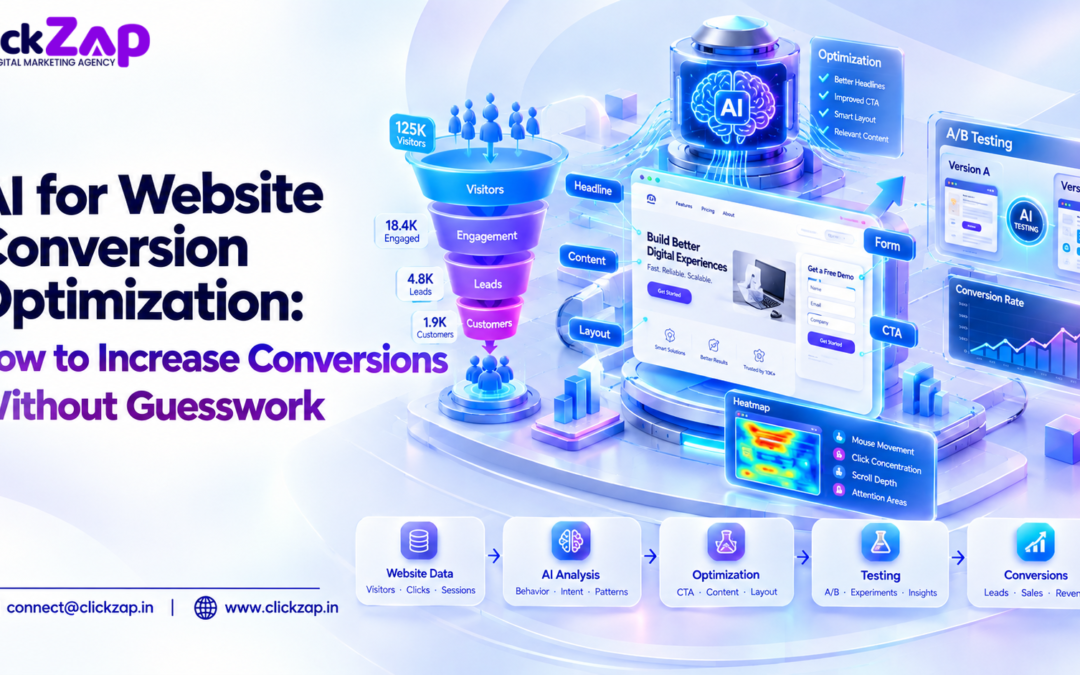
Also Read: AI for Website Conversion Optimization: How to Increase Conversions Without Guesswork
0 Comments