
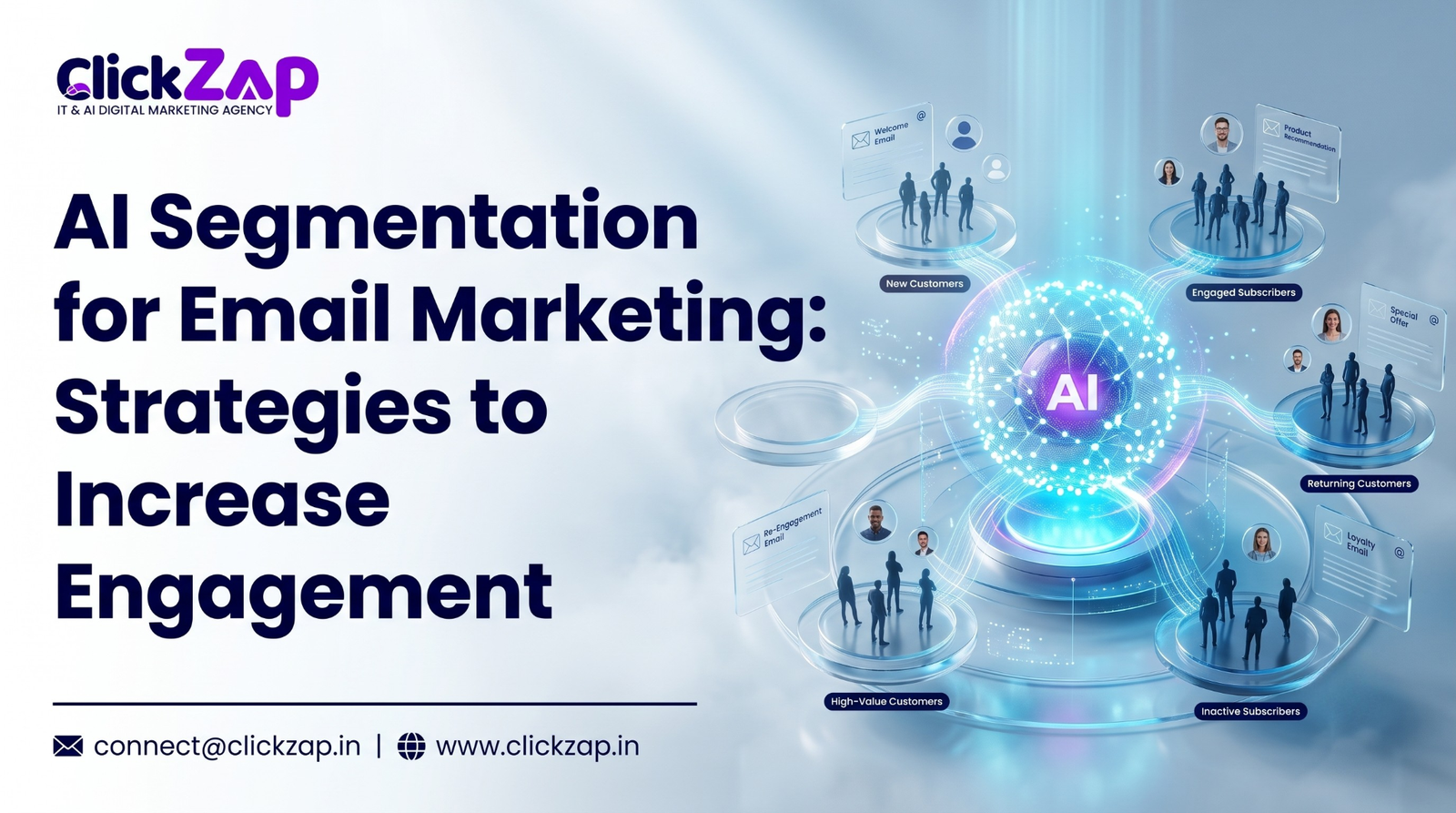
Imagine you run an online store. On Monday you send a 20% discount email to your whole list. A loyal customer who bought last week sees a discount they didn’t need. A first time visitor who has never opened an email ignores it. Someone who was close to buying a laptop gets a message about shoes. That is the gap AI segmentation for email marketing is built to close, because it reads each person’s behavior and helps you send the message that fits.
Same email, three different people, and none of them got what they needed.
This is the problem with treating a subscriber list as one audience. Subscribers differ in their interests, behavior, purchase history, engagement level, lifecycle stage, and buying intent. AI segmentation for email marketing helps you read these signals at scale, so you can group subscribers by what they do rather than only by who they are.
This guide explains how it works, what data it uses, which strategies are worth trying, and how to get started without overcomplicating things.
What Is AI Segmentation for Email Marketing?
AI segmentation for email marketing is the use of artificial intelligence and machine learning to analyze subscriber data and group people into relevant audience segments, often automatically and with less manual rule building.
You may also see it called AI email segmentation, AI powered email segmentation, or automated email segmentation. The idea is the same. Software studies how people interact with your brand and helps you find groups that deserve different messages.
Traditional segmentation vs. AI driven segmentation
Traditional segmentation is rule based. You decide the rules, then build the segment by hand. For example:
- Customers who purchased in the last 30 days
- Subscribers located in Hyderabad
- Contacts who opened at least one email this month
These rules are useful, but they only capture what you thought to look for.
AI driven email segmentation looks at many signals at once and can surface patterns you may not have defined. Take that “purchased in the last 30 days” group. Instead of treating all those buyers alike, AI can look at their purchase behavior, email engagement, browsing activity, and lifecycle stage. It might reveal that some are likely repeat buyers, some made a one time gift purchase, and some are already drifting away.
That gives you three segments with three different follow up emails, instead of one generic “thanks for buying” message.
How Does AI Email Segmentation Work?
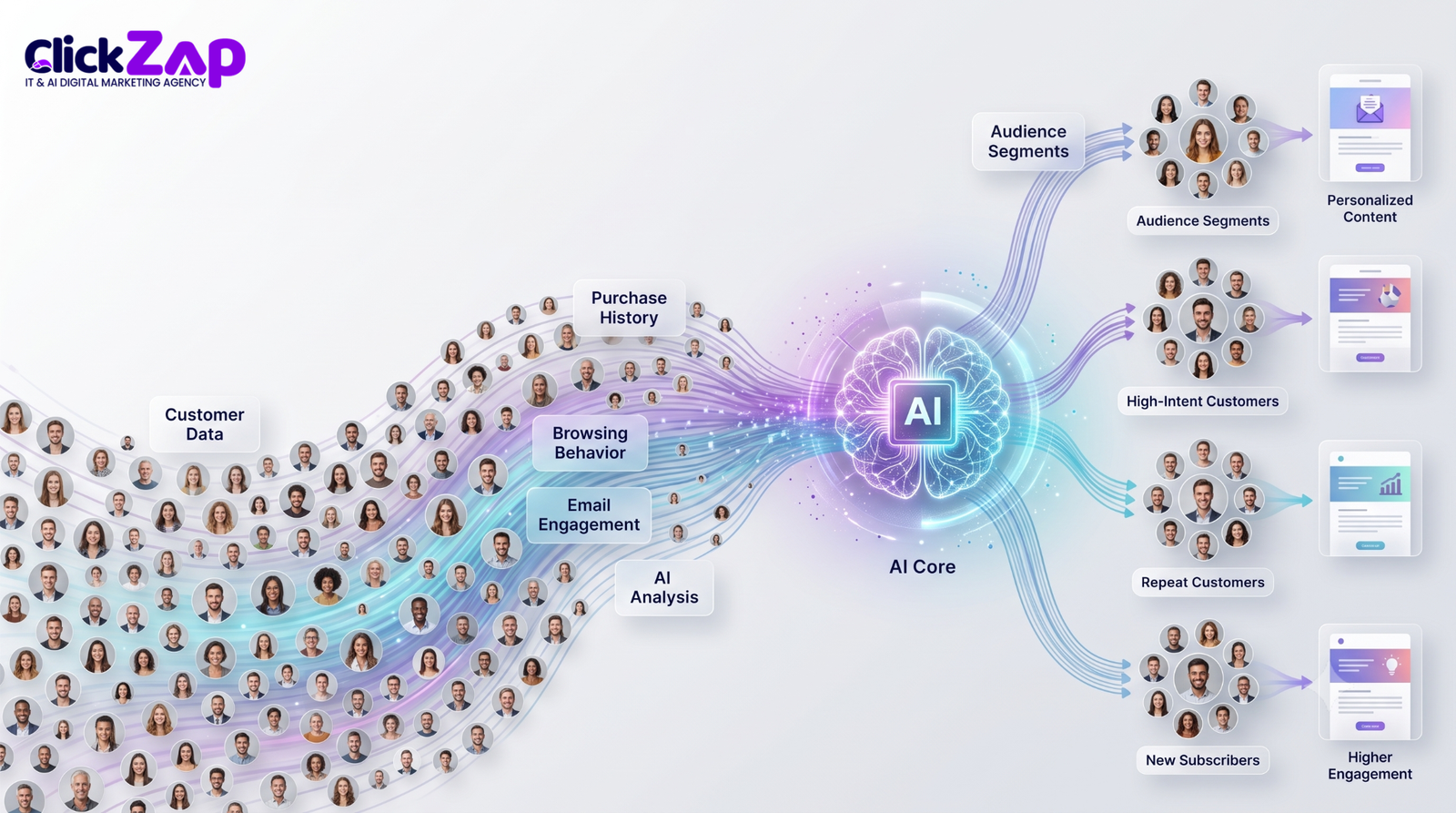
The process looks complex from the outside, but the logic is simple. Here is how it typically works, step by step.
- Collect customer data. Information flows in from your email platform, website, CRM, online store, and analytics tools.
- Analyze customer behavior. The system reviews what people click, view, buy, ignore, or abandon. This is the foundation of customer behavior segmentation.
- Identify patterns. Machine learning for email marketing means algorithms find patterns across thousands of records that would be tedious to spot manually. For example, subscribers who read your pricing guide and visit the demo page twice tend to request a call.
- Create audience segments. The patterns become groups, such as “high-intent prospects,” “price sensitive shoppers,” or “disengaging subscribers.”
- Predict customer intent. This is predictive email segmentation. Based on past behavior, the model estimates what a subscriber might do next, such as buy, compare, or go quiet.
- Personalize campaigns. Each segment receives content, offers, and timing that fit its behavior.
- Update segments continuously. This is dynamic email segmentation. As someone’s behavior changes, they move between groups automatically.
- Measure and improve. You review engagement and results, then adjust the approach.
One important point: AI doesn’t replace marketing judgment. It processes data faster and finds patterns more easily. You still decide the goals, the messaging, and what is appropriate to send.
What Data Does AI Use for Email Segmentation?
AI is only as useful as the data it works with. These are the main data types businesses can use.
Demographic and firmographic data
Basic profile details, including:
- Age range
- Location
- Industry
- Job role
- Company size
For B2B companies, industry, role, and company size are often the most useful starting points.
Behavioral data
What people do on your website and in your emails:
- Pages visited
- Emails opened
- Links clicked
- Products viewed
- Forms submitted
Behavior often says more than demographics. Two people of the same age and location can have very different interests.
Purchase behavior
For e-commerce and subscription businesses, this includes:
- Previous purchases
- Order frequency
- Average order value
- Product categories purchased
Email engagement data
How subscribers respond to your campaigns:
- Open activity
- Click activity
- Inactive subscribers
- Campaign responses
One caution. Open tracking can be less reliable than it used to be, because some email apps preload images or limit tracking. Clicks and on site actions tend to be stronger signals.
Customer lifecycle data
Where someone stands in their relationship with your business:
- New subscriber
- Prospect
- First time customer
- Repeat customer
- Loyal customer
- Inactive customer
Customer intent signals
Intent signals suggest what someone is trying to do right now. A person who reads a “how to choose” guide is probably researching. Someone who views a pricing page and a comparison article is likely evaluating options. Someone who adds items to a cart is close to buying. And a long time customer who stops opening emails may be losing interest.
AI can combine these small signals into a clearer picture of intent, which helps you decide whether to educate, nudge, or re-engage.
Types of AI Email Segmentation
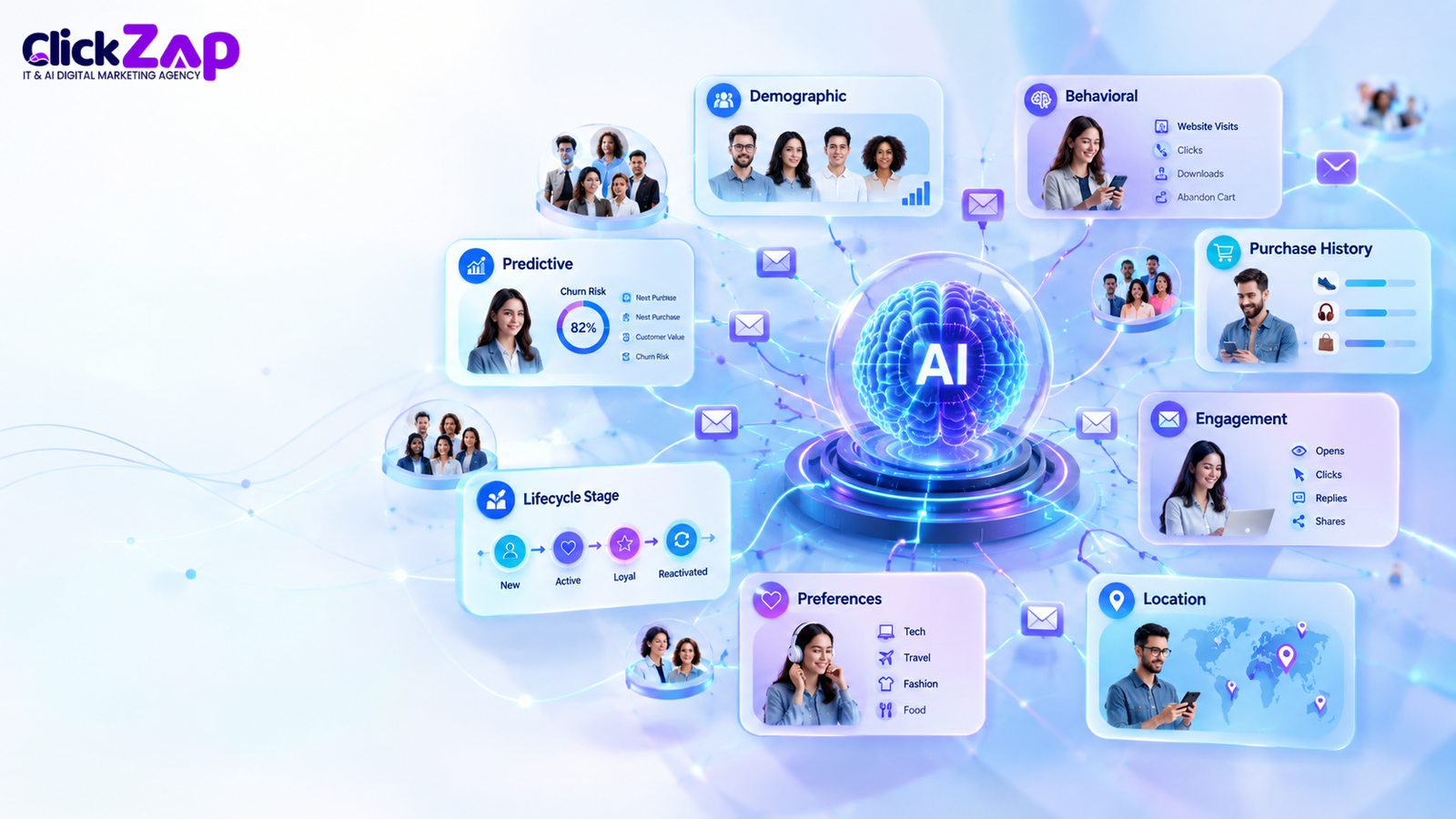
Here are the main segmentation approaches AI can support. Most businesses combine several.
1. Behavioral email segmentation
This groups subscribers by their actions, such as pages viewed, links clicked, or content downloaded. Someone who repeatedly reads your blog posts on SEO can receive more SEO focused content. AI behavioral email segmentation does this across many actions at once instead of one rule at a time.
2. Engagement based segmentation
Here, segments depend on how people interact with your emails. You might separate highly engaged readers, occasional readers, and subscribers who haven’t interacted in months. Each group needs a different approach.
3. Purchase behavior segmentation
This uses buying history and patterns. A customer who buys skincare every two months is a different audience from someone who bought once during a sale. Purchase behavior segmentation helps you recommend relevant products and time reorder reminders.
4. Customer lifecycle segmentation
A new subscriber needs a welcome sequence. A first-time buyer needs onboarding and reassurance. A loyal customer may appreciate early access or a loyalty perk. Lifecycle segmentation keeps the message matched to the relationship.
5. Predictive email segmentation
Predictive models estimate likely future behavior, such as who may buy soon, who may churn, or who may respond to a particular offer. These are probabilities, not certainties, so treat them as guidance and test them.
6. Customer intent segmentation
This focuses on what a person seems to want right now: learning, comparing, buying, or leaving. It is closely related to behavioral segmentation, but it looks for the purpose behind the actions.
7. Dynamic email segmentation
Static lists go stale. In dynamic segmentation, members enter and leave a segment as their behavior changes. A prospect who buys moves out of the “considering” segment and into “new customer” without manual work.
SEO Services for Your’s website
AI Segmentation vs. Traditional Email Segmentation
Neither approach is always the right choice. Here is how they compare.
|
Factor |
Traditional Segmentation |
AI Driven Segmentation |
|
Data analysis |
Based on rules you define |
Analyzes many signals together and can find patterns |
|
Manual effort |
Higher as segments multiply |
Lower once the system is set up and connected |
|
Segment creation |
Built by hand |
Suggested or created automatically |
|
Real time updates |
Often periodic or manual |
Can update as behavior changes |
|
Personalization |
Group level |
Can support more granular personalization |
|
Predictive insights |
Limited |
Can estimate likely future actions |
|
Scalability |
Gets harder with large, complex data |
Better suited to large datasets |
|
Complexity |
Simple to understand and control |
Needs good data, setup, and monitoring |
Traditional segmentation is still a good fit for straightforward campaigns. If you’re announcing a store opening in Hyderabad, a simple location based rule works well. A small list with a clear offer may not need AI at all.
AI becomes more useful when you have larger datasets, many products or services, multiple touchpoints, or customer behavior too varied to capture with a handful of rules. Many teams use both, with rule based segments for clear cut cases and AI for deeper analysis.
How AI Segmentation Improves Email Engagement
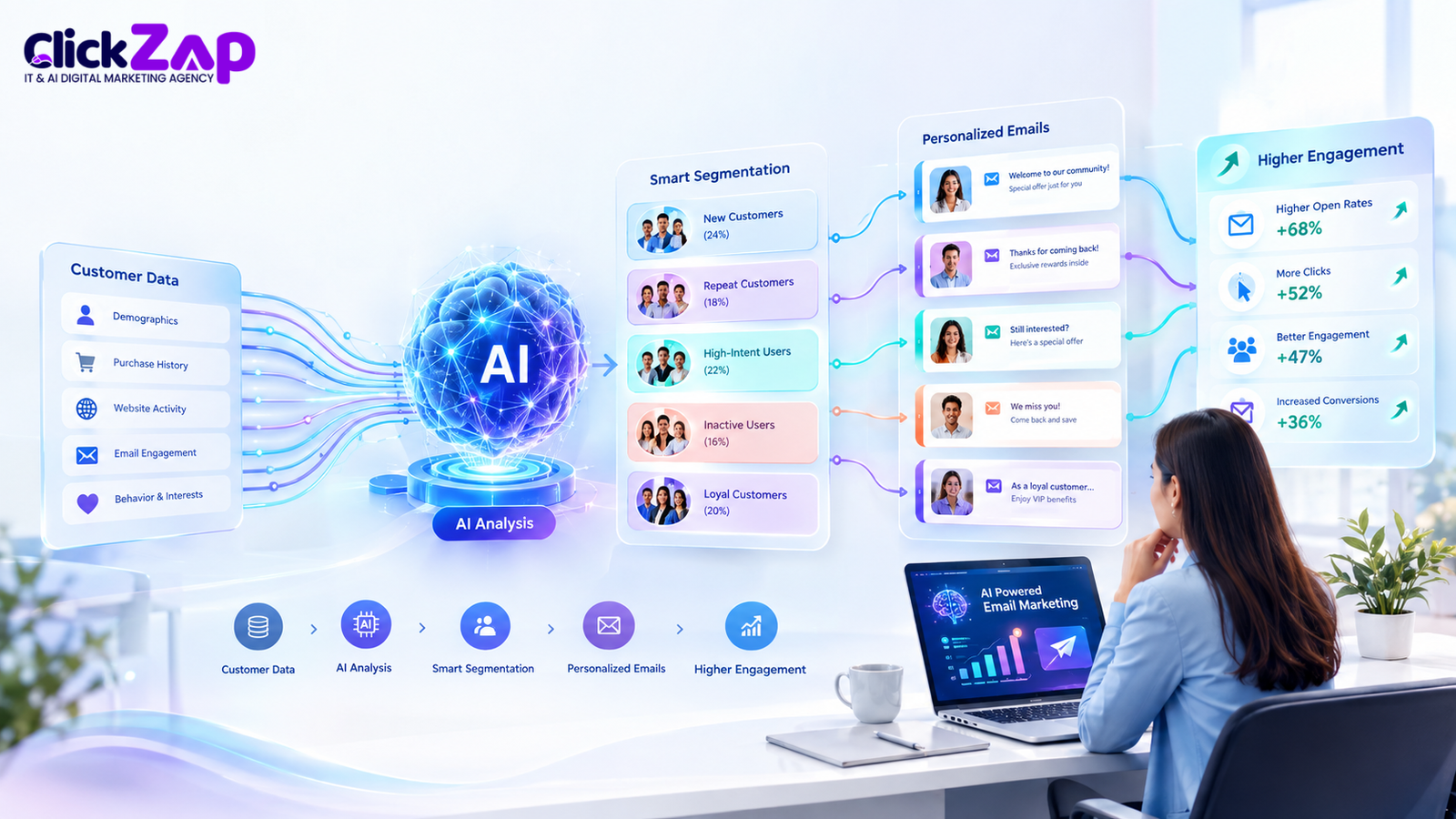
When segmentation works well, emails feel more relevant, and relevance is what drives engagement. This is how AI based approaches can help, without guarantees.
- More relevant content. Subscribers receive topics and offers connected to their interests.
- Better email personalization. AI email personalization goes beyond adding a first name. It can tailor products, content, and timing to behavior.
- Reduced irrelevant messaging. Fewer mismatched emails can mean less fatigue and fewer unsubscribes.
- Better targeting and timing. Some platforms can suggest when a subscriber is more likely to engage, though results vary.
- Improved customer experience. People feel understood rather than spammed.
- More personalized email campaigns at scale. Small teams can run campaigns that once required large ones.
- Retention opportunities. Spotting early signs of disengagement lets you reach out before a customer leaves.
To be clear, none of this guarantees higher open rates, clicks, or revenue. Results depend on your data quality, offer, creative, and audience. The honest claim is that AI segmentation for email marketing can make campaigns more relevant, and relevance may improve engagement over time.
AI Email Segmentation Strategies Businesses Can Use
Here are practical strategies, each with a short example.
- Segment subscribers by engagement level. Separate highly engaged readers from casual ones. Example: A SaaS company sends product updates to active users and a “here’s what you missed” digest to those who rarely open.
- Identify high intent customers. Look for repeated visits to pricing, demo, or checkout pages. Example: A B2B agency follows up with a case study and a consultation invite when a lead views service pages twice.
- Create lifecycle based segments. Example: A fitness studio sends a welcome series to new sign ups and a milestone message to members at their six month mark.
- Use purchase behavior for product recommendations. Example: A coffee brand recommends filters and grinders to customers who regularly buy beans.
- Identify inactive subscribers. Find people who have stopped engaging before they quietly drag down your list of health. Example: A fashion retailer sends a “still interested?” email with a preference center link.
- Build dynamic audience segments. Let membership update automatically. Example: A course provider moves a student from “trial user” to “paying learner” the moment they enroll.
- Combine multiple customer signals. Single signals can mislead, but combinations are stronger. Example: A retailer targets people who viewed a product, clicked an email, and haven’t purchased within a week.
- Use predictive segmentation. Example: A subscription brand identifies customers who look likely to cancel and sends helpful tips or a feedback request.
- Personalize by customer interest. Example: A publisher sends travel budget articles to readers who engage with budget content and luxury guides to those who prefer premium topics.
- Keep updating segments with new behavior. Example: An electronics store refreshes its “researching laptops” segment weekly so that buyers stop receiving purchase nudges.
Start with two or three of these rather than all ten. Focused execution beats scattered effort.
How to Implement AI Segmentation for Email Marketing
You don’t need a massive budget to begin. Follow this process.
Step 1: Define the marketing goal
Decide what you want. Examples include increasing engagement, generating leads, boosting repeat purchases, or reactivating inactive customers. Your goal determines which segments matter.
Step 2: Identify available customer data
List what you already have: email engagement, website activity, purchase records, CRM notes, form responses, and support interactions. Many businesses already hold more useful data than they realize.
Step 3: Connect relevant marketing platforms
Segmentation improves when systems share data. Your email platform, CRM, analytics tool, and online store should connect so that behavior in one place informs messaging in another. Check integration options before committing to any tool.
Step 4: Choose relevant segmentation signals
Pick signals that match your goal. For reactivation, focus on recent engagement and purchase gaps. For lead generation, focus on content interest and page visits. More signals are not always better.
Step 5: Create initial segments
Use your platform’s AI features, built-in suggestions, or analysis to identify meaningful groups. Review them with a human eye. Ask whether each segment is large enough to matter and different enough to deserve its own message.
Step 6: Personalize campaigns
Adjust the message, offer, product selection, or content for each segment. Even simple changes, like different subject lines or featured products, can make emails feel more relevant.
Step 7: Test and measure
Run A/B tests and compare segment level performance. Watch both engagement and downstream results like conversions.
Step 8: Continuously improve
Customer behavior changes, so segments should too. Review them regularly, retire ones that no longer perform, and add new ones as your data grows.
AI Email Segmentation Tools and Platforms
Different tools play different roles. It helps to separate them by category rather than assuming they all do the same thing.
Email marketing platforms
- Mailchimp offers audience management, tagging, and segmentation tools for small and growing businesses.
- ActiveCampaign is known for automation and customer experience workflows with segmentation options.
- Klaviyo is widely used by e-commerce brands and focuses on connecting store data with email and messaging.
- Omnisend is also aimed at e-commerce, combining email with other channels and automation.
- Brevo provides email marketing alongside CRM and automation features.
CRM and marketing automation platforms
- HubSpot combines CRM, marketing, and sales tools, with contact lists and segmentation based on CRM data.
- Salesforce Marketing Cloud targets larger organizations that need enterprise level data management and journey orchestration.
- Microsoft Dynamics 365 includes CRM and marketing capabilities for businesses already working within the Microsoft ecosystem.
Analytics platforms
- Google Analytics 4 (GA4) helps you understand website and app behavior, such as which pages people visit and how they convert. It can inform segmentation strategy and audience insights, but it is not an email platform.
AI tools
- OpenAI and ChatGPT can assist with analysis, brainstorming, and content, as covered in the next section. They are general purpose AI tools, not email platforms.
A few cautions apply here. Features vary by plan, region, integrations, and platform updates. Not every tool offers the same AI segmentation capabilities, and some “AI” features may be basic automation under a different label. Always review the platform’s current documentation or ask the vendor before deciding, and choose based on your goals, data setup, and team skills rather than brand names.
How ChatGPT and OpenAI Can Support Email Segmentation
An AI assistant like ChatGPT can help marketers think and work faster. But it does not automatically have access to your private customer database, email platform, or analytics. It only works with what you give it.
There is a clear difference between two things:
- AI assisted analysis: you share data you’re permitted to share, or a summary of it, and ask for help interpreting it.
- Direct access to customer data: a connected platform or system working with live subscriber records, within its own permissions and privacy settings.
Here is where an AI assistant can help:
- Brainstorming segment definitions. Describe your business and ask for segment ideas to test.
- Creating customer personas. Turn research notes into draft personas.
- Developing campaign ideas. Get angles for each segment.
- Generating message variations. Draft different subject lines or intros for different groups.
- Analyzing marketer provided data. Share anonymized or aggregated numbers and ask for observations.
- Writing segment specific copy. Produce a first draft you then edit.
- Identifying audience questions. Ask what you should be asking about your subscribers.
Be careful with personal information. Avoid pasting identifiable customer data into any tool unless your privacy policy, agreements, and the tool’s data terms allow it. Anonymized or aggregated data is the safer route. And always review AI generated copy for accuracy and brand voice before sending.
Digital Marketing Services for Your’s Business
Common Mistakes to Avoid With AI Email Segmentation
- Using poor quality data. Duplicates, missing fields, and incorrect tags lead to weak segments. Clean data first.
- Creating too many segments. Fifty tiny segments are hard to manage. Start with a manageable number.
- Ignoring customer privacy. Collecting and using data without consent damages trust and may create legal risk.
- Relying entirely on AI recommendations. AI can misread patterns. Review suggestions with business context.
- Using outdated data. Behavior from two years ago may not reflect current interests.
- Failing the test. Assumptions need evidence. Test before rolling out widely.
- Over personalizing messages. Emails that reveal too much about someone’s browsing can feel intrusive. Personalize helpfully, not creepily.
- Ignoring inactive subscribers. They need a re-engagement plan, or a clean exit, rather than neglect.
- Segmenting without a clear objective. Every segment should connect to a goal and a planned message.
Privacy and Data Considerations
Better segmentation depends on customer data, which means responsible handling matters. This is general guidance, not legal advice, so consult a qualified professional for your specific situation.
- Consent. Collect and use subscriber data with appropriate permission.
- Data security. Protect customer information with sensible access controls and secure tools.
- Transparency. Explain in plain language what data you collect and why.
- Responsible personalization. Use data in ways customers would reasonably expect.
- Applicable privacy regulations. Follow the laws that apply to your business and audience, such as India’s data protection rules or international regulations like GDPR where relevant, along with each platform’s policies.
- Data minimization. Collect only what you need. More data isn’t always better data.
Trust is part of the customer experience. People are more willing to share information when they see clear value in return.
Best AI Digital Marketing Agency in Hyderabad
How to Measure the Success of AI Email Segmentation
Segmentation only matters if it improves outcomes. Track these metrics:
- Open rate (interpret with care, given tracking limitations)
- Click through rate
- Conversion rate
- Unsubscribe rate
- Engagement rate
- Revenue per email
- Customer retention
- Repeat purchase rate
- Segment level performance
Why segment level results matter for AI segmentation for email marketing
Overall campaign numbers can hide important differences. A campaign with an average click rate might include one segment performing very well and another performing poorly. Comparing performance by segment shows which groups respond, which messages work, and where to adjust.
Also remember that benchmarks vary by industry, audience, campaign type, and measurement method. Compare your results against your own past performance first, rather than chasing someone else’s numbers.
Future of AI Segmentation in Email Marketing
These are trends and possibilities, not guarantees:
- More predictive segmentation, estimating likely actions earlier.
- Real time audience updates, so messages match current behavior.
- Deeper personalization, across content, products, and timing.
- AI-assisted campaign creation, with drafts tailored to each segment.
- Customer intent analysis, reading signals across more touchpoints.
- Cross channel segmentation, aligning email with SMS, web, social, and ads.
- Automated journey optimization, where systems suggest changes to the customer path.
As the tools develop, human oversight, clean data, and respect for privacy will matter at least as much as the technology.
Frequently Asked Questions
What is AI segmentation for email marketing?
It is the use of artificial intelligence to analyze subscriber behavior, preferences, and engagement, then group people into relevant segments. Instead of relying only on manual rules, it can find patterns across many signals and help marketers send more relevant, personalized emails.
How does AI segment email subscribers?
AI collects data from email, website, CRM, and purchase activity, then looks for patterns in behavior and engagement. It groups subscribers with similar actions or likely intent and can update those groups as new behavior appears. Marketers review and refine the results.
What data does AI use for email segmentation?
Common data includes demographics, website behavior, email opens and clicks, purchase history, lifecycle stage, and intent signals like pricing page visits. The more accurate and relevant the data, the more useful the segments tend to be. Businesses should also follow privacy rules.
Is AI email segmentation better than traditional segmentation?
Not always. Traditional rule based segmentation works well for simple, clear campaigns. AI can be more useful with large datasets, varied customer behavior, or a need for predictive insights. Many businesses combine both, depending on the goal and the data they have.
Can small businesses use AI email segmentation?
Yes. Many email platforms include segmentation and automation features suited to smaller teams. Start with a clear goal, clean data, and a few simple segments such as engaged subscribers and inactive subscribers, then expand as your data and confidence grow.
Conclusion
Email works best when it feels relevant. AI helps businesses move from broad, one size fits all lists toward segments built on real behavior, interests, and intent. Done well, AI segmentation for email marketing helps you send fewer irrelevant messages and more useful ones.
Success still comes down to a few fundamentals: useful customer data, clear objectives, relevant segmentation, responsible personalization, and continuous testing. The technology supports these fundamentals but doesn’t replace them.
If you’re planning to improve your email strategy or build a broader growth plan, ClickZap IT, a digital marketing agency in Hyderabad, can help. Our team works across SEO, digital marketing, AI powered marketing, paid advertising, and content marketing to help businesses build practical, measurable strategies. Get in touch with our team to discuss what would work for your business.
Also Read: How AI Email Send Time Optimization Improves Email Marketing Results
0 Comments